AI Highlights — the whole picture — 2026-10-05 (Mon) Evening News
Source links point to the original outlet. The AI Integrated Analysis is auto-generated from the headlines below only and is not intended to add facts beyond them. Not investment advice.
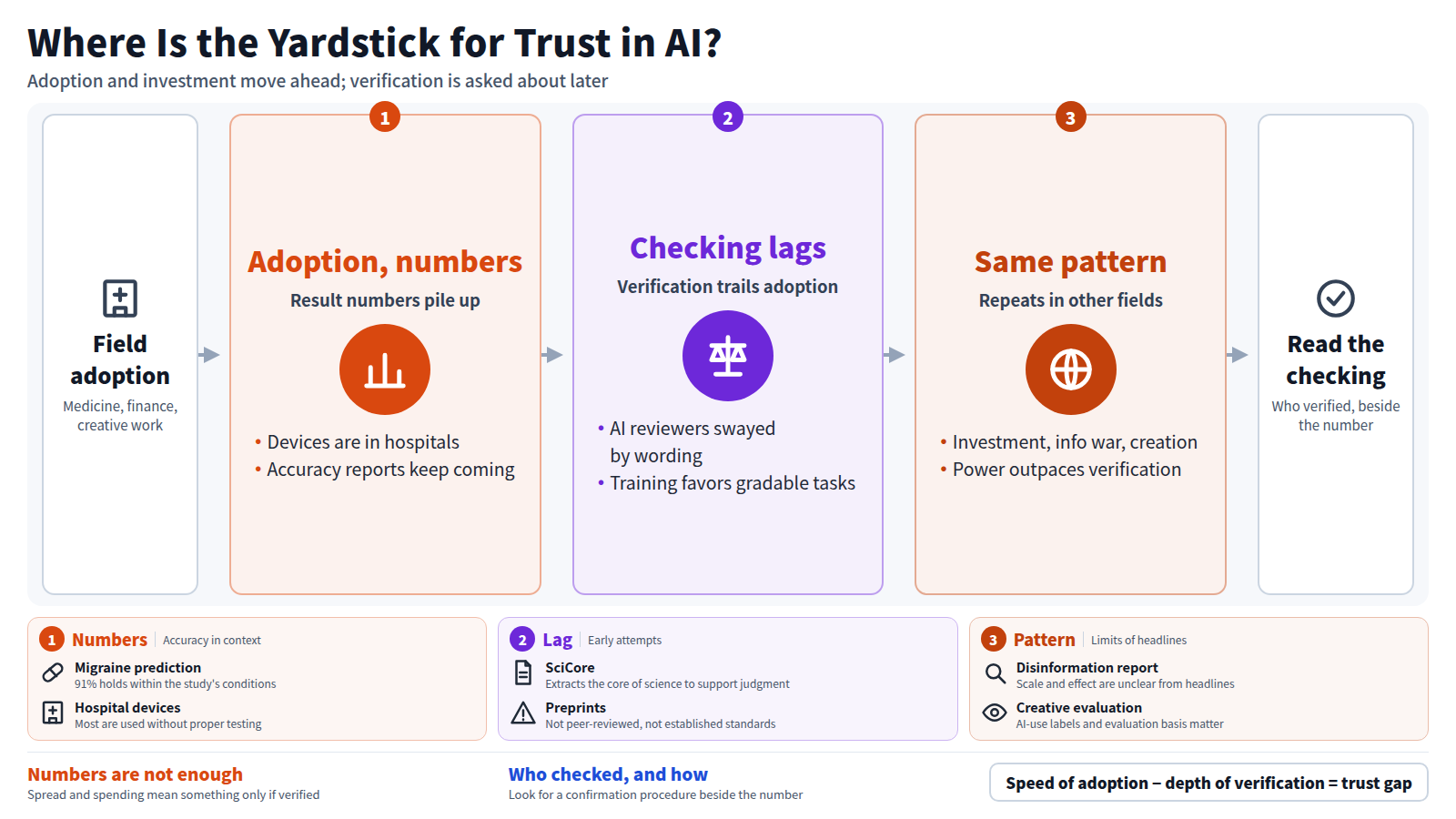
AI adoption and investment is moving forward in healthcare, finance, and research. Hospitals already have AI equipment, but according to Earth.com, most of it is being used without being properly tested. The numbers are stacking up, with research reporting a 91% accuracy rate in predicting migraines before they occur. On the other hand, there are also indications from preprints that AI reviewers may give different verdicts to manuscripts that simply restate the same science. What I learned over the course of this half-day was not so much the speed of adoption, but rather the question of where to use the yardstick to check whether the output is correct or not. In each of the following sections, we will examine investment, information warfare, and creation in order to see if there is a yardstick.
Introduction to sites where verification cannot keep up
Medical AI is already in hospitals. However, Earth.com reports that most devices are being used without being properly tested. Meanwhile, on the research side, reports on predictive AI continue to be reported. MedicalNewsToday covered whether AI can predict migraines before they start, and reported that a study found the accuracy was 91%. Bioengineer.org highlights a study in which AI combined brain scans and clinical data to predict stroke recovery outcomes. While validation of equipment entering hospitals is weak, accuracy numbers are piling up in papers.
The targets of prediction are not limited to brain diseases. The Journal of Electronics Electromedical Engineering and Medical Informatics has published ProtoSurv-X, which makes it possible to predict the survival of brain tumors. npj Precision Oncology includes MAVEN, an automated multimodal framework for predicting VETC and early recurrence of hepatocellular carcinoma. UCLA reported on its efforts to use AI to test for Alzheimer's disease and dementia, and Live Science reported that a new AI "voice clock" could indicate the speed of aging from your voice. Although the diseases and input data are different, they all achieve the same goal: predicting the future.
When reading, you need to look at the size of the number and where it was confirmed. The accuracy of 91% is within the conditions of the study. The same accuracy in the hospital setting cannot be guaranteed under the circumstances described by Earth.com. The fact that research is increasing is no substitute for individual equipment being tested in the field.
If there is a difference between the spread of adoption and the depth of verification, it will be necessary to change the index for measuring the spread of AI from the number of introductions to the content of verification. In the next section, we will look at how this difference is manifested in settings other than medical care.
AI that is asked about the evaluation itself
The tools used to check the output of AI are now being reconsidered. Although LLM is increasingly being used to review papers, the arXiv preprint points out that AI reviewers may give different verdicts to manuscripts that express the same science in different ways (on their website). This paper established stability to wording and discrimination between papers as a set of requirements, and presented a benchmark to measure them. We also propose SciCore, a peer review method that extracts the ``core of science'' from manuscripts to supplement judgment. However, since this is a preprint that has not been peer-reviewed, it is appropriate to read the results as an early attempt to create a yardstick for verification, rather than as definitive findings.
On the agent side, the targets for training are limited to the range that can be scored. GraphForge, which constructs a graph of evidence from actual files and derives the task text and grading criteria from the same graph, is a proposal to train a working agent with tasks whose results can be verified (own site). LongCat-DeepResearch's technical report for writing a research report also shows a procedure that combines the overall plan ResearchSpec with parallel research and local corrections for each node (own site). Both are preprints and have not been peer-reviewed. For assignments where grading criteria can be established in advance, or where revisions can be narrowed down to individual passages, a checking mechanism can be incorporated into the design. On the other hand, in jobs where it is difficult to set standards, this system may not necessarily work as is.
There are similar questions on the human side. Analytics Insight looks at how learning AI skills could weaken humans' ability to reason. If the ability of those who judge the output of AI decreases, the person responsible for checking it will also become weaker. A similar movement is occurring in the area of safety. The Mighty 790 KFGO reported that OpenAI's safety employee has resigned, saying "the time for trial and error is over." Bloomberg.com reports that SoftBank's Masayoshi Son issued a rare warning about the safety of AI. All of the statements were reported as statements made by the person himself, and the circumstances outside of the article cannot be verified.
Safety officials and managers have issued warnings about the fact that the evaluation scale is swayed by wording, and that learning is focused on graded assignments. If you look at them side by side, you can see the same problem: the development of the verification side is lagging behind the implementation. When readers read implementation examples, they need to first look at who verified the output and based on what standards, rather than the size of the numbers. Next, we will look at how this method of confirmation is used in the field.
Huge investment and rebound to the economy
Goldman Sachs announced that AI investing will further boost the S&P 500's strong earnings season (Seeking Alpha). In terms of corporate profits, spending on AI is starting to show up in numbers. NBC Palm Springs' ``What to watch in business this week'' also lists AI safety as an item, along with Federal Reserve minutes and retail sales (NBC Palm Springs). AI is now featured in the same weekly economic news as interest rates and consumption. However, the strong financial results show that the investment has led to profits. There is no way to tell whether the AI output is correct or not.
On the other hand, some people acknowledge the impact if investment assumptions are incorrect. The Bank of England (BOE) recognizes that misjudging the growth prospects of AI could pose a threat to national debt, the WSJ reported (WSJ). Futurism argues that AI is creating a "loop of doom" throughout the economy (Futurism). This headline is a statement of opinion, not established fact. However, at the same time, there have been views on investments that will boost financial results and views that are wary of misaligned growth prospects. If the input of growth prospects is incorrect, investment decisions and financial market evaluations based on this information will also be affected.
Even in terms of employment, materials are not aligned in one direction. Anthropic announced that it will invest $10,000 and train 10,000 AI engineers by 2027 (Indian Television Dot Com). Singapore Economic Development Board (EDB), based on data from LinkedIn, showed that AI jobs and talent are rapidly increasing in the country. On the other hand, there was a survey that asked workers themselves whether AI was causing unemployment, and the author was surprised by the results (The Good Men Project). Increased demand for talent and concerns about unemployment emerge as separate statistics and testimonials, and neither of them, taken alone, gives the whole picture.
These numbers and headlines show that investments in AI have been linked to both economic prospects and jobs. In that case, the question is not so much the scale of the investment, but rather the extent to which the estimates and research supporting the outlook have been verified.
Power used for information warfare and surveillance
Regarding Anthropic's report, DW.com asked, "Is Russia using AI for disinformation operations in places like the Central African Republic?" (DW.com) The same content is also distributed under the title "Is Russia using AI for disinformation in the Central African Republic and elsewhere?" (DW.com). It is important that the headline is a question rather than a conclusion. Development companies report on how their AI is used, and the news media verifies the reports. In this order, the reader does not receive a verified conclusion, but material that serves as a starting point for verification. Even though we hear that AI has been used in misinformation operations, it is difficult to judge from the headlines how effective or on what scale it was.
There are also moves on the government side. According to Open Magazine, President Trump announced a "super intelligence unit" to coordinate U.S. AI policy (Open Magazine). Regarding China, Modern Ghana picked up a DW News program and reported that China's AI plans are bigger than ChatGPT (Modern Ghana). Tech Policy Press discussed this trend from both policy and military perspectives in an article titled ``AI Treaties, New Emperors, and Autonomous War Commands'' (Tech Policy Press). The United States set up a coordinating organization, and China demonstrated the scale of its plans. However, what we can see from these issues is that the framework for competition is being put in place. It is unclear from the title who will be responsible for checking the correctness of the output and how it will be used.
In the field of surveillance, the power of AI will be directed more directly at people. Modern Ghana covered how Israel is using AI and facial recognition to track Palestinians in Gaza (Modern Ghana). mronline.org has an argument for reclaiming worker ownership of artificial intelligence and technology (mronline.org). On the one hand, there are the people being tracked, and on the other, there are the workers questioning ownership of the AI. The two articles ask the same question of who is in charge of AI, but from different angles.
Whether it's misinformation, national planning, or facial recognition tracking, the mechanisms by which AI's output can be verified from the outside are less visible than the power in its hands. The question of who controls AI is inseparable from the question of who can verify its output. In the next section, we will turn our attention to the systems that support this verification.
Fluctuating creativity and human views
In the creative field, AI has already entered into both production and evaluation. A Swedish ball bearing company's ad uses American and Chinese AI to bring back actress Greta Garbo (Lee News Central). In the music field, the AI-based evaluation platform ``Baltazar'' has appeared, and Billboard is introducing it as an evaluation platform for music assets. In the field of film, Chinese film director Liu Shuheng talks about his ideas for the film he will submit to the Astana AI Film Festival (qazinform.com). AI is involved in three areas: expression, evaluation, and presentation, such as the image of a deceased actor, the judgment of the value of a song, and the works submitted to a film festival.
What readers should be looking at here is not so much what AI can create, but who is going to check the output and how. To what extent is the recreated appearance of the actress connected to her own intentions? On what basis is the value of music assets indicated by the evaluation platform? When AI films are shown at film festivals, how much of the creator's intentions and production process are revealed to the audience? These are not the points that are answered in the source article, but just like in the medical and financial settings seen in the previous section, the structure is such that the implementation goes first, and the verification steps are asked later. It is easy to say that creative writing is an area where there is no correct answer. That is why the bare minimum of verification, such as indications of AI intervention and the basis for evaluation, separates the judgment of users and receivers.
There are also points that question the human perspective behind these movements. Vietnam.vn reports that we are losing faith in humanity and are "deifying" AI. The less we feel that we can rely on human judgment and expression, the more likely we are to accept AI's output as more neutral and accurate than humans. If that happens, the necessity of verification itself becomes difficult to see.
Awareness of this problem is also coming from the technology side. Kevin Luce, New York Times tech columnist and co-host of the Hard Fork podcast, gave a book talk about his book, The Race to AI – and the Fight for Humanity (The Greenwich Sentinel). The New York Times Opinion section also has an article discussing controlling the risks posed by AI and other threats to humanity (The New York Times). Alongside discussions that focus on the speed of competition, there are ongoing discussions about how humans should face AI.
What is happening in the creative field is not only the expansion of AI's capabilities, but also the choice of whom to entrust human judgment to. This choice will lead to the next issue of social structure and governance.
Medical equipment, the accuracy of research, strong financial results, reports of information manipulation, recreated appearances of actresses. In every section, the fact that AI had entered the story and the fact that investments had been made were confirmed, but the evidence to show whether the output was correct was left mostly elsewhere. Benchmarks for measuring peer review and agents trained with graded tasks are both early attempts to create a yardstick for verification, and are not established standards. So what readers should be looking at is less about how fast it spread and more about who verified the output and how. The penetration numbers and investment amounts have meaning only if they are verified. When reading announcements about AI, the starting point for making decisions is to see if there is a confirmation procedure written next to the number.
Q1: Can you explain who confirms the accuracy of the output of the AI you are using and how? Q2: When governing the use of AI, to what extent do you require records and standards to demonstrate that the output has been verified? Q3: Does the basis for investment decisions in AI include not only the numerical results but also evidence that the output has been verified?
Finally, three questions
- Can you explain who confirms the accuracy of the output of the AI you are using and how? Q2: When governing the use of AI, to what extent do you require records and standards to demonstrate that the output has been verified? Q3: Does the basis for investment decisions in AI include not only the numerical results but also evidence that the output has been verified? - When governing how AI is used, to what extent do you require records and standards to demonstrate that the output has been verified? Q3: Does the basis for investment decisions in AI include not only the numerical results but also evidence that the output has been verified? - Does the basis for investment decisions in AI include not only the numerical results but also evidence that the output has been verified?
📚 Sources (all material)
Every item this issue drew on. External links open in a new tab. 40 items.
AI Industry
AI and the Economy
AI and Finance
Living and Working with AI
- I Surveyed Workers to See if AI Had Caused Job Losses and Was Surprised by the Findings — The Good Men Project
- Surge in artificial intelligence job growth and talent in Singapore: LinkedIn data — Singapore Economic Development Board (EDB)
AI and Healthcare
- Opinion | Controlling Risks Posed by A.I. and Other Threats to Humanity — The New York Times
- Could AI predict migraine before it strikes? Study finds 91% precision — MedicalNewsToday
AI, Welfare and Long-term Care
AI and International Politics
AI Around the World
- Trump Announces ‘Super Intelligence Force’ to Coordinate US AI Policy — Open Magazine
- China's AI plan is bigger than ChatGPT | DW News — Modern Ghana
AI Ethics
AI & Education
- Anthropic to invest $100 million to train 10,000 AI engineers by 2027 — Indian Television Dot Com
- Can Learning AI Skills Weaken Human Logical Thinking? — Analytics Insight
AI, Philosophy & Thought
AI, Arts & Creativity
AI in Medicine (Cancer Care, Rare Diseases)
AI and Agriculture
- Satellites and Machine Learning Fall Short at Reading Peanut Photosynthesis From Space — Bioengineer.org
- India’s supercomputing capabilities expanding to support AI, weather forecasting, scientific research: Govt — IANS LIVE
- Lightweight AI Spots Grapevine Virus From Drone Hyperspectral Images — Bioengineer.org
AI Regulation, Safety and Geopolitics
- OpenAI safety employee quits, says ‘time for trial and error is over’ — The Mighty 790 KFGO
- SoftBank’s Masayoshi Son Has Rare Cautionary Note on AI Safety — Bloomberg.com
- SoftBank CEO Raises AI Safety Concerns Amid $65B OpenAI Investme — gurufocus.com
AI and the Pharma Industry
- CRScube Acquires Mednet to Expand AI-Assisted Data Entry in Clinical Trials — The Clinical Trial Vanguard
AI and Cancer Research
- ProtoSurv-X: Explainable Brain Tumor Survival Prediction — Journal of Electronics Electromedical Engineering and Medical Informatics
- MAVEN: an automated multimodal framework for predicting VETC and early recurrence in HCC — npj Precision Oncology
AI and Frontier Research (Papers)
- AI Reviewers That Score the Wording, Not the Science ── A preprint that defines rhetorical robustness as stability plus discrimination, and proposes SciCore, a reviewer that also judges an extracted science core — 自サイト
- Should a Research-Writing AI Separate the Plan from the Section Work? ── A technical report (preprint) on LongCat-DeepResearch, which pairs a global ResearchSpec plan with parallel section research and local revision — 自サイト
- Training Agents for Real File Work with Tasks That Can Be Graded ── A preprint proposing GraphForge, which builds an evidence graph over real files and derives both tasks and rubrics from it — 自サイト