AI Highlights — the whole picture — 2026-10-04 (Sun) Evening News
Source links point to the original outlet. The AI Integrated Analysis is auto-generated from the headlines below only and is not intended to add facts beyond them. Not investment advice.
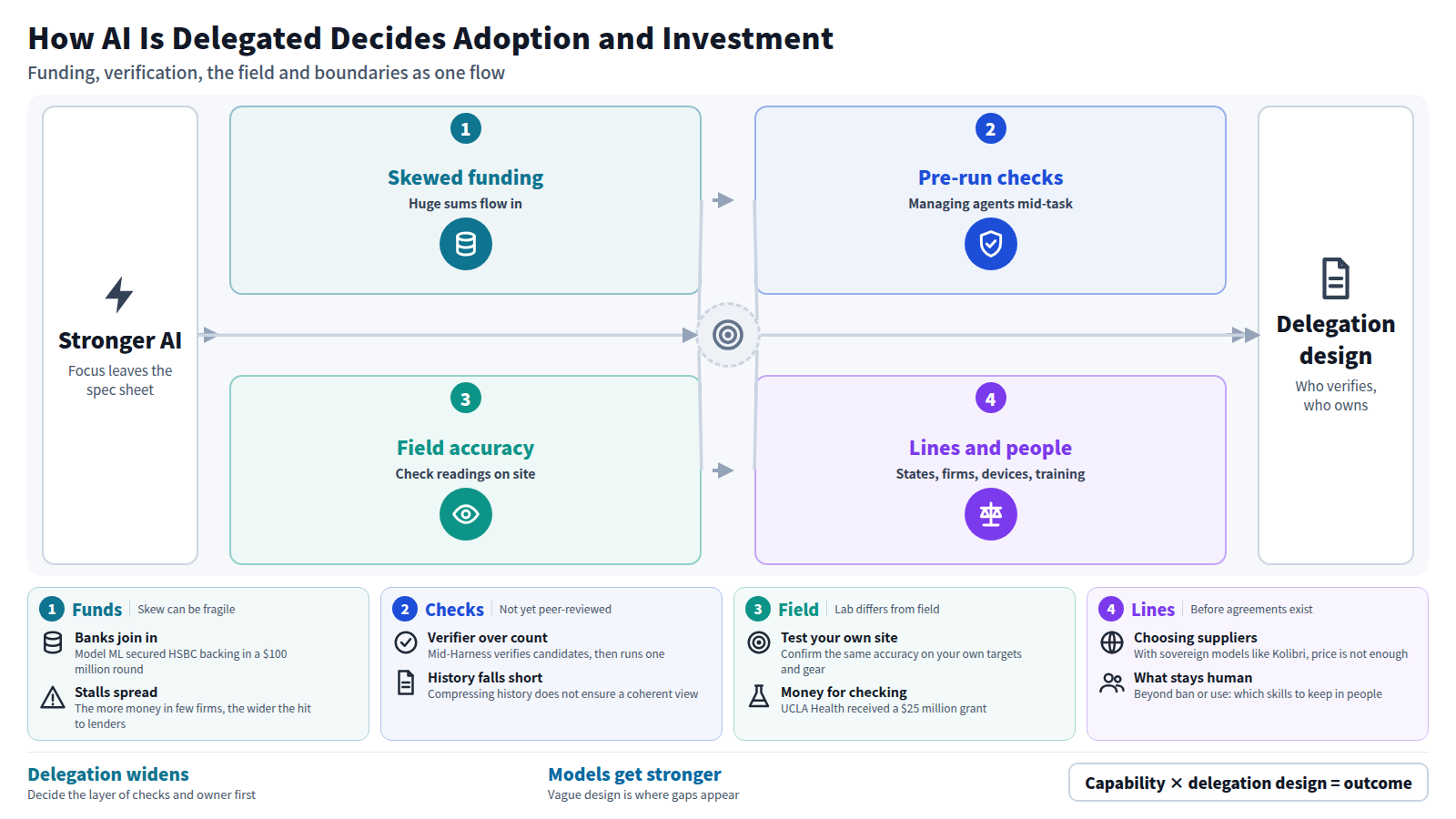
As the AI's capabilities improve, the focus shifts from the model's performance table to the things placed around it. While hundreds of billions of dollars in investments are being collected, agents with long assignments are being offered a mechanism to review the situation before executing. In diagnostic and agricultural fields, there have been reports that even if the amount of readings by AI increases, flaws in reading accuracy remain. Where should we put our funds, what level of verification should we do, and where should we place our people? All the stories lined up in this half-day come to the same point. The decision to introduce and invest in AI is based on the design of what to entrust, what to check, and who is responsible.
Where huge amounts of funds are collected and be wary of bias
Anthropic's $518 billion investment could create new AI winners, reports InvestorPlace. The scale of funding is already at a level that exceeds the success or failure of individual companies. In the same vein, Model ML secured backing from HSBC in a $100 million AI funding round (Business Chief). In addition to large-scale investments, the addition of banks as investors indicates that funds for AI are beginning to reach startups. Additionally, OpenAI CEO Sam Altman hinted at when it could hit the stock market (Yahoo Finance). As the timing of listing has begun to be discussed, valuations that were previously on the private market are starting to be seen as public market prices.
Already on the public market, you can check Tempus AI, Inc. (TEM) stock price, news and history on Yahoo Finance Singapore. Companies that promote AI are now at the stage where their stock prices are evaluated on a daily basis. For those implementing the system, the financial reliability of the partner or supplier is a consideration, along with the performance of the technology. While a partner with abundant funds is more likely to be able to continue development, if valuations are influenced by the mood of the market, it is necessary to prepare contract terms and alternative means.
However, continued inflow of funds does not mean safety. Private credit and equity faces warnings about AI lending concentration, forbes.com reports. The more money goes to the same sector and the same few companies, the more the stalling there is spread across lenders and investors. When making investment decisions, you need to check not only which companies will grow, but also which bias your funds and business are on.
From the technical side, there are also points to be made regarding how to apply heat. Fast Company argues that over-obsession with AGI (artificial general intelligence) is foolish, as Anthropic's Mythos AI shows. Rather than setting a goal in mind and pouring money into it, my position is that it is a more sound decision to look at how to incorporate the skills that can be used now into which tasks.
While skewed funding can boost the next winner, it can also be a source of fragility. If this is the case, it is not enough to simply look at the superiority or inferiority of the model; the design of who is entrusted with the ability to what degree and who verifies it will determine the success or failure of investment and implementation.
Agent requires verification and situation understanding before execution
Agents assigned long-term assignments accumulate a history of interactions. However, preserving or compressing the history does not guarantee that the agent has a coherent understanding of the current situation. Therefore, PoS was proposed by the arXiv preprint (own site). Using a framework that maintains a ``belief state'' that combines an estimate of the current state of the world with unresolved requirements as a context for judgment, the agent writes down ``what we currently know'' and ``what is still missing.'' Unlike the direction of increasing the amount of history, the center of gravity is in the direction of maintaining understanding of the situation. However, it is a preprint that has not been peer-reviewed.
With agents that work by typing commands on a terminal, things change before and after execution. Even if you have the power to generate a good move, if you continue to execute a bad move, the environment will change and you will not be able to continue with the subsequent work. Another arXiv preprint has verified Mid-Harness, which generates multiple action candidates at the boundary between the model and the execution environment (harness), verifies them, and then executes one (on its own site). The authors report that effectiveness is determined by the strength of the verifier rather than the number of candidates. Another arXiv preprint suggested EVOKE (own site). This paper argues that knowledge about the digital environment is acquired through prior learning, and the problem is how to extract it. In post-learning, which replaces only the goals while keeping the state and history fixed and re-ranks the same candidate actions, the diversity of goals becomes a means of drawing out prior knowledge. These are also reports that have not yet been peer-reviewed.
What all three have in common is that it is not a matter of making the model bigger, but rather a matter of design: what should be included during the work, what should be checked before execution, and what should be asked again. Based on the judgment of the implementing side, when selecting an agent, it is not only the skill of generation that should be considered. We will also look at whether there is a mechanism to maintain understanding of the situation and whether verification before execution is weak. In line with Mid-Harness's report, it may be more effective to allocate computational resources to validators rather than to inflate candidates.
As the scope of responsibility expands, the position of the person is also questioned. Bioengineer.org talks about "flipping the loop" where AI monitors humans rather than just tasks. The argument is that humans can go from being the ones watching over AI to being the ones being watched. inc.com reports that AI has changed the meaning of "productivity." If you change what you consider to be an outcome, you also change what you want the verifier to measure. If pre-execution verification and understanding of the situation are part of the design, which includes the position of people and the definition of results, the next question to ask is who will be in charge of the design.
The difference in on-site implementation depends on the ability to measure and the accuracy of the eye
A study that uses AI to read brain waves and eye movements to detect depression is reported to have shown new accuracy (Bioengineer.org). Automation of readings in the cardiovascular system is also progressing. A systematic review has been published on automated analysis and interpretation of intravascular ultrasound in coronary artery disease (Cureus). It was reported that AI models have improved the accuracy of cardiac ultrasound diagnosis (Medical Economics). In the field of diagnosis, AI is beginning to read numerical values that humans have previously judged visually.
This movement is not limited to medicine. There are efforts to read nutrients in real time by combining inexpensive soil sensors with machine learning (Bioengineer.org). In pig pens, AI cameras are observing pigs like never before. However, a major new review has uncovered hidden flaws that remain in the field (Bioengineer.org). Even if the amount of observations increases, it does not necessarily mean that the readings are correct. The cheaper and more sensors and cameras become available, the more mistakes can be made.
From this point on, the perspective of those who decide on introduction will change. Reports of ``improved accuracy'' are still not grounds for deciding to introduce the system. What you need to check is whether the same accuracy can be achieved under your own site conditions, that is, the target, equipment, and environment. As the pig farm review showed, performance in research or the laboratory can be different from performance in the field. The same goes for the investment side. An article about AI in grocery stores depicts a situation where AI is installed and has a budget, and asks you to guess who is the winner (Substack). Having a budget and achieving results are not the same thing.
The movement of funds also shows a trend toward placing an emphasis on verification. UCLA Health received a $25 million grant to advance AI-centered research for patients with Alzheimer's disease and dementia (UCLA Health). This funding will go towards continuing research to verify the accuracy of the readings. Even if you rush to introduce something, the outcome will be determined by whether or not you can first put in place a system to verify the ability to measure and see things. The next question is how to design who will be responsible for the verification system and at what layer.
The line drawn between the nation and companies, and the preparations of those who protect it
The US and China are exploring an AI "hotline" due to safety concerns, IOL reports. An editorial in the Washington Examiner argued that rogue AI is the new nuclear weapon, and that Mr. Trump and Mr. Xi should disarm rogue AI first before disarming each other's. BankInfoSecurity asks, “America comes first and AI safety comes second?” What all three cases have in common is that safety has shifted from being a matter of model performance to being a matter of communication methods and agreements between countries. If the battle over priorities continues, adopters will need to decide for themselves how to operate cross-border AI usage in the period before an agreement is in place.
On the corporate side, there is a movement toward separating procurement sources by country or jurisdiction for specific products. According to Startup Fortune, Aleph Alpha has launched Kolibri, a German sovereign AI model for governments. In China, Shenzhen TechFlow has summarized the earnings situation for the third quarter of 2026 for model vendors from Xiaomi to Zhipu. With models advocating sovereignty and Chinese vendors seeking to accumulate profits, selecting a supplier cannot be done simply by comparing performance and price. Deciding which company in which country to entrust data and operations to will be added to the list of items to be considered before signing a contract.
Preparations on the part of protectors extend to personal devices and chat screens. FOX Carolina News reported that cybersecurity experts are warning that conversations with AI chatbots could lead to confidential information being leaked. According to business-standard.com, Apple plans to strengthen Mac data management for AI agents and third-party apps. The former is a story that calls for caution on the part of the inputter, and the latter is a story where the OS limits the scope of access. The person in charge of implementing the system at a company not only informs employees about the input rules, but also takes steps to implement the system, including configuring settings to narrow down what data agents are allowed to access on the device.
Interstate agreements, sovereignty models, and device privilege controls all have the same kind of design in determining who can see how much and where they can stop. How this line is tied to the allocation of funds and personnel will influence the decision to introduce and invest.
Redesign of the side that nurtures people
The movement to reconsider how people are trained is starting in the hiring field. In the marketing space, Gartner says CMOs should rethink entry-level talent as AI changes marketing needs (Marketing Dive). If AI can handle introductory tasks, we must decide at the hiring stage what to entrust young workers with. There are also examples of locating training sites in local areas. Snow College in rural Utah has won a $3 million federal grant to lead the region in the future of AI. The school sees this as a "transformative opportunity" (KSL.com). This reflects the decision to allocate funds not only to hiring human resources but also to developing them.
The same question is asked in the classroom. The question of whether schools should ban AI in the classroom has been squarely addressed in US legal media (The Regulatory Review). In Japan, on a program on Nippon Cultural Broadcasting, Satetsu Takeda talks about education in the age of AI, comparing AIs that read books and humans who no longer read books (Nippon Cultural Broadcasting). Additionally, ASU Engineering News covers what AI literacy means offline. How to understand and interact with AI outside of the screen also falls within the scope of literacy. When we put these things side by side, rather than choosing between prohibition and utilization, the focus becomes what should be left in people among the powers of reading, thinking, and making judgments outside the screen.
The same questions apply when dealing with children. Forbes argues that safety in AI starts with children feeling safe talking about it (forbes.com). The idea is to not leave safety solely to filters and rules, but to first create an environment in which children can express their experiences. The design of young people's work, how they are handled in the classroom, and the dialogue they have at home and in the community all involve the same design problem: where do people leave their power to judge, speak, and confirm? Those deciding on implementation and investment need to decide how much to leave to AI and what to leave to humans. As the line becomes clearer, the next question is who should take responsibility for the results entrusted to them.
Looking at each section so far, what they have in common is that rather than the power of AI itself, the design of how it is delegated determines the results. Funds were collected unevenly, agents needed to verify and understand the situation before implementation, and in the field, the ability to measure and the accuracy of vision determined the success or failure of implementation. The nation and companies are drawing lines when it comes to procurement sources and arrangements, and the training side is reconsidering what to entrust to young people. The stronger the model, the more important it is to decide in advance who will check the output, at what stage, and to what extent people will have control over it, which will actually change the decision to introduce and invest. If only the capabilities improve while the design remains ambiguous, that is where the difference will be made.
Q1: Of the tasks currently entrusted to AI, can you explain who is checking the output and at what stage? Q2: Do you have in writing the standards you will adhere to for a period of time before an agreement is in place regarding how to use AI? Q3: When deciding whether to invest or introduce the next AI, how much money and time are you allocating to designing how to leave it to other companies, other than model performance?
Finally, three questions
- Can you explain who is checking the output and at what stage of the work currently entrusted to AI? Q2: Do you have in writing the standards you will adhere to for a period of time before an agreement is in place regarding how to use AI? Q3: When deciding whether to invest or introduce the next AI, how much money and time are you allocating to designing how to leave it to other companies, other than model performance? - Do you have documented standards that you will adhere to for a period of time before an agreement is in place regarding how AI will be used? Q3: When deciding whether to invest or introduce the next AI, how much money and time are you allocating to designing how to leave it to other companies, other than model performance? - When deciding on your next AI investment or implementation, how much money and time are you allocating to designing methods other than model performance?
📚 Sources (all material)
Every item this issue drew on. External links open in a new tab. 40 items.
AI Industry
AI and the Economy
- Cash-Strapped Americans Tap Home Equity and AI to Keep Spending — Yahoo! Finance Canada
- AI Just Changed What ‘Productive’ Means — inc.com
AI and Finance
Living and Working with AI
- Flipping the Loop: When AI Watches the Human, Not Just the Task — Bioengineer.org
- CMOs must rethink entry-level talent as AI alters marketing needs: Gartner — Marketing Dive
AI and Healthcare
AI, Welfare and Long-term Care
AI and International Politics
AI Around the World
AI Ethics
- Cybersecurity experts warn AI chatbot conversations could expose sensitive information — FOX Carolina News
- Apple to tighten Mac data controls against AI agents and third-party apps — business-standard.com
- Should Schools Ban AI in the Classroom? — The Regulatory Review
AI & Education
AI, Philosophy & Thought
- Brave Little Grokster | AI Consciousness — YouTube
- The AI Industry Is Playing God, in the Weirdest Possible Way — National Review
- We don't develop AI. We breed it. — Stefan Waldhauser | Substack
AI, Arts & Creativity
AI in Medicine (Cancer Care, Rare Diseases)
- Artificial Intelligence for Automated Analysis and Interpretation of Intravascular Ultrasound in Coronary Artery Disease: A Systematic Review — Cureus
- Tempus AI, Inc. (TEM) stock price, news, quote and history — Yahoo Finance Singapore
- Pharma executives sentenced in $92M black-market HIV drug scheme; Trump reveals Rep. Neal Dunn’s serious heart diagnosis; AI model improves accuracy of cardiac ultrasound diagnoses – Morning Medical Update — Medical Economics
AI and Agriculture
AI Regulation, Safety and Geopolitics
- AI Safety Starts With Children Feeling Safe Enough To Speak — forbes.com
- Is It America First, AI Safety Second? — BankInfoSecurity
- OpenAI CEO Sam Altman hints at when it could hit the stock market — Yahoo Finance
AI and Frontier Research (Papers)
- Making Long-Horizon Agents Write Down What They Know and What Is Still Missing ── A preprint proposing PoS, which maintains explicit belief states instead of accumulating history — 自サイト
- Choosing a Terminal Agent's Next Command Again, Before It Runs ── A preprint testing Mid-Harness, which spends compute at the boundary between model and harness — 自サイト
- Swapping Only the Goal to Draw Out What an Agent Already Knows ── A preprint proposing EVOKE, a post-training method that teaches action rankings through goal diversity — 自サイト