AI Around the World News — 2026-10-03 (Sat) Daily News
Source links point to the original outlet. The AI Integrated Analysis is auto-generated from the headlines below only and is not intended to add facts beyond them. Not investment advice.
Overview
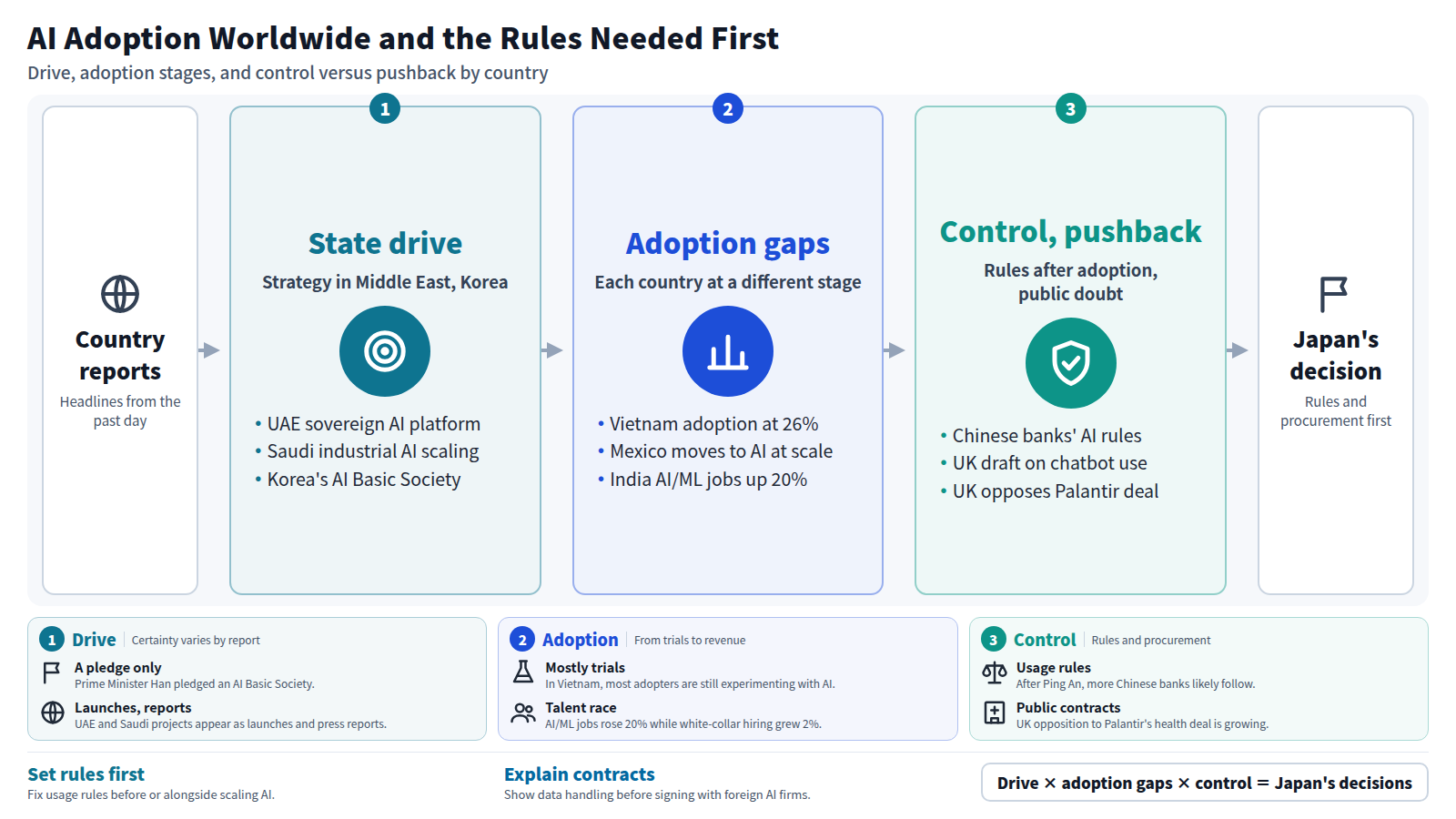
In the past 24 hours, state-led industrial AI and sovereign AI movements have been noticeable in the Middle East (UAE and Saudi Arabia). In Europe, China, and South Korea, there have been movements regarding rules for the use of AI and social acceptance. In the United States, India, and Vietnam, the current state of education, employment, and business introduction was reported.
Domestic in the United States
- United States (Texas): An organization led by Mike Morath helped introduce AI tools into public school classrooms (report on the introduction process).
Domestic in China
- China: Ping An has adopted AI regulations for banks. Analysts say other banks are likely to follow suit.
European countries
- UK Government: Created a draft requesting staff not to thank chatbots and to shorten prompts (to save energy, in draft stage). - United Kingdom: Opposition to Palantir's contract with health services grows.
India/South Asia
- India (Naukri): Job openings for AI/ML roles increased by 20%. The overall increase in white-collar employment will be limited to 2%. - Government of India (PIB): Issued a bulletin featuring semiconductors and AI (headline only, content not confirmed).
Southeast Asia/Oceania
- Vietnam: AI adoption rate rose to 26%. However, the majority of companies that have introduced it are in the trial stage.
Korea/Taiwan
- South Korea (Prime Minister): announced that they aim for an inclusive "AI-based society" (statement stage). - South Korea: A summary of trends in physical AI was reported. - South Korea: It is reported that the rise in stocks related to materials, parts, and back-end processes due to semiconductor investment will "begin in earnest from now on." - South Korea (MegazoneCloud, Portal26): Developing business targeting shadow AI countermeasures. - Taiwan: No applicable information
middle east
- UAE: Sheikh Tahnoon reportedly aims to establish dominance in AI (The Guardian). - Saudi Arabia: IFS and Echelon partner to expand industrial AI (partnership announcement). - UAE (Abu Dhabi): An AI expo and summit gathering global tech executives and unicorns was reported. There are articles stating that the event will be held and articles stating that it has been held. - UAE: MetisJean announces sovereign AI platform for businesses and governments.
Africa/Central and South America
- Africa: No applicable information - Brazil: It was reported that unreliable information from AI was influencing the election campaign (France 24). - Mexico: The tech market is reported to be moving from the adoption stage of AI to the stage of large-scale deployment.
Integrated analysis: What can be seen when comparing the movements of each country
*Similar movement: Improvement of usage rules* - China's AI rules for banks, the UK government's draft usage guidelines, and South Korea's countermeasures against shadow AI all deal with post-implementation usage management. - Although the targets are different from financial regulations, energy consumption by government, and unauthorized use by companies, the common point is that they are at the stage of being controlled with the assumption that they will be introduced.
*Similar movements: Positioning of nations and industries* - The Korean Prime Minister's ``AI-based society'', the UAE's pursuit of sovereign AI and AI superiority, Saudi Arabia's industrial AI, and Germany's sales of industrial AI are all in line with moves to treat AI as an industrial and national strategy. - However, Germany's achievements are based on survey results, the South Korean Prime Minister's statements, and the UAE's projects are announcements and reports, so the accuracy of the results differs.
*Different movements: stage of introduction* - In Vietnam, the implementation rate is 26%, with most of it in the trial stage. Mexico is considered to be in the stage of large-scale expansion. Germany is showing results in terms of sales. - Even with the same "introduction", the stages differ greatly depending on the country.
*Different movements: social reaction* - Opposition to Palantir's health contract grows in the UK, making public procurement a political issue. - In Brazil, AI-derived information in elections is viewed as a problem. - In Texas, implementation in educational settings has progressed with support from administrative agencies. - Even within the same public sphere, there are areas where it is accepted and areas where there is opposition.
*Labor market* - In India, job growth for AI/ML jobs (20%) was significantly higher than for white-collar jobs overall (2%). Demand for AI talent is growing faster than the overall demand.
*Points that will change the decisions of Japanese companies and governments (analysis based on the above report)* 1. Developing usage rules in advance: The examples of Chinese banks, the British government, and Korean companies show the process of determining usage rules before or in parallel with expanded implementation. Japan's financial institutions and government will also find it difficult to postpone the development of rules. 2. Accountability in public procurement: The UK's growing opposition means that contracts with large foreign AI companies will require an explanation of how they handle data and why they are contracted. When Japanese local governments and medical institutions consider similar types of contracts, the preliminary explanation design will be the deciding factor. 3. How to measure results: Examples include sales, such as the German study, and examples that focus on trials, such as Vietnam. Japanese companies need to decide for themselves the criteria for moving from trial to profitability. 4. Recruitment policy: Recruitment trends in India show that competition for AI talent is moving faster than in other occupations. Involved in securing human resources and determining compensation for Japanese companies. 5. Transactions with the Middle East: Sovereign AI and industrial AI businesses are underway in the UAE and Saudi Arabia, and they will be considered as potential partners for Japanese companies to collaborate with and sell to.
Future points of interest
Will banks other than Ping An adopt AI rules in China (analysts say they are likely to follow suit)? 2. How will opposition to Palantir's healthcare contract develop in the UK? Will the draft AI usage guidelines for government employees be finalized? 3. Will the "AI-based society" announced by the Prime Minister become a concrete policy in South Korea?
- How Mike Morath’s agency helped get an AI tool in Texas public school classrooms — Houston Public Media10/02 14:33 UTC
- More Chinese banks likely to adopt AI rules after Ping An move: analysts — South China Morning Post10/03 03:00 UTC
- UK gov't draft tells staff not to thank chatbots, and to use shorter prompts to save energy — The Cool Down10/03 05:31 UTC
- Growing UK opposition to AI giant Palantir's health service deal — CGTN10/02 14:22 UTC
- German Study Finds Industrial AI Driving €120 Billion in Revenue — circleid.com10/02 15:37 UTC
- AI/ML jobs surge 20% as India's white-collar hiring grows 2%: Naukri — TechGig10/03 02:52 UTC
- Semiconductor and AI Revolution — PIB10/03 03:13 UTC
- Vietnam’s AI Adoption Jumps to 26%, but Most Adopters Are Still Experimenting — TechRepublic10/02 16:51 UTC
- Prime Minister Han pledges inclusive AI Basic Society — Aju Press10/03 04:10 UTC
- South Korea Physical AI News Round Up — AI Insider10/03 02:00 UTC
- AI Reshapes South Korea's Semiconductor Investment Landscape—The Rally in Materials, Components, and Back-End Processing Is Just Beginning — finance.biggo.com10/03 02:25 UTC
- MegazoneCloud, Portal26 Target Shadow AI in Korea — Channel Insider10/02 17:44 UTC
- Fixer, financier, spymaster: how the UAE’s Sheikh Tahnoon is setting his sights on AI dominance — The Guardian10/02 09:59 UTC
- IFS partners with Echelon to scale industrial AI in Saudi Arabia — Oil Review Middle East10/02 15:59 UTC
- Abu Dhabi to gather global tech leaders, unicorns at premier AI expo — ANews10/02 12:37 UTC
- MetisJean Launches Sovereign AI Platform for UAE Enterprise and Government — konsulteer.com10/02 11:39 UTC
- Focus - What's real and what's fake? How AI is impacting Brazil's election race — France 2410/02 11:34 UTC
- Mexico’s Tech Market Moves From Adoption to AI at Scale — Mexico Business News10/02 22:24 UTC