AI & Finance News — 2026-10-06 (Tue) Morning News
Source links point to the original outlet. The AI Integrated Analysis is auto-generated from the headlines below only and is not intended to add facts beyond them. Not investment advice.
Overview
It has been reported that AI agents may have been used in cyberattacks on six banks in South Korea, and there are speculations that insurance, securities, and online banking may be targeted in Japan as well (ITmedia, 조선일보). In the United States, Mr. Bowman and Mr. Waller of the Fed each mentioned AI-derived cyber threats and payment/agent-based commerce (JDSupra). In the market, while the Nasdaq has hit a new all-time high, there are both bubble theories and cautionary opinions regarding Nvidia's valuation (qz.com, Yahoo Finance, Investopedia).
Bank trends
The Fed's Mr. Bowman pointed out that AI-based cyber threats will reach regional banks (JDSupra). In South Korea, six banks were attacked by a cyberattack, and the personal information of over 25,000 people was leaked, and it was reported locally that AI agents may have been used (ITmedia). Other reports say more than 65,000 people left, but the numbers vary (vietnam.vn). In the Korean financial region, the existence of COBOL from 50 years ago is said to have been exposed, and it has been pointed out that there is an urgent need to ease network separation regulations (finance.biggo.jp). There is also an article explaining the use of AI by investment banks (Oracle NetSuite).
Insurance trends
A cyber insurance company has added an AI-based risk assessment service (businessinsurance.com). Savvy opened up insurance comparison and purchase to AI agents (Coverager). Opportunities for agent-based AI are being discussed in health insurance (Healthcare Dive). The implications of essays on AI and trust for insurance were also discussed (InsuranceNewsNet). In Japan, there are reports that insurance, securities, and online banking are targets of AI hacking (조선일보).
Trends in asset management and market transactions
Menos AI raises $5.1M to build AI infrastructure for institutional investors (citybiz). BlackRock Portfolio Management LLC disclosed a 1.2% stake in Palladyne AI Corp. as of September 2026 (Kalkine Media). Nasdaq hits a record high as AI stocks rise amid high bond yields (qz.com). There is also an article questioning the bias in AI investment (MoneyLion). Wall Street lenders reportedly disputed Nvidia's valuation of advanced AI hardware assets (TIKR.com).
Fintech/payment trends
Mastercard signs global reseller agreement with Rezolve Ai to power AI-powered commerce (rezolve.com, Digital Transactions, Benzinga). Fed Director Waller discussed AI and agent-based commerce in payments (JDSupra). Visa is also betting on AI in combination with stablecoins, and the implications for investors were discussed (Yahoo Finance). It appears that major payment companies are shifting their focus to AI-based agent-based trading.
Remarks from key figures and authorities in the financial world
The financial figures being tracked include Jamie Dimon, Larry Fink, Jane Fraser, David Solomon, Brian Moynihan, Ted Pick, Ken Griffin, and Paul Atkins. There are no statements about these people in the headlines, and there are no noteworthy movements. Among officials, Fed's Mr. Bowman warned regional banks of AI-derived cyber threats (JDSupra). Fed Director Waller discussed AI and agent-based commerce in payments (JDSupra). Regarding the SEC, a new high-ranking official in charge of AI (AI czar) reportedly left the SEC, and the SEC is said to have taken a tough stance on crypto assets (thestreet.com).
Trends in AI-related stocks and funding
There is a view that Nvidia's valuation is a new counterargument to concerns about an AI bubble (Yahoo Finance). DBS's CIO says AI stocks are far from a bubble (Seeking Alpha). It has been pointed out that AI has become not only an opportunity but also a risk for investors (Investopedia). There was also an opinion that the AI bubble could burst even if demand did not disappoint (Opening Bell Daily). IREN's AI cloud revenue grew 687% in one year (Startup Fortune). Menos AI raises $5.1M (citybiz).
Trends in financial regulation and supervision
An issue raised was the extent to which boards of financial services companies can review and challenge AI once it has been approved (internationalbanker.com). Regarding the SEC, it was reported that a high-ranking official in charge of AI has resigned and the SEC is taking a tough stance on crypto assets (thestreet.com). A study has found that AI-based pension answers “could be harmful” (Financial Planning Today). The actions of Japanese authorities such as the Financial Services Agency are not in the headlines, and there are no notable developments.
Integrated analysis: What is happening now
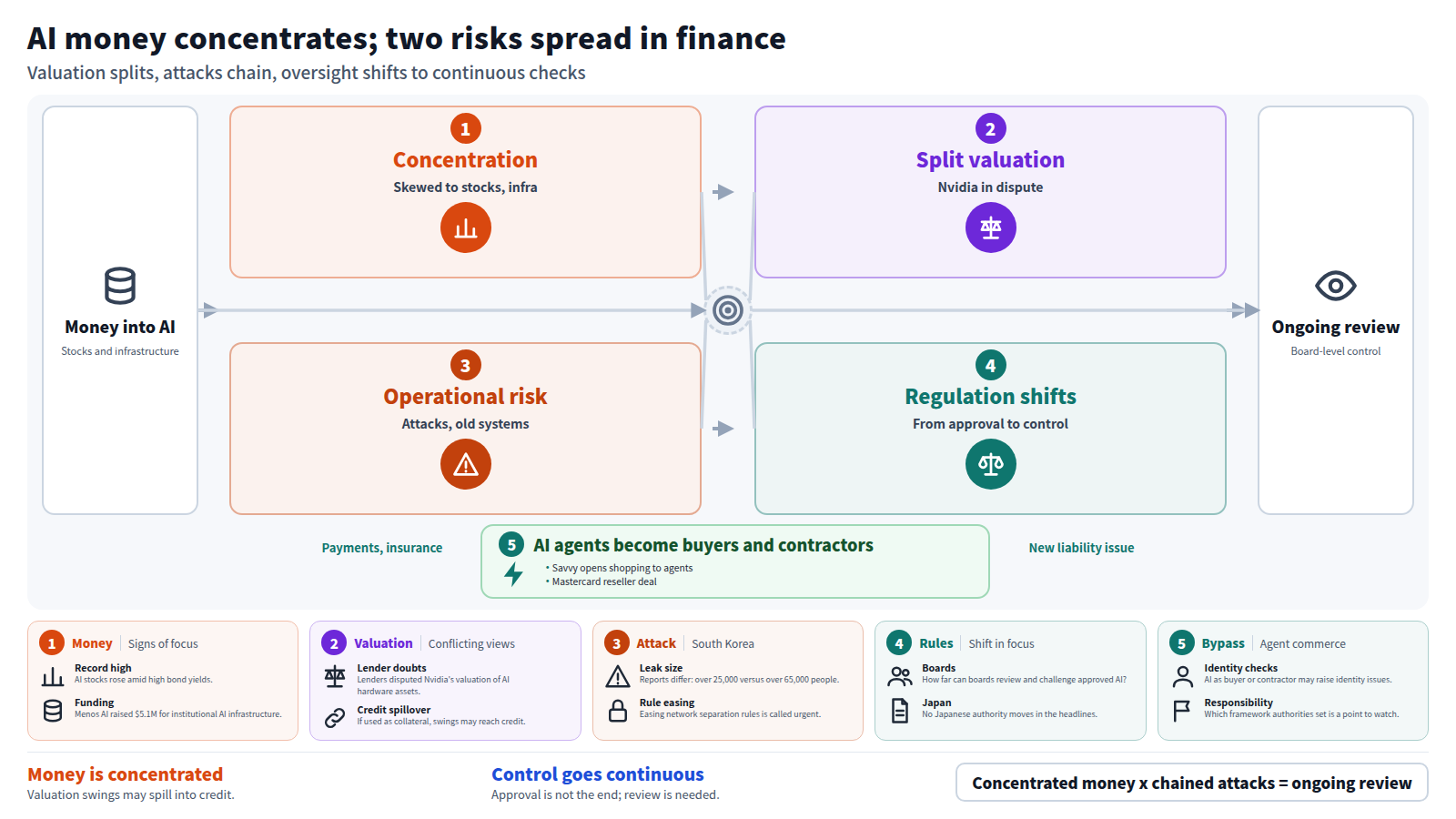
Money is concentrated in AI stocks and AI infrastructure, as evidenced by Nasdaq's all-time high, IREN's AI cloud revenue growth, and Menos AI's raise (qz.com, Startup Fortune, citybiz). At the same time, Nvidia's valuation has conflicting views, including those denying the bubble and objections from lenders. If loans are evaluated using cutting-edge AI hardware assets as collateral, fluctuations in evaluation may have a ripple effect on credit. The risk is two-fold. One is market valuation risk, and AI is beginning to be recognized as both an opportunity and a risk (Investopedia). The other is operational risk, and in the case of South Korea, it appears that a chain of attacks by AI agents and the persistence of an old system (COBOL) overlapped. Bowman's warning is consistent with the concern that similar threats extend to U.S. regional banks. In payments and insurance, there is a growing movement for AI agents to become the main actors in purchasing and contracting (Savvy, Mastercard, Waller's remarks). This may open up new points of contention regarding identity verification and where responsibility lies. The focus of regulation appears to be shifting from approval for the introduction of AI to continuous verification and control by the board of directors (internationalbanker.com).
Future points of interest
- Clarification of the scale and causes of damage caused by cyberattacks on South Korean banks (including discrepancies in reporting on the number of people affected), and the future of discussions on relaxing network separation regulations. - Will lenders' objections to Nvidia's valuation affect loan terms and market valuations related to AI hardware? - What kind of responsibility and control framework will the authorities provide in the payment and insurance fields in response to the expansion of agent-based commerce?
- How Investment Banks Are Using AI — Oracle NetSuite10/05 08:06 UTC
- Cyber insurer adds AI-based risk assessment service — businessinsurance.com10/05 15:33 UTC
- Savvy opens insurance shopping to AI agents — Coverager10/05 17:05 UTC
- The real opportunity for agentic AI in health insurance — Healthcare Dive10/05 10:19 UTC
- What a Time essay on AI and trust means for insurance — InsuranceNewsNet10/05 15:56 UTC
- Y(AI)2K — Carson Group10/05 16:32 UTC
- Menos AI Raises $5.1M to Build AI Infrastructure for Institutional Investors — citybiz10/05 14:45 UTC
- BlackRock Portfolio Management LLC Reveals 1.2% Stake in Palladyne AI Corp. as of September 2026 — Kalkine Media10/05 16:59 UTC
- Nasdaq hits record high as AI stocks rally amid high bond yields — qz.com10/05 17:36 UTC
- Mastercard Selects Rezolve Ai in Worldwide Reseller Agreement to Advance AI-Powered Commerce — rezolve.com10/05 15:22 UTC
- Wall Street Lenders Challenge Nvidia Valuation on Advanced AI Hardware Assets — TIKR.com10/05 16:07 UTC
- Visa is Betting on Stablecoins and AI: Why Should Investors Care? — Yahoo Finance10/05 15:40 UTC
- Nvidia's Valuation Is Giving AI Bubble Fears a New Counterargument — Yahoo Finance10/05 12:48 UTC
- Investors Aren’t Just Treating AI as an Opportunity. It’s a Risk Now, Too — Investopedia10/05 15:56 UTC
- Made Money on AI Stocks? How Cost Segregation Could Lower That Tax Bill — technology.org10/05 08:47 UTC
- Approving AI Is the Easy Part. Can Financial-Services Boards Challenge It? — internationalbanker.com10/05 09:47 UTC
- Bitcoin Miner IREN's AI Cloud Revenue Jumped 687% in a Year — Startup Fortune10/05 14:24 UTC
- AI pension answers ‘potentially harmful’ - survey — Financial Planning Today10/05 09:25 UTC
- AI Hacking Targets Insurers, Brokerages and Internet Banks Too — 조선일보10/05 15:55 UTC
- Hackers Used AI to Attack Multiple South Korean Banks, Leaking Data of Over 65,000 People — vietnam.vn10/05 10:02 UTC
- AI chain hacking that hit South Korea's financial region exposes COBOL from 50 years ago... Relaxation of network separation regulations is an urgent need — finance.biggo.jp10/05 10:06 UTC