AI & Healthcare News — 2026-10-06 (Tue) Evening News

Source links point to the original outlet. The AI Integrated Analysis is auto-generated from the headlines below only and is not intended to add facts beyond them. Not investment advice.
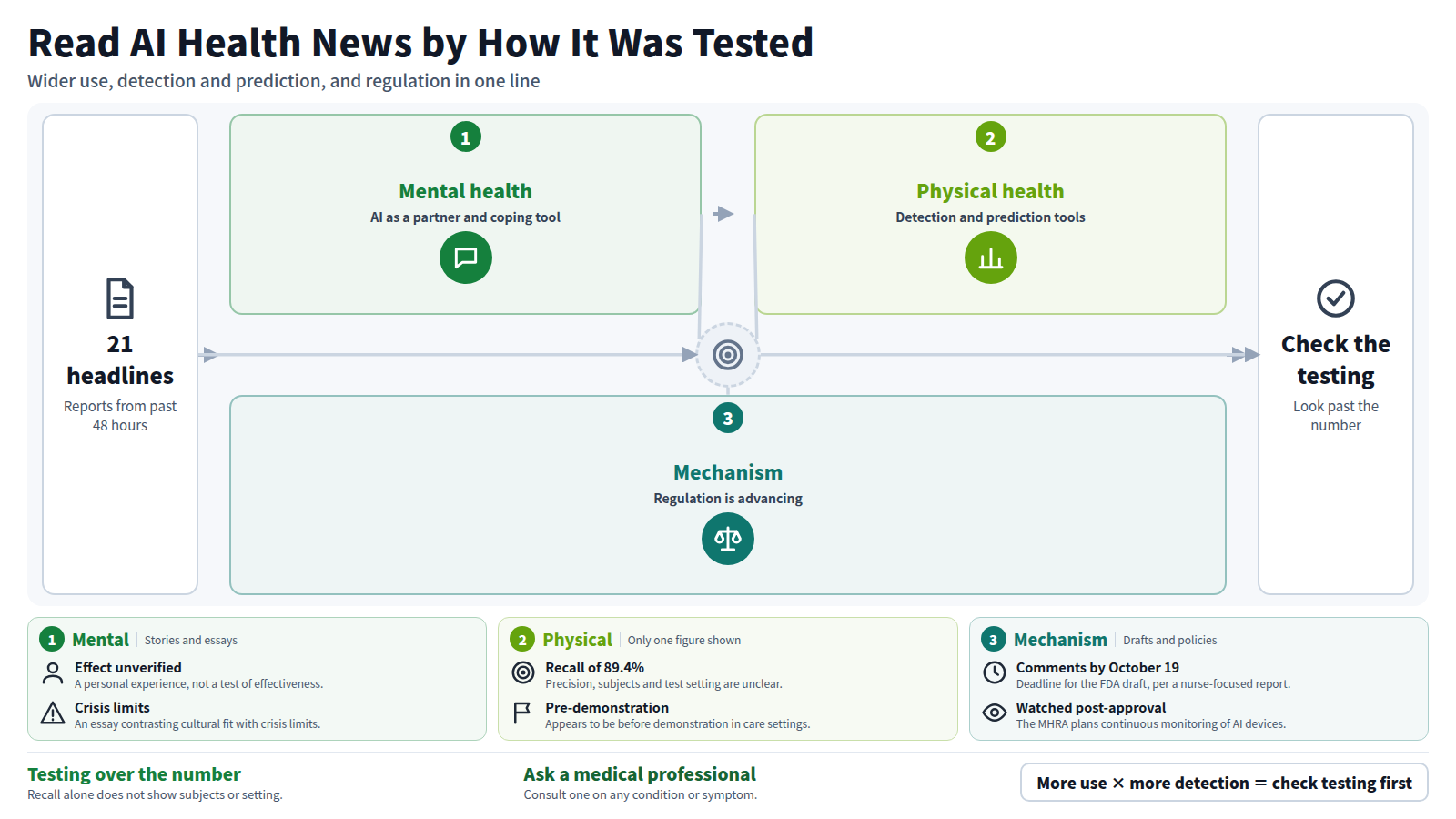
Overview
- Mental health: Focusing on the movement to use generative AI as a conversation partner and coping mechanism, and reports on the pros and cons of doing so. - Physical health: There were notable developments in detection and prediction systems, such as reading anxiety using wearables and AI for detecting signs in nursing care settings. - Mechanism: Progress is being made in regulatory development, including the FDA's draft framework for generation AI devices (currently seeking comments) and the UK MHRA's continuous monitoring policy.
Mental health
- "Anxiety about AI has entered therapy chats" (Yahoo): Reports indicate that anxiety about AI is being brought into consultation sessions. Measurement and scale are unclear from the headline. - “When a Mental Health Chatbot Understands Your Culture — But Not Your Crisis” (Vocal): An essay that contrasts understanding of culture and the limits of crisis response. The stage of evidence is unknown. - Reports that a woman who lost her spouse has written a book about her experience using AI for mental health care (Boston 25 News and others): Personal experience. This is not a verification of effectiveness. - "People are using AI more to cope with problems. Is that healthy" (southeastarrow.com): Article questioning the increasing use of AI for coping purposes. Data indicating health is unclear from the headline.
Exercise/physical activity
- "AI model that reads anxiety from wearable signals and suggests ways to calm down" (bioengineer.org): A model that reads anxiety from wearable signals and suggests ways to calm down. The detection accuracy, number of people targeted, and testing stage are all unclear from the headline. - Other headings (Mistlabs/Ambi, AI glasses in Norway and Cyprus) are not directly related to the health outcomes of exercise/physical activity and will not be addressed.
sleep
No applicable information
Nutrition/Meals
- "AI identifies children who are most likely to benefit from obesity prevention programs" (bioengineer.org): Content that AI has been used to identify children who are most likely to benefit from obesity prevention programs. The target audience is children. The size of the effect and study design are unclear from the headline.
Prevention/Medical checkup
- "AI analysis: Predictors of death from fatty liver disease differ significantly between women and men" (bioengineer.org): Report that predictive factors of death from fatty liver disease differ significantly between women and men. The size and region of the target population, as well as the stage of the research, are unclear from the headline. - "Did AI Just Discover a Way to Reverse Aging?" (Banyan Hill): An investment information media with a question-type heading. The basis cannot be confirmed and will not be evaluated.
Self-management of chronic diseases
- "Doctors, Patients Shouldn't Let Fear Define The AI Debate" (Forbes): An essay on the debate surrounding AI. No specific diseases or outcome measures were indicated.
Elderly people/nursing care
- South Korea: Plans for 24-hour AI elderly care starting in 2028 (The Korea Herald). Details are unclear from the headline. - UAE: The UAE is becoming a place for testing medical AI, and the real challenge is post-test operation (Fast Company Middle East). - For information on nursing care AI in Japan, see "11. Trends in Japan." - "Anthropic expected to IPO..." is not information in the health field and will not be treated.
Digital treatment/regulation
- US FDA: Developed a draft regulatory framework for devices equipped with generative AI (JDSupra). For reports aimed at nurses, the deadline for soliciting opinions is October 19th (Nurse.org). - UK MHRA: Policy for continuous monitoring of AI-equipped medical devices (ET HealthWorld). The MHRA has started the third phase of Airlock, with the UK reportedly accepting the AI Commission's proposed regulations (Health Tech World). - UltraSight: raises $24 million to expand AI-assisted echocardiography to non-specialist ICU staff (insights.citeline.com). This is a funding report, and the details of clinical efficacy and approval are unclear from the headline.
Workplace health
- "Their jobs were among the first to be changed by AI. Now some are trying to avoid it" (CNN). It has been reported that some people whose jobs were changed early on by AI are trying to avoid it. Information on measuring the impact on the mind and body is unclear from the headline. - “AI adoption could reinforce gender imbalance in manufacturing, report warns” (The Manufacturer). A report states that the introduction of AI in the manufacturing industry could perpetuate gender bias. No association with health indicators has been shown.
Japanese movements
- Panasonic HD: Developed a "predictive solution" that supports nursing care sites using AI and sensors (Cloud Watch and other media). Utilizes machine learning and generative AI to detect signs of changes in the physical condition of elderly people. "Health condition change analysis AI" for nursing care facilities has a reproduction rate of 89.4% for signs of changes in physical condition (Mynavi News). The stage of progressing to demonstration in nursing care settings (projectdesign.jp). Only the recall rate is shown; the precision rate, number of subjects, and verification environment are unclear from the headline. It appears to be in the pre-demonstration stage. - Welmo: Medical care AI company. Head office relocated to "Tenjin Business Center II" in Tenjin, Fukuoka (PR TIMES). It is not information about health outcomes.
Remarks from VIPs
No relevant information (list of important people being tracked is empty)
AI video/commentary
No applicable information supplement - The above is an arrangement based only on headings, and the efficacy and safety of each drug has not been verified. Judgments related to physical condition and symptoms should be consulted with a medical professional. - ``Communication between AIs,'' ``OpenAI model postponement,'' and ``University AI detectors'' could not be confirmed from the headlines as being directly related to health, so they were excluded.
- When a Mental Health Chatbot Understands Your Culture — But Not Your Crisis — Vocal10/06 01:54 UTC
- Widow pens book about using AI for therapy amid losing her husband — Boston 25 News10/06 02:44 UTC
- People are using AI more to cope with problems. Is that healthy — southeastarrow.com10/05 23:59 UTC
- AI Model Reads Anxiety From Wearable Signals and Suggests Ways to Calm Down — bioengineer.org10/06 00:44 UTC
- Mistlabs Raises $26M Pre-A as Ambi Launches AI-to-AI Communication — Unite.AI10/05 17:10 UTC
- Norway targets AI glasses as Cyprus watches privacy debate — Cyprus Mail10/06 04:00 UTC
- Grappling with 'homework scams,' US universities shun AI detectors — ABS-CBN10/06 06:05 UTC
- OpenAI shelves new AI model release over safety concerns — The Business Standard10/05 07:57 UTC
- AI Reveals Which Children Benefit Most From Obesity Prevention Programs — bioengineer.org10/06 04:26 UTC
- UK says it will monitor AI-based medical devices continually — ET HealthWorld10/06 02:11 UTC
- Doctors, Patients Shouldn’t Let Fear Define The AI Debate — Forbes10/06 08:45 UTC
- UK accepts AI commission regs as MHRA opens Airlock Phase 3 — Health Tech World10/06 08:01 UTC
- Did AI Just Discover a Way to Reverse Aging? — Banyan Hill Publishing10/05 16:33 UTC
- The UAE is becoming a test bed for medical AI. But the real test begins after the pilot — Fast Company Middle East10/06 05:02 UTC
- Korea plans round-the-clock AI eldercare from 2028 — The Korea Herald10/06 05:50 UTC
- Anthropic expected to IPO despite market concerns, AI safety concerns — wandtv.com10/05 22:22 UTC
- AI Reveals That What Predicts Death From Fatty Liver Disease Differs Sharply Between Women and Men — bioengineer.org10/05 18:09 UTC
- UltraSight Raises $24M To Expand AI-Guided Echocardiography To Non-Specialist ICU Staff — insights.citeline.com10/05 21:00 UTC
- Their jobs were among the first to be changed by AI. Now some are trying to avoid it — CNN10/05 11:00 UTC
- AI adoption could reinforce gender imbalance in manufacturing, report warns — The Manufacturer10/06 00:42 UTC
- Healthcare AI firm Welmo moves headquarters to Tenjin Business Center II in Fukuoka — PR TIMES10/06 01:00 UTC