AI and Cancer Research ── Breast ── 2026-10-05
Breast cancer: treatment, trials and AI
- Abstract
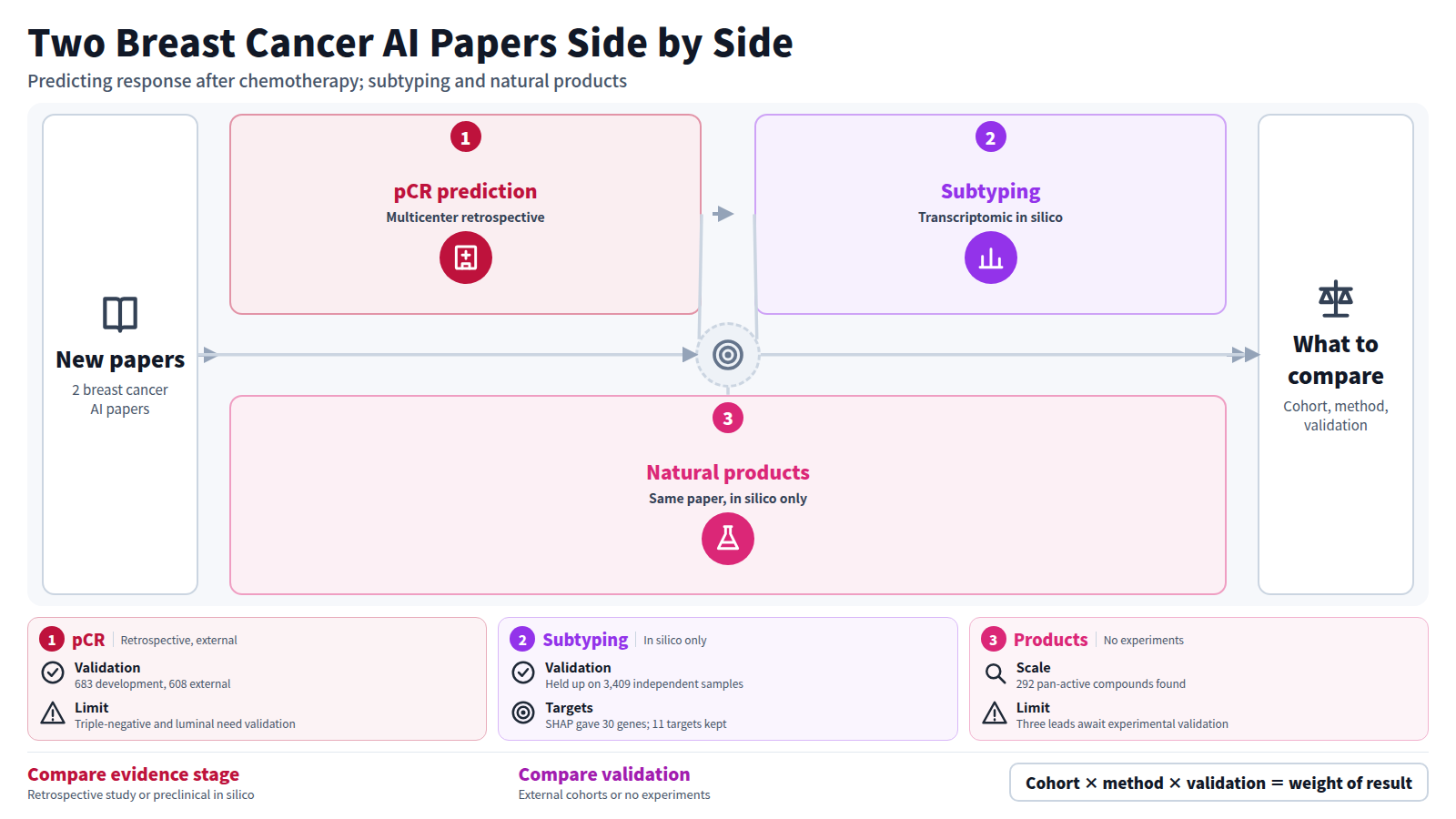
BACKGROUND: Pathological complete response (pCR) is a key endpoint following neoadjuvant chemotherapy (NAC) in breast cancer, with potential to guide treatment adaptation and surgical de-escalation. However, limited generalizability across institutions remains a major challenge due to heterogeneous imaging protocols (scanner vendors, field strengths, and acquisition parameters) and diverse patient populations, which can cause significant domain shifts in model performance. This study develops and externally validates a multimodal framework for post-neoadjuvant, preoperative prediction of pCR using multiparametric MRI (mpMRI) and routinely available clinical data. METHODS: In a multicenter retrospective setting, 1291 patients from five institutions were enrolled and institutionally divided into a development cohort pooled from two centers (n=683) and three independent, single-center external validation cohorts (n=608). Model inputs comprised post-treatment mpMRI (dynamic contrast-enhanced and diffusion-weighted imaging) for deep feature extraction, clinicopathological variables, radiomics features from both pre- and post-treatment scans, and delta-radiomics features capturing longitudinal within-sequence changes (Δ = post - pre). A dual-tower attention network incorporating a Feature Quality Enhancer (FQE) module-which regularizes the latent space by promoting intra-class compactness, inter-class separability, and feature consistency-was designed to learn discriminative imaging representations. Deep, radiomic, and clinical features were then integrated through a hierarchical feature selection strategy, with robustness assessed via repeated experiments.. Predictive performance was evaluated using the area under the receiver operating characteristic curve (AUC) in both development and external validation cohorts. RESULTS: The proposed AIFPS achieved an AUC of 0.882 (95% CI: 0.855-0.905) in the development cohort. In external validation, AIFPS achieved the highest numerical AUCs (0.853, 0.888, and 0.895) and demonstrated statistically significant improvements over all single-modality models in all cohorts. While its superiority over certain dual-modality models did not reach statistical significance after correction for multiple comparisons, the full multimodal approach consistently yielded the numerically highest discrimination. CONCLUSION: AIFPS integrates quality-enhanced deep imaging features with radiomics, including delta-radiomics, and clinicopathological variables to enable accurate and generalizable preoperative prediction of pathological complete response, particularly in HER2-positive disease, while further validation is required for triple-negative and luminal subtypes. Its application in luminal breast cancer requires further dedicated subtype-specific modeling. With prospective validation, this approach may support individualized treatment stratification following neoadjuvant chemotherapy.
Journal IF-equivalent: 4.3 (OpenAlex 2-year mean citedness, value as of 2026-10-04, retrieved 2026-10-05; not the official Clarivate IF)Reference: Ke Y, Yang W, Yang Z, Yue J, Li C, Yuan P, et al. A dual-tower multimodal framework with feature quality enhancement for predicting pathological complete response after neoadjuvant chemotherapy in breast cancer: a multicenter study. Transl Oncol. 2026 Nov;73:103060. doi:10.1016/j.tranon.2026.103060. PMID: 42822322.Checked: Abstract only - Abstract
Breast cancer comprises five intrinsic molecular subtypes with distinct transcriptomic programs, prognoses, and therapeutic vulnerabilities. Yet, accurate subtype discrimination remains limited by boundary-overlap and poor cross-cohort generalisability, while single-target agents often fail against pathway redundancy and acquired resistance. We developed an integrated computational framework linking transcriptomic-classification, explainable target prioritisation, and multi-target natural-product discovery. Three transcriptomic cohorts (METABRIC-BRCA-2016, TCGA-BRCA-2012, and TCGA-BRCA-2018; n = 2512 after quality-control and ComBat-correction) were integrated. Differential-expression analysis and PCA-based feature selection yielded a 50-gene signature that retained more than 90% of the subtype-associated variance. Among the six evaluated classifiers, XGBoost achieved the best performance and generalised to an independent cohort of 3,409 samples (accuracy: 85.70%; ROC-AUC: 0.95–0.99). SHAP-analysis identified 30-candidate genes associated with Basal-like and HER2-enriched subtypes, which were cross-referenced against ChEMBL to retain 11 targets for proteochemometric (PCM) modelling. A hybrid PCM multilayer-perceptron integrating ProtBERT and ChemBERTa embeddings with molecular fingerprints and chemical descriptors achieved a balanced-accuracy of 0.9140 and mean ROC-AUC of 0.9696. Screening of 30,898 NPASS natural products identified 292 pan-active compounds. Independent binding- and safety-prioritisation strategies converged on three leads: NPC139056, NPC196231, and NPC471997. This reproducible pipeline provides computationally prioritised leads for experimental validation in clinically challenging breast cancer subtypes.
Journal IF-equivalent: 5.2 (OpenAlex 2-year mean citedness, value as of 2026-10-04, retrieved 2026-10-05; not the official Clarivate IF)Reference: Jakkula BK, Perugu S. Explainable machine learning and hybrid transformer-based proteochemometric modelling for breast cancer molecular subtyping and multi-target natural product discovery. Sci Rep. 2026 Oct 2 [Epub ahead of print]. doi:10.1038/s41598-026-71603-1.Checked: Abstract only