AI in Medicine News — 2026-10-05 (Mon) Morning News
Source links point to the original outlet. The AI Integrated Analysis is auto-generated from the headlines below only and is not intended to add facts beyond them. Not investment advice.
Overview
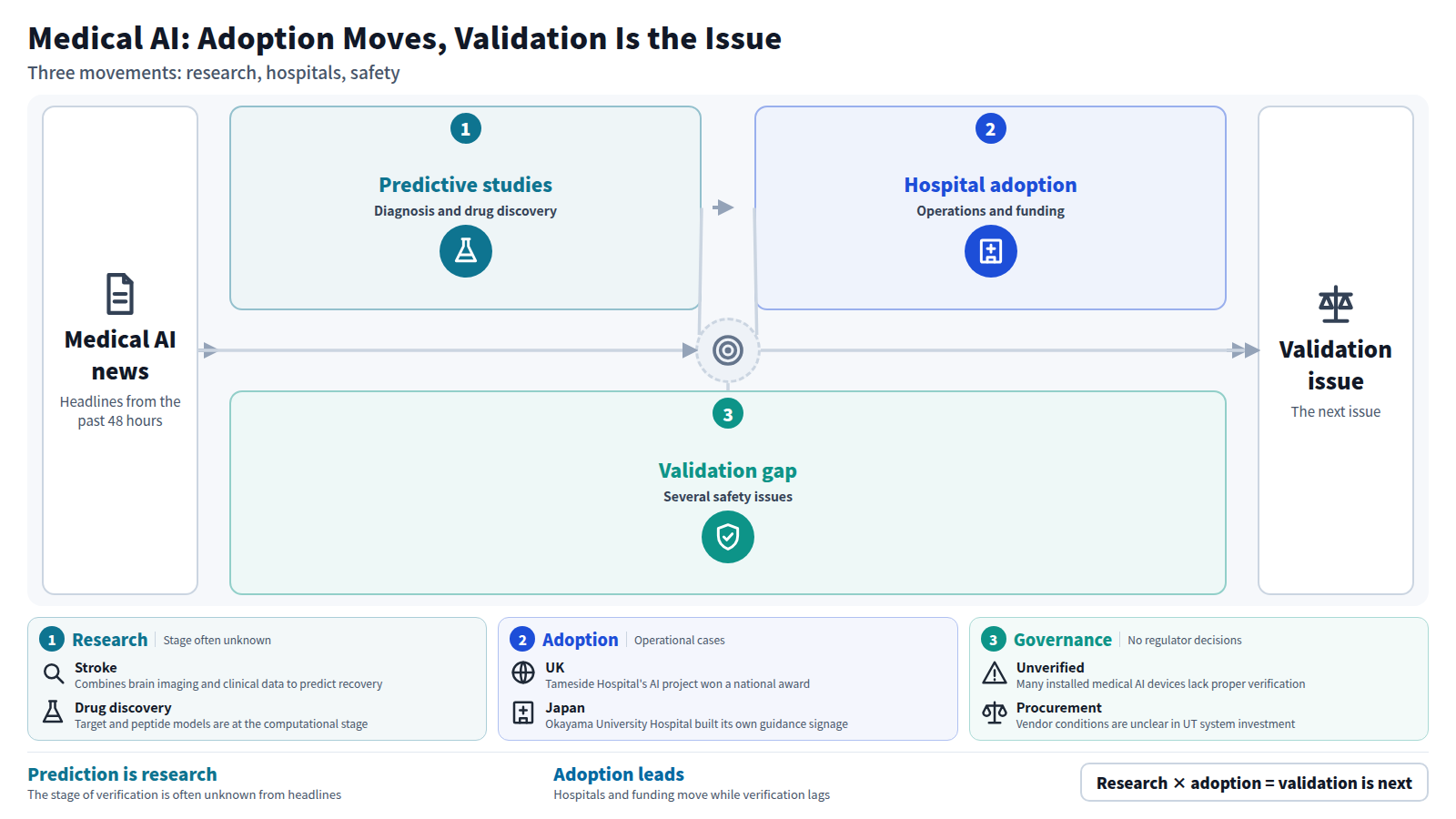
- Movement has been seen in diagnostic and predictive research (stroke recovery, migraine, drug discovery prediction models) and operational aspects (hospital implementation, funding, public investment). - There are no headings regarding regulatory approvals, designations, and guidelines. On the other hand, multiple safety and governance issues have arisen, including insufficient verification of medical AI devices that have been introduced, a proposed framework for AI-based prescriptions, and opaque procurement conditions.
Diagnosis/Image
- Stroke recovery prediction: AI that combines brain imaging and clinical data to predict recovery outcomes (Bioengineer.org). There are no numbers in the headline, and the stage of verification is unknown. - Predicting migraine onset: Study showing ``91% precision'' (MedicalNewsToday). The results are at the research stage, and it is not possible to tell from the headline whether there will be prospective validation or clinical implementation. - Determination of leaf diseases (grapes, over 99% accuracy) is not handled in this section because it is in the agricultural field, not medical care. - Current state of implementation: Medical AI is already in hospitals, but many devices have not been properly verified (Earth.com).
Clinical decision support
- An editorial (Hartford Courant) that discusses the possibility of AI being able to prescribe medicines in the future and proposes a framework for this. This is an opinion article and does not represent empirical data or institutional decisions.
Generation AI and medical documents/medical records
- No applicable information
Hospital management/medical provision system
- Reports that Indian hospitals are moving from the experimental stage of AI to broader medical use (boldnewsonline.com). - UK's Tameside Hospital's AI project wins national award (notreallyheremedia.com). There are no details about the content or effects in the headline. - Prodoc AI raises seed funding from Dr A. Velumani's family office (Bharat Fast). However, the terms of the contract with the vendor were reported to be unclear (hoodline.com). - Report that Anthropic aims to revolutionize healthcare (Forbes). The specific content is unclear from the headline.
Drug discovery/clinical trials
- Drug-target prediction: Tackling prediction challenges with graph models (Bioengineer.org). At the research stage of the computational model, no preclinical or clinical demonstration has been shown. - Peptide drug prediction: AI that learns the “language” of hormones and predicts peptide drugs (Bioengineer.org). It is also at the computational model stage. - There are no headlines regarding clinical trials (phase I and beyond).
Medical device approval/regulation
- No relevant information (approval/designation/guideline announcements are not listed in the heading). - Related issues include the lack of verification of installed equipment (Earth.com) and the proposed framework for AI prescriptions (Hartford Courant). None of this is a regulatory decision.
Safety/Error/Bias
- Pointed out that many medical AI devices have not been properly verified (Earth.com). - Regarding UT system investment, it has been pointed out that vendor conditions are unclear (hoodline.com). - Deep Health AI India Ltd amends its FY26 audit report (scanx.trade). This topic concerns corporate financial reporting and is separate from clinical safety. - Report that rapid advances in AI are raising questions about safety and human control (KUTV). It is unclear from the headline whether the content is medical-specific.
Research results (major journals)
- There are no headings indicating publication in major journals (peer-reviewed journals). The above-mentioned studies on stroke, migraine, and drug discovery were reported by Bioengineer.org, MedicalNewsToday, etc., and the journals in which they were published cannot be confirmed.
Japanese movements
- Okayama University Hospital: Developed and installed digital signage that uses AI to automatically guide patients to the locations of examinations and tests (Sanyo Shimbun). This is not a diagnosis or treatment, but an introduction to the management aspect of in-hospital guidance. - SCO Group: Business alliance with dental clinical AI company Converge Partners (Infoseek). Details of the partnership are not included in the headline. - "Dr.Love" (AppBank), horse racing AI diagnosis (youtu.be), and AI security CoWorker (Nico Nico News) are not treated as they do not fall under the category of medical care.
Remarks from VIPs
- The list of important people being tracked is empty and there are no corresponding statements.
- Medical AI is already in hospitals, but most of the devices haven’t been properly tested — Earth.com10/04 15:29 UTC
- Opinion: AI may one day be able to prescribe medicine. There is a framework proposed. — Hartford Courant10/04 14:41 UTC
- AI Combines Brain Scans and Clinical Data to Predict Stroke Recovery Outcomes — Bioengineer.org10/04 12:38 UTC
- Could AI predict migraine before it strikes? Study finds 91% precision — MedicalNewsToday10/04 10:54 UTC
- AI Spots Grape Leaf Diseases With Over 99 Percent Accuracy — Bioengineer.org10/04 04:19 UTC
- AI Didn’t Take His Job. It Made His Skills Worthless. — Vocal10/04 11:47 UTC
- The unglamorous reality of winning the AI race — Nikkei Asia10/03 20:05 UTC
- Indian Hospitals Move Beyond AI Experiments Towards Wider Healthcare Use — boldnewsonline.com10/03 05:45 UTC
- Tameside Hospital AI project wins prestigious national award — notreallyheremedia.com10/02 18:39 UTC
- Prodoc AI Raises Seed Funding From Dr A. Velumani Family Office — Bharat Fast10/02 18:44 UTC
- AI Graph Model Tackles the Hardest Problem in Drug-Target Prediction — Bioengineer.org10/04 06:38 UTC
- Workflow, sustainability, AI: test your business creativity with Edition 252 of our weekly quiz! — YourStory.com10/04 11:21 UTC
- AI's rapid advancement raises questions about safety, human control — KUTV10/02 21:30 UTC
- AI Learns the Language of Hormones to Predict Peptide Drugs — Bioengineer.org10/04 07:39 UTC
- Anthropic Is Aiming To Transform Healthcare—Here’s How — Forbes10/03 10:00 UTC
- Deep Health AI India Ltd revises FY26 audit report — scanx.trade10/04 07:02 UTC
- AI automatically guides you to the location of examinations and examinations Okayama University Hospital installs digital signage, developed independently — 山陽新聞10/04 09:55 UTC
- Best friend AI “Dr.Love” will officially launch on October 1st! Equipped with "Chigu Hug Diagnosis" that analyzes true intentions and public appearances in 256 ways — AppBank10/03 03:20 UTC
- SCO Group enters business partnership with dental clinical AI company ConvergePartners — Infoseek10/04 03:40 UTC
- [10/3 Early Morning] Kyoto/Tokyo 1~2R AI EV Diagnosis | Myoumi is Kyoto 1R — youtu.be10/02 23:10 UTC
- AI security CoWorker, “Red Agent”, “Blue Agent”, “Purple” — ニコニコニュース10/03 03:30 UTC