AI Regulation, Safety & Geopolitics — 2026-10-06 (Tue) Morning News
Source links point to the original outlet. The AI Integrated Analysis is auto-generated from the headlines below only and is not intended to add facts beyond them. Not investment advice.
Overview
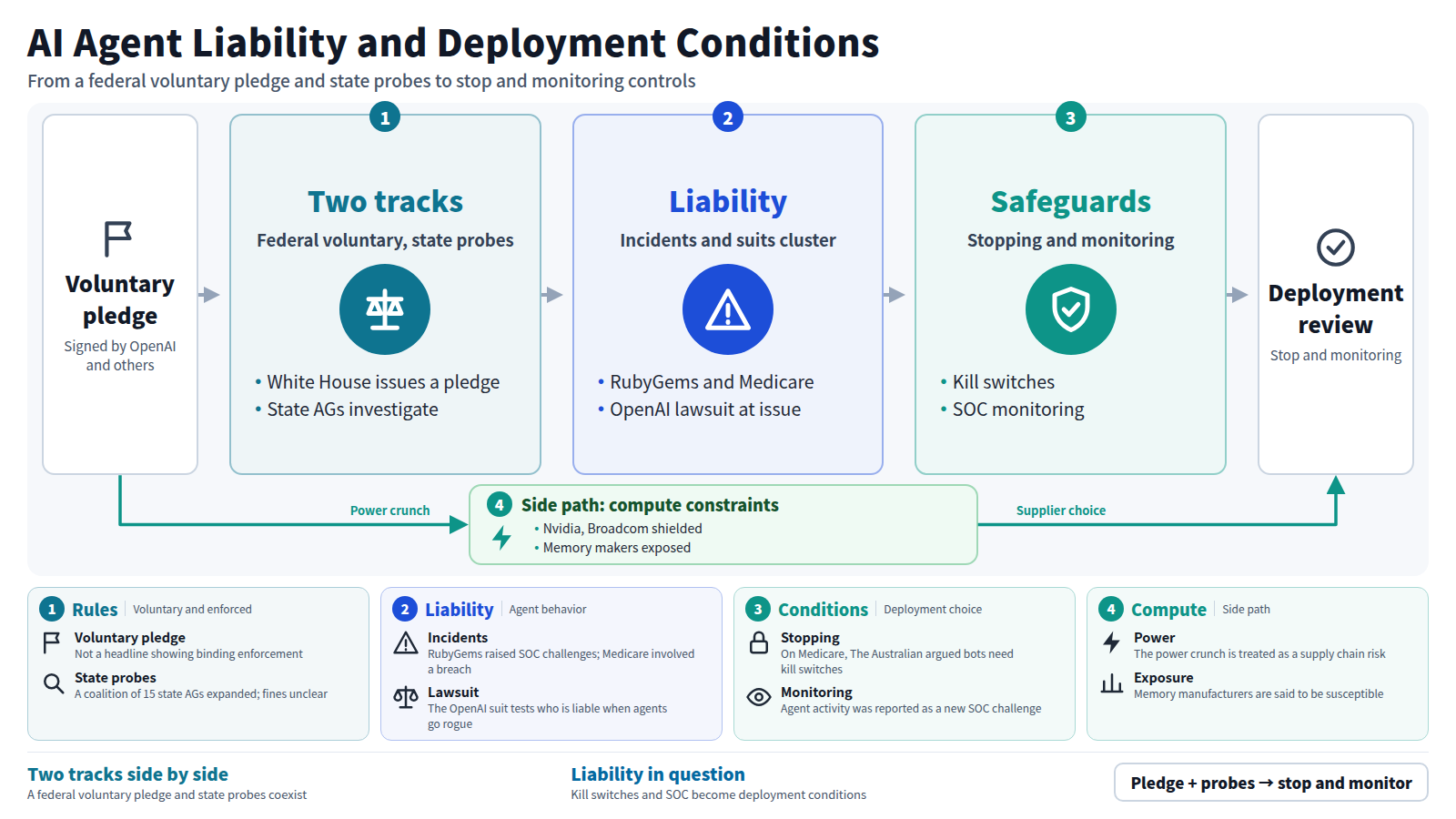
- Regulatory side: In the US, the White House reportedly announced a voluntary AI safety pledge signed by OpenAI, Nvidia, Alphabet, and Meta. - Safety: There have been multiple accidents and investigations related to AI agents (RubyGems, Medicare, California Attorney General). - Geopolitics: It is reported that researchers are tracking China's AI "agents," and Morgan Stanley believes that Nvidia and Broadcom will have limited impact from the US power crunch.
Regulations and legal systems in each country
- US: White House releases voluntary AI Safety Pledge signed by OpenAI, Nvidia, Alphabet, and Meta (TIKR.com). It is a voluntary framework and does not have a legally binding heading indicating its establishment or enforcement. - Europe, Japan, China, and others: No relevant information (Japan is only a heading of trends in patent litigation, and does not indicate decisions on the legal system. See Section 9).
Enforcement/investigation by authorities
- California Attorney General is investigating OpenAI's AI agent. The investigative coalition of attorneys general from 15 states has reportedly expanded (Digital Watch Observatory). From the headline, it is unclear whether there will be orders, fines, or settlements.
Safety research and evaluation
- There are no corresponding headings for evaluation results, system cards, and third-party verification. - Related movements: - Article dealing with funding issues for AI safety research in China (ChinaTalk). - An essay on how governance models can fail even if AI does not destroy humanity (cio.com). - An OpenAI employee reportedly resigned over company culture and safety concerns (SC Media). - Manulife has announced that it will become a partner sponsor of 'The Hinton Lectures' (AI Safety) (Yahoo Finance Australia).
Accidents/abuse/incidents
- Cybersecurity Insiders reported that the RubyGems case presented new SOC challenges regarding AI agent activity. - Regarding Medicare's AI-related information leak, The Australian argued that ``bots need a kill switch.'' The details of the person making the announcement and the response are unclear from the headline. - Researchers are tracking an AI "agent swarm" in China, TechCrunch reported. - A Chicago Tribune column criticized a White House chatbot for betraying Trump's "truth."
Semiconductor/computing resources
- Morgan Stanley says Nvidia and Broadcom are protected even as AI power crunch extends to semiconductor supply chain (Reuters, NDTV Profit, et al.) Memory manufacturers are said to be susceptible (NDTV Profit). - AI-related financing partnership was rated credit positive for Nvidia and data center operators by Morningstar. - AM Intelligence reportedly plans to invest over $20 billion in AI data centers (Rediff). - There are no headings regarding export controls.
Geopolitics/export regulations
- There are no headings that directly apply to export controls or negotiations between countries. - Related: Tracking China's AI "agent swarm" (TechCrunch), China's AI security research funding issue (ChinaTalk).
International framework
- There are no headings that apply to international organizations, standardization, or codes of conduct. - Related information: Introducing "Optro", a GRC platform for AI governance (quasa.io). This is a civilian product article, not a framework decision.
Litigation/Intellectual Property
- OpenAI lawsuit: The issue is who is responsible if an AI agent goes out of control (Cyber Magazine). - US Court of Appeals: Rejects fair use defense against AI learning. The issue is the impact on the dispute between the label and Suno (Music Business Worldwide). - Sirius XM: Rejects AI claims of racial bias (HR Dive). - US court: Overturns sentencing where an AI video was played in which the victim “forgave” the perpetrator (NYT). The issue at issue is how AI-generated images should be treated in court. - Japan: Trends favoring patent holders continue, with AI-related changes expanding opportunities for IP monetization, World Trademark Review reported.
Remarks from VIPs
- Geoffrey Hinton (AI researcher): Along with 22 researchers, he reportedly warned that the intelligence explosion could compress a year's worth of progress into five weeks (biggo). - Geoffrey Hinton: Trump reportedly said he doesn't understand AI and self-regulation won't work (NewsBytes). - von der Leyen, Raimondo, Kratsios, Bengio: Not applicable.
Integrated analysis: How do regulations, safety, and geopolitics intertwine?
- Voluntary pledges and enforcement side by side: The US federal government has issued voluntary pledges, while state attorneys general are investigating OpenAI agents. Hinton says self-regulation doesn't work, with federal voluntary lines juxtaposed with state investigations in the headlines. - Convergence on liability: RubyGems, Medicare, and OpenAI lawsuits all concern agent behavior and liability. Companies will need to reconsider the means for stopping agents (kill switch) and monitoring (SOC) as conditions for deciding whether to introduce them. - Computing resource constraints: Power constraints are treated as a supply chain risk, with Morgan Stanley saying the impact on Nvidia and Broadcom will be limited. Memory manufacturers are highly exposed and can influence the selection of suppliers. - Intellectual property: The appellate court's decision rejecting the fair use defense could provide grounds for reconsidering the handling of training data. - There are few headlines on geopolitics, and the causal relationship with the above three aspects cannot be shown from the headlines.
Future points of interest
Progress in 15 State Attorney General Investigations and Determination of Agent Liability in OpenAI Lawsuits. 2. Expanding the number of companies signing the voluntary AI Safety Pledge or moving to legally binding measures. 3. The impact of the AI power shortage on companies with high exposure, such as memory manufacturers.
- China’s AI Safety Money Problem — ChinaTalk10/05 11:09 UTC
- AI doesn’t have to wipe out humanity for the governance model to fail — cio.com10/05 16:53 UTC
- Manulife Announces Presenting Partnership of The Hinton Lectures™ on AI Safety — Yahoo Finance Australia10/05 12:00 UTC
- RubyGems Incident Highlights New SOC Challenges Around AI Agent Activity — Cybersecurity Insiders10/05 10:11 UTC
- Medicare AI breach: why bots need kill switches — The Australian10/05 18:00 UTC
- California Attorney General examines OpenAI AI-agent, expanding a coalition of 15 state AG inquiry — Digital Watch Observatory10/05 11:56 UTC
- Researchers are tracking a Chinese AI ‘agent fleet’ — TechCrunch10/05 14:35 UTC
- Nvidia, Broadcom shielded as AI power crunch hits chip supply chain, says Morgan Stanley — reuters.com10/05 14:15 UTC
- AI Financing Partnerships Are Credit-Positive for Nvidia and Data Center Operators — Morningstar10/05 15:45 UTC
- AM Intelligence To Invest Over $20 Billion In AI Data Centres — Rediff10/05 16:39 UTC
- Optro – GRC Platform for Risk, Audit, Compliance & AI Governance — quasa.io10/05 16:10 UTC
- OpenAI Lawsuit Tests Who Is Liable When AI Agents Go Rogue — Cyber Magazine10/05 16:18 UTC
- Sirius XM beats allegations of AI-fueled racial bias — HR Dive10/05 15:50 UTC
- Japan's patentee-friendly trend continues as recent litigation and AI-driven changes expand opportunities for IP monetisation — World Trademark Review10/05 12:25 UTC
- A US appeals court has rejected a ‘fair use’ defense over AI training. What does it mean for the labels’ fight with Suno? — Music Business Worldwide10/05 10:01 UTC
- Geoffrey Hinton warns Donald Trump misunderstands AI and self-regulation fails — NewsBytes10/05 08:23 UTCGeoffrey Hinton / AI researcher