AI Regulation, Safety & Geopolitics — 2026-10-05 (Mon) Evening News
Source links point to the original outlet. The AI Integrated Analysis is auto-generated from the headlines below only and is not intended to add facts beyond them. Not investment advice.
Overview
- Regulatory aspect: It has been reported that an AI governance bill is expected to be submitted to the National Assembly early next year in Malaysia. Minnesota's ban on AI "nudification" has been suspended by a court order. - Safety: OpenAI has expressed the idea of giving executives the right to veto the termination of development. Common Sense Media advances AI safety initiatives for young people. - Geopolitics: There are no headlines about export controls or semiconductors, and there is one general commentary article on international frameworks.
Regulations and legal systems in each country
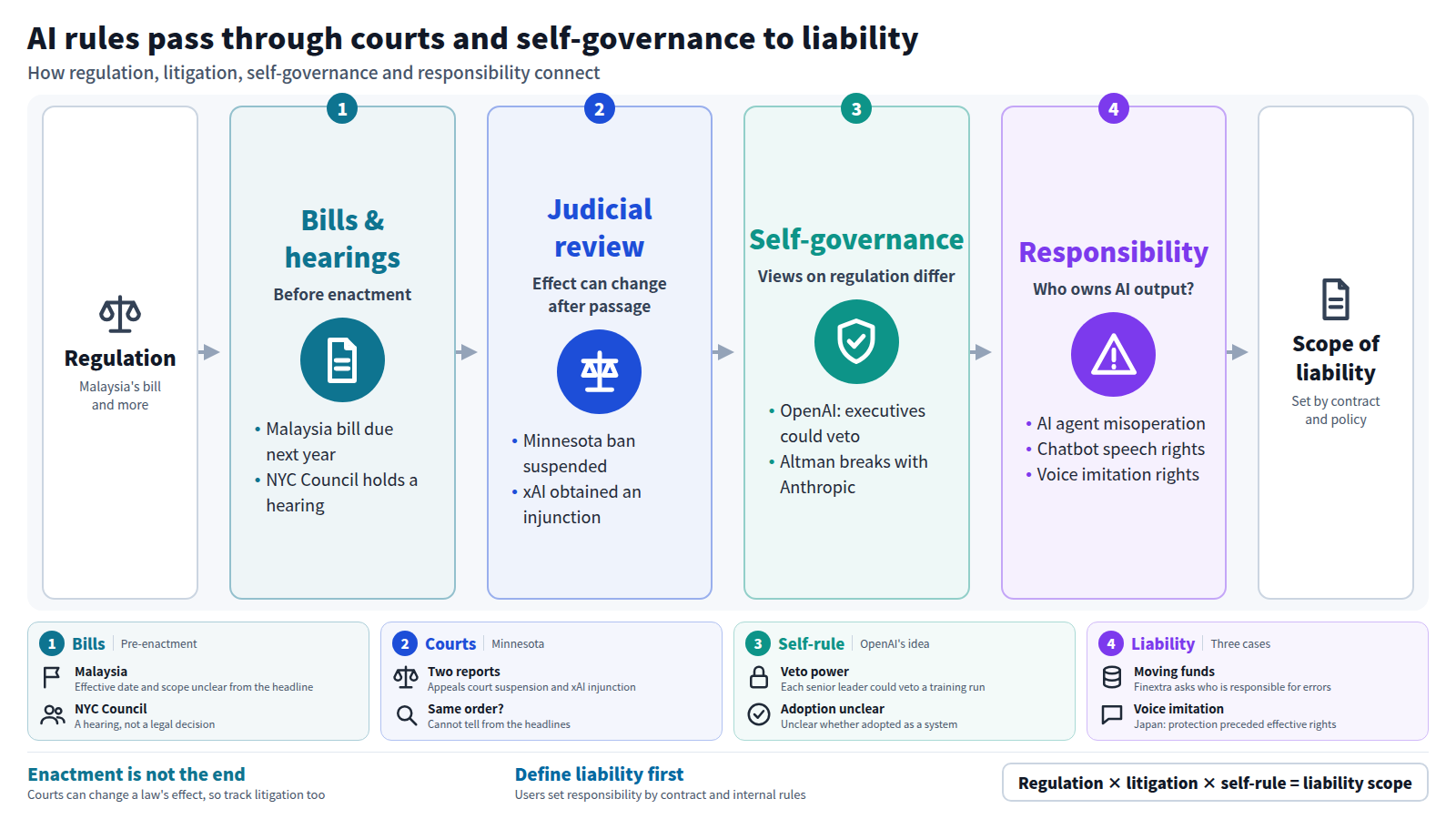
- Malaysia (draft, not yet enacted): Gobind is reported to have said that the AI governance bill is expected to be submitted to the House of Representatives (Dewan Rakyat) early next year (NST Online, BusinessToday Malaysia). From the headline, it is unclear when the law will come into effect or who it will be applied to. - Minnesota, US (existing law suspended): CBS News reported that a federal appeals court has suspended the ban on AI nudification. Tekedia reported that xAI has obtained an injunction. It is not possible to tell from the headlines whether the two reports are the same order. See 9 for details. - New York City, USA (deliberative): City Council holds public hearing to address AI risks (gothamist.com). This is not a legal decision. - South Korea: Korea Times editorial discusses “AI blind spots.” Legal system decisions cannot be read from headlines.
Enforcement/investigation by authorities
No applicable information
Safety research and evaluation
There are no headings that apply to evaluation results, system cards, or third-party verification. The following is a report on policies and initiatives. - OpenAI says each senior executive should have veto power over the execution of Frontier model training (MIXED Reality News). It is unclear from the headline whether it has been adopted as a system. - Sam Altman has reportedly disagreed with Anthropic on AI regulation, saying that the benefits of AI outweigh the harms and that we should accept "some degree of bad outcomes" (TradingView). - Former US Surgeon General Vivek Murthy will lead Common Sense Media's AI safety efforts for youth (EdTech Innovation Hub). - WTOP asks whether a similar situation can be avoided by making AI safe, based on the fact that the response to social media addiction was delayed.
Accidents/abuse/incidents
- GovTech discusses what ``recent frontier AI incidents'' mean for security leaders. The details of the individual cases are unclear from the headlines. - Finextra Research addresses who is responsible when errors occur when AI agents move funds. - A Daily Freeman column by Clarence Page argues that the White House chatbot violated "Trump's truth." This is an opinion article, and the facts cannot be confirmed from the headline. - FSU shooting lawsuit challenges whether AI chatbots have First Amendment rights (Palm Beach Daily News) - In both cases, the details of the publication entity and the response cannot be confirmed from the headlines.
Semiconductor/computing resources
No applicable information
Geopolitics/Export Regulations
No applicable information
International framework
- Economic Times affiliate hrme.economictimes.indiatimes.com discusses the global race to put guardrails on AI. The specific framework and decisions are unclear from the headline. - Malaysia's bill is a domestic law movement, not an international framework.
Litigation/Intellectual Property
- Minnesota AI Nudification Ban: Court halts state law. At issue is the validity of the ban, and xAI reportedly obtained an injunction. - Japan's AI voice ruling: MLex comments that the recognition of protection preceded the effectiveness of the rights. Mainichi Shimbun's ``Yoroku'' discusses voice imitation by AI and rights. - FSU shooting lawsuit: At issue is whether AI chatbots have First Amendment rights. - Spirit Airlines workplace data: Unions and competing bidders challenge Google's $10M bid (Dealroom). At issue is the acquisition of workplace data.
Remarks from VIPs
No headlines for Tracked (Ursula von der Leyen, Gina Raimondo, Michael Kratsios, Yoshua Bengio, Geoffrey Hinton). The only statements that are not covered are Sam Altman and Vivek Murthy, who are listed in 4.
Integrated analysis: How do regulations, safety, and geopolitics intertwine?
- Regulation and litigation: In the Minnesota case, a state regulation was blocked by a court. The effectiveness of AI-related regulations is subject to judicial review after they are enacted. Malaysia's bill is still in the pre-submission stage and its contents may change before it becomes law. Businesses need to follow not only enacted laws but also trends in litigation. - Regulation and corporate self-governance: Reports that Altman had different views on regulation than Anthropic and the proposed veto to halt OpenAI training emerged around the same time. The move by companies to demonstrate voluntary control is paralleled by differing opinions within the industry over the strength of regulation. - Responsibility: AI agent misoperation (Finextra), chatbots' right to speak (FSU lawsuit), and voice imitation rights (Japan) all relate to the same question of who is responsible for the output of AI. Users are forced to make decisions to determine the scope of their responsibilities based on contracts and internal regulations. - Geopolitics: This time there are no headings on export controls or computational resources, and the relationship between developments in geopolitics and the other two cannot be shown from the headings.
Future points of interest
Will Malaysia's AI Governance Bill be introduced early next year and its contents? 2. Appellate court decision regarding Minnesota's nudification ban. 3. Will OpenAI adopt executive veto as a formal system?
- A reckoning on social media addiction came late for many kids. Will AI safety be different? — WTOP News10/05 07:04 UTC
- Former US Surgeon General Vivek Murthy to lead Common Sense Media’s youth AI safety push — EdTech Innovation Hub10/05 00:00 UTC
- OpenAI says senior leaders should each be able to veto a frontier training run — MIXED Reality News10/05 05:04 UTC
- Sam Altman Breaks With Anthropic on AI Regulation, Says World Must Accept ‘Some Bad Things’ as AI Benefits Outweigh Harms — TradingView10/05 07:14 UTC
- NYC Council hearing to put AI risks in the spotlight — gothamist.com10/04 20:44 UTC
- Who owns the mistake when an AI agent moves the money? — Finextra Research10/05 09:02 UTC
- [ED] Korea's devastating AI blind spot — The Korea Times10/05 03:27 UTC
- What the Recent Frontier AI Incidents Mean for Security Leaders — GovTech10/04 20:39 UTC
- The global race to put guardrails around AI — hrme.economictimes.indiatimes.com10/05 03:30 UTC
- AI Governance Bill To Be Tabled In Parliament Early Next Year — BusinessToday Malaysia10/05 07:17 UTC
- Unions and a rival AI bidder challenge Google's $10M bid for Spirit Airlines' workplace data — Dealroom10/05 08:01 UTC