AI & Education News — 2026-10-03 (Sat) Daily News
Source links point to the original outlet. The AI Integrated Analysis is auto-generated from the headlines below only and is not intended to add facts beyond them. Not investment advice.
Overview
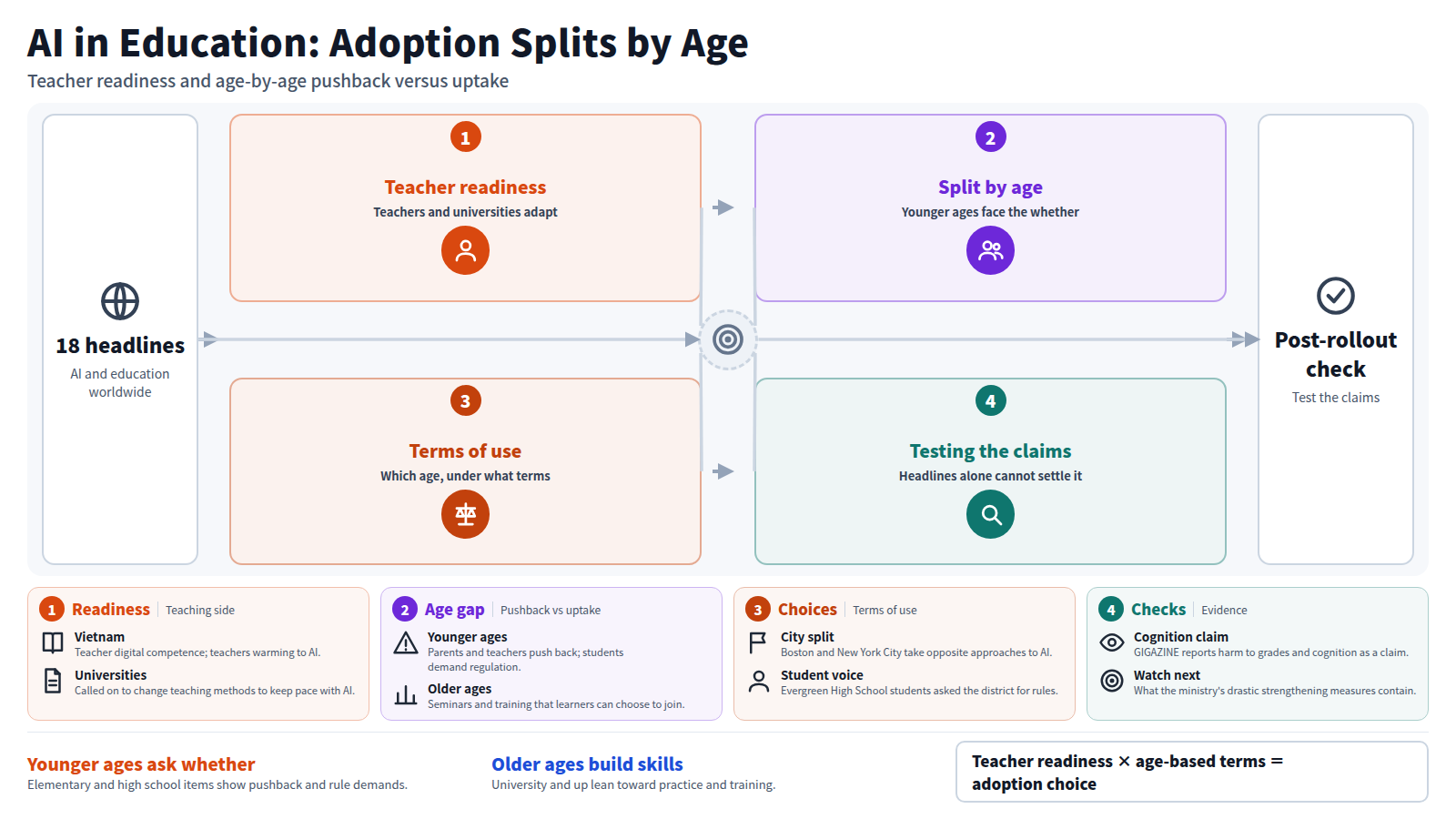
- In the section on elementary and high school students, headlines featured opposition from parents, teachers, and students to the introduction of AI, as well as demands for regulation. - In the sections for junior high school students, university students, adults, and old age, the focus was on developing AI skills, such as teacher training, class practice, and seminars. - There is only one commentary article on early childhood education, and the content of the movement cannot be gleaned from the headline.
AI Literacy
- The participation report of the international summit "Raspberry Fields" has been published. More than 200 people from 45 countries, including Japan, gathered in Cambridge, UK to discuss the future of children and AI education (Infoseek). - In Japan, the disclosure of the above report falls under this category. The contents of the report (recommendations and conclusions) are not listed in the heading and cannot be confirmed.
Early childhood education
- Fortune India published an article titled ``Debate over AI in the classroom: Be careful and keep it in context.'' The target age group and specific examples are unclear from the headline, and it is not possible to confirm the implementation details directly related to young children. - No applicable information in Japan.
Elementary school students
- GIGAZINE reported that as Google's AI permeates school education, there is growing opposition from parents and teachers who say it is having a negative impact on children's cognitive functions and grades. Whether or not there is an adverse effect is a media claim, and it is not possible to confirm causality or extent from the headline. - In Vietnam, an international conference on AI in education addressed the opportunities and challenges of digital competency for teachers. Tuong Mai District also integrated digital skills and AI during Lifelong Learning Week (Vietnam.vn). The latter is a report on implementation, but the effects are not in the headlines. - No relevant information in Japan (GIGAZINE's article is in Japanese, but the target country cannot be identified from the headline).
Junior high school students
- It was reported that teachers in a mountainous region of Vietnam (Laizhou) are working to familiarize themselves with AI and develop AI skills through classroom practice (Vietnam.vn). In both cases, the focus is on teachers' familiarization and classroom practice, and the effects on students cannot be confirmed. - In Japan, a headline on facta.co.jp states that the Ministry of Education, Culture, Sports, Science and Technology has come up with ``drastic reinforcement measures,'' and that technical colleges are talking about the social implementation of robots and AI. The content and targets of the reinforcement measures are not listed in the heading, and it is difficult to tell whether they are in the planning stage or have already been implemented.
high school student
- Students at Evergreen High School in Oregon, US, asked the school district to regulate AI in the classroom. The complaint is "Pencils, not prompts," and as it is still at the request stage, we cannot confirm the school district's response (KGW). - Boston and New York City have diametrically opposed policies on AI in schools (GovTech). It is unclear from the headline which policy is which. - In Japan, information has been released for high school teachers across the country about a service that automates everything from converting handwritten notebooks into AI data to coordinating career guidance (news.nicovideo.jp). The idea is to create a portfolio of daily records, but we cannot confirm the implementation results or effects. Additionally, the Sanyo Shimbun has a project to find ``the possibilities of data and AI and personal options'' in Hiroshima. There are no details in the heading.
university student
- In Vietnam, some argue that universities need to change their teaching methods to keep pace with advances in AI (Vietnam.vn). This is a recommendation, and implementation cannot be confirmed. - In Japan, 31 students from Nagasaki University used generative AI to create a comic about themselves in 5 years (news.nicovideo.jp). This is a report on the implementation, but the learning effects are not mentioned in the headline. Additionally, the president of the United Nations University is scheduled to give a lecture in Naha on the 8th on "SDGs in the age of AI" (Okinawa Times). This is a plan and is yet to be implemented.
adult
- "FPT TRANSFORM 2026" was introduced in Vietnam as an opportunity to experience AI technology practically (Vietnam.vn). - In Japan, a design seminar to decipher AI design issues is scheduled for October 26th (Monday) (news.nicovideo.jp). It is still in the planning stage.
Old age
- In Japan, BEYOND AGE conducted training at the "Generative AI Practical Seminar that you can put into practice today" sponsored by the Hiroshima Industrial Promotion Organization (Infoseek). It is not possible to confirm the age range of the participants or their achievements from the headlines. It is unclear whether the fact that it is classified under the section of old age can be accepted as is. - No applicable information overseas.
Remarks from VIPs
Headlines regarding Sal Khan (founder of Khan Academy) are not within the scope of this collection, and there is no relevant information.
Integrated analysis: How is lifelong learning changing?
common movements - From elementary school students to university students, the composition of ``teachers and educational institutions being forced to take action'' overlaps. Headlines in Vietnam include teachers' digital abilities (elementary school students), teachers' AI proficiency (middle school students), and changes in university teaching methods (university students), all of which highlight the preparation of teachers as an issue. - For adults and senior citizens, short-term opportunities such as seminars and training are the main focus, and the headline shows that learners choose to participate on their own.
Different movements depending on the age - For elementary and high school students, opposition to the introduction and demands for regulation are in the headlines (parent/teacher opposition, students demanding regulation, policies divided by city). On the other hand, for university students and beyond, there are many headlines that encourage experience and utilization. The younger the age group, the more questions are asked about the pros and cons of introducing the system itself. However, this trend is based on the number of headlines and cannot be generalized. - High school students in Japan are moving toward using AI for recording and career support, such as career guidance and portfolios.
Points where judgment changes - Teachers are required to judge not only whether or not to use AI, but also in which age group and under what conditions. The divergence of policies in Boston and New York City is an example. - Those who learn are also in a position to give their opinions on decisions about how to use the product, just as high school students asked for regulations. - Claims about negative effects or effectiveness cannot be verified based on headlines alone. Post-implementation confirmation is necessary as a basis for judgment.
Future points of interest
The content of the "Raspberry Fields" report and whether it is reflected in Japan's policies. 2. The specific details of the Ministry of Education, Culture, Sports, Science and Technology's "drastic reinforcement measures" and the implementation status for junior high school students and technical colleges. 3. How U.S. school districts respond to regulatory demands and whether there is research to support claims about children's cognitive function and performance.
- Report Published on Raspberry Fields International AI and Education Summit in Cambridge — Infoseek10/02 14:40 UTC
- The AI in classrooms debate: Pay heed but stay contextual — Fortune India10/02 13:35 UTC
- Parents and Teachers Push Back as Google AI in Schools Is Linked to Harm to Children's Cognition and Grades — GIGAZINE10/02 10:00 UTC
- International Conference on AI in Education: Opportunities and Challenges in Teachers' Digital Competence — Vietnam.vn10/02 09:34 UTC
- Tuong Mai Ward Integrates Digital Skills and AI Into Lifelong Learning Week — Vietnam.vn10/02 11:22 UTC
- Ministry of Education, Culture, Sports, Science and Technology's "drastic strengthening measures" / "Flying dreams" technical college power / Robots and AI social implementation — facta.co.jp10/02 16:02 UTC
- Teachers in Mountainous Lai Chau Get Familiar With AI — Vietnam.vn10/02 09:34 UTC
- Building AI Skills Through Classroom Practice — Vietnam.vn10/02 10:31 UTC
- Evergreen High School students demand AI regulation in classrooms from district: 'Pencils, not prompts' — KGW10/03 06:16 UTC
- Boston and New York City Take Opposite Approaches to AI in School — GovTech10/02 16:13 UTC
- For High School Teachers Nationwide: Automating Handwritten Planner AI Digitization Through Career Guidance Coordination — news.nicovideo.jp10/03 08:00 UTC
- Discovering Data and AI Possibilities and "Choices That Fit Me" in Hiroshima — Japanese media10/02 19:13 UTC
- Naha to Host UN University Rector Lecture on SDGs in the AI Era on the 8th — Japanese media10/02 18:58 UTC
- “Is there anything you want to do?” 31 students from Nagasaki University used generative AI to create a comic about themselves in 5 years — news.nicovideo.jp10/03 03:30 UTC
- Universities Must Change Teaching Methods to Keep Pace With AI Advances — Vietnam.vn10/02 23:25 UTC
- Let's think together about what's wrong with this design! We will also understand the challenges of AI design!! 10/26 (Monday) Popular seminar “Ko — news.nicovideo.jp10/03 08:45 UTC
- FPT TRANSFORM 2026: A Chance to Experience AI Technology in Practice — Vietnam.vn10/02 23:55 UTC