AI & Economy News — 2026-10-04 (Sun) Morning News
Source links point to the original outlet. The AI Integrated Analysis is auto-generated from the headlines below only and is not intended to add facts beyond them. Not investment advice.
Overview
The view that AI-related spending is supporting the US economy has come to the fore. Reid Hoffman was quoted as saying, "The AI boom is the only reason we are avoiding recession" (Startup Fortune, trendingtopics.eu). On the other hand, households are using home equity and AI to maintain spending, and the support for the economy is biased toward AI investment (Yahoo! Finance Canada). Tensions over power and data center locations are also growing (seattletimes.com, Business Insider).
Macroeconomic/growth trends
Reid Hoffman says AI spending is the only thing keeping the US out of recession (Startup Fortune). In a similar statement, it was reported that the AI boom is the "only reason" there is no recession (trendingtopics.eu). The headline ``Cash-Strapped Americans'' shows how cash-strapped Americans continue to spend using home equity and AI (Yahoo! Finance Canada). Trump's Super Intelligence Summit, AI Safety Accord, GDP Beats, and Midterm Predictions were listed as topics, but only the headlines and no details are available (finance.biggo.com). Minneapolis Federal Reserve Bank President Kashkari appears to have said that things other than AI-related factors are also boosting the U.S. economy (TBS NEWS DIG).
Productivity trends
Some commentators say that AI has changed the meaning of "productive" (inc.com). There are reports that while the use of AI may increase productivity, it may impair mental abilities such as thinking ability (Nacionale News). In the UAE, 65% of workers are concerned about being easily replaced by AI, according to a Workday survey (Fast Company Middle East). In retail, there is an article (Substack) that discusses the relationship between grocery stores implementing AI and consumers on a budget.
Trends in employment and labor market
California has a new law that addresses workers' biggest concerns about losing their jobs to AI (The Guardian). It introduces 10 jobs that are unlikely to be replaced by AI, including jobs with six-figure annual incomes (Yahoo Creators). There are no specific figures for layoffs or hiring in the headlines.
Trends in energy/power demand
Amazon pledges $1B in data center investments, highlighting growing tensions over AI construction (seattletimes.com). Consulting firms point out that electricity demand may continue to increase even as AI becomes cheaper (Business Insider). There are no specific measures for power transmission grid or power generation investment in the headlines.
Remarks by central banks, international organizations, and VIPs
The IMF noted that the rapid adoption of AI will facilitate Kazakhstan's integration into international value chains (trend.az). Minneapolis Federal Reserve Bank President Kashkari appears to have said that things other than AI-related things are also boosting the U.S. economy (TBS NEWS DIG). Statements by Christine Lagarde, Bank of Japan Governor Kazuo Ueda, Andrew Bailey, Kristalina Georgieva, Mathias Cormann, Ajay Banga, Daron Acemoglu, and Erik Brynjolfsson are not found in this headline.
Trends in corporate capital investment
Dell Technologies (DELL) has joined Japan's $15 Billion AI data center business (Yahoo Finance). Nvidia cites five reasons for AI-Factory's profitability (FourWeekMBA). Amazon's $1B data center investment is another example of increased capital spending (seattletimes.com).
Trade and industrial policy
In Japan, the digitalization/AI introduction subsidy (formerly IT introduction subsidy) is said to be a maximum of 4.5 million yen, a subsidy rate of 1/2 to 4/5, and an acceptance rate of 44% (subsidy portal). In the US, Trump's Super Intelligence Summit and AI Safety Accord became a hot topic (finance.biggo.com). There are no headings regarding customs duties or export regulations.
Integrated analysis: What is happening now
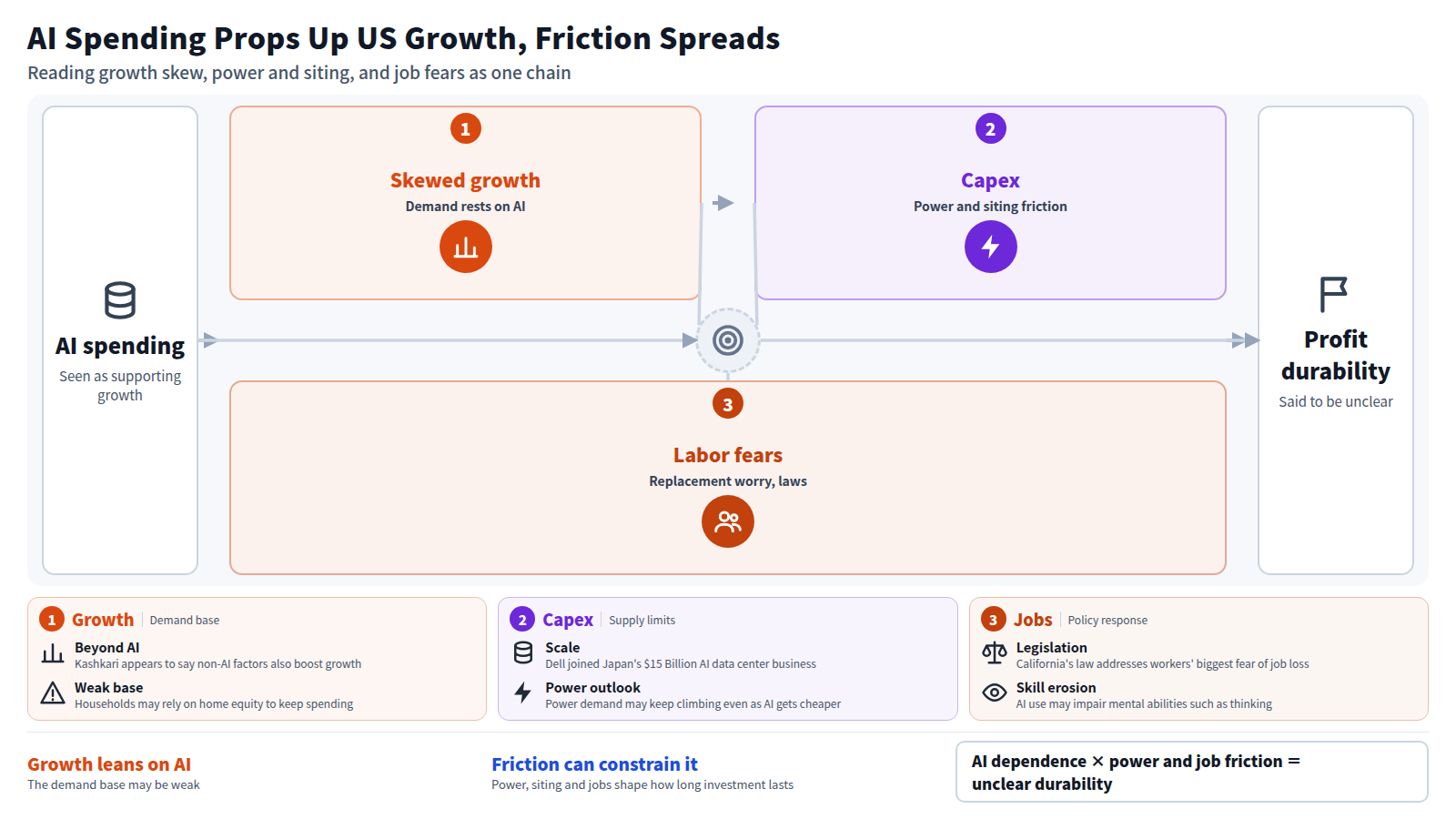
Growth appears to be highly dependent on AI investment. Hoffman's comments, combined with reports that households are using home equity to maintain spending, suggest that the demand base may be weak (Startup Fortune, Yahoo! Finance Canada). Capital investment (Dell, Nvidia, Amazon) is creating friction between electricity demand and regions, and increased investment may directly lead to supply constraints and location issues (Yahoo Finance, Business Insider, seattletimes.com). On the labor side, concerns about substitution are spreading, and policy responses such as California's legislation have begun (The Guardian, Fast Company Middle East). The sustainability of profits is unclear, with both productivity improvements and capacity declines being pointed out (Nacionale News).
Future points of interest
① How much will the slowdown in AI investment affect US growth? ② Will data center power demand and local opposition constrain investment plans? 3) Will employment protection legislation spread to other regions?
- Cash-Strapped Americans Tap Home Equity and AI to Keep Spending — Yahoo! Finance Canada10/03 14:00 UTC
- AI Just Changed What ‘Productive’ Means — inc.com10/03 17:21 UTC
- Your Grocer Has AI. You Have a Budget. Guess Who’s Winning. — Substack10/03 13:34 UTC
- AI Usage Boosts Productivity but May Harm Our Mental Skills — Nacionale News10/03 11:33 UTC
- 65% of UAE workers fear AI could make them replaceable, finds Workday — Fast Company Middle East10/03 13:22 UTC
- Worried AI could replace your job? These 10 careers are among the safest — and some pay six figures — Yahoo Creators10/03 15:28 UTC
- Consulting firms say that as AI gets cheaper, power demand could keep climbing — Business Insider10/03 09:59 UTC
- Rapid AI adoption to boost Kazakhstan’s global value-chain integration - IMF — trend.az10/03 10:52 UTC
- NVIDIA Cites Five Sources for AI-Factory Returns — FourWeekMBA10/03 13:28 UTC
- What is the digitalization/AI introduction subsidy (formerly IT introduction subsidy)? Up to 4.5 million yen, subsidy rate 1/2 to 4/5, acceptance rate 44% [Latest October 2026] — 補助金ポータル10/03 07:43 UTC
- Pushing up the U.S. economy in ways other than AI-related things - Minneapolis Fed President Kashkari Photo Gallery | TBS CROSS DIG with Bloomberg — TBS NEWS DIG10/03 09:44 UTC