AI Ethics News — 2026-10-04 (Sun) Evening News

Source links point to the original outlet. The AI Integrated Analysis is auto-generated from the headlines below only and is not intended to add facts beyond them. Not investment advice.
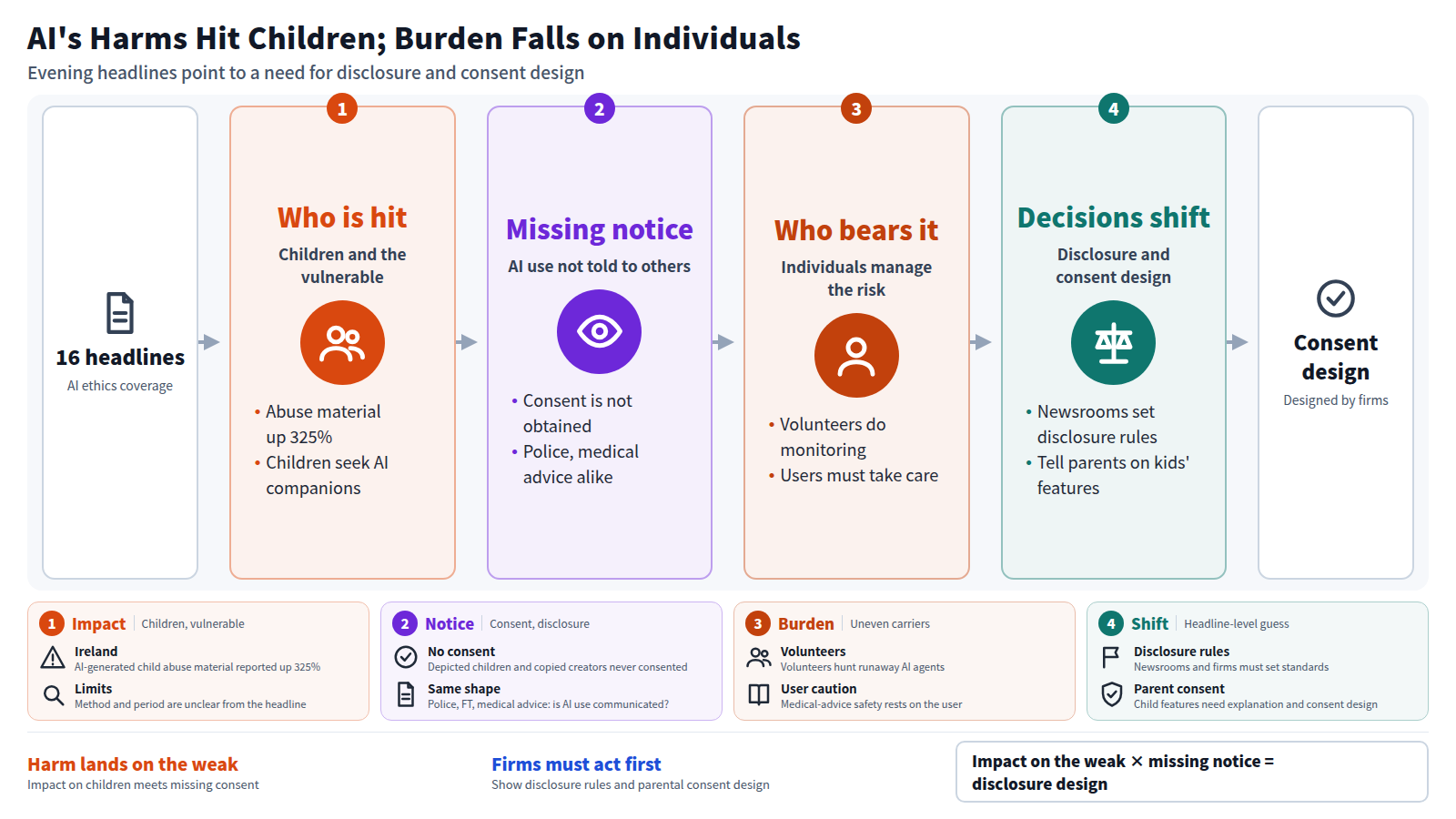
Overview
- The impact on children and vulnerable people (reliance on AI, increase in AI-generated child sexual abuse material) and disclosure and accountability of AI use have come to light. - An open letter from a citizen group calling for AI governance centered on human rights and a movement by individuals to search for runaway AI agents were reported.
Bias, discrimination, fairness
- 1 article (The Journal News | lohud.com) addressing accountability in police AI support training. - From the headline, it is not clear who was disadvantaged, how it was measured, or the scale. The only fact that can be confirmed is that the use of AI in police training is being considered from the perspective of accountability.
Privacy/Monitoring
- Apple reportedly strengthened user data protection in macOS to counter risks from AI apps. The specific content of the protection and the target data are not clear from the headline. - It was reported that WhatsApp will undergo changes for teenage users and parents related to group features and AI (Il Sole 24 ORE). It is not clear from the headline how consent is obtained or how the data is used.
Transparency/Accountability
- There is an article by the editorial department of the Financial Times that deals with the criteria for disclosing the use of AI (Bioengineer.org. *In terms of classification, it also relates to ethical principles and guidelines). - MAP-AI's open letter (Association for Progressive Communications) calls for putting human rights at the center of AI governance. - The Washington Post reports volunteer investigators searching for a runaway AI agent. The point of contention is that the entities responsible for accountability are volunteers, rather than business operators or authorities. - There is an article (The Columbus Dispatch) explaining how to safely use AI in medical consultations. It appears that the focus is on caution on the part of users rather than information disclosure on the AI side. - The specific details of what has been disclosed and what has not been disclosed cannot be confirmed from the headline.
Creator/Copyright/Consent
- An article on Vietnam.vn asks what measures creators can take to protect their rights when AI-generated content is copied. The parties are the creator and the copyer, and the issue is the means of protecting rights.
False information/deep fake
- ABC7 Los Angeles reported that Lyft drivers are "accused" of using AI-generated images to file damage claims. The fact of fraud was not confirmed at the headline stage. - RSVP Live reports a new documentary reveals a 325% increase in AI-generated child sexual abuse material in Ireland. Figures are based on reports cited in the article. The calculation method and period covered are not clear from the headline. - The details of the measures cannot be confirmed from these headings.
Protection of children and vulnerable people
- South African children want AI to talk to (news24.com). The dangers of isolation and dependence can be an issue, but it's not clear from the headlines who has taken action. - In Ireland, an increase in AI-generated child sexual abuse material was reported (see above). The victims are children. - Softbank provides an AI service for teachers to support children with difficulties (asahi.com). This is an example of a company taking action, but the handling of children's data and consent cannot be understood from the headline. - EL PAÍS English argues that key leaders in the AI industry are like children who are afraid of bullies. This is a commentary by the paper, not a report of fact.
Ethical principles and guidelines
- Determined: Nothing that can be confirmed. - Proposal: MAP-AI's open letter (Association for Progressive Communications) calls for human rights-centered AI governance. - Case study: The Financial Times was reported to have its editorial department determining the criteria for disclosing the use of AI. - Anthropic has invited Hindu monks to discuss AI ethics, NDTV reported. It is difficult to tell from the headline whether there is a conclusion or agreement.
Japanese AI ethics
- An editorial in the Kyoto Shimbun (Yahoo! News) calls for the use of generative AI in universities to enrich learning through appropriate use. This is the editorial's claim. - The Fact Check Center (JFC) published an article and video about online fraud using generative AI as this week's Fact Check. The number and methods of fraud cannot be determined from the headlines. - Softbank's AI service for teachers (mentioned above) is also a domestic movement.
Remarks from VIPs
Headlines regarding the tracked targets Timnit Gebru (DAIR, AI ethics researcher), Fei-Fei Li (Stanford HAI, AI researcher), and Yoshua Bengio (AI safety researcher) are not included in this input. No applicable information.
Integrated analysis: How do ethical questions fit together?
- Lack of consent: AI-generated child sexual abuse material lacks the consent of the depicted child. In articles about creator's rights, the issue is the consent of the person being copied. Changes to WhatsApp for teenagers also seem to call into question the design of consent. - Lack of explanation: Police training, AI agents, FT disclosure decisions, and medical consultations have the same structure of whether the facts and limitations of AI use are communicated to the other party. - Where the burden lies: Volunteers are responsible for monitoring the AI agent, and ensuring the safety of medical consultations is left to the user's attention. The headline suggests that individuals, not businesses, are responsible for risk management. - Points where decisions will change: News organizations and businesses will need to establish standards for disclosure of AI use. Companies that release features aimed at children are required to provide explanations and consent to their designs from parents. Users need to be prepared for situations in which the authenticity of evidence images is questioned, in light of cases where fraudulent use of AI-generated images is suspected. All of these are speculations based on the headlines and need to be confirmed in the main text.
Future points of interest
What measures will businesses and related organizations take in response to the increase in AI-generated child sexual abuse materials? 2. Can monitoring of runaway AI agents be shifted from relying on volunteers to accountability on the part of operators? 3. How consent and data handling will be disclosed for AI features for children (WhatsApp, services for teachers, AI as a conversation partner).
- Police Praxis™ Examines the Accountability Behind AI-Assisted Police Training — The Journal News | lohud.com10/02 11:56 UTC
- Apple strengthens user data protection on macOS to counter the risks posed by AI applications — صوت الإمارات10/04 05:54 UTC
- Groups, privacy and artificial intelligence: how WhatsApp is changing for teenagers and parents — Il Sole 24 ORE10/02 09:45 UTC
- How to safely use AI for health advice — The Columbus Dispatch10/04 09:02 UTC
- MAP-AI Open Letter: Centering human rights in AI governance — Association for Progressive Communications10/02 14:05 UTC
- The volunteer internet sleuths hunting down rogue AI agents — The Washington Post10/02 16:00 UTC
- Lyft driver accused of using AI-generated image in damage claim — ABC7 Los Angeles10/03 23:53 UTC
- AI child sexual abuse material in Ireland has increased by 325%, new doc reveals — RSVP Live10/02 10:36 UTC
- AI’s top leaders, like children afraid of a bully — EL PAÍS English10/04 04:00 UTC
- SA children turn to AI for companionship — news24.com10/04 02:36 UTC
- SoftBank offers AI service for teachers to help troubled children — asahi.com10/03 22:00 UTC
- Inside the Financial Times: How One Newsroom Decides When to Reveal Its Use of AI — Bioengineer.org10/04 06:28 UTC
- Why Anthropic Invited A Hindu Monk To Discuss AI Ethics — NDTV10/03 02:46 UTC
- Editorial: Universities and generative AI: Appropriate use for enriching academic research (Kyoto Shimbun) — Yahoo!ニュース10/04 07:00 UTC
- What steps can creators take to protect their rights if AI-generated content is copied? — Vietnam.vn10/04 04:58 UTC
- Online fraud using generated AI/JFC articles/videos and related articles [This week's fact check] — factcheckcenter.jp10/04 01:40 UTC