1. Remembering the history is not the same as understanding the situation
An LLM agent opens files, runs searches, executes commands, reads the results and decides on its next step. The longer the task, the longer the record of these exchanges. Most systems either keep that record in context, summarize it to save space, or store it in an external memory and retrieve pieces when needed.
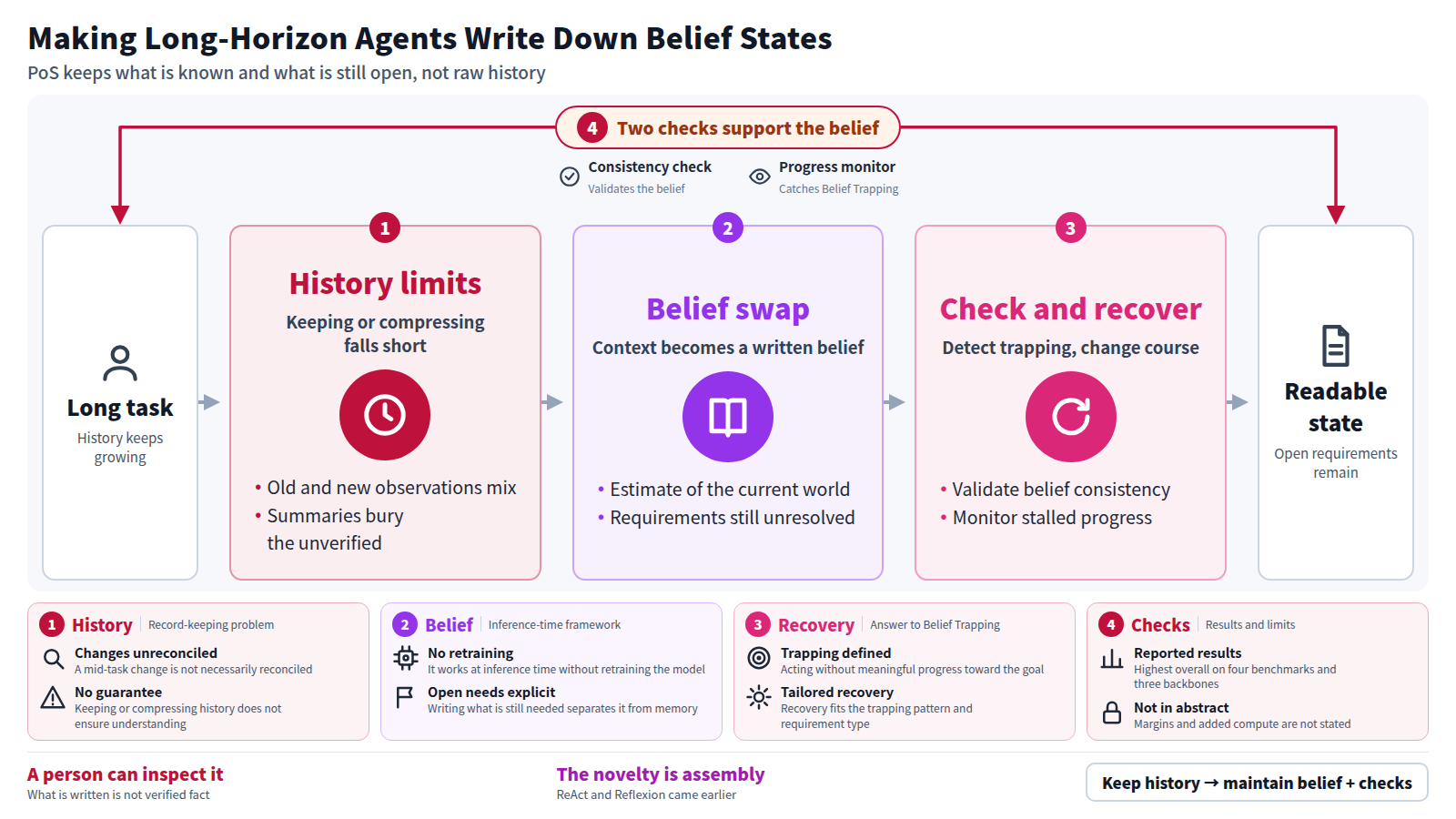
The authors argue that this kind of record-keeping does not ensure a coherent understanding of the current world. Old and new observations sit side by side; when the situation changes mid-task, the change is not necessarily reconciled. A summary is shorter, but what is already settled and what remains unverified tends to get buried inside it.[1]
Put in operational terms: a thicker work log does not mean the person doing the work can say, at any given moment, how far they have got and what they still need to check. The paper tries to give the agent an explicit representation of exactly that. The primary source is an arXiv preprint and has not yet been through peer review.
2. The core idea: maintain the decision context as a belief
PoS operates at inference time and does not require retraining the model. Its core can be stated in one sentence: replace the context the agent consults when choosing its next action, swapping raw history for an explicitly written belief state, and keep maintaining that belief throughout the task.
Each belief has two parts. One is an estimate of the current world state. The other is the task requirements that are still unresolved. The first says what is known now; the second says what the agent still needs to learn and accomplish. Making the second part explicit is what separates this approach from memory management.
Writing beliefs down does not by itself stop an agent from acting on a wrong belief. PoS therefore adds two checks: it validates the consistency of the belief, and it monitors task progress. The progress monitor is designed to catch what the authors call Belief Trapping, a state in which the agent keeps acting without making meaningful progress toward the goal. Once trapping is detected, recovery is tailored both to the trapping pattern and to the type of unresolved requirement.
3. What the abstract reports
The evaluation covers four benchmarks spanning execution and diagnosis tasks, with three LLM backbones. The authors report that PoS achieves the highest overall performance on every benchmark with every backbone. The abstract does not name the baselines or give the size of the margins.
Ablation experiments, which remove components one at a time, are said to show that consistency validation and recovery both matter. Context-scaling experiments are said to show resilience as the context grows.
From these results the authors argue that building and continually maintaining beliefs is a foundation for long-horizon context management that goes beyond retaining and compressing history. That claim rests on the experimental conditions of this paper: four benchmarks and three backbones. Whether it holds when the task definition itself shifts mid-way, as real work often does, cannot be determined from the abstract.
4. A worked example: a literature review split across several sessions
Consider an agent asked to reconcile published literature on a drug's safety with the revision history of its package insert, over several working sessions. The agent reads search results, finds conflicting statements and looks for further material, and the loop runs for a long time.
Accumulate and summarize history
Papers read and searches run pile up in context and get summarized when they grow too long. The summary lists that paper A was read and that the insert revisions were checked, but the fact that the two disagree, and that the disagreement is still unexplained, is easily lost inside a sentence. The agent repeats the same kind of search with different wording. Work appears to continue, yet the question has not moved.
Maintain a belief state
At the center of the context are two separate entries: a world estimate, such as the facts confirmed from the revision history, and an unresolved requirement, such as the absence of any source that explains the conflict between paper A and the insert. If repeated searches do not shrink the unresolved requirement, the progress monitor flags Belief Trapping and the agent switches to a recovery suited to that requirement, for example turning to a different kind of source.
The point of the comparison is that, on the right, what is still unknown remains in a form a person can read. That does not guarantee the output is correct, but it gives a reviewer something concrete to check mid-task.
5. What is not new, and what the abstract does not settle
Interleaving reasoning and action and accumulating the trace in context has been the basic pattern since ReAct.[5] Reflecting on failures in natural language, storing the reflection and using it on the next attempt was shown earlier in work such as Reflexion.[6] The term belief state has long been used in research on decision-making under uncertainty. The contribution of PoS can be read as assembling these elements, together with explicit unresolved requirements and the detection of and recovery from stalled progress, into an inference-time approach to context management.
The limitations are clear. First, the abstract does not name the four benchmarks or the three backbones, so the difficulty of the comparison is unknown. Second, the size of the advantage behind the highest overall performance is not stated. Third, building and validating beliefs must cost extra inference, but the abstract gives no figures for added compute or latency. Fourth, it does not say how far consistency validation catches a belief that was written incorrectly in the first place.
The implementation is public as a repository.[2] On the paper-sharing page it has 77 upvotes and 3 comments, and the GitHub repository has 22 stars.[3] These numbers indicate attention, not correctness. No independent reproduction has been found yet.
6. Why this theme is forming a cluster now
In this collection run, the paper was selected as the representative of a cluster of size 2. Two signal families were raised, reader votes and cluster thickness. Both measure how much attention a topic is getting; neither measures importance or validity.
The other paper in the cluster proposes decision-aligned on-policy distillation for long-horizon agents.[4] Its title speaks of going beyond timestamps, while PoS speaks of going beyond memory. One approaches the problem from training, the other from inference-time context management, but both ask what an agent should rely on when it makes decisions deep into a long task.
The cluster's keywords include long-horizon, belief, memory and decision-aligned. Read together, the two papers suggest that the problem of long-horizon agents is shifting from how much context or memory they hold to how they keep a sound basis for decisions. With only two papers, though, it is too early to say whether this becomes a sustained theme.
7. Where this connects to pharmaceutical and regulatory work
The first connection is readability of records. Pharmaceutical work expects that the course of an activity can be reconstructed and checked by a person afterwards. A long history or a compressed summary may contain plenty of material yet make it hard to see what was established and what was still unverified at a given point. Keeping confirmed facts and open requirements apart, as a belief state does, points in the direction that requirement asks for.
The second is how an agent stops. An agent that keeps acting without progress wastes money and also fills the record with meaningless repeated searches and operations. Detecting Belief Trapping and changing course is a useful reference when designing business agents that change approach once they judge they are stuck, and hand the task back to a person if that still fails.
Whether the content of a belief state is correct is a separate matter. Given that this is a preprint, what an agent writes down as known cannot be treated as verified fact. Being inspectable is not the same as being right, and it is no reason to skip the inspection.