AI, Welfare & Long-term Care News — 2026-10-05 (Mon) Morning News

Source links point to the original outlet. The AI Integrated Analysis is auto-generated from the headlines below only and is not intended to add facts beyond them. Not investment advice.
Overview
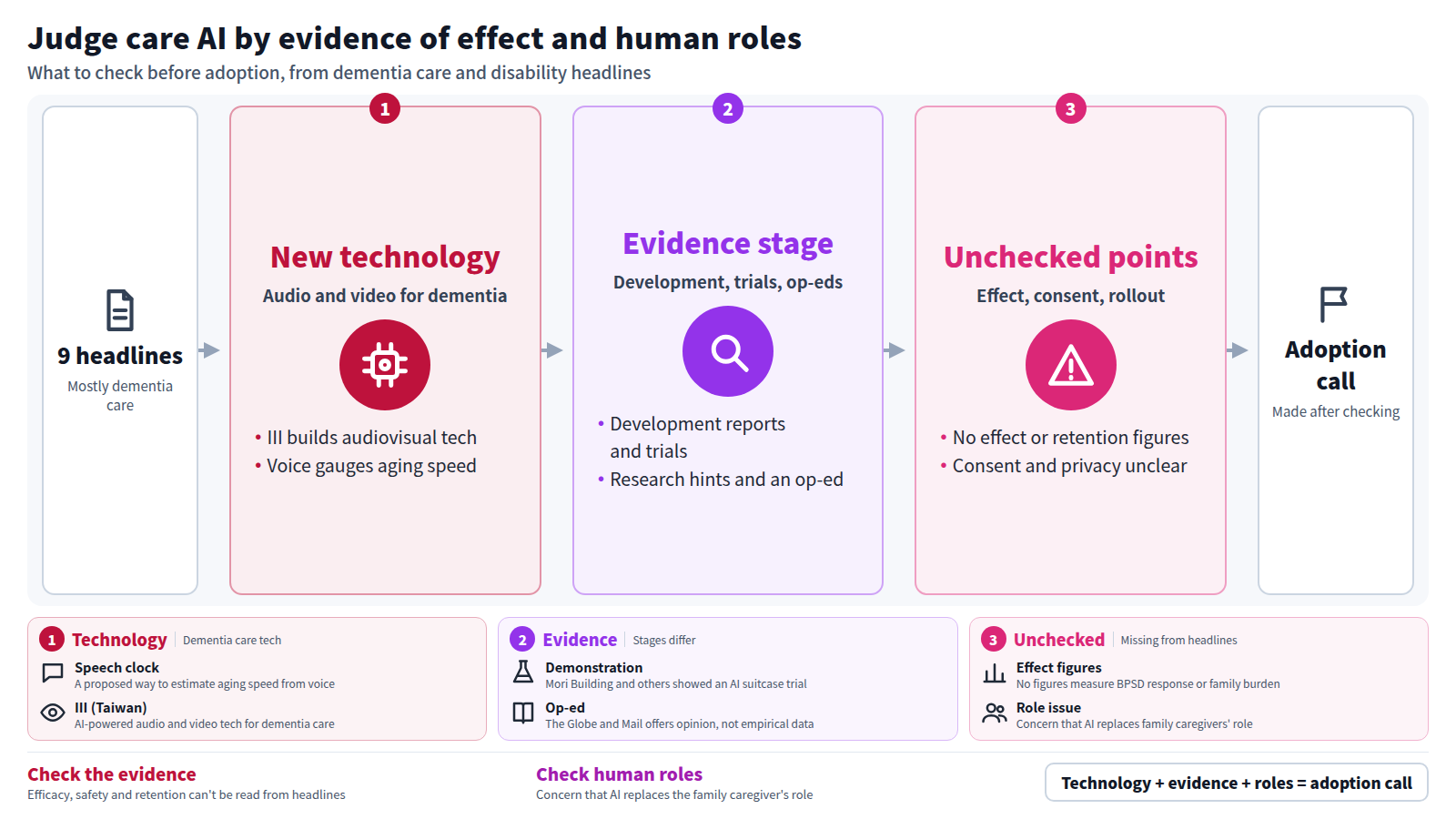
- There are only 9 headlines, and the focus is on dementia care technology (audio/video) and AI governance theory for disability welfare. There are few headlines that show the movement of systems and personnel. - In Japan, there is only one demonstration of mobility support for visually impaired people, and there are no headings regarding records, billing, and staffing at nursing care sites. - No figures indicating effectiveness or retention are given in any headings.
AI in nursing care settings
- There are no headings regarding operational efficiency (records, billing, shifts, care plans), and there is no information indicating reduced time or personnel. - Only one headline could be related: the postponement of the "AI Workforce Webinar" by the US long-term care provider association AHCA/NCAL. Other than the indication that it has been postponed, the contents (details of the theme, reason for postponement, new schedule) are not clear from the headline.
Labor shortage and workers
- There are no headings regarding staffing standards, turnover, or foreign personnel. - It is suggested that the above AHCA/NCAL webinar (with Workforce in the title) was scheduled to cover workers and AI, but the content is unclear. - Regarding the issue of the role played by caregivers, there is an editorial in The Globe and Mail (see 4 below).
Dementia care
As far as can be seen from the headings, all of these are related to detection, evaluation, and care support, and do not indicate the establishment of a diagnosis or the effectiveness of treatment. - UCLA "Putting AI to the test for Alzheimer's and dementia": An initiative to test AI for Alzheimer's disease and dementia. It is unclear from the headline what will be verified and the level of evidence. - Live Science "AI 'speech clock': Voice may indicate speed of aging": Proposal of a method to estimate the speed of aging from voice. It is an expression of "suggests" and refers to findings at the research stage. There is no relationship between the detection and diagnosis of dementia in the heading, and detection and diagnosis need to be treated separately. - Focus Taiwan (CNA): Taiwan's III develops AI-powered audio and video technology for dementia care. This is a development report, and there are no headlines about its effectiveness in the field, the number of facilities in which it has been introduced, or how it deals with consent and privacy. The proof appears to be in the development stage (nearly the prototype stage), but details are unknown. - The Globe and Mail (op-ed): Opinion that AI robots will tempt caregivers of family members with dementia to "back off." Raising concerns about the role of family caregivers and AI replacement through editorial rather than empirical data. - There are no headings that show numerical values measuring the response to BPSD and the reduction in the burden on families.
Home care/monitoring
- There are no headings regarding sensors, fall detection, or remote monitoring, and there is no information about false alarms or oversights. - The above Globe and Mail editorial touches on the relationship between AI robots and home-based family care, but it is unclear from the headline whether it deals with aspects of the accuracy and monitoring of the monitoring equipment.
Care robots/equipment
- There are no headings indicating the number and continuation rate of transfer support, rehabilitation, and communication devices introduced. There are no headlines about cases that did not continue. - Only the editorial (Globe and Mail) discusses the impact of care robots on the role of family caregivers.
System/Insurance
- There are no domestic headlines regarding long-term care insurance, long-term care fees, community comprehensive care, and local government demonstrations. - As an overseas policy theory, there is Policy Options: ``Disability policy can serve as a guideline for AI governance in the Canadian federation.'' It is a policy argument that the perspective of people with disabilities should be reflected in AI regulations, and is not a headline indicating specific system changes or implementation. - Punchbowl News' ``What worries progressives most about artificial intelligence'' deals with political concerns in the United States, and a direct relationship with welfare and nursing care cannot be confirmed from the headline.
Japanese movements
- "AI suitcase" demonstration experiment released (Jiji Press): Mori Building and others have released a demonstration experiment of an AI suitcase that supports the movement of visually impaired people. It is still at the stage of a demonstration experiment, and there are no headlines about the number of participants, degree of improvement in transportation, or safety results. The handling of user consent and privacy (location, video data, etc.) is also not indicated in the headline. - There are no domestic headlines related to the nursing care field.
Remarks from VIPs
The list of important people to be tracked is empty and there is no relevant information.
Please note: This report is based on headings only. Efficacy, safety, and retention rates cannot be gleaned from headlines.
- AI Workforce Webinar Postponed — AHCA/NCAL09/22 18:58 UTC
- Putting AI to the test for Alzheimer’s and dementia — UCLA09/25 17:59 UTC
- Your voice may reveal how fast you're aging, new AI 'speech clock' suggests — Live Science10/01 18:15 UTC
- Opinion: AI robots tempt the caregivers of loved ones with dementia to step aside — The Globe and Mail09/26 10:30 UTC
- III develops AI-powered audiovisual technology for dementia care — Focus Taiwan - CNA English News10/04 09:21 UTC
- What worries progressives most about artificial intelligence — Punchbowl News09/28 04:30 UTC
- How disability policy can guide federal AI governance in Canada — Policy Options09/30 11:22 UTC