AI Ethics News — 2026-10-05 (Mon) Evening News

Source links point to the original outlet. The AI Integrated Analysis is auto-generated from the headlines below only and is not intended to add facts beyond them. Not investment advice.
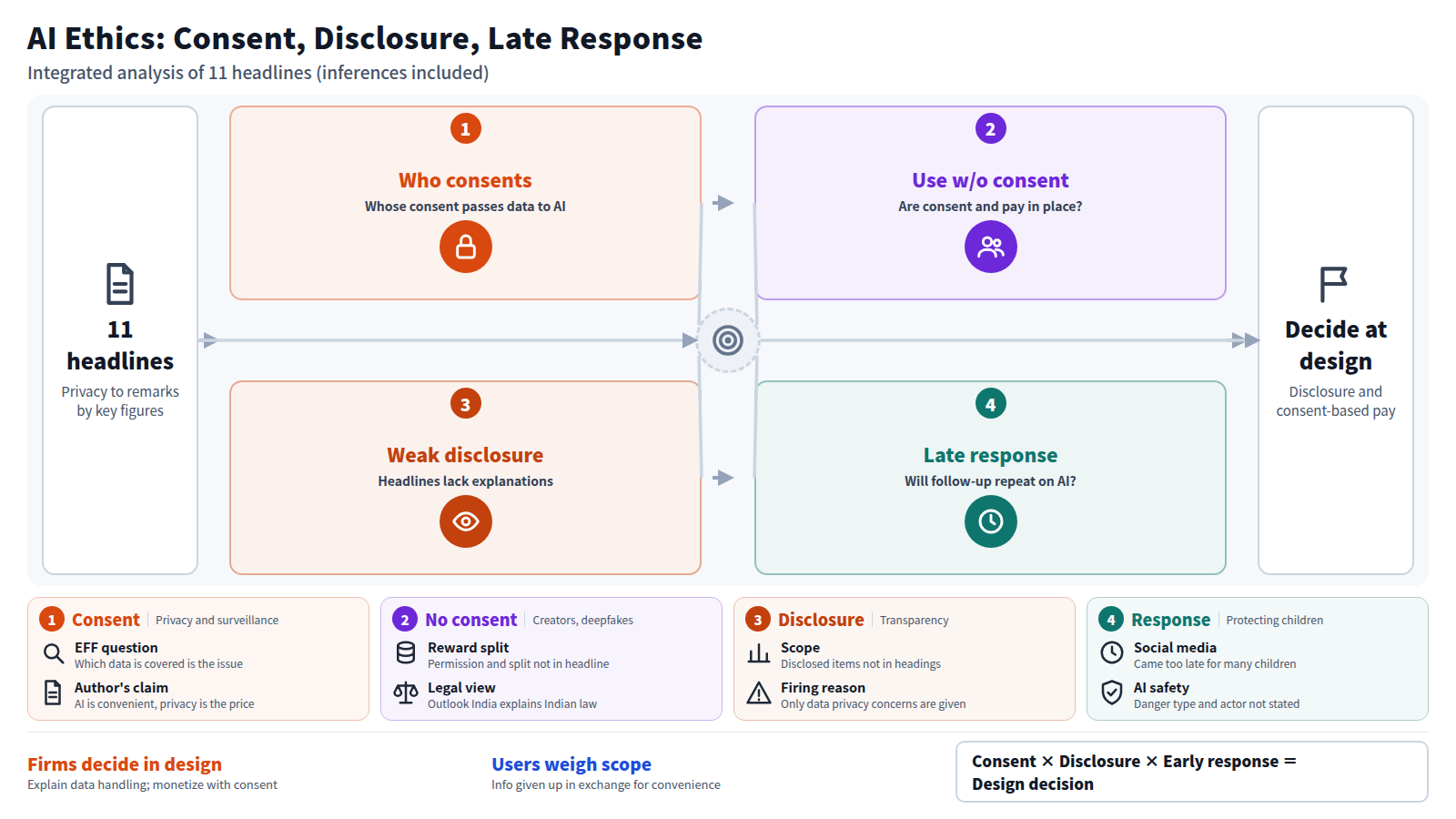
Overview
- Two questions that have come to the fore are: how much personal information should AI have (privacy) and whether child protection will be left behind? - Creator consent and remuneration (AI clones, distinction between learning and writing) and damage from deep fakes were also listed. - AI ethics researcher Timnit Gebru was reportedly selected as the award recipient.
Bias, discrimination, fairness
No applicable information
Privacy/Monitoring
- Three OpenAI employees fired (Cybersecurity Insiders): The headline says three people were fired over data privacy concerns. - EFF “How much should AI know about you?”: Content that questions the scope of personal information held. The issue can be seen as who gives consent and what data is covered. - Vitalik Buterin's 3-layer test (tokenpost.com): Let's say you test a remote AI request with 3 layers of privacy protection. The specific method and results are not listed in the heading. - Il Sole 24 ORE: Claims that "AI is convenient, but the price is privacy." This is the author's argument.
Transparency/Accountability
- Autodesk: Reportedly tied AI transparency cards to assistant. Items to be disclosed are not in headings. - bioengineer.org: AI models for industrial process monitoring bring transparency. The talk is about AI increasing visibility on the ground, but it is unclear whether it deals with the accountability of AI itself. - From the headline, it is not possible to confirm the scope of disclosure or whether it has been verified by a third party.
Creator/Copyright/Consent
- Straits Times (forum post): In the AI copyright debate, a poster argues that there should be a distinction between learning and writing. - The Economic Times: Reports that AI cloning will open new avenues for monetization for celebrities and creators. The headline does not say whether it will be done with the person's permission or how the reward will be distributed.
False information/deep fake
- Outlook India: An article explaining the background and treatment of Indian law regarding Janhvi Kapoor and Jr. NTR's AI deepfake videos. - What can be said as a confirmed fact is that such videos have become a hot topic and have even been explained from a legal perspective. The extent of the damage and the effectiveness of countermeasures cannot be determined from the headline.
Protection of children and vulnerable people
- Messenger-Inquirer: Says that the response to social media addiction has come too late for many children, and asks whether AI safety measures would have a different outcome. - The type of danger and the person responsible for the action are not written in the heading. The question raises concerns that even AI will be slow to respond.
Ethical principles and guidelines
- Toronto Sun: Reports that Chow supporters are criticizing Bradford's app over ``AI, ethics, and Israel.'' The content of the criticism and the features of the app are not in the headlines. - Institutional decisions and guidelines cannot be identified from the headline.
Japanese AI ethics
No applicable information
Remarks from VIPs
- Timnit Gebru, AI Ethics Researcher, DAIR: The Eastleigh Voice reports that the Ethiopian-born Gebru has been selected as the 2026 Right Livelihood Award recipient. The information is only in one headline, and the announcement by the award recipient has not been confirmed. - Mr. Fei-Fei Li, Mr. Yoshua Bengio: No applicable information
Integrated analysis: How do ethical questions fit together?
- A common question about the location of consent: OpenAI's dismissal, EFF's question, and Il Sole 24 ORE's points are connected in terms of whose consent personal data is passed on to AI. AI clones also have the same structure, with the consent of the individual and compensation being established. Deepfakes are a form of harm when used without consent. - Lack of explanation is a common question: Transparency cards can be read as a move to build disclosure into products. On the other hand, there are also cases where explanations are insufficient at the headline stage, such as the reason for dismissal or the content of safety measures for children. - Delayed response: Messenger-Inquirer asks whether AI will repeat the follow-up response that occurred on SNS. - For companies, explaining how data will be handled and designing monetization based on the consent of the individual can be the difference between making a decision. For users, the range of information they give in exchange for convenience is a deciding factor. However, these are just inferences based on the headlines.
Future points of interest
Are the reasons and circumstances for OpenAI's dismissal clear in the text and explanations from the parties involved? 2. Whether Mr. Gebru's award will be confirmed by the award recipient and what he said. 3. Will specific actors and measures be indicated in AI safety measures for children?
- OpenAI dismisses Three Employees over Data Privacy concerns — Cybersecurity Insiders10/05 05:57 UTC
- How Much Should AI Know About You? — Electronic Frontier Foundation10/04 16:05 UTC
- Vitalik Buterin Tests Three Privacy Layers for Remote AI Requests — tokenpost.com10/04 15:09 UTC
- AI is convenient to use, but privacy is the price we pay — Il Sole 24 ORE10/04 16:30 UTC
- AI Model Brings Transparency to the Chaotic World of Industrial Process Monitoring — bioengineer.org10/05 03:49 UTC
- Autodesk links AI transparency cards to its assistant — Tech in Asia10/05 00:13 UTC
- Forum: AI copyright debate should distinguish training from authorship — straitstimes.com10/04 21:00 UTC
- AI cloning opens new monetisation route for celebrities, creators — The Economic Times10/04 19:03 UTC
- Janhvi Kapoor-Jr NTR AI Deepfake Video Explained: What Happened And What Indian Law Says — Outlook India10/05 07:57 UTC
- A reckoning on social media addiction came late for many kids. Will AI safety be different? — Messenger-Inquirer10/05 07:00 UTC
- AI, ethics, Israel: Chow supporters slam Bradford’s app — Toronto Sun10/05 07:35 UTC