Living and Working with AI News — 2026-10-04 (Sun) Morning News
Source links point to the original outlet. The AI Integrated Analysis is auto-generated from the headlines below only and is not intended to add facts beyond them. Not investment advice.
Overview
- Main focus is on reviewing human resource development and young recruitment (Gartner, HR Magazine) and responding to Japan's labor shortage (Health, Labor and Welfare White Paper, AI robot base for food manufacturing). - There are no headlines about corporate decision-making itself (account settlement, organizational restructuring, personnel planning), and there are many stories about the stages of policy statements, proposals, and opening of bases. - There are no headlines regarding humanoid (humanoid robot) factory operations or investment amounts.
Corporate management decision-making
- No applicable information. - For reference, it has been reported that in China, with a youth unemployment rate of 18.9%, huge investments are being made in AI, and there are widespread concerns about a "Great AI Leap Forward" (Courier Japon). This is a matter of investment allocation for the country as a whole, not a decision made by individual companies.
How the company organization should be
- No applicable information.
Changes in employee roles
- ``Flipping the Loop'' (Bioengineer.org) seems to involve a composition in which AI observes not only tasks but also humans. This suggests a reversal of the relationship in which humans supervise AI, in other words, AI becomes the one monitoring how humans work. Details are unclear from the headline. - It is reported that the 71-year-old chairman of the Japan Science and Technology Agency has significantly changed the way he works through voice input and generation AI (Toyo Keizai Online). This is a personal use case, not an organizational implementation.
Required competencies
- No applicable information. - Indirectly, Building the Ultimate AI-Defiant Workforce (TechSpective) can be read as a proposal to create an image of human resources that will not be swayed by AI. Specific ability requirements are unknown.
Employee education/human resources development
- Gartner says CMOs (Chief Marketing Officers) should reconsider the positioning of entry-level talent as AI changes marketing requirements (Marketing Dive). It raises the issue of changing the way young people are brought up, and it is not possible to confirm actual measurements from the headline. - HR Magazine argues that employers shouldn't create an AI skills shortage themselves. The tone of the argument is to question the company's responsibility for training. - TechSpective's article focuses on the "Future of Work Mega-Platform," which handles human resources and work infrastructure as one. This is an introduction to the product/concept, and the effects of its introduction are unknown.
Organizational construction
- No applicable information.
Division of roles between AI agents and employees
- Workday announces that it will bring employee benefits into the "age of agents" (Workday Blog). AI agents (AI that work autonomously) are expected to take over the welfare field, but the scope of delegation, approval, and audit design are unclear from the headline. - There are no incidents of accidents or audits.
Production management using humanoids
- There are no cases of humanoids. - Related: "Food Tech AI Robotics Lab" has opened at Hokkaido University of Science (TBS NEWS DIG). The AI robot base for food manufacturing is said to be an industry-academia collaboration that supports workplaces suffering from labor shortages and technology inheritance. At the stage when the research/demonstration base is open, there are no on-site operational records or actual measurements of personnel allocation.
ROI concept
- No applicable information. - Concerns about China's "Great AI Leap Forward" (Courier Japon) can be read as doubts about whether huge investments will lead to employment outcomes, but the basis for withdrawal is unclear from the headline.
Balance of investment in human resources and humanoids
- No applicable information. - As a suggestion, the Health, Labor and Welfare White Paper calls for the use of robots and AI to address the shortage of medical and nursing care workers (NHK News). This is a policy recommendation that encourages allocation to machinery, and there is no comparison with investment in people.
Labor Administration/Worker Protection (Regulatory Authority Perspective)
- The Health, Labor and Welfare White Paper recommends the use of robots and AI to combat labor shortages in the medical and nursing care fields (NHK News). Policy direction rather than mandates. - Kyodo News PR Wire introduces a service that uses AI to visualize the way companies work, from discovering labor issues to proposing improvements. Although it is used for labor management and may raise issues regarding the handling and monitoring of employee data, there is no mention of regulation in the headline. - There are no headings regarding obligations, penalties, trials, and labor-management consultations.
Movements in each country
- Japan: The Health, Labor and Welfare White Paper recommends the use of robots and AI in medical and nursing care. Hokkaido University of Science's food manufacturing AI robot base opens. - China: Concerns are growing as massive investment in AI progresses amid a youth unemployment rate of 18.9%. - Europe and the US: Mainly communications from companies and researchers such as Gartner, Workday, HR Magazine, etc., and there is no government action. - India, Israel, Australia, South Korea: No applicable information.
Remarks from VIPs
- No applicable information. There are no headlines regarding the six people being tracked.
Integrated analysis: How is it effective for management decisions
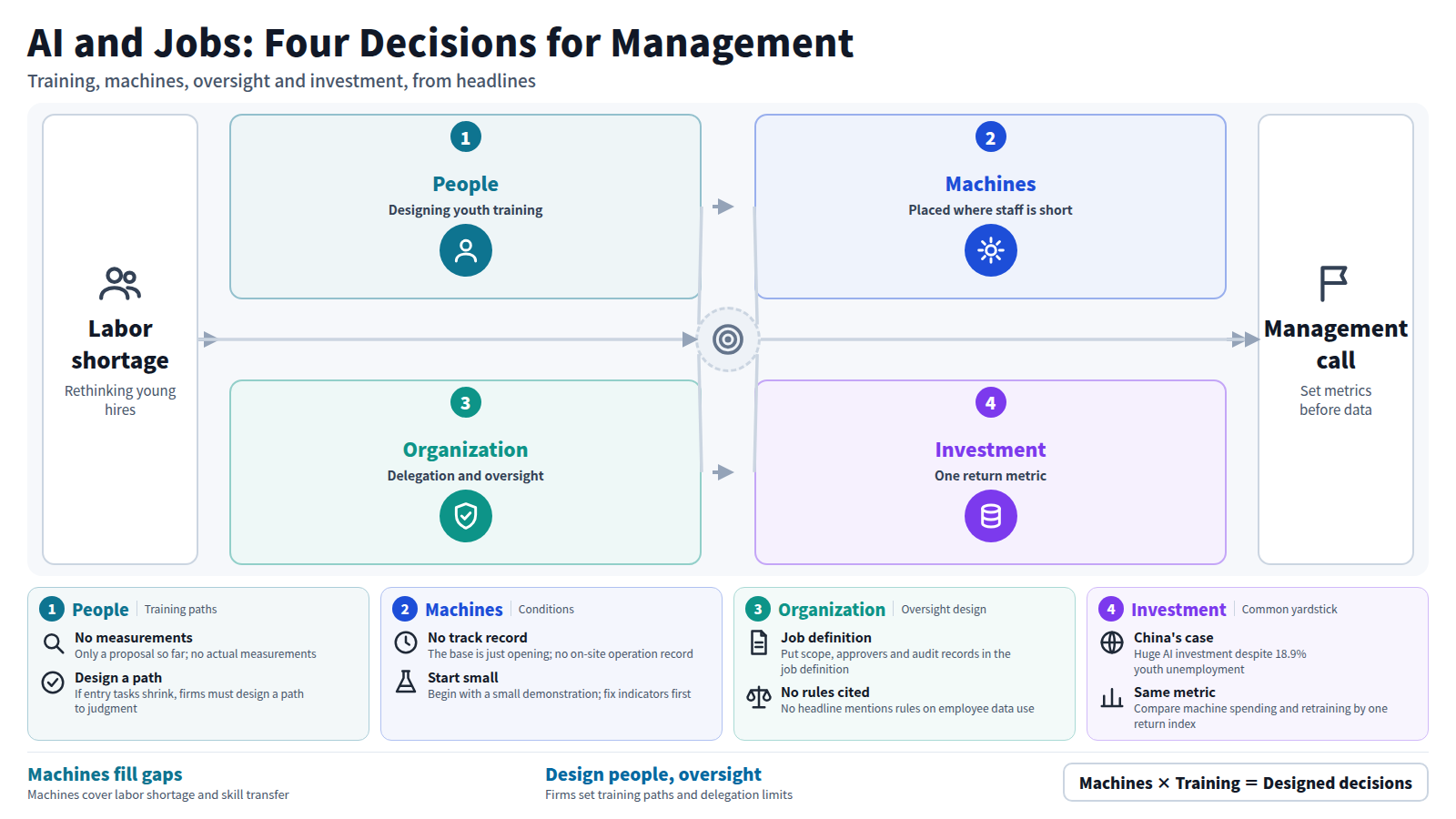
The following four points come to mind based on the relationship between the headings. All of these are inferences based on headlines, and there is no support for actual measurements. - People (development design for young people): Gartner's rethinking of new human resources and HR Magazine's theory of responsibility for training refer to the same issue. If AI is to reduce front-line tasks, companies will need to design a path for young employees to acquire decision-making skills. - Machines (deployment in areas with labor shortages): The Health, Labor and Welfare White Paper and AI robot bases for food manufacturing agree on the direction of using machines to compensate for labor shortages and technology inheritance. However, since the base is in the opening stage and there is no operational track record, it is necessary to start with a small-scale demonstration and decide on measurement indicators first. - Organization (supervision design): Workday's transformation into an agent, AI observing people (Bioengineer.org), and work style visualization service (Kyodo News PR Wire) question the line between delegation of authority and use of employee data. Scope of delegation, approvers, and audit records should be included in the job definition. - Investment: The case of China shows concerns about large-scale AI investment in a time when youth employment is tight. When it comes to investment allocation, the challenge is to make it possible to compare machine spending and human retraining using the same return index.
Future points of interest
Will there be actual changes in companies' systems regarding the recruitment and training of young and new employees (implementation of Gartner's recommendations)? 2. Are actual measurements of on-site operation of AI/robots and personnel allocation reported in medical/nursing care/food manufacturing? 3. Will there be regulations and labor-management agreements governing the handling of employee data regarding the visualization of work styles and the introduction of AI agents?
- Flipping the Loop: When AI Watches the Human, Not Just the Task — Bioengineer.org10/03 14:12 UTC
- CMOs must rethink entry-level talent as AI alters marketing needs: Gartner — Marketing Dive09/29 14:47 UTC
- Building the Ultimate AI-Defiant Workforce: The Future of Work Mega-Platform — TechSpective09/30 21:55 UTC
- “Employers must stop creating an AI skills shortage” — HR Magazine10/02 10:07 UTC
- Workday Brings Employee Benefits Into The Agentic Era — Workday Blog10/01 16:17 UTC
- Health, Labor and Welfare White Paper “Use of robots and AI due to shortage of medical and nursing care workers” — NHKニュース09/29 02:06 UTC
- Huge investment in AI despite youth unemployment rate of 18.9% Concerns about the "Great AI Leap Forward" spreading in China (Courier Japon) — Yahoo!ニュース10/02 02:45 UTC
- AI robot base for food manufacturing opens; Industry-academia collaboration ``Food Tech AI Robotics Lab'' is born to save workplaces suffering from labor shortages and technology inheritance Hokkaido University of Science — TBS NEWS DIG10/02 08:40 UTC
- Visualize the way companies work with AI! Introducing a hot new service that covers everything from discovering labor issues to proposing improvements. — 共同通信PRワイヤー10/02 05:15 UTC
- The way the Japan Science and Technology Agency president (71 years old) works has changed dramatically! An astonishing intellectual production revolution brought about by “voice input” and “generation AI” — 東洋経済オンライン10/03 06:00 UTC