AI, Philosophy & Thought News — 2026-10-04 (Sun) Evening News

Source links point to the original outlet. The AI Integrated Analysis is auto-generated from the headlines below only and is not intended to add facts beyond them. Not investment advice.
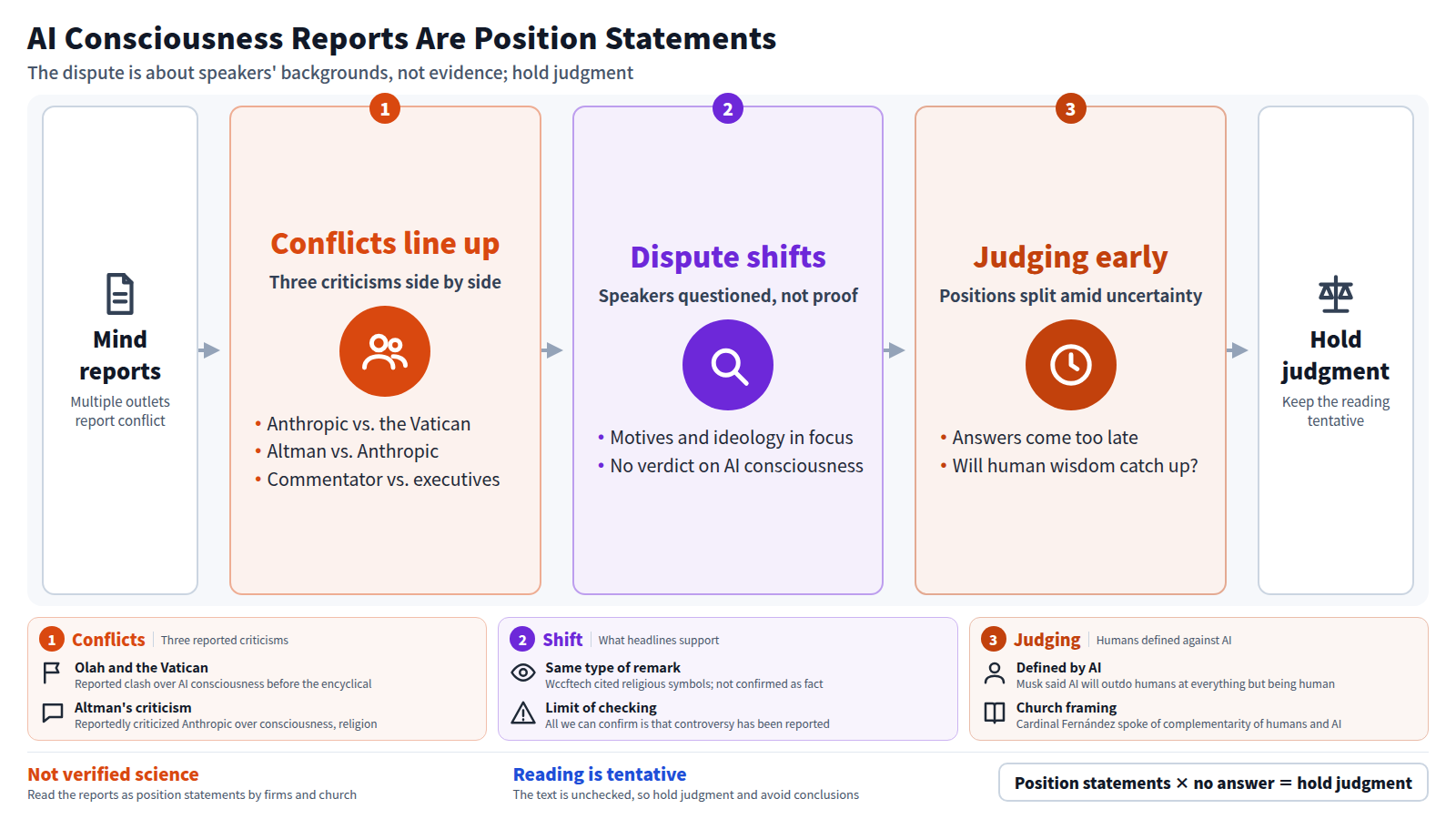
Overview
- Conflict between Anthropic, OpenAI, and the Catholic Church (Vatican) over AI consciousness was reported in multiple media. - There are three Catholic-related headlines, which confirm that the church treats AI as a human issue. - There are no headlines this time about the VIPs being pursued (Harari, Chalmers, Vallor).
Philosophy of mind/consciousness
- forkast.news reports Anthropic's Olah clashed with the Vatican over AI consciousness before the encyclical was released. - The Times of India reports that OpenAI's Sam Altman criticized Anthropic's move to explore AI consciousness and religion. - Wccftech describes Altman's criticism as ``forgetting that he himself has used religious symbols.'' This is an evaluation by the same media and has not been confirmed as fact. - All we can confirm from the headlines is that ``controversy has reportedly occurred,'' and none of the headlines indicate a conclusion as to whether or not AI is conscious.
What is a human?
- Time Magazine argues that the answers to the most important questions surrounding AI "we won't know until it's too late." - A conversation between Gerd Leonhard & William Halal on YouTube asks whether humans are getting smarter while AI gets smarter. - gigazine.net presents five scenarios put forward by researchers for when AI will destroy humanity.
Knowledge and truth
- UCL discusses the art of asking questions in education in the age of AI, drawing on Gadamer's hermeneutics. From the headline, it can be read as a position that places emphasis on asking questions rather than getting answers. - Elon Musk said there will be nothing that AI can't do better than humans, other than being human, MARCA reports.
Free will/responsibility/subject
- public.news criticizes the philosophy of "effective altruism" behind Anthropic executives' fear of machine "suffering" as superficial and reductionist. - There are no headings that directly deal with free will or responsibility. This headline is a critique of the debate over whether AI should be accorded moral status.
Remarks by thinkers and intellectuals
- The UCL contribution (based on Gadamer) discusses AI in relation to the education of questions. - Leonhard and Halal discuss the relationship between intelligence and wisdom. - A public.news commentator criticizes the ideology behind Anthropic executives. - None of the above people are included in the tracking list.
Religion/Spirituality and AI
- EWTN Vatican has a headline about Catholic education: "In a high-tech age, we need to be deeply human." - In the Jamaica Gleaner, Sean Major-Campbell asks, "Should the church talk about AI?" - Vatican News reports that Cardinal Fernández spoke about the complementarity of humans and AI. - The aforementioned conflict between Anthropic and the Vatican, as well as Altman's criticism of AI consciousness and religion, are also related to this item.
Thoughts regarding the future of humanity
- Time argues that important questions are answered too late. - gigazine introduces five scenarios for the extinction of humanity. - Leonhard and Halal ask if human wisdom will ever catch up. - Musk says AI will outperform everything except being human.
Japanese thought and AI
- A YouTube video discusses the philosophy of peace brought about by the fusion of computerization and AI. The headline also uses the phrase ``illusion of peace,'' and it is difficult to judge whether you are positive or skeptical based on the headline alone.
Remarks from VIPs
- There are no headings that correspond to the three names on the tracking list (Harari, Chalmers, Vallor). - Reference (not listed): - Sam Altman (OpenAI) reportedly criticized Anthropic's exploration of consciousness and religion. - Elon Musk (entrepreneur) reportedly said that AI will outperform everything except being human. - Cardinal Fernández reportedly spoke about the complementarity of humans and AI.
Integrated analysis: What is happening now
Common Structure 1: Humans are talked about as ``existences that are defined by their differences from AI.'' - Musk's statement defines humans as a "remnant of capabilities no less than AI." - Cardinal Fernández's "complementarity" and EWTN's "deeply human being" define the uniqueness of humans in relation to AI. - UCL's contribution, drawn by Gadamer, places the role of humans in the act of questioning. -Although their starting points are different, they all determine human characteristics based on what AI can handle.
Common Structure 2: Questions of consciousness have shifted to contestations over who is qualified to speak. - There are three types of criticism: Anthropic vs. the Vatican, Altman vs. Anthropic, and public.news commentators vs. Anthropic executives' background thinking. - Each headline focuses on the motives and ideological background of the speaker, rather than proof that AI is conscious. Wccftech's reference to "his own use of religious symbols" is of the same type.
Common Structure 3: Recognizing that a judgment has to be made before an answer is given. - Time argues that important questions can only be answered too late. - Leonhard and Halal ask whether human wisdom will catch up with technology. - The headline does not indicate a firm conclusion, and positions remain divided with uncertainty.
What makes your judgment different: Reports on consciousness fit the headlines better when read as a back-and-forth exchange of position statements between corporations and religious institutions, rather than as progress in scientific veracity. However, as the text has not been confirmed, this reading is tentative.
Future points of interest
How will the conflict between Anthropic, OpenAI, and the Vatican develop in terms of the arguments presented in the text (scientific basis or statement of position)? 2. Will the tracked Harari, Chalmers and Vallor react to this controversy? 3. Where exactly does the Catholic Church's view of humanity (complementarity, being deeply human) conflict with the arguments of corporations?
- OpenAI's Sam Altman criticises Anthropic’s push to explore AI consciousness and religion — The Times of India10/04 02:16 UTC
- We Won't Know the Answers to AI's Most Important Questions Until It's Too Late — Time Magazine10/03 11:00 UTC
- AI Is Getting Smarter. Is Humanity Getting Wiser? | Gerd Leonhard & William Halal — YouTube10/01 20:44 UTC
- What if AI were to destroy humanity? Five scenarios proposed by researchers. — gigazine.net10/01 21:00 UTC
- Beyond answers: Gadamer, AI, and the educational art of questioning — UCL | University College London10/04 01:06 UTC
- Elon Musk, entrepreneur: “There will be nothing that AI cannot do better than people, except, perhaps, for being human” — MARCA10/03 21:27 UTC
- Catholic Education in the Age of AI: ‘With High-Tech, We Need to Be Deeply Human’ — EWTN Vatican10/04 07:41 UTC
- Sean Major-Campbell | Should the Church talk about artificial intelligence? — Jamaica Gleaner10/04 05:09 UTC
- Cardinal Fernández on the complementarity of humanity and AI — Vatican News10/01 12:53 UTC