AI Ethics News — 2026-10-03 (Sat) Daily News
Source links point to the original outlet. The AI Integrated Analysis is auto-generated from the headlines below only and is not intended to add facts beyond them. Not investment advice.
Overview
- The question of protecting children and mentally vulnerable people from AI chatbots was the most frequently asked question (research reports, legislative proposals, university initiatives, responses from religious groups). - Next, questions arose about bias and censorship in AI output (restrictions on topics for free AI made in China, presence of bias in AI peer review), and trust in medical data and election information. - At the same time, mechanisms for consent and accountability were created, including the return of compensation to creators, the self-control of AI companies, and the labeling of the origin of products.
Bias, discrimination, fairness
- CBS News: Researchers have reportedly confirmed that a free AI made in China has off limits that limit responses depending on the topic. The question is who should have limited access to information. The measurement method and scale are unclear from the headline. - Bioengineer.org: Study reports no gender or regional bias in AI-based peer review abstract scoring. This contrasts with the above in that there was also a result that there was no bias. Method and scale unknown. - oikoumene.org: 2026 Right Livelihood winners are featured as challenging tyranny, patriarchy, and AI bias. The names of the award winners and their activities are unclear from the headline.
Privacy/Monitoring
- Healthcare Dive: Reports that data privacy concerns can deter patients from using AI. The composition is such that patients' decisions on use are determined by which data is used and with which consent. The specific details of the investigation are unknown. - (Related) Bioengineer.org: The "hidden ethics" of AI that reads emotions in the classroom is discussed. The handling and consent of students' emotional data will be questioned.
Transparency/Accountability
- CNBC: Facebook whistleblower Frances Haugen questions whether AI companies can police themselves. The issue is how outsiders can confirm internal information that has not been disclosed. - CBS News' report (topic restrictions on Chinese-made AI) is also related to the issue of not making the existence of restrictions clear to users.
Creator/Copyright/Consent
- CommBank (Australia): Royalty fees will be returned to Australian creators under new AI contract. The parties are the bank and the creator, and the issue at issue is the allocation of compensation for educational use. Details of the contract are unknown.
False information/deep fake
- NC Newsline: Election experts warn that AI will make it easier to create political disinformation and undermine voter trust. This is a warning from experts, and the specific damage caused is unclear from the headline. - Chemistry World: An effort to mark proteins designed by AI at the design stage so that scientists can identify who created them. An example of a measure to display the origin of products.
Protection of children and vulnerable people
- Futurism: New research shows signs that AI chatbots being aggressively marketed to billions of people are causing serious psychological harm. The scale and methods of the study are unknown. - Rep. Miller-Meeks (U.S. House of Representatives, official website): Submitted bipartisan bill to protect children from human-like chatbots. The person who took action was a member of the Diet. It is a bill, but it has not been enacted. - Clemson News: New safeguards to protect young people from unsafe AI-generated content could reduce harm. - Cincinnati Children's: Articles discussing AI, mental health and the public interest. - Focus on the Family: An essay by a religious group on how Christians should respond to AI.
Ethical principles and guidelines
- Decision: According to MLex, South Korea has adopted AI ethical guidelines for the public sector. - Proposal/Call: Unric is calling for papers to promote research on AI ethics.
Japanese AI ethics
- mbp-japan.com: An article by Kinya Hasegawa that deals with the question of imitating "voice" with generative AI. The details of the content are unclear from the headline. The focus seems to be on the person's right to voice and consent.
Remarks from VIPs
- Timnit Gebru (AI Ethics Researcher, DAIR): No applicable information - Fei-Fei Li (Stanford HAI): No applicable information - Yoshua Bengio (AI safety researcher): No applicable information
Note that the statements made by Frances Haugen (Facebook whistleblower) are not subject to tracking, but are listed in 4 above.
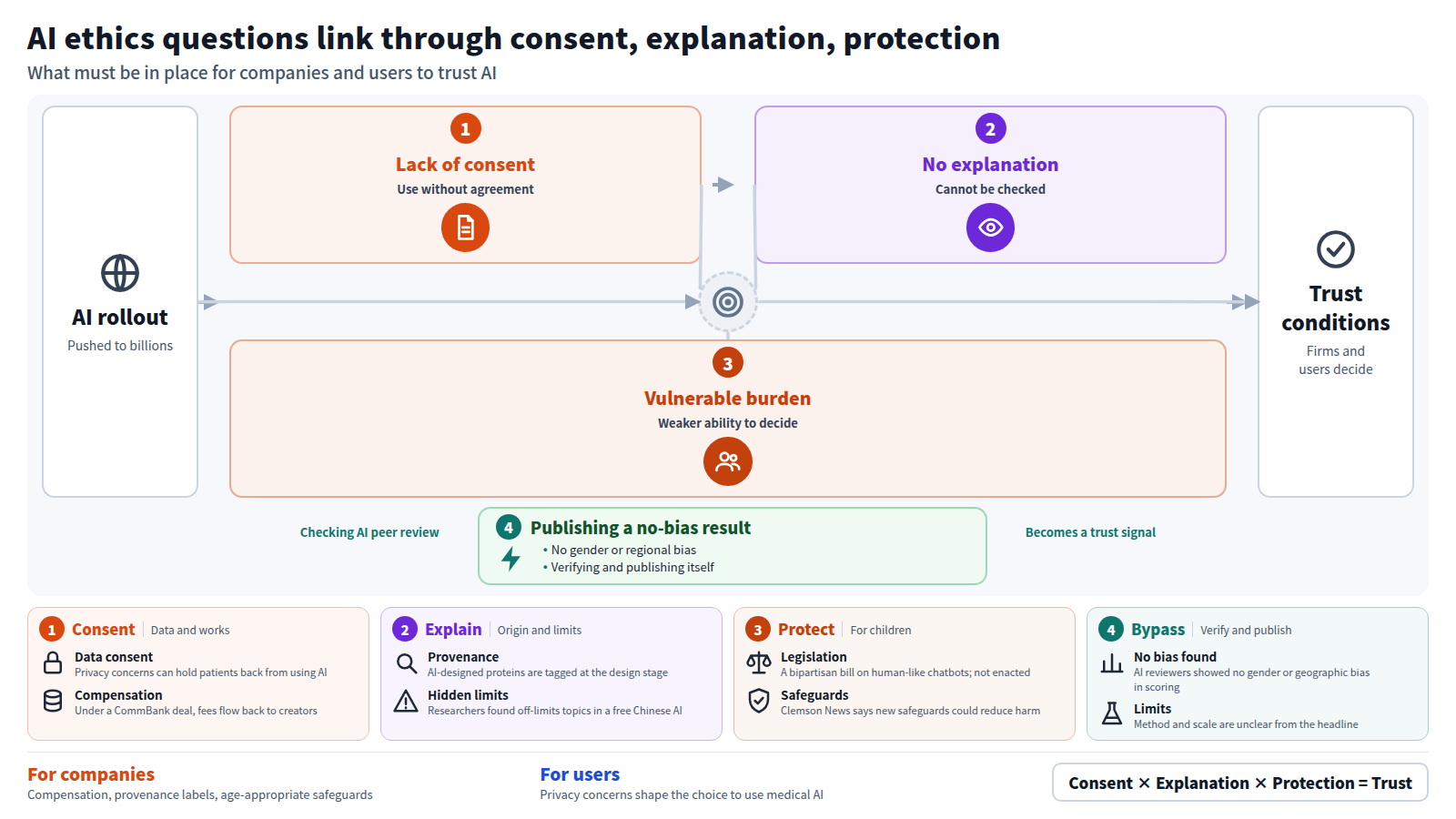
Integrated analysis: How do ethical questions fit together?
- Lack of consent: Whether the patient's medical data (3), the student's emotional data (3), the creator's work (5), and the person's voice (9) consent is used is a common question. The CommBank contract is an example of agreement and distribution in the form of compensation. - Lack of explanation: Topic restrictions (2, 4), questions about AI companies' self-control (4), and provenance of products (6) are linked in that users cannot be sure what to trust. Clarification of sources and limitations influences trust. - Burden on vulnerable groups: Children and mentally unstable people (7) are criticized for having a relatively weak ability to consent and make decisions, and therefore being easily influenced by companies' aggressive promotion measures. - Points that will change your judgment: For companies, reimbursement, labeling of provenance, and age-appropriate safety measures can be conditions for trust. For users, privacy concerns are influencing their decisions to use medical AI (3). The result (2) that there is no bias indicates that verifying and publishing information itself is a source of trust.
Future points of interest
The future of the bill to protect children from human-like chatbots and the implementation of safety measures by companies. 2. How to obtain consent for personal data (health, emotions) in medical and educational settings and its impact on user trust. 3. Will the system for displaying the origin of products and reimbursing products be spread to other fields and companies?
- Some topics are off limits inside popular Chinese-made free AI, researchers find — CBS News10/02 17:08 UTC
- 2026 Right Livelihood laureates challenge autocracy, patriarchy, and AI bias — oikoumene.org10/02 13:08 UTC
- AI Reviewers Show No Gender or Geographic Bias in Abstract Scoring, Study Finds — Bioengineer.org10/02 18:02 UTC
- Data privacy concerns could hold patients back from using AI — Healthcare Dive10/01 15:57 UTC
- Copyright fees to flow back to Australian creators under new CommBank AI agreement — CommBank10/02 08:13 UTC
- NC election experts warn about voter trust as AI makes political misinformation easier to create — NC Newsline10/02 18:53 UTC
- Tagging AI-generated proteins during design process will let scientists know who made them — Chemistry World10/02 08:39 UTC
- Artificial Intelligence — How Can Christians Respond? — Focus on the Family10/02 21:59 UTC
- New safeguards could help protect young people from unsafe content generated by artificial intelligence — Clemson News10/01 11:32 UTC
- The AI Chatbots That Tech Companies Are Aggressively Pushing to Billions of Users Appear to Be Causing Serious Psychological Harms, New Research Finds — Futurism10/02 13:02 UTC
- Miller-Meeks Introduces Bipartisan Legislation to Protect Children from Human-Like Chatbots — Representative Mariannette Miller-Meeks | (.gov)10/01 19:33 UTC
- AI, Mental Health and the Common Good — scienceblog.cincinnatichildrens.org10/01 18:01 UTC
- Call for papers: Advancing research on the Ethics of Artificial Intelligence — Unric10/01 09:17 UTC
- South Korea adopts AI ethics guidelines for public sector — MLex10/02 05:09 UTC
- When Classrooms Learn to Read Feelings: The Hidden Ethics of Emotion-Sensing AI in Schools — Bioengineer.org10/02 18:00 UTC
- What Happens When Generative AI Imitates a Voice? — mbp-japan.com10/01 05:20 UTC
- Happy Opt Out October! Let's Find Real Alternatives to the Tech Giants — EFF10/01 19:27 UTC