AI Ethics News — 2026-10-03 (Sat) Daily News
Source links point to the original outlet. The AI Integrated Analysis is auto-generated from the headlines below only and is not intended to add facts beyond them. Not investment advice.
Overview
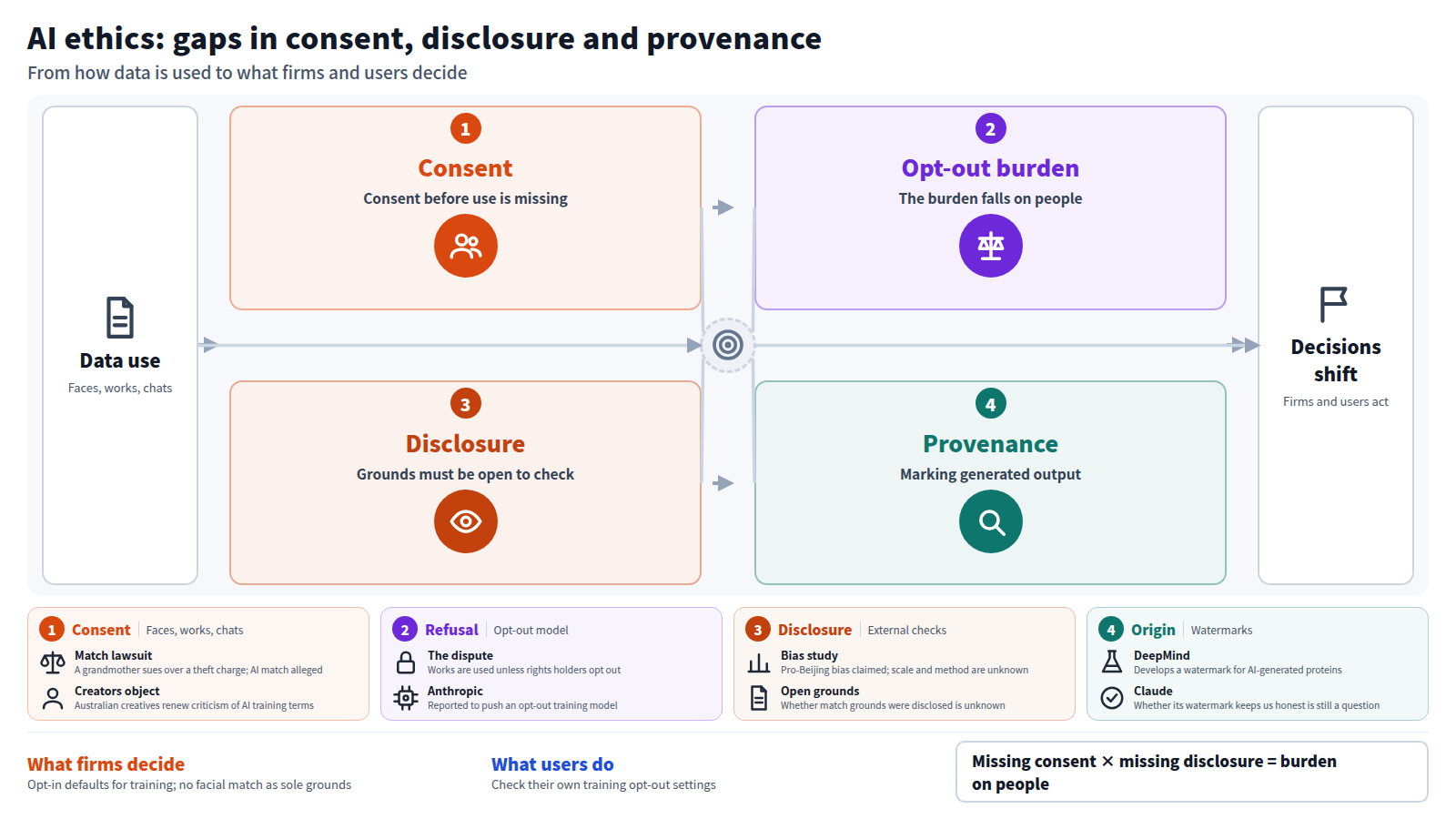
- Misidentification due to false matches in facial recognition (consent and accountability), opt-out methods for creators in AI learning (consent), and identification of AI products (transparency) have come to light. - A study examining the political bias of Chinese-made AI coincided with news coverage of Timnit Gebru's 2026 Right Livelihood Award.
- It's unclear from the headlines who will be affected, how it will be measured, and how large it will be. Treat it as a research claim, and check the original text for details.
Privacy/Monitoring
The headline is ``alleged,'' and whether or not there is an AI match and the circumstances of the misidentification are at the stage of the lawsuit. The fact that facial data was used for verification without the person's consent is an ethical issue. - Using chatbots for learning: CNET explains how to opt out of having your conversation data used for AI learning. It suggests a structure that is used for learning by default and requires user operation to reject.
- Claude's watermark: An article has appeared asking whether Claude's new "watermark" will keep people honest (Florida International University). The headline is in the form of a question, and the effect is not something that has been verified, but rather a question.
- Complaints related to false arrests also lead to questions of accountability as to whether the basis of the AI judgment was disclosed to the parties involved (however, the headline does not indicate whether or not it was disclosed).
False information/deep fake
- Washington Examiner editorial positions AI as "last chance" for failing to protect children on social media. This is the argument of the commentator, and the specific danger or the entity that took the measures cannot be determined from the headline.
- Study Finds Pro-Beijing Bias in Popular Chinese AI — Yahoo10/02 23:36 UTC
- Understanding Key Stakeholders' Perspectives Towards Artificial Intelligence in Home Care Work — Cornell ILR School10/01 12:00 UTC
- Grandmother falsely accused of bank theft after alleged AI facial recognition match sues for $10M — ABC News - Breaking News, Latest News and Videos10/01 23:18 UTC
- Keep Your Data Yours: How to Opt Out of AI Chatbot Training — CNET10/01 17:31 UTC
- Trillium Labs Promotes Transparency in Artificial Intelligence Research — Nacionale News10/02 16:20 UTC
- Will Claude's new AI "watermark" keep us all honest? — Florida International University10/01 21:50 UTC
- From music streaming to AI training: What India’s IP data tells us about the next copyright debate — MediaNama10/01 12:41 UTC
- Opt in to opt out? Renewed criticism from Australian creatives over AI training — victoriannews.com.au10/02 06:53 UTC
- Anthropic pushes for opt-out training model as ABC warns of news cannibalisation — news.lavx.hu10/01 20:07 UTC
- Who Gets to Set the Terms? Power in the Age of AI — SundiataPost10/01 12:01 UTC
- Google DeepMind develops watermark for AI generated proteins — dqindia.com10/03 02:35 UTC
- Over three-quarters of Czechs concerned about AI-generated fraud: Report — Anadolu Ajansı10/01 10:36 UTC
- We failed our children on social media. AI is our last chance to get it right — Washington Examiner10/02 15:00 UTC
- Hack the Agent: Teaching Responsible AI Use With Dynamic Education — AFCEA International10/01 12:00 UTC
- Prominent AI researcher Timnit Gebru named 2026 Right Livelihood Award recipient — facebook.com10/03 07:47 UTCTimnit Gebru / AI ethics researcher (DAIR)