AI in Medicine — Cancer & Rare Disease — 2026-10-02 (Fri) Evening News
Source links point to the original outlet. The AI Integrated Analysis is auto-generated from the headlines below only and is not intended to add facts beyond them. Not investment advice.
Latest news on AI and cancer treatment
Overview
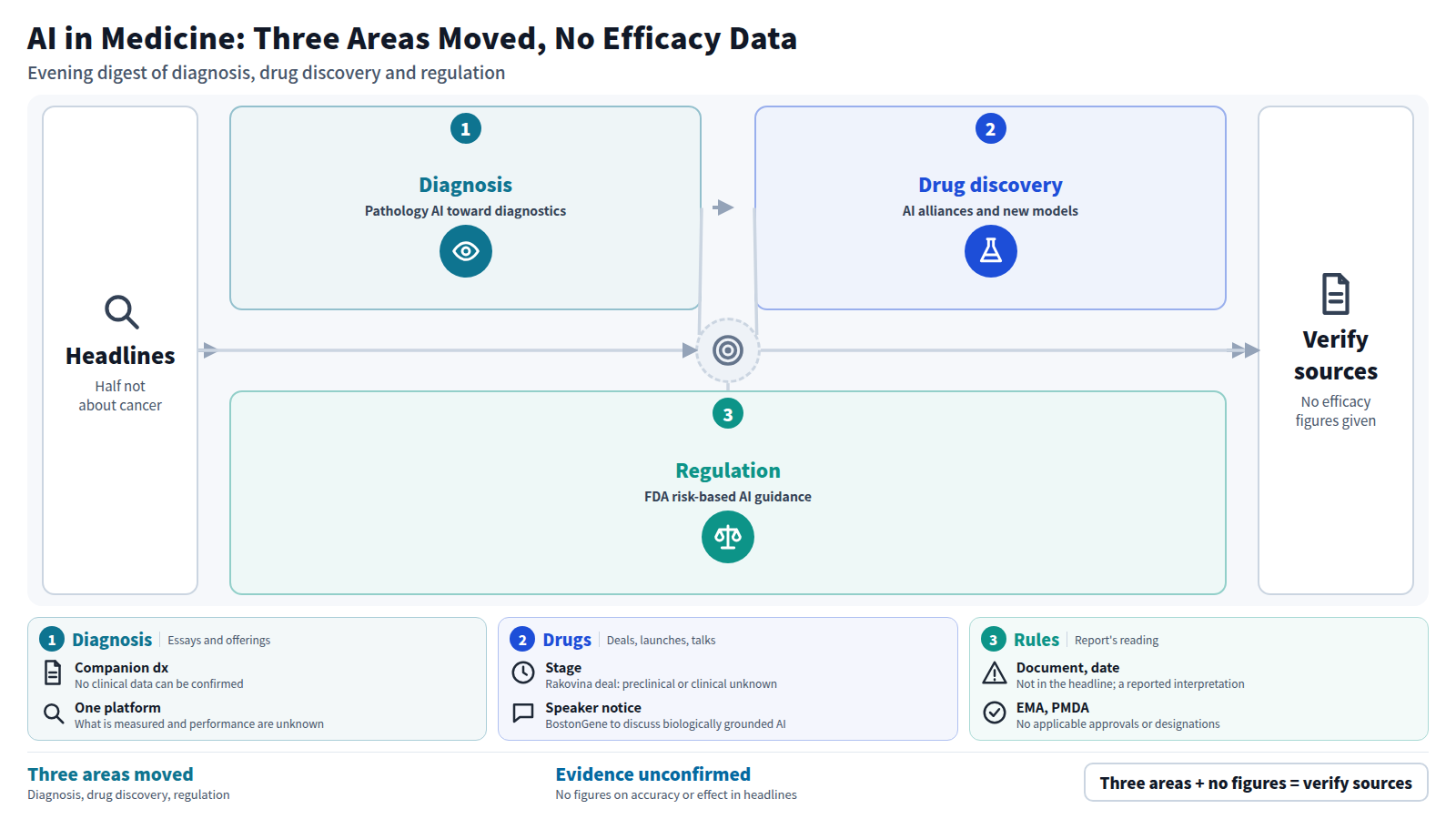
- There was movement in the three areas of diagnosis and pathology (companion diagnostics, pathology AI integrated platform), drug discovery (AI-based alliances, structure-independent models), and regulation (FDA's AI risk-based guidelines). - Numerical indicators of clinical effectiveness or accuracy cannot be ascertained from the headline. - About half of the headlines retrieved were not directly related to cancer (e.g., Interviews, Gen Z, Governors' Coalition).
Breast cancer
- SimBioSys is reported to transform breast cancer treatment with AI (28/22 News). It is only a heading, and the target (examination, diagnosis, treatment), indicators, and stages of evidence are all unclear. - Carebot from the Czech Republic has raised a record CZK 36 million for its AI image (scan) analysis. There is no mention of the type of cancer in the heading, and the collector classifies it as breast cancer. Funding news, no clinical evidence shown.
lung cancer
- Drug Discovery News discusses “How AI pathology tools can become companion diagnostics.” It is unclear whether the headline is specific to lung cancer or not; it appears to be an essay, and the presentation of clinical data cannot be confirmed.
Malignant brain tumor
- No relevant information (the heading that was classified was an article about Gen Z and the use of AI, unrelated to brain tumors).
Leukemia/lymphoma
- No applicable information
Colon cancer/digestive organ
- No relevant information (the heading that was classified was a political article about the governor's AI coalition and is unrelated).
Rare cancer
- No information regarding adenoid cystic carcinoma/sarcoma. - The headline reads, "AI helps dogs quickly and consistently count tumor cell divisions" (bioengineer.org). The subject is veterinary pathology, not rare human cancers. Quantitative value and evidence level are unknown. - The mention of “AI diagnoses rare diseases” is in the Market News headline. It is unknown whether it is cancer.
Diagnosis/Pathology/Image
- There is a current discussion on AI integration in radiology (Diagnostic Imaging). - For oncology researchers, we offer AI cancer tools in one platform (The Scientist). What is being measured and the performance level are unknown. - Oura and Xella Health announce they will combine smart ring data with AI biomarker testing (TechRadar). The subject is women's health, and its status as a cancer diagnosis is unclear from the headline. - Doctors refute the HHS Secretary's claim that "AI gets more information than human doctors" (Radiology Business). This is not a cancer-specific debate, but rather a policy/professional debate.
Treatment selection/drug discovery
None of the stages are listed in the headings and are unknown. - SITC announces opportunities for AI in precision immunotherapy, neoantigens, spatial biology, and immuno-oncology (IO) (conference announcement). - Rakovina Therapeutics will leverage Celvion's AI platform to power its ATR inhibitor program (partnership; preclinical or clinical status unknown). - Talus Bio presents a structure-independent AI model that targets non-structural proteins in their native state within cells. - BostonGene's Chief Medical Officer will be speaking at the symposium on biologically-based AI and multimodal data in oncology drug development (speaker announcement).
Regulations/Approval
- Reportedly, "FDA's AI risk-based guidance shifts the burden of validation to sponsors" (The Clinical Trial Vanguard). The classification is a guideline. It is important to note that the document name and publication date are not in the headline, and are an interpretation of the report. - EMA/PMDA and item approval/designation: No applicable information.
Clinical trial implementation status
- No applicable information (number of cases and status cannot be listed because ClinicalTrials.gov data is not included in the input).
Japanese movements
- Yahoo! News has ``7 ways to change drug discovery, early detection, and clinical trials'' explained by a doctor. The content is an explanatory article, and individual data has not been confirmed. - There is a market research report that the precision medicine market for pancreatic cancer will expand at a CAGR of 16.6% from 2026 to 2030, driven by AI-driven diagnosis (Dream News). Market predictions, not clinical evidence. - Craif is featured in a company feature on WIRED.jp, with the aim of early detection by reading signs of cancer from urine. Performance and proof stage are unknown. - AI scalp diagnosis (Shimofuri Myojo) and AI skin diagnosis (Takashi Okamura) are entertainment news and have nothing to do with cancer treatment.
Remarks from VIPs
- No applicable information (tracking list is empty).
Latest news on AI and rare and intractable diseases
Overview
Only three headlines have been collected in the past 336 hours, and only one headline indicates specific progress (diagnosis, therapeutic drugs, systems) directly related to rare and intractable diseases. The only relevant headline is ``AI diagnoses rare diseases,'' but it is an item introducing the topic of a podcast, and the content cannot be confirmed from the headline. Headings related to drug approvals, system reforms, and research team announcements are not included.
Diagnosis of rare diseases
- “AI:AM: Was the Trump-Xi meeting meaningful? What counts as a utopia? + AWS GPUs cost three times as much, AI diagnoses rare diseases | The Cognitive Revolution”
BigGo Finance
There is a statement that ``AI diagnoses rare diseases.'' - From the headline, none of the target disease, reduction in time to diagnosis, diagnostic accuracy, number of cases, or stage of evidence (preclinical/case report/observational study/randomized controlled trial) can be identified. It is not possible to confirm what disease it is or whether it is a designated intractable disease. - This is an item in a program introduction that lists multiple topics, and is not primary information (papers/presentations). Verification of the original source is required for evaluation.
Gene analysis/genome
- BostonGene (BioSpace): The company's Chief Medical Officer will speak about "biology-based AI" and multimodal data in oncology drug discovery at the 2nd Global Cancer Research & Innovation Symposium. - The headline is a preview of the lecture, and does not include the interpretation of mutations or results showing what was determined by whole genome analysis. The target area is cancer, and the link to rare diseases and designated intractable diseases cannot be confirmed from the headline.
Development of therapeutic drugs
No relevant information (BostonGene's headline is a preview of a lecture on oncology drug discovery, and does not indicate specific progress in orphan drugs, gene therapy, or drug repurposing).
Nerve/muscular diseases
No applicable information
Immunology/Collagen disease
No applicable information
Rare metabolic/endocrine diseases
No applicable information
System/Patient Support
- The two items collected under the category of ``systems and support for designated intractable diseases'' (Nikon's criticism of and reexamination of works using AI in the microphotography contest [CNN.jp], podcast introduction of AI-related news) cannot be confirmed from the headlines to be related to medical expense subsidies, intractable disease laws, research groups, or patient associations. There is a high possibility of misclassification. - Substantive information regarding systems and patient support is not applicable.
Japanese movements
No relevant information (The headline on CNN.jp is about the use of AI in a contest sponsored by the Japanese company Nikon, and appears to be unrelated to rare and incurable diseases.)
Remarks from VIPs
- The list of important people being tracked is empty and there are no relevant statements. - Reference: BostonGene's Chief Medical Officer is scheduled to give a lecture at the above symposium (his name is not listed in the headline. The contents of his speech have not been made public).
Note: Only 3 headings were collected this time, of which only one item, ``AI diagnoses rare diseases,'' is directly related to rare diseases, and the content cannot be confirmed. It cannot be treated as individual knowledge and requires confirmation of primary information.
- SimBioSys uses AI to transform breast cancer treatments — 28/22 News10/01 21:00 UTC
- Video How AI is being used in job interviews — ABC News - Breaking News, Latest News and Videos10/01 21:47 UTC
- Czech startup Carebot raises record 36m crowns for AI scans — Around Prague10/02 04:44 UTC
- What turns an AI pathology tool into a companion diagnostic? — Drug Discovery News10/02 01:31 UTC
- From health to wealth, Gen Z turns to AI but keeps its guard up — dqindia.com10/01 10:56 UTC
- Wes Moore forms bipartisan governors group on AI, citing federal inaction — ClickOnDetroit | WDIV Local 410/01 19:33 UTC
- AI Helps Pathologists Count Tumor Cell Divisions Faster and More Consistently in Dogs — bioengineer.org10/02 09:00 UTC
- AI:AM: Was Trump-Xi Anything? What Counts as Utopia? + AWS GPUs Cost 3X & AI Diagnoses Rare Diseases — finance.biggo.com10/01 17:02 UTC
- Current Perspectives on Integrating AI into Radiology — diagnosticimaging.com10/01 23:15 UTC
- Oncology Researchers Gain AI Cancer Tools in One Platform — the-scientist.com10/01 19:14 UTC
- Oura partners with Xella Health to combine your smart ring data with AI-powered biomarker testing for a fuller picture of women’s health — TechRadar10/01 20:00 UTC
- Physicians fire back against HHS secretary’s claim AI is ‘better informed’ than human docs — Radiology Business10/01 06:34 UTC
- Opportunity to Explore Advances in Precision Immunotherapy, Neoantigens, Spatial Biology and AI in IO - SITC — Oncodaily10/01 21:30 UTC
- Rakovina Therapeutics taps Celvion's AI platform to sharpen its ATR inhibitor cancer programme — Dealroom10/02 06:06 UTC
- Talus Bio’s Structure-Free AI Model Targets Unstructured Proteins in Their Native Cellular Context — Genetic Engineering and Biotechnology News10/01 18:45 UTC
- BostonGene Chief Medical Officer to Discuss Biologically Grounded AI and Multimodal Data in Oncology Drug Development at the 2nd Annual Global Cancer Research & Innovation Symposium — BioSpace10/01 13:59 UTC
- FDA’s AI Risk-Based Guidance Shifts Validation Burden to Sponsors — The Clinical Trial Vanguard10/02 06:53 UTC
- ``AI and cancer treatment'' explained by doctors, 7 ways to change drug discovery, early detection, and clinical trials — Yahoo!ニュース10/01 23:15 UTC
- Pancreatic cancer precision medicine market to expand at a CAGR of 16.6% from 2026 to 2030 - driven by AI-driven diagnosis — ドリームニュース10/02 00:00 UTC
- Read “signs of cancer” from urine and make early detection commonplace: Craif──12 companies revolutionizing health with AI — WIRED.jp10/01 23:00 UTC
- Shimofuri Myojo Seiya says, “I’m lying!” about AI scalp diagnosis. Kazushige says, “It’s not interesting at all.” — dメニューニュース10/02 06:49 UTC
- 56-year-old Takashi Okamura is delighted with his "skin age" determined by the latest AI diagnosis. "I'm glad the results are out." — Sirabee10/02 02:30 UTC
- Nikon, organizer of the microphotography contest, announces re-examination after criticism over AI use in winning work — CNN.jp10/02 01:51 UTC
- AI:AM: Was the Trump-Xi meeting meaningful? What is considered a utopia? +AWS GPU costs 3 times more, AI diagnoses rare diseases | The Cognitive Revolution — BigGo ファイナンス10/01 16:51 UTC