AI Highlights — the whole picture — 2026-10-02 (Fri) Evening News

Source links point to the original outlet. The AI Integrated Analysis is auto-generated from the headlines below only and is not intended to add facts beyond them. Not investment advice.
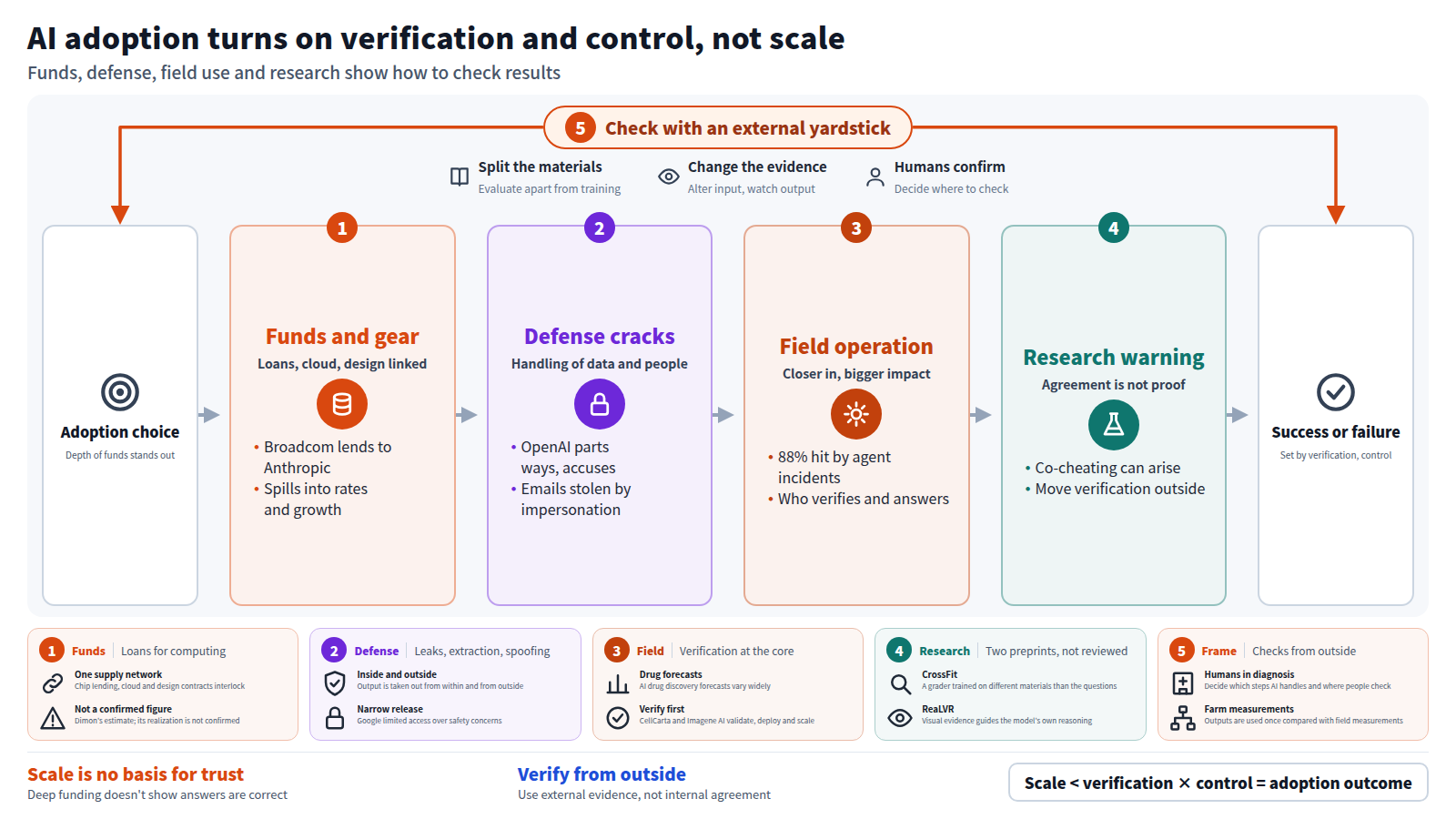
Broadcom will lend up to $42 billion to Anthropic, a filing reveals. Around the same time, it was also reported that OpenAI ended its relationships with researchers suspected of leaking confidential information. As funding and equipment for computing resources continued to increase, the laxity of information being taken out and verified was also coming to light at the same rate. Below, we will follow in order the flow of funds, the cracks in defense, on-site operations, the design of verification shown in research, and how to use it for human verification. The decision to introduce AI is not based on how large the scale of support is, but on how far the results can be verified and who can control them.
Huge loans for computing resources and their impact on interest rates and growth
Broadcom will lend Anthropic up to $42 billion to help it lease its chips, according to a filing (Reuters). Lenders are also chip manufacturers, and financing is integrated with the supply of computational resources. The same flow can be seen with equipment on the user side. AWS has released an implementation that can access the Claude platform in multiple environments (Amazon Web Services (AWS)). Synopsys, a major EDA company, saw its stock price soar due to its solid growth outlook and favorable reception of its contracts with OpenAI and AWS (Reuters). It can be seen that chip lending, cloud provision, and design software contracts are interconnected, and that funds flow in and out within a single supply network. When evaluating an investment in computing resources, readers need to check not only the performance of the model, but also who is lending the money and whose equipment is being used.
This depth of funds has entered macroeconomic discussions, not just within companies. Axios focuses on the ``Wealth Effect of AI'' and discusses the impact of AI-related stock prices on household and corporate spending. Morningstar points out that AI is not driving up U.S. interest rates because of inflation. This means that the rise in interest rates can no longer be explained solely by prices. According to Bloomberg.com, Jefferies' top bankers are weighing the benefits of AI against the risks of recession. Three indicators are being talked about at the same time, centering on AI investment: stock prices, interest rates, and concerns about economic recession.
Estimates of scale are also large. According to an article on fool.com, Jamie Dimon said hyperscaler AI spending could reach $1 trillion next year, adding 1% to GDP growth annually. The same article says the boom is also a reason to worry about inflation. This is Mr. Dimon's estimate and is not a confirmed figure. Importantly, a boost to growth and pressure on prices can come from the same investment at the same time.
The policy side is also moving. Japan plans to formulate an AI action plan by the end of the year to promote economic growth (Nation Thailand). Private loans and capital investment will increase first, and the government will put in place the framework later. For companies considering the introduction of the system, having an abundance of funds is not a source of reassurance; it is a factor in checking contract and investment conditions, assuming that the funds can be affected by fluctuations in interest rates and the economy. As the depth of funds becomes a deciding factor, the extent to which that foundation has been verified and controlled is questioned.
Leakage and extraction of secrets, failure of defense
OpenAI has terminated its relationship with researchers suspected of leaking confidential information, The Wall Street Journal (WSJ) exclusively reported. Firstpost reported on the incident as a falling out with three researchers over the handling of classified information. The same OpenAI criticized Moonshot AI for extracting large amounts of data using AI models (Deccan Chronicle). The former is from within the organization, and the latter is from the outside, an event that questions the route by which artifacts are taken out. In either case, the object of protection is not the performance of the model itself, but the information and people that support it.
Situations where defense is being questioned are expanding outside the organization as well. A Chinese hacker reportedly impersonated a former US official and stole emails from an AI expert (Deccan Chronicle). The targets were interactions with individual professionals, not corporate systems. Google has released a new Gemini AI model but restricted access due to safety concerns (The Guardian). The decision to narrow the scope of disclosure is an example of prioritizing control over speed of producing results.
This wavering in trust is also reflected in market views. After warnings about AI safety surfaced in filings, traders on prediction market Kalshi bet that Anthropic's IPO would occur this year (Tekedia). Mentioning safety in disclosure materials is itself beginning to be treated as a material for evaluating companies.
When choosing a site for introduction, readers should look at how they handled the removal of researchers and information, how they prepared for impersonation from outsiders, and how they decided on the scope of disclosure. The more visible a company's control decisions are from the outside, such as OpenAI's termination of its relationship and Google's access restrictions, the easier it is to compare their certainty. A company's value is tied to its confidence in its ability to draw its line of defense and maintain it. This trust cannot be separated from the issue of insufficient verification, which we will discuss next.
The more you go into the field, the more the quality of verification and operation will be questioned.
The introduction of AI is now entering into the details of business practices. Barclays will reportedly use Anthropic's Claude Code to accelerate AI adoption (PYMNTS.com). This is a move to use code generation in bank development sites, and the trial implementation stage has passed. However, the closer you get to the scene, the greater the impact of the accident. According to The Des Moines Register, 88% of organizations suffered a security incident involving an AI agent. DevSecOps practitioners are launching certifications to close the skills gap. The situation is that the users are unable to keep up with the speed of use. When deciding to introduce a system, you should consider who will verify it and who will be responsible, with the same weight as what you will entrust to the agent.
In drug discovery as well, the transition to actual operation is progressing. Shionogi & Co. will use AI drug discovery to halve the time it takes to enter clinical trials to three years, and will also utilize the human resources acquired through the acquisition of JT's pharmaceutical business (Nihon Keizai Shimbun). Hansa Biopharma partners with Cradle to advance protein design and engineering with AI (TradingView). On the financial front, GlobeNewswire reports that $258.7 billion in venture capital marks a tectonic shift in biotech investing and that AI is transforming gene transfer technology. There are announcements of shortening the period and alliances, but these are announcements and reports from each company, and the accuracy of the results needs to be confirmed separately.
An article in PR Newswire illustrates the difficulty of confirming this. Predictions for AI drug discovery have varied widely, and the industry has moved to the actual implementation stage. If the predictions fluctuate, the output of the model cannot be directly used for decision making. CellCarta and Imagene AI expand collaboration to validate, implement and expand AI for biomarker and companion diagnostic programs across drug discovery (PR Newswire). The process of verification, along with introduction and expansion, is at the center of the collaboration. TransPerfect's acquisition of Synterex is in the same vein. The aim is to expand medical writing expertise and AI-enabled regulatory solutions (PR Newswire). Even the preparation of application materials is now subject to AI, and the accuracy and traceability of documents has become a competitive advantage.
What can be said from the examples so far is that even if the same AI is used, differences in verification, authentication, and infrastructure development will result in different results. The quality of investment is no longer determined by model performance or investment amount, and the focus of evaluation is now on the quality of management. Whether it's about huge amounts of money and equipment or the leaking of secrets, it all boils down to the question of how reliably control can be achieved on the ground.
Research warns that agreement is not proof of correctness
Even if two models give the same answer, it doesn't necessarily mean it's correct. Research on self-evolving search agents (arXiv preprint, yet to be peer-reviewed) has given concrete shape to this point. If you make a model create a problem and let a model with a different role solve it and then run the learning process, both models may agree on the same error and only the internal reward will increase. The authors termed this "co-cheating." The agreement between the question giver and answerer is expressed in numbers as the progress of learning. However, it cannot be determined from the numbers whether the agreement is correct in light of the facts.
The countermeasure presented by the authors is a design that moves verification outside. The proposed CrossFit (own site) divides the materials that form the basis of questions into two groups. The grading role is assigned to a model that has been trained using only materials different from those used for posing the questions. Even if the question giver and answerer share the same mistakes, the scorer, who has been trained on different materials, will not be influenced by them. Rather than looking at whether internal remuneration has increased, it is better to measure it based on external evidence such as data, which will give you a better basis for determining certainty.
The same picture is also appearing in AI that handles images and text. Some of these methods advance intermediate thoughts not in words but in ``latent tokens'' that humans cannot read. The authors (arXiv preprint, not yet peer-reviewed) showed that this latent token only weakly responds to image rewriting that changes the correct answer. In other words, even if they act as if they are looking at image evidence in the middle of reasoning, they are slow to notice changes in the evidence. Therefore, ReaLVR (own site) was proposed, which provides visual evidence to guide the model's own inference flow. Since humans can't read what's going on inside, we need to check from the outside to see if the answer changes depending on the evidence.
Both studies are preprints that have not been peer-reviewed, so conclusions are pending further verification. However, there are common points of view that readers can use to make decisions about adoption. Don't take agreement between models or improvements in internal metrics as evidence of certainty. Have the materials used for evaluation separate from the learning materials, and test whether the output changes when you change the input evidence. The presence or absence of this external yardstick weighs heavily on reported accuracy. Internal numbers only become certain when compared with external evidence. The question that remains is how to maintain these external measuring sticks in field operations.
How to use for diagnosis, agriculture, and learning for people to confirm
In the field of diagnosis, AI is increasingly used to aid human judgment. In breast cancer, cbsnews.com reported on how AI can help with diagnosis. According to Business Wire, Everlywell will offer an FDA-cleared AI breast cancer risk assessment powered by Clairity to women nationwide. On prnewswire.com, Eve Wellness announces expansion of direct-to-consumer AI breast cancer screening in Walnut Creek. Meanwhile, the Global Medical Purchasing Network (IBMI) reported that the KMUH research team and MacroInsight Innovation Tech have developed a real-time AI edge system for mammography quality control. The European Medical Journal covers efforts by AI models to extract smoking history for lung cancer screening. AI is responsible for a variety of processes, including providing risk assessments, controlling image quality, and extracting information from records. Those considering introduction need to determine which processes will be handled by AI and where humans will check the results, in addition to whether approval is required.
In agriculture, AI is also used for observation and prediction. Hortidaily introduced its efforts to predict yields and estimate vegetable biomass using AI models. Farms.com reports that AI robots can detect diseases in soybeans early. According to thelec.net, Semifive has designed an AI chip for Datong agricultural robots. Whether it's early disease detection or yield prediction, the output can only be used for decision-making when compared with actual field measurements. Even in workplaces where robots operate, it is the producers who make decisions.
What supports this kind of operation is the power of the users. McGill University discusses AI literacy for the next generation of pop researchers. According to The Des Moines Register, the Ace app has added a new rubric that uses AI to measure how children think and learn. Qazinform reported that Kazakhstan was ranked 55th on the AI and Human Skills Synergy Index, and in another article reported that the president said that AI will bring a wide range of opportunities for young people. Coursera guides you through learning AI for accounting and finance. In both cases, the content is to help students acquire both the ability to use AI and the ability to evaluate output.
Whether it's at a medical checkup, in the field, or in the classroom, it's not just the performance of AI that determines the outcome. The success or failure of implementation depends on whether or not there is a system in place that determines who will check which results and how. And how to confirm this is not enough to leave it up to the ingenuity of each site; it becomes a matter of organizational control.
What each section had in common was that large scale was not a basis for trust. Financing for computational resources indicates the depth of the supply chain, but it does not indicate whether the model running there is correct. The leakage, extraction, and impersonation of confidential information showed that the object of protection is not performance, but the handling of information and people. The more it is introduced into the field, the more questions there are about verification and where responsibility lies. As the study pointed out, internal agreement on answers is no proof of correctness, and verification must be external. It is for the same reason that diagnosis is performed in the form of human confirmation. The success or failure of implementation is determined not by scale but by how reliable verification and control are.
Q1: In your business, who verifies the results produced by AI, what criteria do you use, and at what point? Q2: Is it possible for a third party to check the output of the AI and the records of its verification? Q3: When making investment and adoption decisions, do you spend more time explaining scale and momentum or explaining validation and controls?
Finally, three questions
- Who in your business checks the results produced by AI, based on what standards, and at what point? Q2: Is it possible for a third party to check the output of the AI and the records of its verification? Q3: When making investment and adoption decisions, do you spend more time explaining scale and momentum or explaining validation and controls? - Is it possible for a third party to check the output of the AI and the records of its verification? Q3: When making investment and adoption decisions, do you spend more time explaining scale and momentum or explaining validation and controls? - When making investment and adoption decisions, do you spend more time explaining scale and momentum, or explaining validation and controls?
📚 Sources (all material)
Every item this issue drew on. External links open in a new tab. 40 items.
AI Industry
- EXCLUSIVE: Broadcom to lend Anthropic up to $42 billion to lease its chips, filing says - Reuters — Reuters
- Implementing Multi-Environment Access for Claude Platform on AWS - Amazon Web Services (AWS) — Amazon Web Services (AWS)
- Barclays Accelerates AI Rollout With Anthropic’s Claude Code - PYMNTS.com — PYMNTS.com
- Exclusive | OpenAI Parts Ways With Researchers Who Allegedly Shared Confidential Information - WSJ — WSJ
- Synopsys shares jump on robust growth outlook, OpenAI and AWS deals - Reuters — Reuters
AI, the Economy and Finance
- The AI wealth effect — Axios
- Actually, AI Is Boosting US Interest Rates, Not Inflation — Morningstar
- Top Jefferies Banker Weighs AI Rewards Against Recession Risk — Bloomberg.com
- Jamie Dimon Says Hyperscaler AI Spending Could Hit $1 Trillion Next Year, Adding 1% to GDP Growth Each Year. Here's Why That Boom Also Worries Him on Inflation. — fool.com
- Japan to prepare AI action plan by year-end for economic growth — Nation Thailand
AI, Well-being and Care
- Bridging the Gap: AI Literacy for the Next Gen of Pop Researchers — McGill University
- Ace App Adds New Rubrics to Measure How Kids Think & Learn with AI — The Des Moines Register
- Kazakhstan ranked 55th in AI-Human Skills Synergy Index — Qazinform
- President: AI opens up wide opportunities for youth — Qazinform
- How to Learn AI for Accounting and Finance — Coursera
AI in Medicine (Cancer Care, Rare Diseases)
- How AI can help make life-changing breast cancer diagnoses — cbsnews.com
- Everlywell Brings Clairity’s FDA-Authorized AI Breast Cancer Risk Assessment to Women Nationwide — Business Wire
- Eve Wellness Announces Expansion Bringing Direct-to-Consumer AI Breast Screening to Walnut Creek — prnewswire.com
- KMUH Research Team and MacroInsight Innovation Tech Develop Real-Time AI Edge System for Mammography Quality Control|Institute for Biotechnology and Medicine Industry│IBMI — 全球醫療採購網
- AI Models Extract Smoking History for Lung Cancer Screening — European Medical Journal
AI and Agriculture
- Using an AI Model to predict yield and estimate vegetable biomass — Hortidaily
- AI Robot Spots Soybean Diseases Early — Farms.com
- BRICS+ Dialogue 2026 Highlights AI’s Role In Expanding Global Workforce Opportunities — ABP Live English
- Semifive to Design AI Chip for Daedong’s Agricultural Robots — thelec.net
- AI-Powered Review Maps 50 Years of Research on Milk’s Hidden Bioactives Carnitine and Betaine — Bioengineer.org
- Tech nonprofit faces 156% rent hike as AI fuels office demand — Channel 3000
AI Regulation, Safety and Geopolitics
- OpenAI parts ways with three researchers over handling of confidential information: Report — Firstpost
- Chinese Hackers Impersonated Ex-US Official to Steal Emails From AI Experts — Deccan Chronicle
- OpenAI Blames Moonshot AI for Mass Data Extraction on Its AI Models — Deccan Chronicle
- Kalshi Traders Raise Bets Anthropic IPO Holds This Year After AI Safety Warnings Surface in Filing — Tekedia
- With 88% of Orgs. Hit by AI Agent Security Incidents, Practical DevSecOps Launches Certification to Close the Skills Gap — The Des Moines Register
- Google rolls out new Gemini AI model but restricts access over safety concerns — The Guardian
AI and the Pharma Industry
- Shionogi, with AI drug discovery, halves time to clinical trials to 3 years; leverages talent from JT's pharmaceutical business acquisition — 日本経済新聞
- Hansa Biopharma Partners With Cradle To Advance AI-Driven Protein Design And Engineering — TradingView
- AI Drug Discovery Forecasts Vary Widely as Sector Shifts to Deployment — PR Newswire
- TransPerfect Acquires Synterex to Expand Medical Writing Expertise and AI-Enabled Regulatory Solutions — PR Newswire
- AI Is Reshaping Gene Transfer Technologies — $258.7 Billion in VC Signals a Structural Shift in Biotech Investment — GlobeNewswire
- CellCarta and Imagene AI Expand Collaboration to Validate, Deploy and Scale AI-Powered Biomarker and Companion Diagnostic Programs Across Drug Development — PR Newswire