AI & Finance News — 2026-10-05 (Mon) Morning News
Source links point to the original outlet. The AI Integrated Analysis is auto-generated from the headlines below only and is not intended to add facts beyond them. Not investment advice.
Overview
Hacking using AI is spreading in the Korean financial world, and information leaks from Shinhan Bank have also been reported. A lone perpetrator is suspected (조선일보, Startup Fortune). In the market, AI-related stocks continue to rise as Treasury yields reach a 24-year high. There is also growing concern about concentration risk and debt dependence (TradingView, Bloomberg, Financial Times). It has been reported that Trump is likely to hire former SEC Chairman Jay Clayton to lead AI (Yahoo, finance.biggo.com).
Bank trends
In South Korea, AI-based hacking has spread throughout the financial industry, and a single culprit is suspected (조선일보). Alert is on the rise (Korea JoongAng Daily). The Shinhan Bank information leak was reported as an example of hacking of a Korean bank by an AI agent (Startup Fortune). President Lee ordered a thorough investigation as commercial banks suffered catastrophic damage (재경일보). BOE sees underachievement of AI-driven growth as a threat to government debt (WSJ). Goldman Sachs said AI spending will once again drive a strong earnings season for the S&P 500 (Seeking Alpha).
Insurance trends
Cayman Captive Forum puts AI at the center of discussion (Captive International). In the insurance sector, the argument is that the next competitive advantage will come from better data (Hindustan Times). An analysis by Yahoo Finance suggests that Verisk Analytics is redefining the strength of AI through its partnership with Truepic for billing verification. There is also an article (FourWeekMBA) that discusses the pricing of AI sovereignty for insurance companies in six stages. Nvidia combines its AI business with insurance and guardrails, launching a $235 billion share buyback (AD HOC NEWS).
Trends in asset management and market transactions
Investors are looking for ways to protect their portfolios from rising AI concentration risks (Financial Times). Ardian's Schmitz said that AI companies' debt-based investments are similar to the dot-com bubble, and there will be a shakeout (bloomingbit). On Wall Street, rising yields are increasing risks to the AI market (Bloomberg). AI markets continue to defy 24-yr high Treasury yields, but risks are also piling up (TradingView). The Nasdaq Composite rose slightly to 26,871.60. Semiconductor stocks rebound, and coverage of Anthropic's initial public offering (IPO) boosts AI stocks (BBN Times). Goldman Sachs said AI trading will extend beyond semiconductors, leading to a "more stock-picking market" (TradingView). Grok has a 60% share of AI trading on Coinbase (AOL.com).
Fintech/payment trends
Jordi Visser says rising interest rates won't crush AI megacaps, but agent-based AI will beat Visa and Mastercard (finance.biggo.com). Ripple releases privacy tools and AI wallet (Yahoo Finance). AI in the fintech market is predicted to grow at an average annual growth rate of 13.7% from 2026 to 2033 (pando.life). In India, 21 startups raised over $473 million between September 28 and October 3. Target areas include Fintech (instagram.com).
Remarks from key figures and authorities in the financial world
No notable movement. For reference, Jay Clayton, who sued Ripple as SEC Chair, will be appointed by Trump to be in charge of promoting AI (Yahoo). It was also reported that he is expected to be named AI czar (finance.biggo.com).
Trends in AI-related stocks and funding
Michael Burry believes the AI bubble will burst soon, predicting that Micron and Nebius will see major declines by mid-2027 (Yahoo Finance). QCOM is reportedly in the final stages of acquiring AI startup Modular for $4B (Stocktwits). Bloom Energy and AI stocks rose even as concerns about OpenAI's safety remained (barrons.com). AI stocks are driving a deeply divided market, Bloomberg reported (Bloomberg). The Telegraph argued that the world cannot survive an AI bubble right now (The Telegraph). With the expansion of AI funding, three credit-related stocks are attracting the attention of individual investors (Yahoo Finance).
Trends in financial regulation and supervision
Trump will hire former SEC Chair Jay Clayton to lead AI promotion (Yahoo). The White House AI Summit highlighted the power dynamics between tech companies (finance.biggo.com). In South Korea, the president ordered an investigation after financial hacking that exploited AI (재경일보). There are no headlines indicating how the SEC, FCA, FSB, Financial Services Agency, etc. are responding to AI. No notable movement.
Integrated analysis: What is happening now
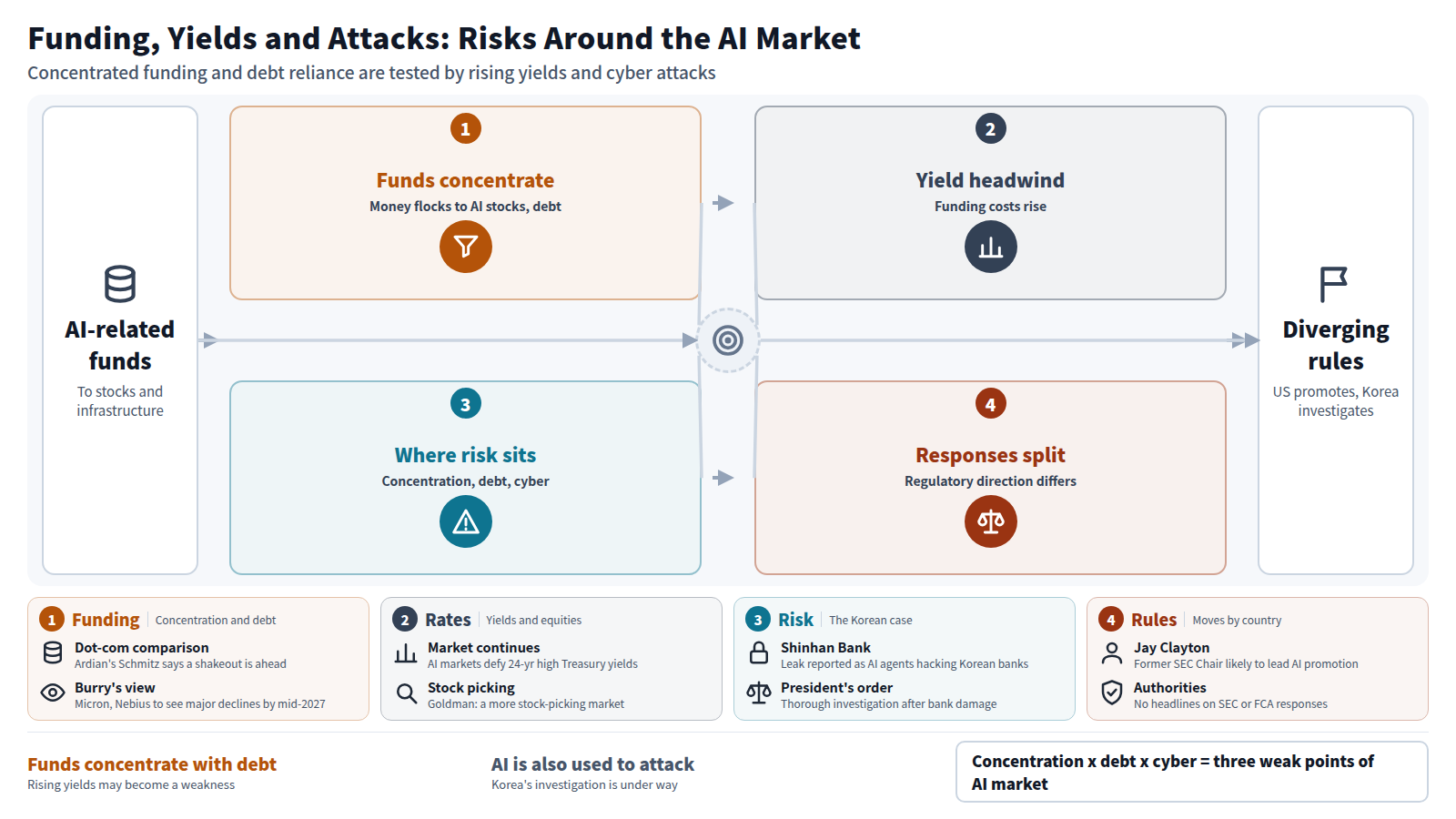
Funds appear to be flocking to AI stocks and AI infrastructure financing, increasing reliance on debt (Hubbis, bloomingbit, Yahoo Finance). On the other hand, there is a headwind of 24-yr high Treasury yields, and rising funding costs may become a weakness for the AI market (TradingView, Bloomberg). The fact that the BOE pointed out the threat to government bonds indicates that the lack of growth in AI could have an impact not only on stocks but also on the bond market (WSJ). Risks can be categorized into three categories: concentration risk, debt, and cyber. The attack by an AI agent targeting a South Korean bank shows that AI has become both a defense and a means of attack (Startup Fortune, Korea JoongAng Daily). In payments, there is a view that agent-based AI threatens the business of existing card networks (finance.biggo.com). The direction of regulations is likely to be divided into AI promotion in the United States and post-accident investigation and response in South Korea.
Future points of interest
Investigation results of attacks on South Korean financial institutions and the spread of damage (재경일보, 조선일보). 2. The impact of rising yields on AI-related debt financing and equity valuations (TradingView, Financial Times). 3. AI promotion measures if Jay Clayton is appointed and the impact on the responses of financial authorities such as the SEC (Yahoo).
- BOE Sees Threat to Government Bonds in AI Growth Miss — WSJ10/04 15:10 UTC
- AI spending to drive another strong S&P 500 earnings season, Goldman Sachs says — Seeking Alpha10/04 14:24 UTC
- AI Hacking Spreads Across Financial Sector; Single Perpetrator Suspected — 조선일보10/04 17:12 UTC
- Shinhan Bank Data Breach Points to AI Agents Hacking Korean Banks — Startup Fortune10/04 10:37 UTC
- AI in insurance: Next competitive advantage will come from better data | Hindustan Times — Hindustan Times10/04 17:38 UTC
- Is Verisk Analytics (VRSK) Quietly Redefining Its AI Edge With Truepic’s Claims-Verification Tie-Up? — Yahoo Finance10/04 12:06 UTC
- Run It With the Agent: Pricing an Insurer’s AI Sovereignty in Six Steps — FourWeekMBA10/04 08:02 UTC
- Nvidia Wraps Its AI Empire in Insurance, Guardrails and a $235 Billion Buyback — AD HOC NEWS10/04 12:01 UTC
- Investors look to shelter portfolios from rising AI concentration risks — Financial Times10/04 12:00 UTC
- Hubbis Macro Corner: Higher Rates, Asia Bond Resilience and AI Infrastructure Finance Reshape Portfolio Positioning — Hubbis10/04 16:06 UTC
- AI Firms’ Debt-Fueled Bets Echo Dot-Com Bubble, With Shakeout Ahead, Ardian’s Schmitz Says — bloomingbit10/04 09:06 UTC
- Grok Dominates Coinbase’s AI Trading with a 60% Share: Which Coins Are Being Purchased? — AOL.com10/04 14:00 UTC
- 3 Credit Stocks Retail Investors Are Watching As AI Financing Ramps Up — Yahoo Finance10/04 10:06 UTC
- Wall Street’s AI Party Is on Edge as Soaring Yields Raise Risks — Bloomberg.com10/04 13:00 UTC
- Nasdaq Composite Inches Up to 26,871.60 as Chip Stocks Recover and Anthropic IPO Report Lifts AI Shares — BBN Times10/04 10:57 UTC
- Between September 28 and October 03, 2026, as many as 21 Indian startups from diverse sectors raised over $473 million in funding from investors. These sectors include Beauty, Healthtech, Fintech, Proptech, Luxury, Pharma, AI, Consumertech, Martech, EV — instagram.com10/04 17:48 UTC
- AI Trade Broadens Beyond Semiconductors As Investors Seek New Winners, Goldman Sachs Says — ‘More Of A Stock Picker’s Market’ — TradingView10/04 15:35 UTC
- XRP Bulls Called for $100 Before Seoul: Ripple Unveils Privacy Tools and AI Wallets. What Do Holders Gain? — Yahoo Finance10/04 16:00 UTC
- Jordi Visser: Rising Rates Won't Kill AI Mega-Caps, But Agentic AI Will Crush Visa, Mastercard — finance.biggo.com10/04 14:08 UTC
- Watch AI Stocks Drive an Increasingly Divided Market — Bloomberg.com10/04 17:24 UTC
- Michael Burry Thinks the AI Bubble Will Burst Sooner Than Later, Including Big Drops in Micron and Nebius by Mid-2027 — Yahoo Finance10/04 12:37 UTC
- Bloom Energy and AI Stocks Rise Even as OpenAI Safety Concerns Persist — barrons.com10/04 09:19 UTC
- QCOM Is Reportedly In Advanced Talks For $4B Acquisition Of AI Startup Modular — Stocktwits10/04 06:30 UTC
- The world cannot afford an AI bubble right now — The Telegraph10/04 16:00 UTC
- White House AI Summit Exposes Tech Power Dynamics as Trump Prepares to Name Jay Clayton AI Czar — finance.biggo.com10/04 09:25 UTC