AI and Cancer Research ── Breast ── 2026-10-07
Breast cancer: treatment, trials and AI
- Abstract
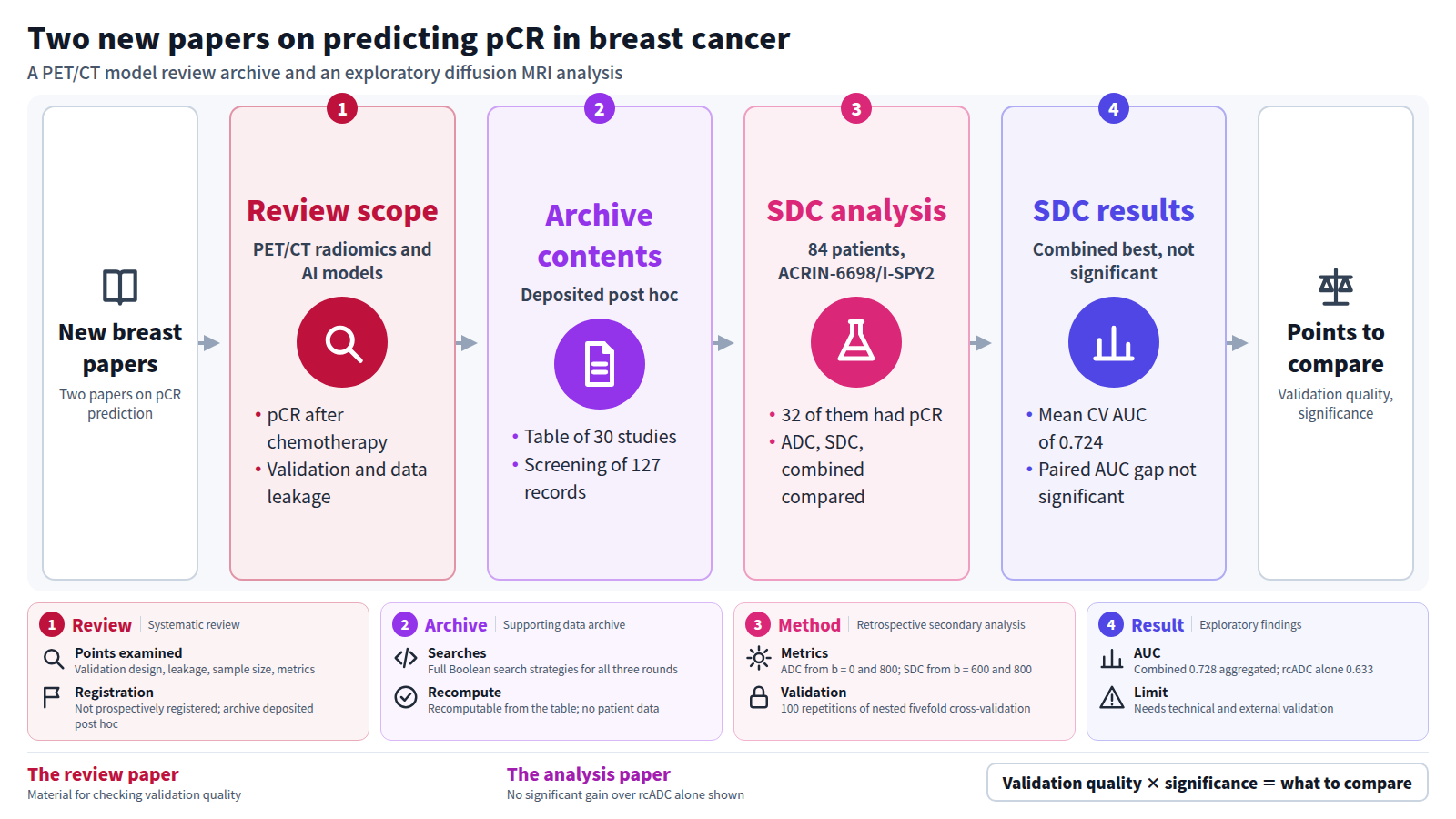
Post hoc transparency archive for a systematic review of validation design, data leakage, sample adequacy and performance-metric reporting in [18F]FDG PET/CT radiomics and artificial-intelligence models predicting pathological complete response to neoadjuvant chemotherapy in breast cancer. The archive contains the review protocol (deposited post hoc; the review was not prospectively registered), the full Boolean search strategies for all three search rounds, the study-level extraction table for the 30 included studies with PROBAST+AI judgements and reason codes, the record-level screening decisions for the 127 records assessed in the relaxed search, and the Python scripts that generate both figures in the article. Searches were last run on 1 October 2026. Every descriptive statistic reported in the article can be recomputed from the extraction table; no patient-level data were used and no full texts are redistributed. Version 1.1.0 replaces the study-level extraction table and the relaxed-search screening file with their English versions; no data values were changed. The study-level table is also supplied with the article as ESM 4 and the screening file as ESM 2.
Journal IF: unknown (could not be matched)Reference: [No authors listed]. Transparency archive for: Validation design, data leakage and performance reporting in [18F]FDG PET/CT radiomics and artificial intelligence models for predicting pathological complete response in breast cancer: a systematic review. Zenodo (CERN European Organization for Nuclear Research). [Epub ahead of print]. doi:10.5281/zenodo.23162322.Checked: Abstract only - Abstract
The apparent diffusion coefficient (ADC) is used to assess breast cancer response but may be influenced by perfusion and T2-related effects. The aim of the study was to compare ADC-only, slow diffusion coefficient (SDC)-only, and combined ADC–SDC models and to evaluate whether SDC provides information complementary to ADC for post-treatment assessment of pathological complete response (pCR). This retrospective secondary analysis included 84 patients from the ACRIN-6698/I-SPY2 dataset, including 32 with pCR. ADC was calculated from b = 0 and 800 s/mm2 and SDC from b = 600 and 800 s/mm2. Lesion-mean values and treatment-related changes were evaluated using 100 repetitions of nested fivefold cross-validation. All normalization, random-forest ranking, and LASSO tuning and selection were performed within the training data. The combined rcADC–rcSDC model achieved the highest mean cross-validated AUC of 0.724. Its aggregated out-of-fold AUC was 0.728, compared with 0.633 for rcADC alone; however, the paired AUC difference was not statistically significant. Treatment-related SDC changes may complement conventional ADC changes in post-treatment pCR assessment. Although the combined rcADC–rcSDC model achieved the highest observed discrimination, a statistically significant improvement over that of rcADC alone was not demonstrated. These exploratory findings require technical and external validation.
Journal IF-equivalent: 1.0 (OpenAlex 2-year mean citedness, value as of 2026-10-06, retrieved 2026-10-07; not the official Clarivate IF)Reference: Sakoda K, Baba S. Slow Diffusion Coefficient Derived from High b-Value Diffusion-Weighted MRI for Assessing Pathological Complete Response after Neoadjuvant Chemotherapy in Breast Cancer: An Exploratory Machine Learning Analysis. Indian J Radiol Imaging. 2026 Oct 5 [Epub ahead of print]. doi:10.1055/s-0046-1829390.Checked: Abstract only