AI and Cancer Research ── Liver ── 2026-10-07
Liver cancer: treatment, trials and AI
- Abstract
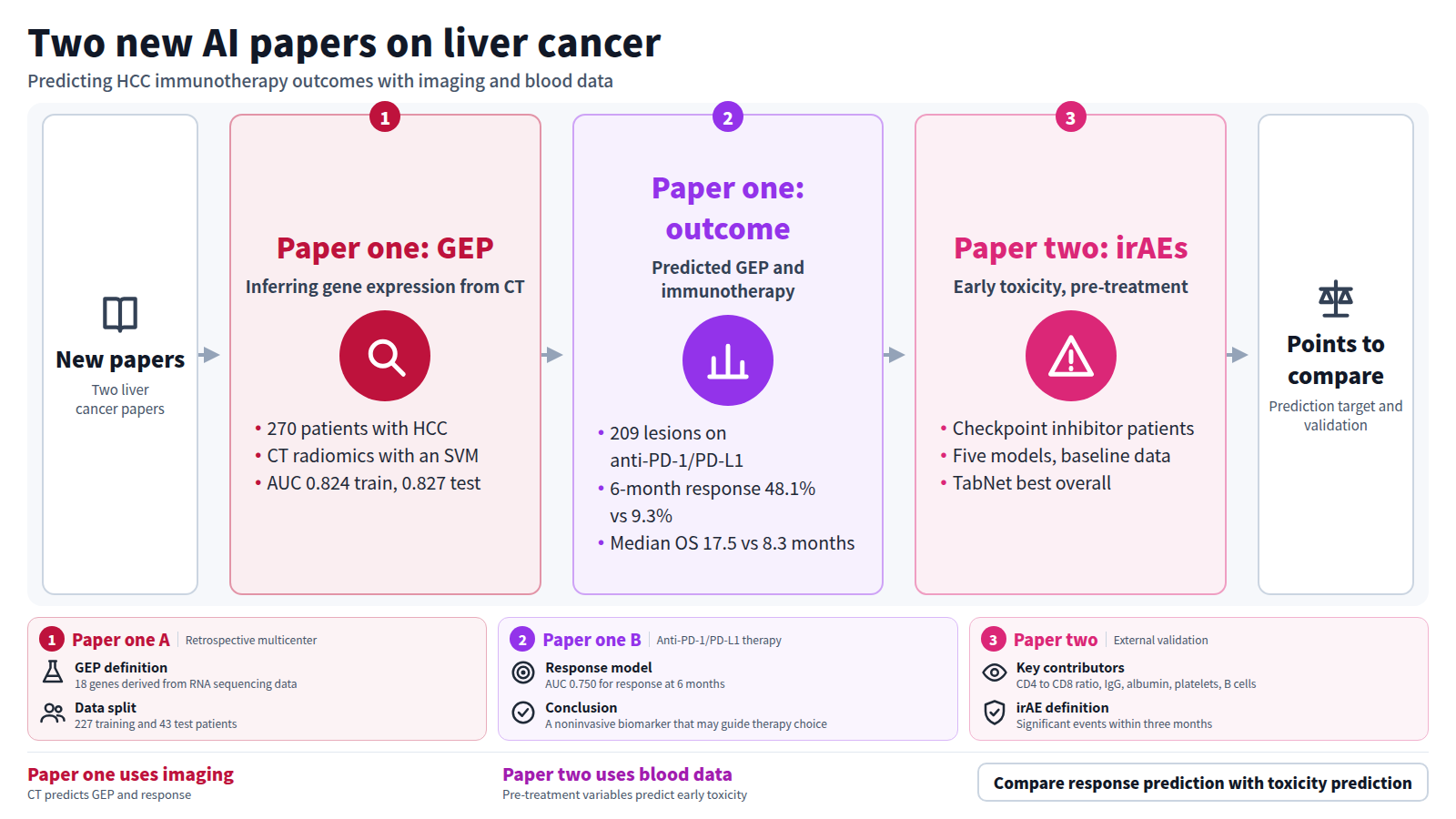
BACKGROUND: The T cell-inflamed gene expression profile (GEP) provides a biomarker for immunotherapy response across various cancers. However, specific biomarkers for immunotherapy response in hepatocellular carcinoma (HCC) are lacking. In this study, we established a computed tomography (CT)-based radiomics model to predict the T cell-inflamed GEP and immunotherapy response in HCC. METHODS: This retrospective, multicenter study included 270 patients with HCC, who were divided into training ( n = 227) and test sets ( n = 43). All included patients had available contrast-enhanced CT and RNA sequencing data. The T cell-inflamed GEP consisted of 18 genes derived from RNA sequencing data, and patients were classified into GEP-high and GEP-low groups. A support vector machine was used to establish the radiomics model. The immunotherapy dataset comprised patients who underwent contrast-enhanced CT and received anti-programmed cell death protein 1/programmed cell death ligand 1 immunotherapy at three hospitals (209 lesions). This immunotherapy dataset was used to evaluate the association between the predicted GEP status and immunotherapy response. Additionally, overall survival was compared between patients with and without predicted GEP-high lesions in the immunotherapy dataset. RESULTS: The areas under the receiver operating characteristic curve of the radiomics model for predicting GEP in the training and test sets were 0.824 (95% confidence interval [CI] = 0.757-0.892) and 0.827 (95% CI: 0.674-0.980), respectively. In the immunotherapy dataset, the response rate of liver lesions at 6 months was significantly higher in the GEP-high group than in the GEP-low group (48.1% vs . 9.3%, p < 0.001). The areas under the receiver operating characteristic curve of the radiomics model for predicting immunotherapy response at 6 months was 0.750 (95% CI: 0.614-0.886). Median overall survival among patients with GEP-high lesions was 17.5 months, which notably exceeded the value of 8.3 months for patients without GEP-high lesions. CONCLUSIONS: This study provides the first CT-based radiomics model for predicting the T cell-inflamed GEP in HCC. This model highlights the potential of the T cell-inflamed GEP as a noninvasive biomarker to help guide immunotherapy selection.
Journal IF-equivalent: 4.2 (OpenAlex 2-year mean citedness, value as of 2026-10-06, retrieved 2026-10-07; not the official Clarivate IF)Reference: Tang M, Sun K, Wu D, Zou Y, Zhou J, Li B, et al. A Computed Tomography Radiomics Approach for Assessing the T Cell‐Inflamed Gene Expression Profile in Hepatocellular Carcinoma and Its Association With Immunotherapy Response. Health Care Sci. 2026 Oct 4 [Epub ahead of print]. doi:10.1002/hcs2.70106; PMCID: PMC13635722.Checked: Full text checked - Abstract
OBJECTIVE: To develop and externally validate an interpretable deep learning model for pre-treatment prediction of early clinically significant immune-related adverse events in patients with hepatocellular carcinoma receiving immune checkpoint inhibitor-based therapy. METHODS: We conducted a multicenter retrospective cohort study of patients with hepatocellular carcinoma receiving immune checkpoint inhibitor-based therapy, with atezolizumab plus bevacizumab serving as the representative regimen in this cohort. The study population was divided into a training cohort and an independent external validation cohort. Early immune-related adverse events were defined as clinically significant events occurring within three months after treatment initiation. Five prediction models were constructed using baseline clinical and circulating immunological variables obtained prior to treatment, including TabNet, logistic regression, random forest, extreme gradient boosting, and support vector machine models. Model performance was evaluated using discrimination, calibration, and clinical utility metrics, and model interpretability was assessed using feature attribution analyses. RESULTS: Among all models, the TabNet model showed the most favorable overall performance profile, considering discrimination, calibration, clinical utility, and external validation performance. Calibration analysis showed good agreement between predicted risks and observed event rates, while decision curve analysis and clinical impact assessment indicated meaningful clinical utility across a range of threshold probabilities. Interpretability analyses identified the CD4 to CD8 ratio, serum immunoglobulin G level, albumin, platelet count, and the proportion of CD19-positive B cells as key contributors to model-predicted early immune-related adverse event risk. Risk-stratified feature clustering further suggested that immune-related features and host functional reserve may represent complementary dimensions associated with model-predicted early immune-related toxicity risk. CONCLUSIONS: An interpretable deep learning model was developed and externally validated for pre-treatment prediction of early clinically significant immune-related adverse events in hepatocellular carcinoma patients receiving immune checkpoint inhibitors.
Journal IF-equivalent: 5.5 (OpenAlex 2-year mean citedness, value as of 2026-10-02, retrieved 2026-10-03; not the official Clarivate IF)Reference: Pan H, Zhao C, Sun H, Zhao H, Tang G, Du X, et al. Development and external validation of an interpretable deep learning model for early immune-related adverse events in hepatocellular carcinoma. Front Immunol. 2026 Sep 21;17:1886946. doi:10.3389/fimmu.2026.1886946; PMCID: PMC13635132.Checked: Full text checked