AI & Education News — 2026-10-04 (Sun) Evening News

Source links point to the original outlet. The AI Integrated Analysis is auto-generated from the headlines below only and is not intended to add facts beyond them. Not investment advice.
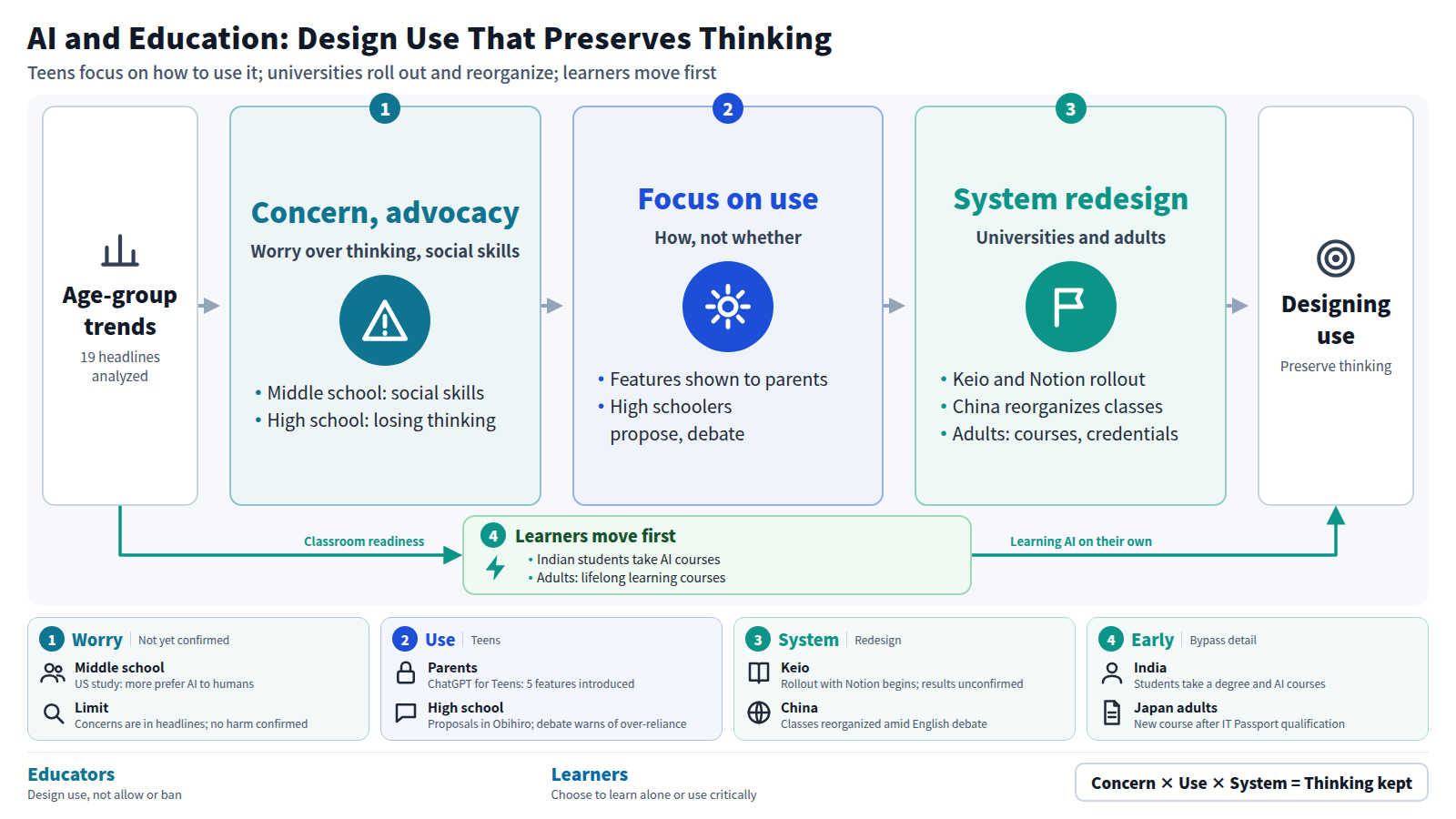
Overview
- The most active groups were high school and university students, with high school students making proposals and discussions about how to use it, and university students making headlines about university-wide introduction and reorganization of classes. - For junior high school students, headlines that raise concerns about the impact on interpersonal interaction and critical thinking stand out. - There are no headings for infants and old age. For adults, this is limited to qualification and lifelong learning courses.
AI Literacy
- The UAE is ranked 6th in the world for AI readiness, with a 243% increase in AI security learning (Fast Company Middle East). The figures are only in the headline, and the target audience and measurement method are unknown. - In India, university students are said to be taking both degrees and AI courses, learning without waiting for classroom support (The Economic Times). - Newspapers in Nigeria discuss the burden of transitioning to an era where society as a whole is required to be AI literate (Independent Newspaper Nigeria). - In Japan, there are no headings that fall under this category.
Early childhood education
No applicable information
Elementary school students
There are no headings that directly address elementary school students. The three cases that fall into this category seem to be aimed at people other than elementary school students from the headlines. - A headline (Newswav) that AI can help people with dyslexia in both education and career. The target age group is unknown. - In China, there is a debate over whether English will become unnecessary due to AI, universities are reorganizing classes, and debates are occurring on social media (Asahi Shimbun). - In Japan, the Kyoto Shimbun published an editorial regarding the relationship between universities and generative AI, calling for its appropriate use for enriching academic studies.
Junior high school students
- A US study found that an increasing number of middle school students "want to interact with AI rather than humans," and there are concerns about the impact on interpersonal skills (SmartNews). At the stage of concern, no impacts have been confirmed. - In Vietnam, the misuse of AI by students and how AI-supported tools can hinder critical thinking was highlighted (Vietnam.vn). - Vietnam's Nghe An province promotes hands-on learning and mastery of digital technology and AI (Vietnam.vn). At the policy/initiative stage, results cannot be seen from the headlines. - In Japan, Professor Fukaya gave a lecture at the Shinsen Project in Okinawa, where he advocated the use of dictionaries to improve vocabulary and the active use of AI (Okinawa Yaeyama Nippo). This is a proposal, not a confirmation of effectiveness.
high school student
- ChatGPT has five features for teenagers, including homework help and screen time management, which were introduced to parents (The Times of India). - There is an opinion that AI for children lacks the attitude to face it seriously (AI: Reset to Zero). - Diamandis said he hopes teens don't have to wait until graduation or college to use AI for things they care about (ababnews.com). - In Japan, the following movements occurred. - At the Obihiro ICT Conference, high school students proposed ways to use AI (Tokachi Mainichi Shimbun). - In a discussion among high school students, the opinion came out that ``If you rely too much, you will lose your ability to think.'' (Asahi Shimbun) - Students from Okayama University held a data science course at Kurashiki Minami High School. The content was to overcome the barrier of English data using generative AI and to experience the usefulness of Mathematics I through the analysis of music data (sanyonews.jp). The implementation can be confirmed, but the learning effect cannot be seen from the headline.
university student
- In Vietnam, an essay has been published stating that universities must change their approach to education in the age of artificial intelligence (Vietnam.vn). - As mentioned above, in India, university students are taking AI courses themselves, and in China, universities are reorganizing their classes. - In Japan, Keio University and Notion have started the university-wide rollout of AI workspaces with the aim of becoming the ``world's best AI campus'' (University Journal Online). This is just a start announcement, but results have not yet been confirmed. An editorial in the Kyoto Shimbun also deals with universities' use of generative AI.
adult
- Vietnam will launch Lifelong Learning Week 2026 with the aim of promoting the acquisition of digital technology and AI (Vietnam.vn). Planning stage. - In Japan, a new course to learn data management skills in the age of AI has begun as a national qualification next to the IT passport (DX Magazine). The results of the course are unknown as the course has just started.
Old age
No applicable information
Remarks from VIPs
There are no headlines regarding Sal Khan (founder of Khan Academy), who is being tracked, and his statements cannot be confirmed. For reference, comments made by Diamandis, who is not on the tracking list, are included in the high school student section.
Integrated analysis: How is lifelong learning changing?
common movements - From junior high school students to university students, there are concerns about the possibility that AI could impair thinking and interpersonal skills, as well as advocacy for its active use. Concerns about ``critical thinking'' among middle school students, opinions that high school students ``lose the ability to think,'' and arguments that AI for children lack rigor are all in the same direction. - University students who take adult courses/qualifications or AI courses on their own show a tendency for learners to take action first without waiting for the system to be in place. Learning options outside of school are increasing.
Different movements depending on the age - For junior high and high school students, the focus is on how to use it (introduction of functions for parents, suggestions and discussions by high school students themselves) rather than whether or not it can be used. - Universities are undergoing organizational design changes such as university-wide introduction (Keio x Notion) and class reorganization (China). - Adults are organized into qualifications and courses.
change in judgment - For educators, the question is not whether to prohibit or allow AI, but how to design ways to use it that preserve the ability to think. - Learners are increasingly deciding whether to learn AI on their own without waiting for a classroom or whether to use it critically. - Many of the concerns are just what is pointed out in the headline, and there is no confirmation of effectiveness or harm in this headline.
Future points of interest
How will Keio University's university-wide rollout of AI workspaces be actually operated and used for learning? 2. Are the concerns expressed by middle school and high school students regarding the use of AI (interpersonal skills and critical thinking) confirmed through research and practice? 3. How will skills such as data management in the age of AI be institutionalized in lifelong learning and new qualification courses?
- AI Literacy Age: Counting The Cost Of Shifting Civilization — Independent Newspaper Nigeria10/04 02:14 UTC
- Degree in one hand, AI course in the other: College students aren’t waiting for classrooms to catch up wit — The Economic Times10/04 02:51 UTC
- UAE ranks sixth globally for AI readiness, with AI security learning up 243% — Fast Company Middle East10/03 14:11 UTC
- AI: A Godsend for those with dyslexia in education and careers — Newswav10/04 06:34 UTC
- Editorial: Universities and Generative AI: Appropriate Utilization for Rich Academic Studies — 京都新聞デジタル10/04 07:00 UTC
- AI doesn’t require English? Education in turmoil in China Universities reorganize classes, debate on social media — 朝日新聞10/03 20:00 UTC
- More junior high school students say they would like to interact with AI more than humans, US study raises concerns about impact on interpersonal skills — SmartNews10/04 08:57 UTC
- Misuse of AI by students: When AI-supported tools inhibit critical thinking. — Vietnam.vn10/04 03:25 UTC
- Professor Fukaya gives a lecture at the Shinsen Project, improves vocabulary with dictionaries and advocates active use of AI — 沖縄八重山日報10/03 20:00 UTC
- Nghe An Province promotes hands-on learning and mastery of digital technology and artificial intelligence. — Vietnam.vn10/04 05:23 UTC
- ChatGPT for Teens: 5 features parents should know about, from homework help to screen time controls — The Times of India10/04 06:18 UTC
- AI: The Missing ‘Tough Love’ in AI for Kids. AI-RTZ #1229 — AI: Reset to Zero10/04 05:02 UTC
- Diamandis: Hope More Teens Use AI for What They Care About, No Need to Wait Until Graduation or College — ababnews.com10/03 22:05 UTC
- How to use AI? High school students propose “ICT conference” in Obihiro — 十勝毎日新聞10/04 06:18 UTC
- How to deal with AI: High school students debate ``If we rely on it too much, we lose the ability to think'' (Asahi Shimbun) — Yahoo!ニュース10/04 01:00 UTC
- [Okayama University] Break through the English data barrier with generative AI! Students conduct a data science course at Okayama Prefectural Kurashiki Minami High School - Experience the usefulness of Mathematics I through analysis of music data - — sanyonews.jp10/03 20:09 UTC
- Keio University and Notion begin university-wide rollout of AI workspaces with the aim of becoming “the world’s best AI campus” — 大学ジャーナルオンライン10/04 04:06 UTC
- Universities in the age of artificial intelligence: We must change our approach to education. — Vietnam.vn10/04 06:14 UTC