AI Ethics News — 2026-10-06 (Tue) Daily News
Source links point to the original outlet. The AI Integrated Analysis is auto-generated from the headlines below only and is not intended to add facts beyond them. Not investment advice.
Overview
- Fairness and responsibility were also discussed, including the point that English-centered evaluations create blind spots in AI, and the point that individuals bear the brunt of errors. - Indication of the origin of products (watermarks) and use in the mental health and medical fields were both reported.
Bias, discrimination, fairness
- DeepMind calls for AI evaluation that takes cultural considerations into account, saying that English-centered bias creates blind spots (CHOSUNBIZ). The measurement method and scale are unclear from the headline. - Substack article argues that when AI gets it wrong, real people pay the price. It is unclear from the headline who suffered what damage.
Privacy/Monitoring
- An article on bioengineer.org criticizes Europe's "Third Way" for justifying the "data sacrifice" of citizens. The target data, whether or not consent was obtained, and the purpose are unclear from the headline.
Transparency/Accountability
- Disclosed: Google DeepMind adds watermark to AI-designed proteins (SingularityHub). An invisible watermark will be added to ChatGPT texts (Android Authority). - Unconfirmed: It is unclear from the headline how watermarks are detected, who can use the detection, and the scope of notification to users. - Regarding responsibility, the Substack article points out that "people pay the price for mistakes" (reposted).
Creator/Copyright/Consent
- Sony Music vs. Platform: The company asked for the removal of over 260,000 AI deepfakes imitating its artists (Rockum, MJVibe, the latter reportedly including Michael Jackson). The issue at issue is the unauthorized imitation of voice and appearance. - Australia's learning data debate: Pearls and Irritations argues that 'long tail' creators should be included in the debate over Australia's AI learning data. - CBA (as written in the article): It was reported that a license has been signed to cover the text of newspaper articles using AI for the workplace (Mediaweek). This is in the form of a license agreement and is based on consent and compensation. Details of the conditions are unknown.
False information/deep fake
- Reported fact: Sony Music requested the deletion of over 260,000 items. - Countermeasure: Watermarking products (ChatGPT text, DeepMind proteins). Validity cannot be confirmed from the headline. - The reality of the damage and the scale of its spread cannot be confirmed from the headline.
Protection of children and vulnerable people
- Mental health chatbots: An article in Vocal points out that even if we understand the culture, we may not understand the crisis itself. The point of contention is the limits of how to respond to users in crisis. - Medical: The American Academy of Pediatrics (AAP) has issued AI guidelines for doctors (UA.NEWS/News-Medical). The content of the guidelines is unclear from the headline. It was AAP that took action.
Ethical principles and guidelines
- What's decided: AAP releases AI guidelines for physicians. - Proposal: DeepMind's call for culturally sensitive evaluation. - Other than the above, there are no new announcements of principles or guidelines in the headings.
Japanese AI ethics
- No relevant information regarding movements of Japanese institutions and companies. - Reference: A Korean newspaper (Mainichi Keizai) reported that AI-generated songs impersonating Harry Styles, Adele, etc. are rapidly increasing, and major record companies are deleting unauthorized songs (local time on the 5th). This is not an issue within Japan.
Remarks from VIPs
There is no relevant information in this headline for statements that fall under the tracking target (Timnit Gebru/DAIR, Fei-Fei Li/Stanford HAI, Yoshua Bengio).
Integrated analysis: How do ethical questions fit together?
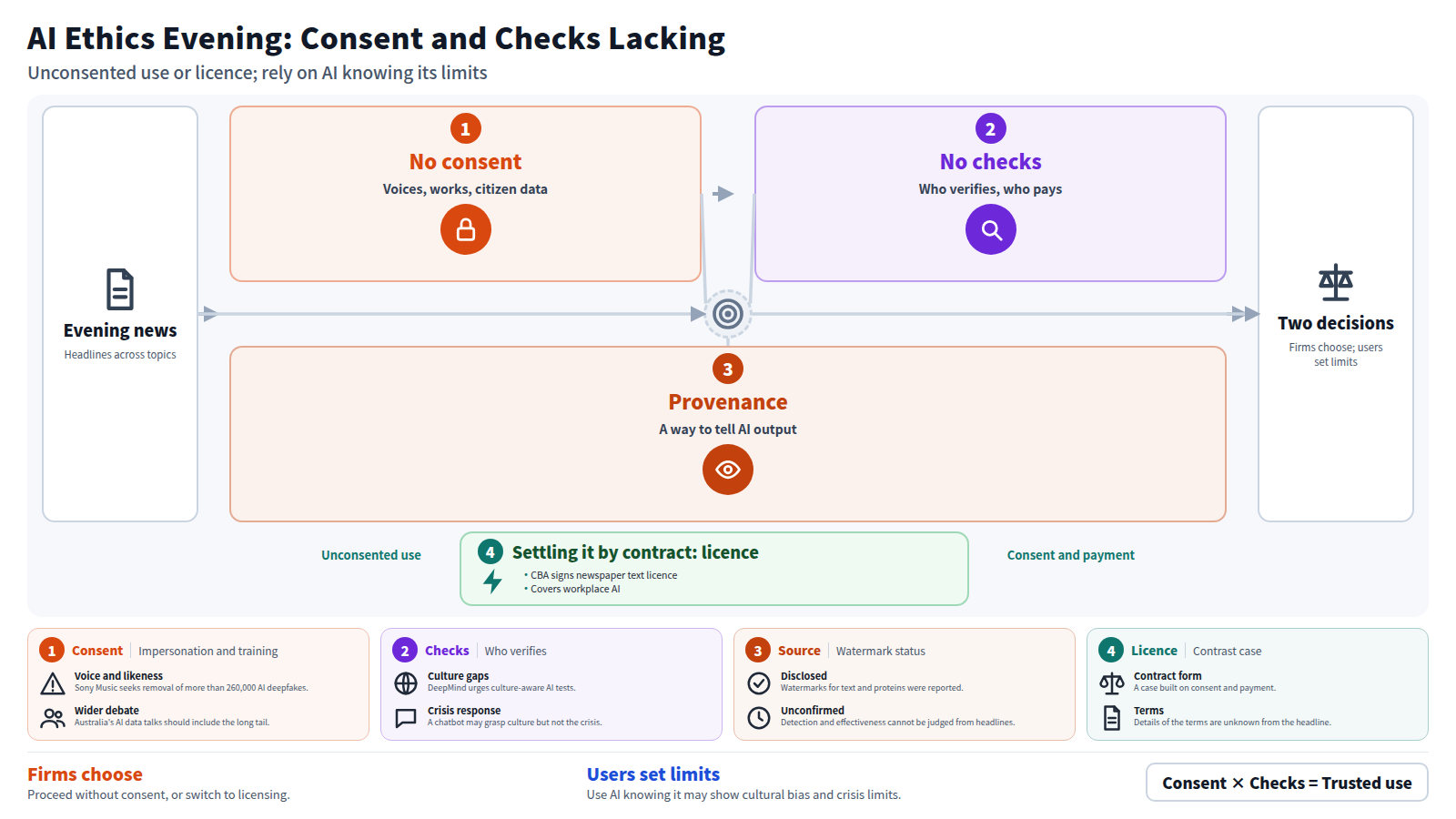
- Lack of consent is common to Sony Music's deletion requests (imitation of voice and appearance without permission), the learning data debate in Australia (concerns about unauthorized use of works), and the criticism of "data sacrifice" in Europe (citizen data). CBA's newspaper license is a contrasting example in which consent and consideration are arranged in a contract. - The lack of explanation and verification is common to the blind spots of English-centered evaluations, the limitations of mental health bots in responding to crises, and the fact that individuals bear the cost of mistakes. In both cases, it is not clear who will conduct the verification and who will be responsible. - In the move towards provenance, watermarks have been reported alongside as a means of making it possible to distinguish products. However, the effectiveness of detection cannot be judged from the headline. - The difference in decision making is for companies to choose whether to proceed with unauthorized use or switch to licensing. For users and medical professionals, the question is whether to use AI based on the premise that the output of AI may have cultural biases or limitations in responding to a crisis.
Future points of interest
Will the scope of deepfake deletion requests expand to rights holders and platforms other than Sony Music? 2. Will permissions for the use of learning data (contracts like the CBA example) become more widespread? 3. Do culturally sensitive ratings and watermarking actually reduce bias and counterfeiting?
- DeepMind urges culture-aware AI tests as English bias fuels blind spots — Chosunbiz10/06 05:03 UTC
- When AI gets it wrong, real people pay the price — Hannah Ferguson | Substack10/05 20:01 UTC
- How Europe's 'Third Way' on AI Justifies Turning Citizens Into Data Sacrifices — bioengineer.org10/06 07:05 UTC
- Sony Music Seeks Removal of More Than 260,000 AI Deepfakes Impersonating Its Artists — Rockum10/06 07:25 UTC
- Are you part of the long tail? Why we should all be part of Australia's AI training data conversation — Pearls and Irritations10/05 22:05 UTC
- CBA signs licence covering newspaper text in workplace AI — Mediaweek10/05 23:05 UTC
- ChatGPT users, your AI-written text will soon carry a hidden watermark — Android Authority10/06 03:38 UTC
- When a Mental Health Chatbot Understands Your Culture — But Not Your Crisis — Vocal10/06 01:54 UTC
- American Academy of Pediatrics issues AI guidance for doctors — UA.NEWS10/06 02:39 UTC