AI & Healthcare News — 2026-10-04 (Sun) Morning News
Source links point to the original outlet. The AI Integrated Analysis is auto-generated from the headlines below only and is not intended to add facts beyond them. Not investment advice.
Overview
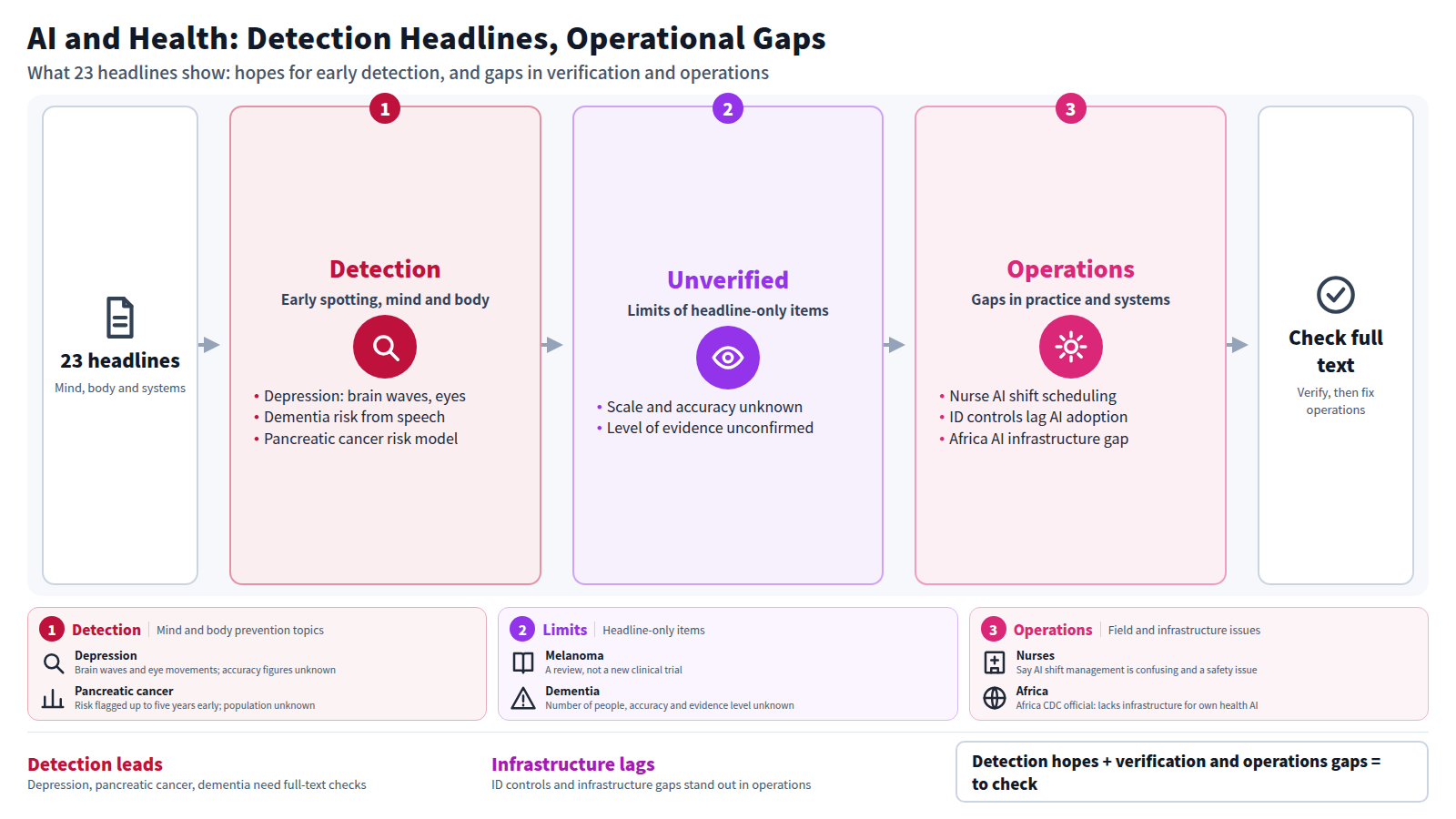
- Mental health: topics related to depression detection (brain waves and eye movements), AI therapy, loneliness and AI. However, the content is only the headline, and the scale of the verification is unknown. - Physical health: Mainly headlines on prevention and early detection, such as pancreatic cancer risk prediction, melanoma prevention, and voice detection of dementia risk. - Mechanism: Operational and infrastructure issues stood out, including safety concerns about AI shift management for nurses, delays in ID management in the medical field, and a lack of health AI infrastructure in Africa.
Mental health
- Detection of depression: Research using AI to read brain waves and eye movements to identify depression (Bioengineer.org). It says "new precision," but the numbers, number of people targeted, and stages are unclear from the headline. - AI Therapy: “Your AI Therapist Will See You Now” (Psychology Today). It appears to be a commentary/explanation, and the content of the verification of effectiveness is unknown. - Loneliness: TEDxIEMSaltLake 2026 (The Tribune) focused on loneliness and human connection in the age of AI. This is an event report, and there is no information on measurement or verification. - Note: Mayo Clinic's radiotherapy and Generate Biomedicines' CAR T trials are cancer treatments and are not covered as they are separate subjects.
Exercise/physical activity
- No direct relevant information. - Reference: Welldoc announces "AI-powered care loop," Duke University launches digital twin program (Fierce Healthcare). Since the details are unknown, we will only touch on it in the section on chronic diseases.
sleep
- No information on sleep detection/improvement. - Neurable releases AI headphones ($499) that read brain waves (HotHardware). There is no mention of sleep in the headline, and no improvement is shown. This is a product release report.
Nutrition/meal
- No applicable information. (Articles about AI in grocery stores and household finances are not included because they do not show the effects of diet or health.)
Prevention/Medical checkup
- Pancreatic cancer: New AI model could identify risks up to five years in advance, reports MedicalNewsToday. The target population, accuracy, and level of evidence are unclear from the headline. - Melanoma: A review of AI screening and aspirin as new prevention topics (Bioengineer.org). This is a review, not a new clinical trial. The effectiveness of aspirin cannot be determined from the headline. - Discussion forum: Panel event to discuss the role of AI in healthcare (Cayman Compass).
Self-management of chronic diseases
- Welldoc announces “AI-powered care loop” (Fierce Healthcare). The target disease and verification details are unclear from the headline. - No other relevant information.
Elderly people/nursing care
- Dementia: Research shows that AI can detect dementia risk from the way you speak (The Eastleigh Voice). The number of people targeted, accuracy, and level of evidence are unknown. - No direct information regarding the burden on caregivers and monitoring. - Surroundings: The increase in nuisance calls from AI automated voices (fox19.com) may have been reported as a concern for people, including the elderly, but it cannot be determined from the headline. - The SMU-Fudan Forum (New Fortune Times), which asks "What does it mean to live well with AI?", is a forum for discussion.
Digital treatment/regulation
- Africa (Africa CDC): Officials say the region lacks the infrastructure to operate its own health AI (The New Times). - USA: AION Biosystems advances to the semi-finals of the 2026 Digital Health & AI Awards (IndyStar). This is an award, not an approval or regulatory judgment. - No itemized information on regulatory approvals, guidelines, or insurance treatment.
Workplace health
- Nurses: AI-based shift management is causing confusion, and nurses say it's a safety issue (WIRED). The voices of the people on the ground are being heard in terms of both systems and operations. The specific number and scale of the incidents is unclear from the headline. - Identity management at medical institutions: Report that ID controls have not kept pace with AI implementation (Campus Security Today). - “AI-Enabled Mission Command” in the military field is not subject to this division.
Japanese movements
- Digital Minister Furukawa mentioned promoting the development of specialized AI (Yanbaru Keizai Shimbun). The link to the health field is unclear from the headline. - An article in Vietnamese media (Vietnam.vn) about preventive measures to protect health and mental well-being against AI-generated short films is not a Japanese initiative. - No relevant information regarding health AI movements by ministries, local governments, and insurers.
Remarks from VIPs
- Tracked list is empty. No applicable information. - (Reference) Philosopher Eric Sadin said, "AI smells like death" (EL PAÍS English). It is not being tracked, and it is unclear whether it describes the effects on health.
AI video/commentary
- No applicable information. Points to note - This time, most of the information is just headlines, and it is not possible to confirm the level of evidence such as sample size, accuracy, and whether or not randomization was performed. Three items related to detection of depression, pancreatic cancer, and dementia require confirmation in the main text.
- Ask Mayo Clinic: AI and proton therapy are reshaping how doctors treat cancer with radiation — PennLive.com10/03 13:00 UTC
- AI Reads Brain Waves and Eye Movements to Spot Depression With New Accuracy — Bioengineer.org10/03 14:53 UTC
- Your AI Therapist Will See You Now — Psychology Today10/03 13:52 UTC
- TEDxIEMSaltLake 2026 explores loneliness and human connection in the era of AI — The Tribune10/03 09:27 UTC
- Generate Biomedicines and Roswell Park dose first patient in AI-designed CAR T therapy trial for ovarian cancer — Dealroom10/02 06:08 UTC
- Your Grocer Has AI. You Have a Budget. Guess Who’s Winning. — Substack10/03 13:34 UTC
- Eric Sadin: ‘AI reeks of death’ — EL PAÍS English10/01 19:57 UTC
- Neurable Launches $499 AI Headphones That Read Brain Waves — HotHardware10/02 14:38 UTC
- AI’s role in healthcare discussed at panel event — Cayman Compass10/02 05:01 UTC
- New AI model may identify pancreatic cancer risk up to 5 years early — MedicalNewsToday10/03 15:18 UTC
- AI Screening and Aspirin Emerge as New Fronts in Melanoma Prevention Review — Bioengineer.org10/03 15:24 UTC
- AI may detect dementia risk through a person’s speech, study finds — The Eastleigh Voice10/03 14:30 UTC
- Why the retirement wave could be government’s AI moment — The World Economic Forum10/02 12:49 UTC
- AI-generated robocalls? Why you could be seeing even more unwanted phone calls — fox19.com10/03 17:24 UTC
- Beyond Productivity: SMU-Fudan Forum Asks What It Means to Live Well with AI? — New Fortune Times10/03 15:50 UTC
- AION Biosystems Named Quarterfinalist in the 2026 Digital Health & AI Awards — IndyStar10/02 22:42 UTC
- Africa CDC official: Continent lacks infrastructure to run its own health AI| The New Times — The New Times10/03 12:20 UTC
- AI-Enabled Mission Command — RealClearDefense10/03 11:00 UTC
- AI Is Making a Mess of Nurses’ Schedules. They Say It’s a Safety Issue — WIRED10/02 09:30 UTC
- Report Finds Healthcare Identity Governance Lagging AI Adoption — Campus Security Today10/02 08:48 UTC
- Precautions to protect personal health and mental well-being in the face of AI-generated online short films. — Vietnam.vn10/03 08:19 UTC
- Promoting the development of specialized AI Digital Minister Furukawa — やんばる経済新聞10/02 13:48 UTC
- Even though Jung Hyun-moo denied the rumor that his wealth is 60 billion won...AI also said, ``Annual income is very high'' [Jung Hyun-moo plan] — starnewskorea.com10/02 12:48 UTC