1. Papers that read well in pieces but do not hold together
Low-quality AI-generated content has acquired a name: AI slop. In academia it shows up in draft papers and review comments alike, and it is no longer unusual.[1]
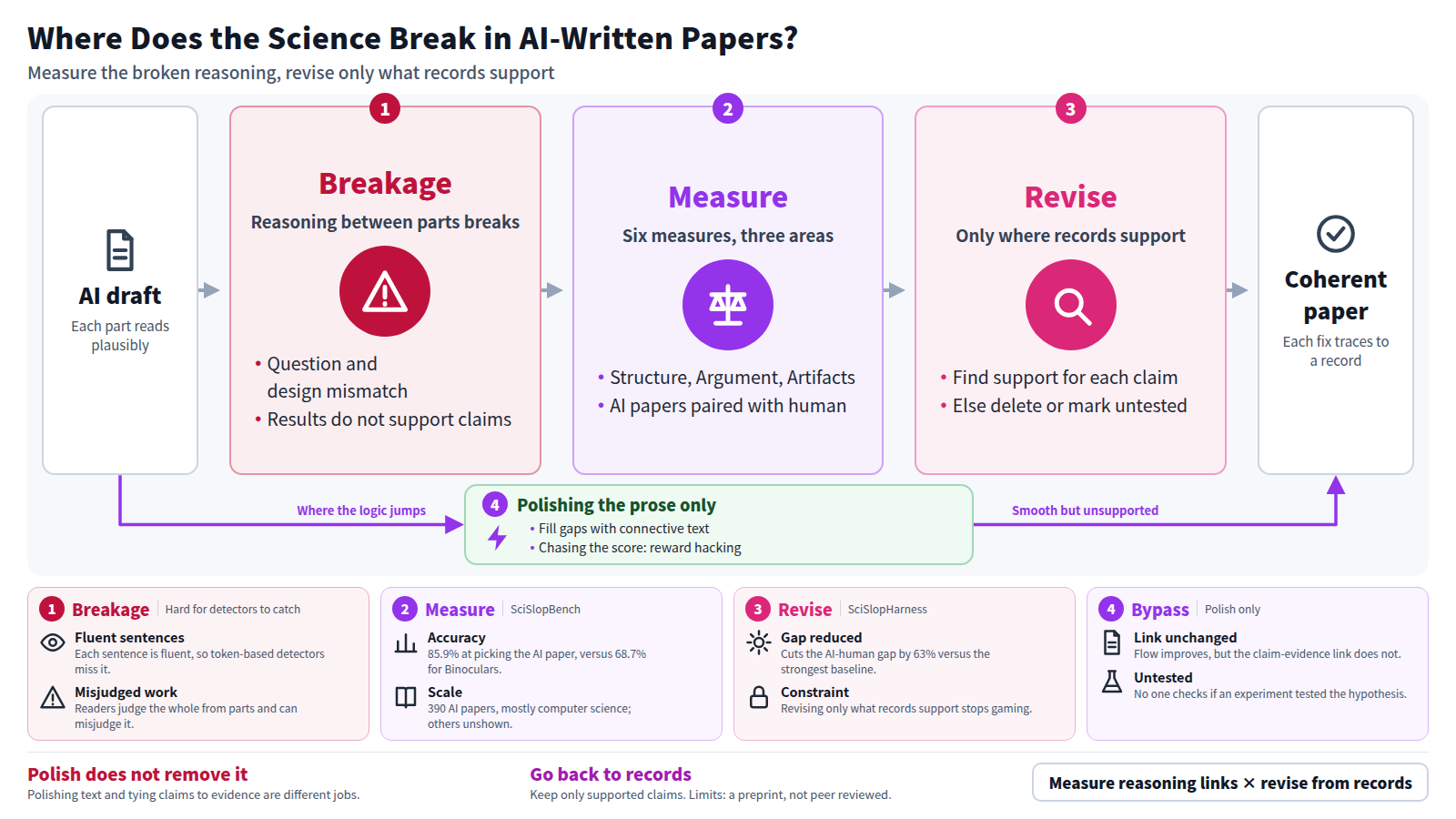
For scientific papers, though, the problem goes beyond awkward wording. In the authors' framing, an AI-generated paper can have sections that each look plausible while the scientific reasoning linking them breaks down. The research question in the introduction does not match the experimental design. The numbers in the results do not actually support the claims in the conclusion. Readers tend to judge the whole from the quality of the parts, so this kind of breakage can mislead how they assess the work.
The authors argue that existing token-based AI detectors have trouble catching it, because every individual sentence is fluent. The primary source is an arXiv preprint and has not yet been peer reviewed.
2. The core idea: measure how the paper connects
The method comes down to one move: measure the reasoning that connects the whole paper, not the surface of the text. The authors define scientific slop through six measures across three areas: Structure, Argument, and Artifacts. The abstract does not define each measure, but the names suggest checks on how the paper is organized, whether claims match their support, and whether artifacts such as figures and code match the text.
To measure it, they build SciSlopBench: 390 AI-generated papers, mostly in computer science but also spanning the life, social, and natural sciences. Each one is paired with a human-written paper matched by research problem and contribution type, so that an AI paper and a human paper on the same question can be compared directly.
To reduce slop, they propose SciSlopHarness, a harness-level framework that guides a fixed LLM to revise only where the experiment records support the change.
3. What the abstract reports
First, when the six measures are used to pick which paper in each pair is the AI one, they are right 85.9% of the time. The Binoculars detector, used as a comparison, reaches 68.7%.[4] The authors read this as evidence that looking at reasoning is more discriminating than looking at statistical quirks of the text.
Second, slop tracks how human reviewers judged papers. Higher slop accompanies lower ICLR ratings, and the measures separate rejected from accepted papers above chance in every year from 2017 to 2025.
Third, reducing slop turns out to be hard. Optimizing the measures directly does not work. Standard revisions leave residual slop, and prompting the model directly to avoid slop triggers reward hacking: rewrites that improve the score without fixing the reasoning. SciSlopHarness, by contrast, reduces the remaining AI-human gap by 63% relative to the strongest revision baseline, without needing human-written reference papers as targets. The code is public on GitHub.[3]
4. A worked example: polish the prose, or go back to the records?
Consider an internal review of the discussion section in a study report that an AI drafted. "Fixing" it can mean two quite different things.
Polishing the prose
Where the logic jumps, add connective sentences. Inserting "These results are consistent with the hypothesis stated above" makes the section read more smoothly. But nobody has checked whether an experiment testing that hypothesis was actually run. The flow improves; the link between claim and evidence does not. Revising against a quality score tends to produce exactly this.
Going back to the records
Pull out each claim in the discussion and look for its support in the lab notebook or analysis logs. Claims with support are rewritten to match the record. Claims without support are deleted or explicitly marked as untested, not reworded. It takes longer, but every revised sentence can be traced back to a record.
SciSlopHarness follows the right-hand approach. The authors present the constraint of revising only what the records support as the thing that keeps the model from gaming the measures.
5. What is not new, and what the abstract does not tell us
Detecting AI-written text is a crowded field. Binoculars, which separates human and machine text by contrasting two closely related language models, was proposed as a detector that needs no training data.[4] Checking a paper's structure and the match between claims and evidence is also an old part of peer review. The contribution here is to define the breakdown of reasoning in AI-generated papers and make it measurable through paired comparison, and to require evidentiary grounding on the revision side.
The limits are considerable. First, the abstract does not define the six measures or explain how they are computed; if an LLM does the judging, its own biases enter the results. Second, we do not know how the matched human papers were chosen. Third, the link to ICLR ratings is a correlation and does not show that slop caused lower ratings. Fourth, most of the 390 papers are in computer science, and the abstract does not show how far the results carry into other fields. Fifth, the detection accuracy comes from a paired setting, where the task is to say which of two papers is AI-written; how the measures behave on a single paper with no pair is a different question.
There is also a risk that these measures get used to decide whether someone used AI. Human-written papers can have broken reasoning too. What the measures detect is a breakdown in reasoning, not the origin of the text, and confusing the two could lead to unfair suspicion of authors.
6. A single paper, not a cluster
The paper drew 54 upvotes on Hugging Face Daily Papers, and its repository has 13 stars.[2] In this site's selection, only the reader-vote signal fired; neither implementer stars nor press coverage reached the threshold. An upvote is a vote that something is worth reading. It is not a statement that the method is correct.
No cluster has formed around the question either. The cluster size is 1: none of the other collected papers addressed the same topic. Research on the quality of AI-written papers and AI-assisted reviewing is growing, but this specific question, how to measure whether scientific reasoning holds together, is not yet surfacing across several groups at once.
The paper is still worth covering because its conclusion applies well beyond academic publishing. Polishing text and reconnecting claims to evidence are different jobs, and that distinction matters anywhere AI drafts documents.
7. What connects to pharma and regulatory work
Pharmaceutical teams are exploring AI drafting for clinical study reports, summaries in submission dossiers, and manuscripts. The failure that matters most in those documents is precisely the one this paper describes: each section reads well, but an efficacy claim is not supported anywhere in the analysis results. In regulatory documents that kind of error is not acceptable.
Two practices follow. One is to review AI drafts by tracing each claim back to its source data rather than by checking how the text flows. Confirming that every claim can point to a table or log is consistent with established quality-control thinking. The other is to avoid making the review metric itself the target of revision. Ask a model to rewrite until a quality score improves, and the score will improve. The reward hacking reported here can happen with internal quality metrics as well.
The evaluation in this paper was mostly on computer science papers, and it does not show the same effect on regulatory documents. This review, too, is limited to what the preprint's abstract states.