AI & International Politics News — 2026-10-05 (Mon) Evening News

Source links point to the original outlet. The AI Integrated Analysis is auto-generated from the headlines below only and is not intended to add facts beyond them. Not investment advice.
Overview
- It was reported that a document in the field of AI and defense was signed at the summit meeting between Japan and India. - It has been reported that the gap in AI performance between the US and China has narrowed, and there are also commentaries discussing the US response. - NATO has reportedly drafted a plan to counter a Russian attack using drones and AI.
Competition between the US and China
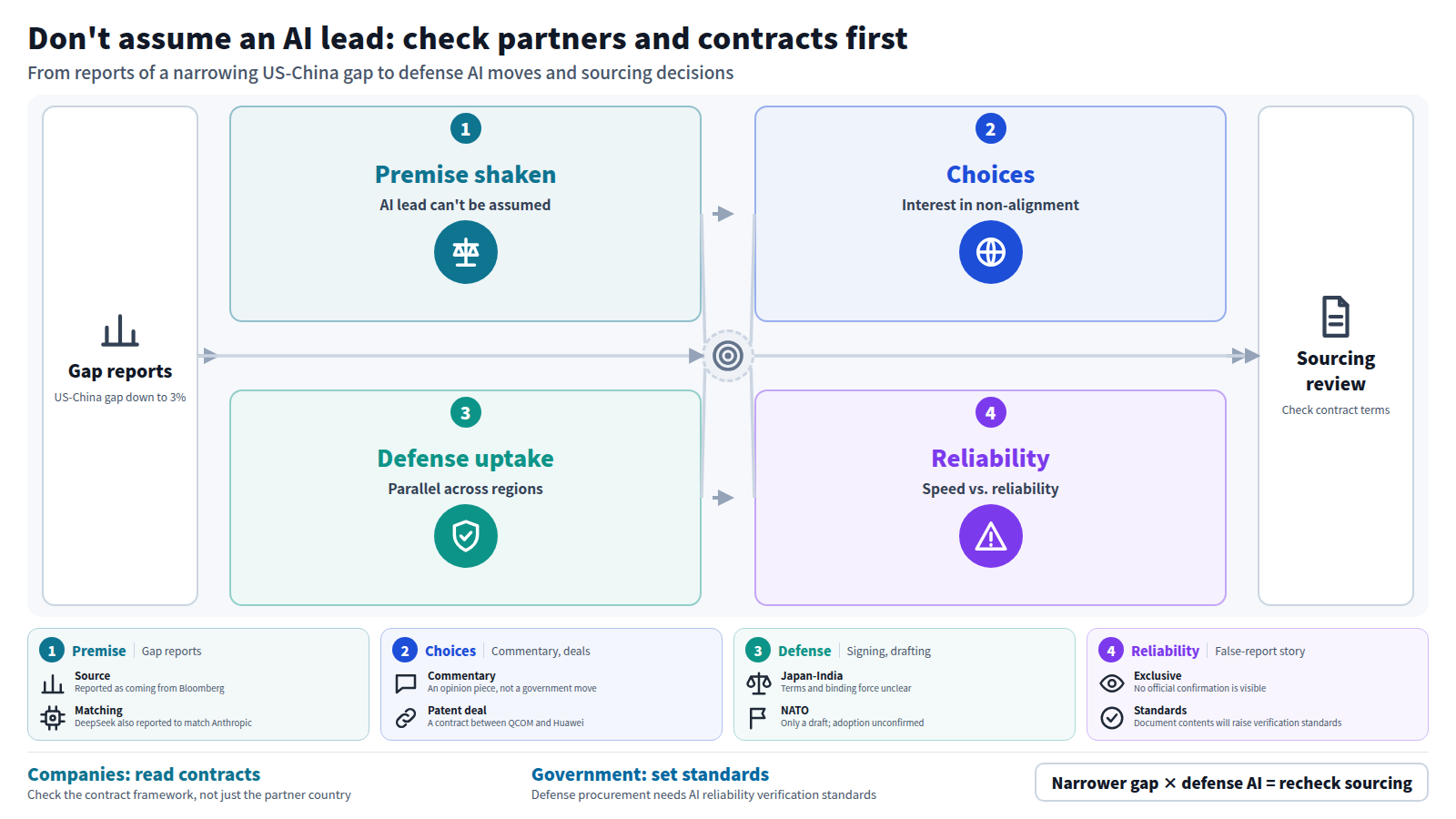
- Performance gap: Bloomberg reports that the gap in AI performance between the US and China has narrowed to 3%. It is also reported that DeepSeek has matched Anthropic's performance (finance.biggo.com, Startup Fortune). All of these are descriptions from the headlines, and the measurement method is unknown. - Commentary from the US side: South China Morning Post's "My Take" describes Dario Amodei's claims as "American AI imperialism." This is a commentary, not a government move. - Business-to-business transactions: QCOM reportedly signed a patent agreement with China's Huawei covering AI chip technology (TradingView). It is a contract between companies, not an agreement between the two governments. - Others: "The AI Non-Aligned Movement" (myRepublica) appears to be an article that discusses positions that do not belong to either the US or China. The text has not been confirmed. - It is not clear from the headlines how the Chinese or US governments responded to each other's moves.
International organizations/international agreements
- "AI, the UN, Xi and Trump" (The Information) appears to be an article dealing with the relationship between the United Nations and the leaders of the United States and China. It is not possible to judge from the headline alone whether this is an agreement or a negotiation, or which countries are participating. - “The AI Race Is Becoming a Race to Turn Capability Into Power” (HackerNoon) is a commentary, not a report on consensus or consultation. - There is no heading indicating that an agreement has been reached by an international organization.
Diplomacy/Summits/Alliance
- India-Japan Summit 2026: Participants included Prime Minister Modi and Sanae Takaichi. It was reported that a major document on AI and defense was signed. This corresponds to a signature. The terms, scope, and binding force are unclear from the headline. - NATO: reportedly drafted a plan to repel Russian attacks with drones and AI (Bloomberg). This is a concept at the drafting stage, and adoption or agreement cannot be confirmed.
Security/Military
- Concept: NATO's draft plan mentioned above. - Operational Issues: The U.S. military has reportedly faced a crisis over false intelligence reports generated by AI, based on an anonymous source (machinelearningweek.com). This is an exclusive report, and official confirmation from the authorities is not clear from the headline. Treat it as unconfirmed information. - Commentary: The Strategist (ASPI) published multiple views on military AI and autonomous systems. It's not a policy move. - There are no headings to confirm actual deployment.
Election/information warfare
No applicable information
Export regulations and negotiations between countries
- There are no headlines indicating the imposition or relaxation of export restrictions by the government. - In a related move, digitimes provides a weekly summary of capacity expansion and geopolitical risks due to demand for AI semiconductors. There are no specific country names or measures in the headline. - QCOM and Huawei's patent agreement marks a trade in AI chip technology between US and Chinese companies. The relationship with regulations is unclear from the headline.
Japanese diplomacy and AI
- It was reported that agreements were signed in both the areas of AI and defense at the Japan-India summit meeting. Details of the content have not been confirmed. - There are no headlines indicating how Japan will be involved in the U.S.-China AI competition or NATO efforts.
Remarks from VIPs
- Narendra Modi (Prime Minister of India): It was reported that he signed a document on AI and defense at the Japan-India summit meeting with Sanae Takaichi. The content of the statement itself is not in the headline. - António Guterres (Secretary General of the United Nations), Emmanuel Macron (President of France): No applicable information.
Integrated analysis: How are international relations moving?
- The performance gap between the United States and China and the choices each country makes: Reports that the performance gap has narrowed to 3% shakes the premise of maintaining an advantage in AI capabilities. At the same time, commentaries that critically discuss the US strategy (SCMP) and articles that discuss a non-aligned position (myRepublica) are appearing, suggesting that interest in options that do not depend on either the US or China may be increasing. However, this is an inference based on the headline. - Japan-India signing and military AI moves: The Japan-India signing on AI and defense and NATO drafting a defense plan to use AI indicate that moves to incorporate AI into defense systems are parallel in multiple regions. On the other hand, unconfirmed reports regarding U.S. military AI misinformation indicate that speed of introduction may not be compatible with ensuring reliability. - Points where Japanese companies and governments change their decisions: - Companies: AI chip technology transactions and patent agreements are taking place between US and Chinese companies. When deciding on procurement sources and technical alliances, it is necessary to check the contract framework in addition to trends in the partner country. - Government: If the contents of the Japan-India document are revealed, it will raise questions about the standards for verifying the reliability of AI in defense procurement and joint development.
Future points of interest
Specific contents of the Japan-India document (target areas, binding force, implementation structure). 2. Whether NATO's draft plan will be adopted and how member states will respond. 3. How will the US and Chinese governments and companies respond to reports of performance differences between the US and China?
- The AI Non-Aligned Movement — myRepublica10/05 01:08 UTC
- NATO Drafts Plan to Defeat a Russian Attack With Drones and AI — Bloomberg.com10/05 07:59 UTC
- Exclusive: US military had close call after using AI for false intelligence report, sources say — machinelearningweek.com10/05 09:07 UTC
- Military AI and autonomous systems: views in The Strategist — The Strategist | ASPI's analysis and commentary site10/05 08:25 UTC
- The AI Race Is Becoming a Race to Turn Capability Into Power — HackerNoon10/05 08:19 UTC
- AI, the UN, Xi and Trump — The Information10/04 23:44 UTC
- U.S.-China AI Gap Narrows to 3% as DeepSeek Matches Anthropic's Performance — finance.biggo.com10/05 06:35 UTC
- QCOM Gains Overnight After Patent Deal With China’s Huawei Covering AI Chip Tech — TradingView10/05 07:40 UTC
- Weekly news roundup: Musk looms large as AI chip boom drives capacity expansion and geopolitical risks — digitimes10/05 01:20 UTC
- My Take | Dario Amodei’s American AI imperialism — South China Morning Post10/04 21:30 UTC
- India-Japan Summit 2026: PM Modi and Sanae Takaichi Sign Major AI, Defense Pacts — The Indian Awaaz10/04 17:28 UTCNarendra Modi / Prime Minister of India