AI & Education News — 2026-10-05 (Mon) Evening News

Source links point to the original outlet. The AI Integrated Analysis is auto-generated from the headlines below only and is not intended to add facts beyond them. Not investment advice.
Overview
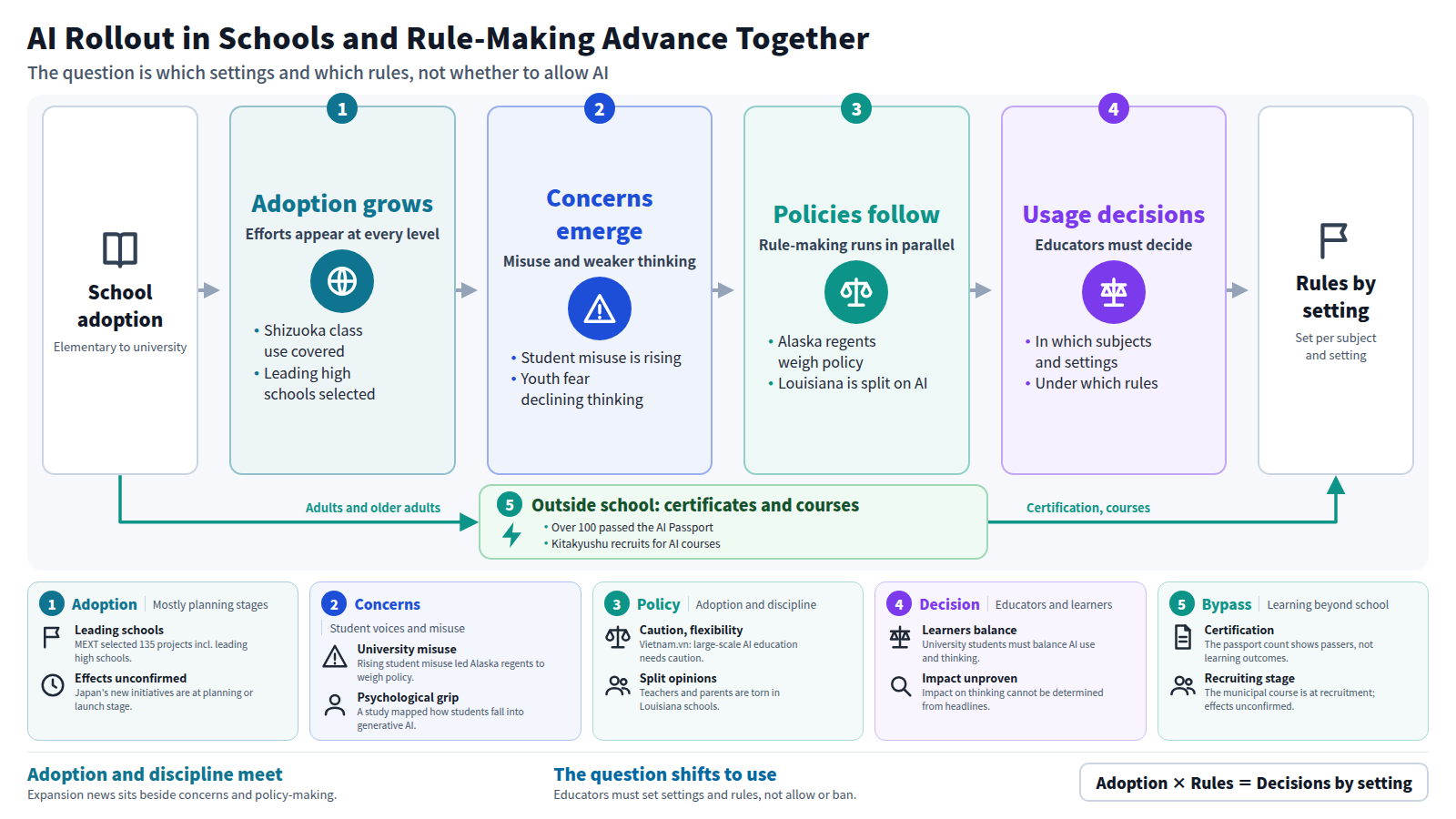
- The expansion of its introduction into schools, from elementary school students to university students, was reported at the same time as concerns about misuse and a decline in thinking ability, and the development of policies. - In Japan, there have been reports on the selection of high schools as leading schools for reform, the start of development of 24-hour learning support AI at universities, and the use of elementary school classes. - Headlines included qualifications (generated AI passports) for adults and recruitment for local government courses for the elderly.
AI Literacy
- An article related to the University of Helsinki in Finland argues that AI skills should be taught in schools and other educational institutions. - Cyber Daily editorial cites breaches by rogue agents in Medicare and argues that AI literacy and operational capabilities are important for lawyers. - Minding The Campus reports that higher education continues to undergo trial and error in response to AI, and Faculty Focus deals with balancing "preparing for AI" and "resisting AI." - Vietnam.vn says that large-scale introduction of AI education in schools requires caution and flexibility. - In Japan, the CEO of US Coursera stated in the Nikkei Shimbun that ``demand for AI education is expanding in Japan.'' This is the view of corporate leaders, and there are no numbers in the headlines to support the increase in demand.
Early childhood education
- In Japan, a nursery school in Takamatsu used AI images and obstacles to make earthquake evacuation drills more realistic. This is an initiative that has already been implemented, but the effects cannot be seen from the headline. - In Japan, SHIFT AI released a free seminar video on ``How to use generation AI for children and decide rules at home'' (for families). - In Japan, Kyoshin has applied for a patent for AI-based interpersonal service support technology in the education and nursing care fields (disclosed on October 5, 2026). At the application stage, it is not possible to confirm the applicability or effectiveness for young children from the headline. - No relevant information regarding overseas movements.
Elementary school students
- South Korea is teaching robotics and coding to elementary school students as part of a huge investment to become an AI superpower to rival the US and China (Al Jazeera). - In the US, ``AI-PLAY'', which turns body movements into AI learning, has been announced. The headline is in the future tense, and implementation and effects have not been confirmed. - In Vietnam, it was reported that the large-scale introduction of AI education in schools requires caution and flexibility. - In Japan, an attempt to utilize generative AI in classes in Shizuoka was covered, including how it was used for each subject and the response. - In Japan, Ryobi Systems will hold an SE work experience using AI for elementary school students on November 15th. This is in the planning stage.
Junior high school students
- Haiphong City in Vietnam has opened an AI experiential learning facility for junior high school students. Although we can confirm that it has been established, the learning effects cannot be seen from the headline. - In Japan, nine teachers presented their ideas for using generative AI as "accompanying guides" at the Gemini for Education ideathon. This is a presentation of an idea, not a confirmation of the effectiveness of practice.
high school student
- In the US state of Louisiana, teachers and parents are divided over the spread of AI in schools. - A study was reported that organized the psychological path by which students become addicted to generative AI. The target age group is unclear from the headline, but there is a possibility that it will involve high school students and above. - In Japan, the Ministry of Education, Culture, Sports, Science and Technology has adopted 135 projects including lead schools for high school education reform. This includes on-campus public cram schools and the use of AI. The adoption is at the policy/planning stage, and the results will be confirmed in the future.
university student
- The University of Alaska's Board of Regents is considering its AI policy following an increase in student abuse. - In Japan, it was reported that an AI course at a U.S. university where students would study Descartes and Rousseau, and young people feared that their thinking ability would decline. - In Japan, Kyoto Sangyo University has begun developing a 24-hour "study support AI" that accompanies each student as they learn. Effects have not been confirmed at the initial stage of development. - In Japan, a university of science and technology was opened in Ankara in cooperation with Japan and Türkiye. The aim is to develop earthquake countermeasures and AI human resources. This is a presentation of goals and results have not been confirmed.
adult
- In Japan, over 100 people passed the "Generated AI Passport" on mediba. This is the number of people who have acquired qualifications, and the headline does not indicate the learning outcomes or how they will be used in the workplace. Human resource development in the workplace is subject to a separate section. - No relevant information regarding overseas movements.
Old age
- In Japan, Kitakyushu City is recruiting participants for an AI/digital course to expand their second career. At the recruitment stage, the track record and effects of the course have not been confirmed. - In Japan, the Educational AI Utilization Association cooperated in the production of the ``Nikosuma Reuse Promotion Project.'' The headings are aimed at children's learning, and the relationship with old age cannot be understood from the headings.
Remarks from VIPs
- There is no relevant information in the headline regarding Sal Khan (founder of Khan Academy).
Integrated analysis: How is lifelong learning changing?
common movements - Introduction and discipline development are progressing at the same time. This is common to elementary school students (Vietnam's cautious argument), high school students (Louisiana's pros and cons), and university students (University of Alaska's policy review), and the item on literacy is also included along with the argument that it should be taught in schools. - In Japan, many new initiatives are in the planning, development, and launch stages, such as high school selection as a leading school, university study support AI development, and elementary school classroom coverage. No examples of confirmed effectiveness can be found within the scope of the heading.
Different movements depending on the age - For toddlers and elementary school students, the focus is on stories in which adults decide the rules. Examples include rule-making seminars for families and the provision of hands-on and programming opportunities. - Junior high and high school students are interested in teachers' ideas for utilization, the development of facilities and systems, and psychological dependence on utilization. - Among university students, many students voiced concerns about how to deal with fraudulent use and a decline in thinking ability. On the other hand, there are also moves by universities to design learning support, such as 24-hour learning support AI. - Regarding adulthood and old age, the focus is on providing opportunities for learning and frameworks for certification, such as qualifications and municipal courses.
Points where judgment changes - Teachers now need to decide not whether or not to use AI, but in what subjects and situations and under what rules. - Learners (university students, etc.) are forced to make decisions that balance the convenience of AI with maintaining their own thinking ability. However, the impact on thinking ability cannot be determined from the headline.
Future points of interest
How is AI utilization actually implemented at the high schools selected by the Ministry of Education, Culture, Sports, Science and Technology, and what is confirmed? 2. How will universities' AI policies (such as the University of Alaska) and Kyoto Sangyo University's development of learning support AI progress? 3. How will rules created for homes and schools be reflected in use by elementary school students and younger? We will also take a look at whether we are entering the stage where the effects are being verified.
- Op-Ed: The rogue agent breach of Medicare highlights the importance of AI literacy and fluency for lawyers — Cyber Daily10/05 04:01 UTC
- “AI skills must be taught in schools and other educational institutions” — Helsinki.fi10/05 05:29 UTC
- Higher Ed Is Still Muddling Through AI — Minding The Campus10/05 04:00 UTC
- Holding an AI Ready AI Resistant Mindset — facultyfocus.com10/05 04:07 UTC
- Large-scale introduction of AI education in schools: Caution and flexibility required. — Vietnam.vn10/05 08:03 UTC
- Coursera CEO Greg Hart: ``Demand for AI education is growing in Japan'' — 日本経済新聞10/04 20:00 UTC
- Kyoshin [4735]: Kyoshin files patent application for interpersonal service support technology using AI in education and nursing care fields October 5, 2026 (timely disclosure): Nikkei Company Information DIGITAL — 日本経済新聞10/05 04:00 UTC
- How do you decide the rules at home when using generation AI for children? SHIFT AI releases seminar videos for free — こどもとIT10/05 06:00 UTC
- Realistic earthquake evacuation training at Takamatsu nursery school using AI images and obstacles | Shikoku Shimbun WEB morning edition — 四国新聞10/04 19:00 UTC
- Leap and learn: AI‑PLAY to turn movement into AI lessons — Mainstreet Daily News Gainesville10/04 23:13 UTC
- South Korea is investing almost $900bn to rival China and the US as an AI superpower. To ensure enough home-grown talent, primary school children are taught robotics and how to code. Credits: Al Jazeera’s Jack Barton — LinkedIn10/05 03:39 UTC
- Implementing AI education on a large scale in schools: Caution and flexibility are necessary. — Vietnam.vn10/05 08:05 UTC
- [Forefront of Reform] Use generative AI in classes! ? How should it be used in which subjects? What's the reaction? Covering trials in the educational field (Shizuoka) — Yahoo!ニュース10/05 08:49 UTC
- SE work experience using AI Event for elementary school students November 15th Ryobi Systems Fujisaki Office (Okayama City) — 47news.jp10/05 07:14 UTC
- Teachers, parents torn as AI expands in Louisiana schools: ‘What are these digital tools?’ — shreveportbossieradvocate.com10/05 09:00 UTC
- Why Students Fall Into the Grip of Generative AI: New Study Maps the Psychological Pathways — Bioengineer.org10/05 04:29 UTC
- Ministry of Education, Culture, Sports, Science and Technology selects 135 projects including leading schools for high school education reform, including in-school public cram schools and the use of AI — 月刊私塾界10/05 07:48 UTC
- University of Alaska regents weigh AI policy as student misuse increases — Anchorage Daily News10/04 18:22 UTC
- Young people fear decline in thinking ability as US university takes AI course to study Descartes and Rousseau — Yahoo!ニュース10/05 07:00 UTC
- Japan and Türkiye collaborate to open science and technology university in Ankara to develop human resources for earthquake and AI — 中日新聞Web10/05 06:36 UTC
- Kyoto Sangyo University begins development of 24-hour “study support AI” that provides optimal “learning accompaniment” for each student — ICT教育ニュース10/05 04:35 UTC
- mediba exceeds 100 successful applicants for “Generated AI Passport” — ニコニコニュース10/05 06:21 UTC
- Recruiting participants for AI/digital course to expand your second career — city.kitakyushu.lg.jp10/05 02:05 UTC
- Educational AI Utilization Association collaborates in the production of the “Nikosuma Reuse Promotion Project” that will help children learn — 時事ドットコム10/05 05:46 UTC