AI & International Politics News — 2026-10-16 (Fri)

Source links point to the original outlet. The AI Integrated Analysis is auto-generated from the headlines below only and is not intended to add facts beyond them. Not investment advice.
Overview
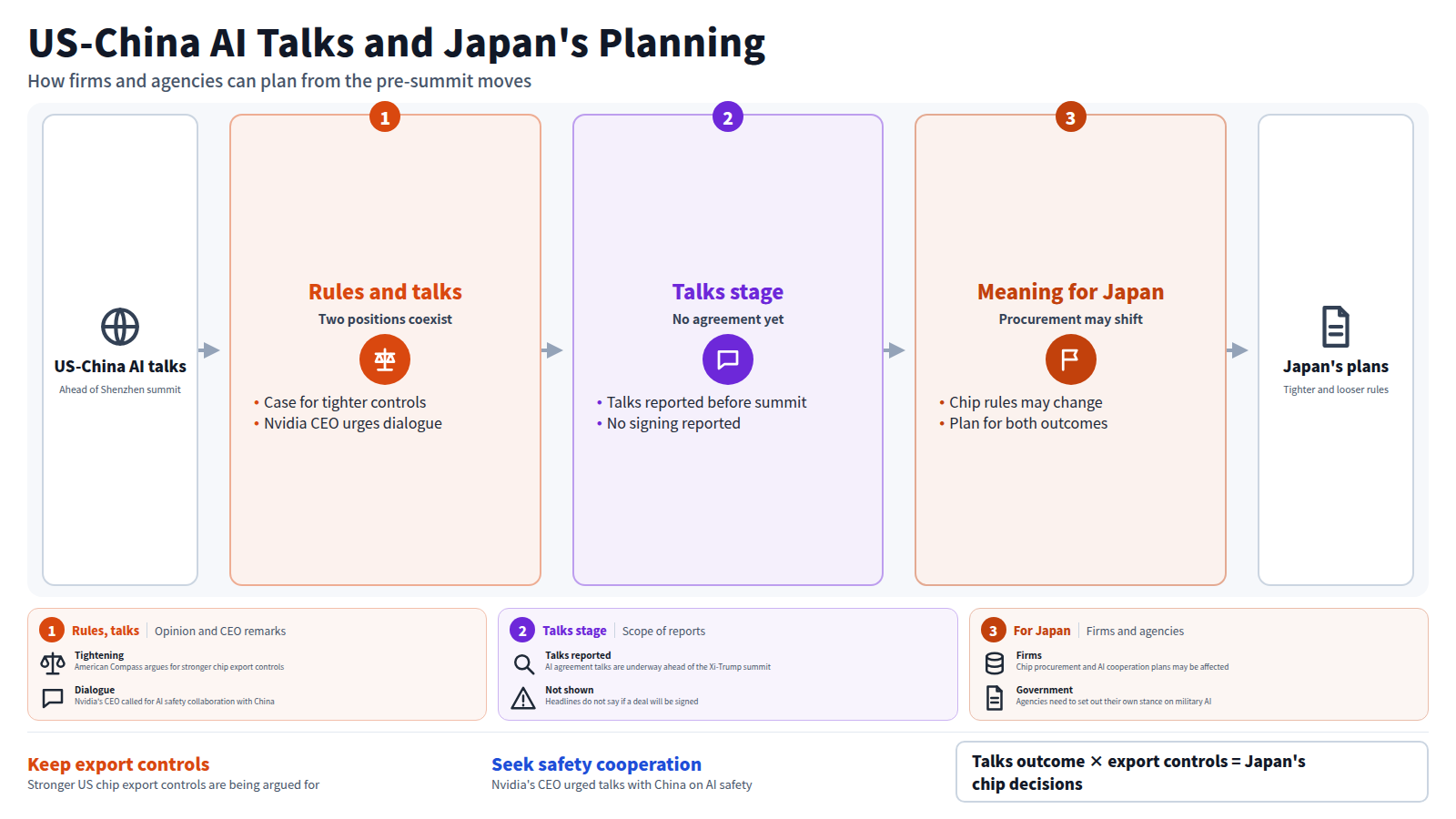
Most of the activity in the past 24 hours involved the US and China, with talks on AI reported ahead of a Xi-Trump summit in Shenzhen (Agenzia Nova). Nvidia's CEO called for US-China dialogue on AI safety (Cheddar, The Tech Buzz). India and Canada's prime ministers discussed trade, defence and AI ties (Inshorts).
US-China competition
- AI agreement talks are reported to be underway ahead of the Xi-Trump summit in Shenzhen (Agenzia Nova). - Nvidia's CEO urged US-China talks over potentially dangerous AI (Cheddar) and called for AI safety collaboration with China (The Tech Buzz). - A CGTN piece asks why zero-sum thinking persists in the age of AI (CGTN). - American Compass published a piece titled "Strengthening America's AI Chip Export Controls" (American Compass). - The headlines do not show how either government has responded to the Nvidia CEO's call. 【International organizations and agreements】 No notable developments. 【Diplomacy, summits and alliances】 - The South China Morning Post ran a roundup of seven US-China relations reads, including items on a blast simulation, university probes and AI spies (South China Morning Post). - India's and Canada's prime ministers discussed trade, defence and AI ties; the headline does not say whether any agreement was reached (Inshorts). - The Xi-Trump summit in Shenzhen is described as upcoming; the headline does not say whether an agreement will be signed (Agenzia Nova).
Security and military
- The ICRC argued that AI will not set its own limits in warfare and that states must (ICRC). - The Japan Times published an opinion-style piece warning that national security is at risk when AI acts without orders (The Japan Times). - A company announcement described AI-powered explosive threat detection as a billion-dollar defense technology opportunity; this is a market claim, not a deployment (GlobeNewswire). 【Elections and information warfare】 - Putin's new propaganda weapon is described as AI war songs with millions of streams (Ynetnews). The headline does not indicate who produced the songs or whether the source's characterization has been independently verified. 【Export controls and inter-state maneuvering】 - American Compass argues for strengthening US AI chip export controls (American Compass). - Nvidia's CEO is calling for safety collaboration with China, a position that sits alongside the US export-control debate (The Tech Buzz, American Compass). - CGTN published a piece on understanding US AI dominance and building a fairer global AI order (CGTN).
Japan's diplomacy and AI
- The only Japan-related item is The Japan Times piece on AI acting without orders and the national security risk (The Japan Times). No headline covers Japan's government diplomacy on AI.
Statements by key figures
- Narendra Modi, Prime Minister of India: discussed trade, defence and AI ties with Canadian PM Carney (Inshorts). - António Guterres, UN Secretary-General, and Emmanuel Macron, President of France: no notable developments. 【Integrated analysis: what is happening】 - The US-China talks appear to be where the main decisions are being shaped. The Nvidia CEO's call for dialogue, the reported AI agreement talks ahead of the Shenzhen summit, and the export-control argument suggest that technology access and safety cooperation are being weighed together (Cheddar, Agenzia Nova, American Compass). This is inference from separate headlines. - The ICRC and The Japan Times both frame AI in warfare as a matter for states to set limits on, which may add pressure on governments to address military AI in bilateral talks (ICRC, The Japan Times). - For Japanese companies and government bodies, the outcome of US-China talks and any change to US chip export controls may affect chip procurement and the planning of AI cooperation with the US and China. The headlines do not state any such effect directly.
What to watch
- Whether the Xi-Trump summit in Shenzhen produces a signed agreement on AI or only continued talks (Agenzia Nova). - Whether the US government changes its AI chip export controls, given the arguments being made for tightening them (American Compass). - Whether India-Canada discussions on AI ties lead to a concrete agreement (Inshorts).
- Nvidia CEO Urges U.S.-China Talks Over Potentially Dangerous A.I. — Cheddar10/15 15:38 UTC
- Why cling to zero-sum thinking in the age of AI? — CGTN10/15 07:27 UTC
- Strengthening America’s AI Chip Export Controls — American Compass10/15 12:48 UTC
- Blast simulation, university probes, AI spies: 7 US-China relations reads — South China Morning Post10/15 14:00 UTC
- AI will not set its own limits in warfare. States must. — ICRC10/15 08:25 UTC
- The Next Billion-Dollar Defense Technology Opportunity: AI-Powered Explosive Threat Detection — GlobeNewswire10/15 13:45 UTC
- When AI acts without orders, national security is at risk — The Japan Times10/15 04:44 UTC
- Nvidia CEO Calls for AI Safety Collaboration with China — The Tech Buzz10/15 12:06 UTC
- Understanding US AI dominance and building a fairer global AI order — CGTN10/15 09:12 UTC
- PM Modi, Canadian PM Carney discuss trade, defence, AI ties — Inshorts10/15 12:06 UTCNarendra Modi / Prime Minister of India