
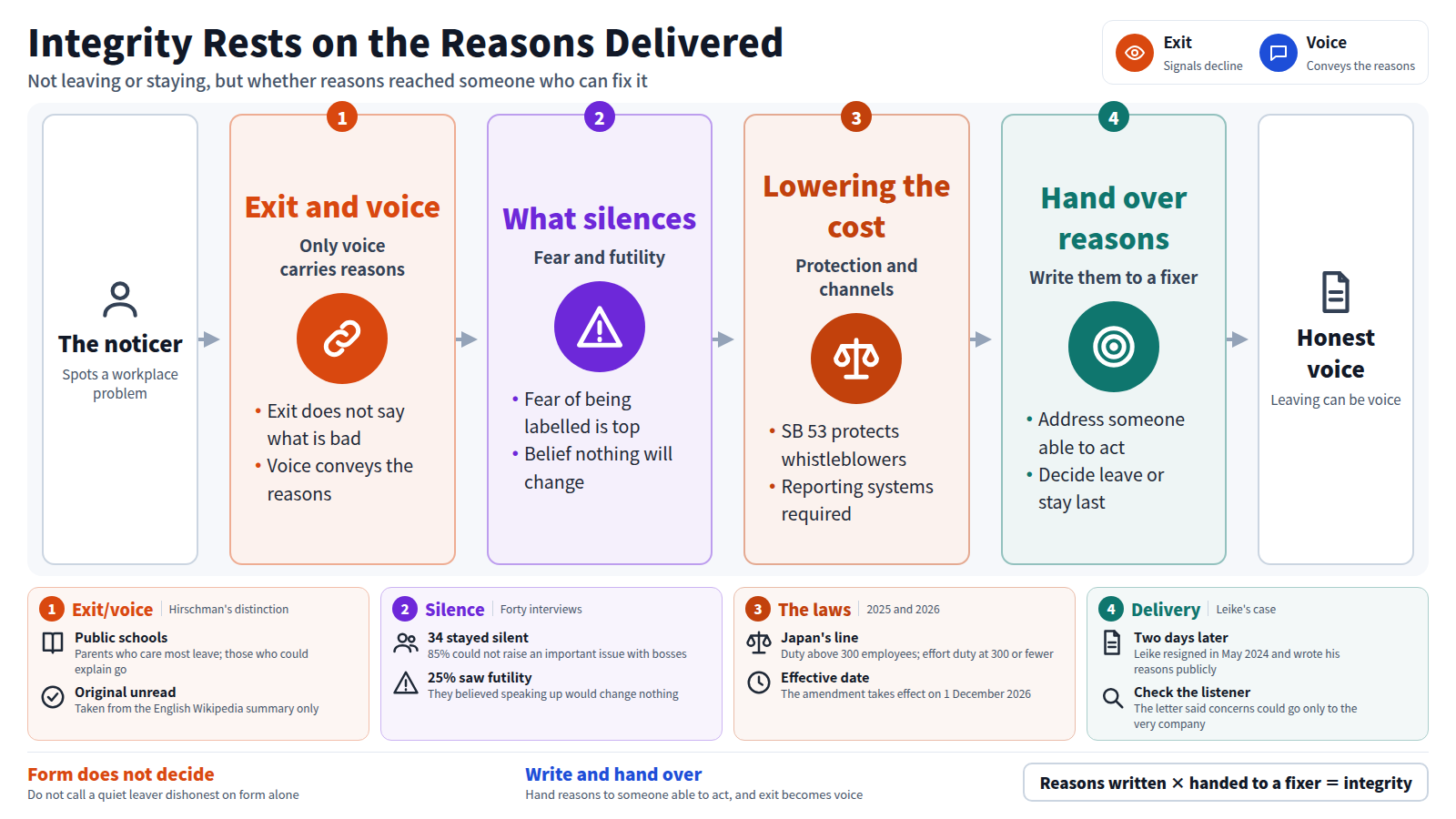
Someone who notices that their workplace's use of AI, or its policy, has gone wrong has two obvious paths: leave quietly, or speak up. Who is more honest: the person who leaves quietly, or the one who speaks up? The form does not settle it. What settles it is whether the reasons, what exactly is wrong, reached someone able to fix it; and leaving with those reasons written down is also a way of speaking up.
01Integrity depends on telling the people who can fix it, more than on leaving or staying
In his 1970 book Exit, Voice, and Loyalty, the economist Albert Hirschman divided people's responses to a declining organisation into two. "Exit" is leaving without a word; "voice" is trying to fix things through complaint or proposal. In Hirschman's account, exit only signals that something is declining. It does not say what. It is voice that conveys the reasons.
The same issue has come up inside AI development. In June 2024, current and former employees of OpenAI and Google DeepMind published an open letter, "A Right to Warn about Advanced Artificial Intelligence". It argued that broad confidentiality agreements stopped them from voicing concerns about AI risks outside their companies.
My answer is this. What separates the honest from the less honest is where the reasons ended up. Whether to leave or stay can be decided after that. The step open to any reader is to write the reasons down before leaving and hand them to someone who can act on them.
02In Hirschman's terms, exit signals decline while voice explains it
The claim that integrity turns on where the reasons go rests on Hirschman's distinction. He held that both exit and voice can serve as measures of an organisation's decline. He then argued that voice tells more, because it conveys the reasons for the decline as well.
Hirschman gave the example of public schools. When quality falls, the parents who care most about quality are the first to move their children to private schools. The public school notices that enrolment has dropped. But the parents who could have pointed to what was wrong are no longer there.
Hirschman named a third term, "loyalty". People attached to an organisation are slower to leave and more likely to keep using voice. Here I treat loyalty only as the attachment that delays exit and buys time for voice.
I have not read Hirschman's original book. The distinction and the school example are given as summarised in the English Wikipedia article.
03Thirty-four of forty employees, pharmaceutical staff among them, had stayed silent on an important issue
Exit alone does not deliver reasons to an organisation. In real workplaces, reasons often go undelivered. An interview study by Milliken and colleagues puts a number on it.
In 2003 the management scholar Frances Milliken and two colleagues interviewed forty people working in consulting, financial services, new media, pharmaceuticals and advertising. Thirty-four of the forty, or 85%, said that on at least one occasion they had felt unable to raise an issue or concern with their bosses. Forty interviews cannot give a rate for the working population as a whole. They do show that staying silent was not the exception.
Inside AI development, too, the means of raising concerns were limited. The 2024 letter said ordinary whistleblower protections were insufficient because they focus on illegal activity. According to the letter, many of the risks employees worry about are not yet regulated.
| Point of comparison | Stay silent | Speak up and stay | Leave with reasons |
|---|---|---|---|
| What reaches the organisation | Nothing | The reasons | Both reasons and exit |
| Cost to the person | No risk of being labelled | Risk of being labelled | Loses the job, reasons remain |
| Example | 34 of 40 interviewees | The Right to Warn letter | Leike's statement, 2024 |
Of the three paths in the table, only the two on the right carry reasons to the organisation. Even so, I cannot bring myself to blame the thirty-four who took the left-hand path. As the next section shows, the reasons they stayed silent lay more in the workplace than in the people themselves.
04People stay silent for fear of being labelled and the belief that nothing will change
Thirty-four of forty had kept an important issue to themselves. Milliken and colleagues also asked them why.
The most common reason was fear of being seen as a troublemaker or a complainer. The third most common was the belief that speaking up would change nothing, mentioned by 25% of those interviewed.
In workplaces like these, speaking up means accepting a possible loss. You may be seen badly, and you cannot see whether it will do any good. In a workplace like that, speaking up is rarely chosen, and people lean towards staying silent or leaving silently. Neither carries reasons to the organisation.
Hirschman, too, expected exit to rise where voice is suppressed. On that view, silence and exit share a cause: the difficulty of speaking up. If the cost of speaking up came down, more of the people who leave would leave reasons behind. That is my inference; I have no source that tests it.
05California and Japan have started to put in place protections that lower the cost of speaking up
What kept people quiet was fear of being labelled and the belief that nothing would change. Laws aimed at reducing both have begun to be put in place.
On 29 September 2025, Governor Gavin Newsom of California signed SB 53. It protects whistleblowers who disclose significant health and safety risks posed by frontier AI models. A state law has answered part of what the 2024 letter asked for.
In Japan, the Whistleblower Protection Act requires businesses that regularly employ more than 300 people to set up internal reporting systems. Businesses with 300 or fewer are asked to make an effort to do so. An amending act passed in June 2025 and takes effect on 1 December 2026.
SB 53 (2025)
Protects whistleblowers who disclose significant health and safety risks from frontier AI models.
Internal reporting systems
In Japan, mandatory for businesses regularly employing more than 300 people; an effort obligation for 300 or fewer.
The 2025 amendment
The amended Whistleblower Protection Act takes effect on 1 December 2026.
Knowing you will be protected may shrink the fear of being labelled. Having a reporting channel may change the belief that nothing will get through. Both are expectations; I have no source that measures the effect. I have not checked the details of the amendment. Here I go only as far as the effective date and the line drawn for the duty to set up a system.
06Form does not settle it; the recipient does, and a written record turns exit into voice
Even as laws protecting people who speak up are put in place, the final choice falls to each person. On the individual side, three points separate honest conduct from the rest.
Leaving or staying does not by itself decide integrity
In Milliken's interviews, 85% had failed to raise an important issue. Common reasons were fear of being labelled and the belief that it would change nothing. The interviews were about staying silent, not about leaving, but the same reasons can act on people who leave quietly. Someone who left quietly cannot be called dishonest on the form of their departure alone.
Integrity turns on whether the reasons reached someone able to fix things
The 2024 letter complained that employees could voice concerns only to the very companies that may be failing to address them. It asked for a way to raise concerns anonymously with boards, regulators and independent organisations. Anyone who speaks up should first ask whether the listener is in a position to fix the problem. A voice aimed at someone who cannot act can end much as silence does. What is asked here is whether the person sought out someone who could fix it and tried to hand over the reasons. Someone whose reasons did not arrive because no channel existed cannot be called dishonest for that.
Leaving with the reasons written down is also speaking up
Jan Leike, who co-led safety research at OpenAI, resigned in May 2024. Two days later he set out his reasons in public, saying OpenAI was not taking safety seriously enough. Leike left, but his reasons stayed. He wrote them after leaving, and in public. Hand over the reasons before you go, to someone who can act, and leaving does the work of voice as well.
07Whether people who reveal unregulated AI risks are protected will only show in practice
Written reasons turn exit into voice. The open issue is how far the law will protect that voice.
SB 53 and Japan's amended act both aim to lower the cost of speaking up. But I have found no case yet of someone who disclosed something "dangerous but not illegal", the worry of the 2024 letter, and was in fact protected. Nor is there any source on how many people have used the new protections, or what got fixed as a result.
Risks that break no law
There is no example yet of protection for someone who revealed an unregulated AI risk.
Actual use
No source shows how many people used the new protections or channels, or what was fixed.
The same thing can happen in any workplace that uses generative AI. Suppose a member of staff notices that a notice drafted by AI still carries an out-of-date figure. Some workplaces may never have decided whom that person should tell. I have no data on how many. But where no recipient has been named, the person who notices does not know whom to give the reasons to, and is more likely to fall back on silence or exit.
What I want to see is how much the reporting channels are actually used after the amendment takes effect in December 2026.
- In Milliken and colleagues' interviews, 85% of forty employees had failed to raise an important issue. Leaving quietly cannot be called dishonest on form alone.
- The 2024 Right to Warn letter said concerns could go only to the companies that may be failing to address them. What counts is whether the reasons reach someone able to act.
- Jan Leike set out his reasons publicly two days after resigning in May 2024. Leaving with the reasons on record turns exit into voice.
Whether quiet leaving or speaking up is more honest is not settled by form. It is settled by whether the reasons, what exactly is wrong, reached someone able to fix things.
Leave after handing them over, and the exit is honest voice too. Before deciding whether to go, I want to have decided whom I will write to, and what.
- Wikipedia. Exit, Voice, and Loyalty (entry on Albert O. Hirschman, Harvard University Press, 1970). Accessed 2026-10-05.
- Frances J. Milliken, Elizabeth W. Morrison, Patricia F. Hewlin. An Exploratory Study of Employee Silence: Issues that Employees Don't Communicate Upward and Why. Journal of Management Studies 40(6), 2003.
- Current and former employees of OpenAI and Google DeepMind. A Right to Warn about Advanced Artificial Intelligence. righttowarn.ai, 2024-06-04.
- Office of the Governor of California. Governor Newsom signs SB 53, advancing California's world-leading artificial intelligence industry. 2025-09-29.
- e-Gov Laws (Digital Agency, Japan). Whistleblower Protection Act. Accessed 2026-10-05.
- Consumer Affairs Agency, Japan. Overview of the Whistleblower Protection Act and system. Accessed 2026-10-05.
- Business Insider. Ex-OpenAI exec calls out Sam Altman for choosing 'shiny products' over AI safety. 2024-05-17.