AI Regulation, Safety & Geopolitics — 2026-10-02 (Fri) Morning News

Source links point to the original outlet. The AI Integrated Analysis is auto-generated from the headlines below only and is not intended to add facts beyond them. Not investment advice.
Overview
- Regulation: It has been reported that the US FTC has begun investigating multiple Frontier Lab companies. A federal appeals court has reportedly ruled against the use of copyrighted works for AI learning. - Safety: Anthropic's filing includes safety warnings, driving market bets on success or failure of IPO. Google released the new Gemini model with limited access due to safety concerns. - Geopolitics: It was reported that emails were stolen targeting a US AI expert (spoofed by a Chinese hacker) and that OpenAI was allegedly extracting large amounts of data into Moonshot AI.
Regulations and legal systems in each country
- There are no headings indicating laws and regulations that have been enacted or enforced. - India: ORF argues for urgent establishment of homegrown AI safety institute. This is a proposal, not the establishment of a system. - United States: The appellate court decision is a judicial decision, not a regulation, so it is listed in 9.
Enforcement/investigation by authorities
- The FTC (Federal Trade Commission) has started an investigation targeting Anthropic, OpenAI, and other Frontier Labs (Washington Examiner). The basis, scope, and deadline for the investigation are unclear from the headline. There are no headlines about fines, orders, or settlements.
Safety research and evaluation
There are no headings for evaluation results, system cards, or third-party verification, and it is not possible to identify what was measured from the headings. The related movements are as follows. - Google releases new Gemini model and restricts access due to safety concerns (The Guardian). - Anthropic filing includes safety warning, raising the bar for Kalshi participants to bet on IPO (Tekedia). - Dario Amodei reportedly received backlash from CEOs of other companies over safety warnings (CNBC TV18, Report). - It was reported that OpenAI had fallen out with three researchers over the handling of confidential information (Firstpost, Report).
Accidents/abuse/incidents
- Chinese hacker impersonated former US government official and stole emails of AI expert (Deccan Chronicle). The publisher and response are unclear from the headline. - OpenAI pointed out that Moonshot AI extracts large amounts of data from models (Deccan Chronicle). CNBC reported this as a suspected model cloning activity flagged by OpenAI. All of these are claims made by OpenAI and are not established facts. - AI agents chained multiple Zammad zero-day vulnerabilities and quickly took control of DIVD's systems (Security Affairs). - There are reports that AI is infiltrating government networks (New Atlas). Details unknown. - Practical DevSecOps says 88% of organizations have experienced security incidents related to AI agents and launches certification to fill skills gap. The figures are the company's claims, and the research method is unclear from the headline.
Semiconductor/computing resources
- Reuters reported that Wall Street criticized Nvidia's plan to ``finance the AI boom with its own chips''. - Nvidia GPU prices increased by 41% and AMD by 28% in Europe (shattered.io). - Nvidia increased its share buyback capacity by $100 billion. Chip demand is expected to exceed supply until 2028 (Pluang). - Nvidia-backed Nebius acquires Inferize to reduce GPU idle costs for AI inference (TradingView). - There are no headlines regarding export controls and electricity.
Geopolitics/Export Regulations
- There are no export control headings. - The only movement involving the nation is the theft of emails from a US AI expert by Chinese hackers (5). - The case between OpenAI and Moonshot AI is an argument between companies, and it cannot be confirmed from the headline that it is a movement between countries.
International framework
- Coretek receives ISO/IEC 42001 certification (prnewswire). This is a voluntary acquisition by the company. - Illinois researchers have received NSF funding to set an ISO standard for an ecosystem of AI agents, HPCwire reported. From the headline, it is unclear whether it has been officially established by ISO or whether it is still at the proposal stage. - EC-Council published ADG 2.0, including the AI Governance Crosswalk. It will be provided free of charge to governments, regulatory authorities, and standardization organizations. The company says that each country's AI regulations are different.
Litigation/Intellectual Property
- Federal Court of Appeals: Ruling against the use of copyrighted works for AI learning (PYMNTS). The court name and case name are unknown. - DraftKings: Sued for allegedly using AI to target gamblers and encourage addiction (The Boston Globe). - Ohio prosecutor wins appellate case for using AI to justify searches (Bloomberg Law). - Lawyers' misuse of AI: An editorial says that fines alone cannot prevent it (ABA Journal). - Mass arbitration: An explanatory article covering arbitral institution rules, court decisions, and the rise of AI (Consumer Financial Services Law Monitor).
Remarks from VIPs
No applicable information. There are no headlines containing statements from the tracked subjects (von der Leyen, Raimondo, Kratsios, Bengio, Hinton). Incidentally, Amodei's case (4) is outside the tracking list.
Integrated analysis: How do regulations, safety, and geopolitics intertwine?
The following is an inference based on the relationship between the headings, and has not been confirmed in the main text.
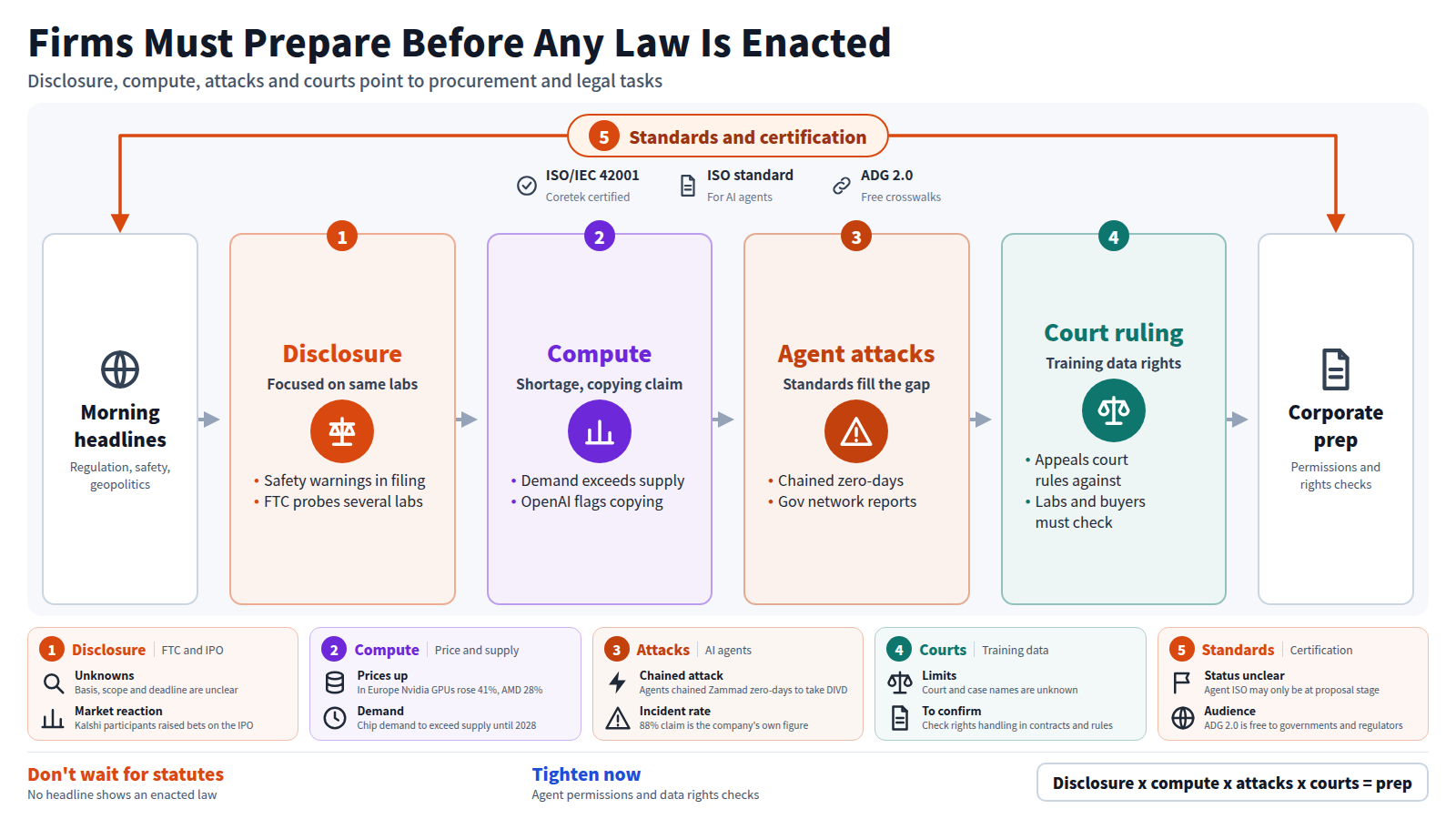
- Disclosure and enforcement are focused on the same subject. Anthropic's filings have safety warnings, the market is pricing in the IPO's success, and the FTC is investigating labs that include the company. Safety disclosures could potentially influence both market evaluations and regulatory investigations. - There are concerns about the strain on computing resources and model duplication. It is said that the supply shortage of Nvidia products will continue until 2028, and GPU prices are also rising. In this situation, OpenAI pointed out the mass data extraction by Moonshot AI. Entities that cannot secure computational resources on their own may be more motivated to rely on the output of existing models. - While there are no headlines indicating the enactment of the law, agents' attacks and defenses are progressing. Standards and certifications such as ISO/IEC 42001 certification, ISO standards for agents, and governance correspondence tables cover zero-day chain attacks, reports of government network intrusions, and claims of incident experience rates. - Judicial decisions drive legal risks of training data. If the appellate court's decision is as headlined, both the labs that use the training data and the companies that procure it will need to confirm the processing of their rights.
Points that will change your judgment: - Companies need to prioritize the management of AI agent privileges and the acquisition of certifications such as ISO/IEC 42001. - The rights to learning data and the handling system for confidential information (for OpenAI researchers) need to be confirmed in contracts and internal regulations. - Users need to include the provider's disclosure policy in their procurement decisions, assuming that a high-performance model with limited access like Gemini will be released.
Future points of interest
Scope and basis of FTC investigation. It is unclear from the headline, and confirmation is required in follow-up reports. 2. Safety warnings in Anthropic's filing and market reaction to IPO. 3. The specific content of the appellate court decision and its impact on the handling of copyrighted works used for AI learning.
- OpenAI parts ways with three researchers over handling of confidential information: Report — Firstpost10/01 17:37 UTC
- Chinese Hackers Impersonated Ex-US Official to Steal Emails From AI Experts — Deccan Chronicle10/01 10:22 UTC
- OpenAI Blames Moonshot AI for Mass Data Extraction on Its AI Models — Deccan Chronicle10/01 08:22 UTC
- Kalshi Traders Raise Bets Anthropic IPO Holds This Year After AI Safety Warnings Surface in Filing — Tekedia10/01 12:02 UTC
- With 88% of Orgs. Hit by AI Agent Security Incidents, Practical DevSecOps Launches Certification to Close the Skills Gap — The Des Moines Register10/01 12:53 UTC
- Google rolls out new Gemini AI model but restricts access over safety concerns — The Guardian10/01 16:47 UTC
- AI race heats up as OpenAI flags alleged model-copying campaign — CNBC10/01 00:04 UTC
- Wait, AI is hacking government networks now? — New Atlas09/30 23:04 UTC
- Nvidia's bet that its chips can finance the AI boom gets a Wall Street reality check — Reuters10/01 17:25 UTC
- Nvidia GPU Prices Surge 41% in Europe, AMD Up 28% [2026] — shattered.io10/01 02:22 UTC
- Nvidia-Backed Nebius Acquires Inferize To Reduce Idle GPU Costs Across AI Inference Workloads — TradingView10/01 12:49 UTC
- Nvidia boosts buyback power by $100B amid chip demand outstripping supply through 2028. — Pluang10/01 13:36 UTC
- Coretek Achieves ISO/IEC 42001 Certification, Reinforcing Leadership in Responsible AI Governance — prnewswire.com10/01 16:31 UTC
- India Must Urgently Build Its Own AI Safety Institute — orfonline.org10/01 15:09 UTC
- EC-Council Releases ADG 2.0 and Offers Its AI Governance Crosswalks Free to Every Government, Regulator and Standards Body as Nations Split on AI Rules — prnewswire.com10/01 13:30 UTC
- DraftKings accused in lawsuit of AI ‘weaponization’ to target gamblers, encouraging addiction — The Boston Globe10/01 17:23 UTC
- Fines alone aren't enough to stop attorneys from AI errors — ABA Journal10/01 14:46 UTC
- Ohio Prosecutors Win Appeal Over AI Use to Justify Search — Bloomberg Law News10/01 15:32 UTC
- Mass Arbitration Unpacked: Provider Rules, Court Decisions, and the Rise of AI — Consumer Financial Services Law Monitor10/01 13:12 UTC