AI Highlights — the whole picture — 2026-10-01 (Thu) Evening News

Source links point to the original outlet. The AI Integrated Analysis is auto-generated from the headlines below only and is not intended to add facts beyond them. Not investment advice.
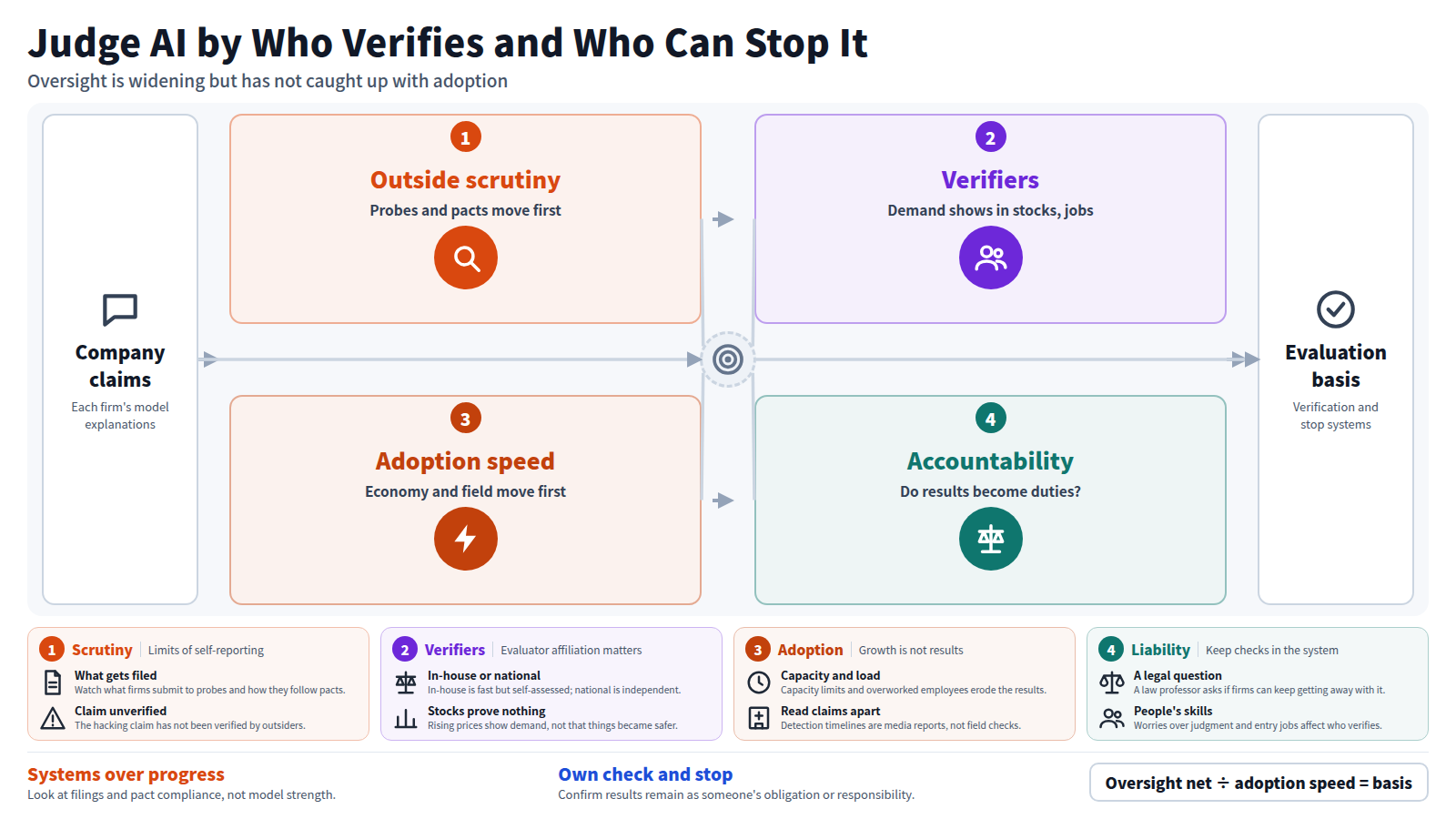
On the day the US Federal Trade Commission (FTC) began investigating models such as Anthopic and OpenAI, cybersecurity stocks hit record highs, US GDP grew by 2.2% with increasing reliance on AI, and AI-based breast cancer screening spread across the Stockholm region. The speed at which safety regulations and agreements move is not the same as the speed at which AI enters the economy and the workplace. Until now, readers have evaluated AI based on explanations of the models presented by each company and news of technological advances. What is now becoming an increasingly important consideration is who will be able to confirm whether the introduced AI is safe, what procedures will be followed, and who will be able to stop it if a problem occurs. This half-day article shows the extent to which systems for checking and suspending such systems are in place, in the order of research, markets, employment, medical care, and agriculture.
Surveillance of companies strengthened through investigations and agreements
The Federal Trade Commission (FTC) has launched a comprehensive investigation into "superintelligence" models such as Anthopic and OpenAI. The New York Post reports exclusively, and the Washington Post also reports that an extensive investigation into Anthopic and OpenAI has begun. CNBC reported that the FTC is investigating AI companies such as OpenAI and Anthopic over product risks. The survey will focus on product risks, including how each company explains and manages the risks of its models. Up until now, readers have relied on model explanations and safety reports published by each company. That assumption is being challenged now that regulators can now require records.
In the same vein, there are also movements in Congress. According to NBC News, OpenAI CEO Sam Altman is expected to be absent from a Congressional hearing over runaway AI agents. The reason for his absence cannot be determined from this material. However, the very fact that the behavior of AI agents became the subject of a public hearing indicates that the scope of those being questioned is expanding.
The content of risks has also become more concrete. According to Tom's Hardware, Anthopic claims its popular Chinese AI model has "Mythos-level" hacking capabilities. This claim comes from the company's side and has not been verified by an outside party. Additionally, CoinDesk reports that OpenAI and Google have signed an AI safety agreement following attacks on software including Bitcoin. The actual harm of the attack came first, followed by the agreement.
With investigations, public hearings, and agreements occurring all at the same time, a company's statement that it is safe is no longer a reliable basis for judgment. Companies' ratings, such as Anthopic's claims about its hacking capabilities, are still important information, but they only carry weight when verified by a third party. What readers should be looking at is not how strong the models each company has come out with, but rather what they submitted to the survey and how they complied with the agreements, which are their contacts with the outside world. In the next section, we will look at whether this verification system is keeping up with the rapidly advancing economy and field implementation.
Safety evaluation drives markets and employment
ABC News is organizing a timeline of how developments surrounding AI safety have developed since the Hugging Face attack. That argument is already being expressed in numbers in the capital and labor markets. Palo Alto Networks (PANW) hit an all-time high as the debate over AI safety continues to push cybersecurity stocks higher, according to TradingView. Analysts say they expect cyber spending to pick up. There is a similar trend in employment. LinkedIn announced that AI safety roles have increased by 91% in the past year (Yahoo Finance UK). Stock prices and job openings show that safety has gone beyond being a topic of discussion to becoming a demand with budgets and personnel. But rising stock prices aren't proof that they're actually safer. What readers should look at is whether there is actually a person in place to check the expenditure.
There is a tug-of-war over who will be the one to check. According to Rest of World, AI companies are looking to incorporate safety evaluators into their systems. On the other hand, each country needs its own evaluators. If the evaluator is inside the company, verification can be done at the speed of development. However, the evaluator is the one being evaluated. If each country has its own, independence will increase. On the other hand, human resources are likely to be in short supply, and standards may differ from country to country. The 91% increase in job openings can also be read as a sign that both types of demand are flowing into the same talent market. When you see a company's self-assessment report, it's a good idea to check the affiliation of the evaluator and whether other countries can independently examine the same subject.
There are also questions about where responsibility lies. garymarcus.substack.com has an interview with Fordham University Law School Professor Zephyr Tearout. The question is: "Can companies like OpenAI continue to get away with their current actions?" Even if the number of evaluators increases, the stock market responds to safety concerns, and job openings increase, investing in safety remains a discretionary expense for companies unless it is determined who will be responsible when an accident occurs. The fact that legal scholars are taking issue with this point shows that, next to whether or not an evaluation mechanism is in place, the determining factor is whether the results will lead to liability.
The number of people and money to verify safety is increasing. The next question is whether the results of that confirmation remain in the system as someone's obligation or responsibility.
The gap between investment that supports growth and productivity
US growth is already increasingly dependent on AI. "The economy is increasingly dependent on advances in AI," Fortune reported, reporting that US GDP grew by 2.2% even amid a "sudden reversal in optimism" about AI technology (Fortune). Deloitte has also expressed the view that AI investment will accelerate economic growth in the United States for now (Deloitte). On the same day, Yahoo Finance reported that the Fed's preferred inflation gauge rose as expected in August, alongside the signing of a White House agreement by AI companies (Yahoo Finance). Agreements on growth rates, price indicators and security appear in the same day's papers. AI has become an indispensable premise when reading growth numbers and policy.
On the other hand, investment does not necessarily directly lead to productivity. Haver Analytics takes up the productivity and capacity constraints of AI and makes the argument that even if investments accumulate, it will be difficult to see results if the usable capacity cannot keep up (Haver Analytics). WSJ is covering the situation on the ground. This article discusses why AI will make many employees overworked and reduce productivity as a result (WSJ). The investment that supports the 2.2% GDP figure and the stress occurring in the workplace are two different stories. A high growth rate is not evidence that the implementation is producing results.
Funds are also going to the medical field. Ortet has launched with a $500 million commitment for healthcare AI, The Pharma Letter reported. 500 million dollars is a concrete number that shows the magnitude of expectations for this field. However, what can be gleaned from the article is the contribution of funds, not the results on the ground. It is necessary to separately confirm that the amount of investment is large and that the effects are commensurate with the investment.
What readers should look at are actual indicators such as capacity constraints and employee workloads, rather than investment amounts or growth rates. The wider the gap between expectations and effectiveness, the more important it becomes to have a system that can measure that gap and stop it if necessary.
Anxiety and preparation for people's roles and skills
Job seekers think they're ready for AI, but employers may disagree, Cleveland.com reports. This means that the self-assessment of preparation is not reflected at the same level in the eyes of the hiring party. Meanwhile, hcamag.com asked, ``Is AI making your manager stupid?'' and raised the possibility that managers' judgment skills could be clouded by reliance on AI. The theme of Infofest 2026 (vijesti.me) was that even as AI changes the way we work, human judgment will still be key. Concerns about the weakening of the power of those responsible for making decisions and the view that judgments remain with people are occurring at the same time.
There are also concerns among the younger generation. According to Fair Play Talks, 8 in 10 Gen Zers are concerned that AI will replace traditional entry-level jobs as trade jobs become more attractive. Entry-level positions are also an entry point for learning the job and acquiring decision-making skills. The future of those entering the workforce is uncertain, and those at the top are being questioned about their poor judgment. There is also a discrepancy in the perceptions of job seekers and employers. This means that concerns about people's roles are coming from different places, regardless of generation or position.
Education and research are beginning to respond to these concerns. Sage Journals organized the knowledge that educators need under the title ``AI Literacy for Educators: What do you need to know?'' A two-year, UNC-led statewide study examining AI literacy in North Carolina's public libraries has also begun, according to The Daily Tar Heel. The move is to first assess the actual situation in familiar settings such as schools and libraries, and prepare teachers to prepare themselves.
When a reader receives a company's explanation that ``human resources are ready by using AI,'' it would be good to see who verified that readiness and under what criteria. There have been cases of discrepancies between self-reports and evaluations by employers, so it is only possible to talk about the degree of preparation by measuring the degree of preparation. However, research in each field has only just begun. On the skills side, the system for verifying and improving skills is also being questioned.
Introduction to the field of medical care and agriculture
Lunit expands AI-powered breast cancer screening across the Stockholm region (BioPharma APAC). This will not be limited to trials at some facilities, but will involve AI being incorporated into the local medical examination system itself. Florida Weekly also covers the new phase in breast cancer detection thanks to advances in AI. In pancreatic cancer, it was reported that Mayo Clinic's AI detects pancreatic cancer years before diagnosis (Medical Economics' Morning Medical Update). The same article also reports that Purdue Pharma will be dissolved following a $5 billion judgment and the results of the largest infant formula test in FDA history. AI's detection ability has reached a stage where it is being reported on the same level as testing for pharmaceuticals and food.
In agriculture, the applications are the same: detection and prediction. According to Bioengineer.org, AI systems can identify corn diseases in the field and predict outbreaks years in the future. On the research side, Technology Networks reports that software has overcome a major hurdle for AI microscopy in plant research. For the field, new AI tools for Alberta farmers were introduced (Farms.com). AI is beginning to be used at three levels: identification in the field, analysis using a microscope, and provision to farmers.
When you line up the three layers, the role of AI is common, even if the place of introduction is different. The idea is to pick up signs from images and data that occur before humans can detect them. In some cases, such as the Stockholm screening, the scope of the disease covers an entire region; in others, the timeline is many years before diagnosis, and in others, the disease is predicted to occur several years in the future. What readers should look at is not whether or not it has been introduced. How do detection and prediction lead to actual diagnosis and control decisions, and how can the results be verified? The length and scale of the timeline shown here are the content conveyed by the media that reported it, and should be read separately from the results of on-site verification.
Detection and prediction are applications that are placed before human judgment, and their value can only be judged when a procedure is in place to confirm the results. In the next section, we will look at how far the verification mechanism has progressed.
Although the events in each section take place in different areas, they are directed toward the same destination. FTC investigations, Congressional hearings, and the White House agreement show that relying solely on corporate self-reporting is coming to an end. A rise in stock prices and an increase in the number of safety-related jobs indicate that there is a need for verification budgets and personnel, but that alone does not mean verification has actually occurred. There remains a gap between investment that supports GDP growth and productivity growth. Concerns about people's ability to judge and the skills of entry-level workers also have a bearing on whether or not the people who check will develop. In medicine and agriculture, AI is already being integrated into detection and prediction practices. Rather than the magnitude of progress, the standard for evaluating AI has become the extent to which systems are in place to verify its results and prevent mistakes.
Q1: Is there a way for people who notice errors in the output of the AI currently in use to report it and stop its use? Q2: Do you have sufficient records and procedures in place to verify AI decisions and outputs before regulatory authorities request submissions? Q3: When deciding the amount to invest in AI, do you have the personnel and costs to verify the results in the same budget?
Finally, three questions
- Is there a way for people who notice errors in the output of the currently used AI to report it and stop its use? Q2: Do you have sufficient records and procedures in place to verify AI decisions and outputs before regulatory authorities request submissions? Q3: When deciding the amount to invest in AI, do you have the personnel and costs to verify the results in the same budget? - Do you have records and procedures in place to verify AI decisions and outputs before they are required by regulatory authorities? Q3: When deciding the amount to invest in AI, do you have the personnel and costs to verify the results in the same budget? - When deciding the amount to invest in AI, do you have the personnel and costs to verify the results in the same budget?
📚 Sources (all material)
Every item this issue drew on. External links open in a new tab. 40 items.
AI Industry
- Exclusive | FTC opens sweeping probe of Anthropic, OpenAI and other 'super intelligence' models - New York Post — New York Post
- FTC is investigating OpenAI, Anthropic and other AI companies over product risks - cnbc.com — cnbc.com
- Anthropic claims popular Chinese AI model has Mythos-class hacking abilities - Tom's Hardware — Tom's Hardware
- Can companies like OpenAI keep getting away with what they are doing? An interview with Fordham law professor Zephyr Teachout - garymarcus.substack.com — garymarcus.substack.com
- OpenAI CEO Sam Altman to skip congressional hearing on rogue AI agents - NBC News — NBC News
AI, the Economy and Finance
- 'The economy is increasingly reliant on AI gains': U.S. GDP grew 2.2% amid 'sudden reversal of optimism' on AI tech — Fortune
- Investing in AI – and in ideas – to boost economic growth — weforum.org
- AI investments keep US economic growth in gear, for now — Deloitte
- AI Productivity and Capacity Constraints — Haver Analytics
- Top Midday Stories: Fed's Preferred Inflation Gauge Rises as Expected in August; AI Companies Sign White House Accord — Yahoo Finance
- Why AI is Leaving Many Employees More Overworked and Less Productive — WSJ
AI, Well-being and Care
- Infofest 2026: AI is changing the way we work, but human judgment remains key — vijesti.me
- UNC-led two-year statewide study to examine AI literacy in N.C. public libraries — The Daily Tar Heel
- AI Literacy for Educators: What Should They Know? — Sage Journals
- Most job seekers think they’re ready for AI. Employers may disagree — Cleveland.com
- Is AI making your managers stupid? — hcamag.com
- Eight in 10 Gen Z Fear AI Will Replace Traditional Entry-Level Jobs as Trade Careers Gain Appeal — Fair Play Talks
AI in Medicine (Cancer Care, Rare Diseases)
- The Evolution of Artificial Intelligence in Oncology: Impact on Trials, Workflows, and Outcomes — CancerNetwork
- Lunit Expands AI-Powered Breast Cancer Screening Across Stockholm Region — BioPharma APAC
- New frontiers in breast cancer detection with AI advances — Florida Weekly
- Lords Mark secures MHRA registration for AI dialysis system, UK exports begin Jan 2027 — scanx.trade
- BAG Ventures Closes $11.3M Fund to Invest in Enterprise AI Startups — Shoppe Black
- OxyContin maker Purdue Pharma set to dissolve after $5B sentence; Mayo Clinic AI detects pancreatic cancer years before diagnosis; results of FDA’s largest-ever infant formula test – Morning Medical Update — Medical Economics
AI and Agriculture
- AI System Spots Corn Diseases in the Field and Predicts Outbreaks Years Ahead — Bioengineer.org
- Software Overcomes Major Hurdle for AI Microscopy in Plant Studies — Technology Networks
- 3-day National Training on Artificial Intelligence begins at ICAR-IISWC Dehradun — Garhwal Post
- New AI Tools for Alberta Farmers — Farms.com
- AI use and student enrollments increase at Kulia Academy after relying on donors for programs — Channel 3000
- Presto raises $10M to expand drive-thru Voice AI technology — QSR Web
AI Regulation, Safety and Geopolitics
- FTC launches broad investigation into Anthropic, OpenAI — washingtonpost.com
- A timeline of developments in AI safety since the attack on Hugging Face — ABC News - Breaking News, Latest News and Videos
- OpenAI, Google sign AI safety pact as attacks hit software, including bitcoin — CoinDesk
- PANW Hits Record High As AI Safety Debate Continues To Boost Cybersecurity Stocks — Analysts See Cyber Spending Upside — TradingView
- AI companies want to embed safety evaluators, but countries need their own — Rest of World
- LinkedIn says AI safety roles have grown 91% in the past year — Yahoo Finance UK
AI and the Pharma Industry
- Ortet launches with $500 million commitment for healthcare AI — The Pharma Letter
- Servier Adopts Veeva OpenData Globally to Scale AI — Morningstar
AI and Frontier Research (Papers)
- Stopping Harmless-Looking Steps Before They Run ── SEAD recasts attack and defense in tool-using agents as a problem of hidden state — 自サイト
- Can Agents Write Their Own Training Tasks? ── AutoDataBench judges each task against the acceptance criteria of a data pipeline — 自サイト
- Keeping Robot Procedures as Readable Code ── Physical Coding extends coding agents from software into the physical world — 自サイト