AI and Cancer Research ── Breast ── 2026-09-30
Breast cancer: treatment, trials and AI
- Abstract
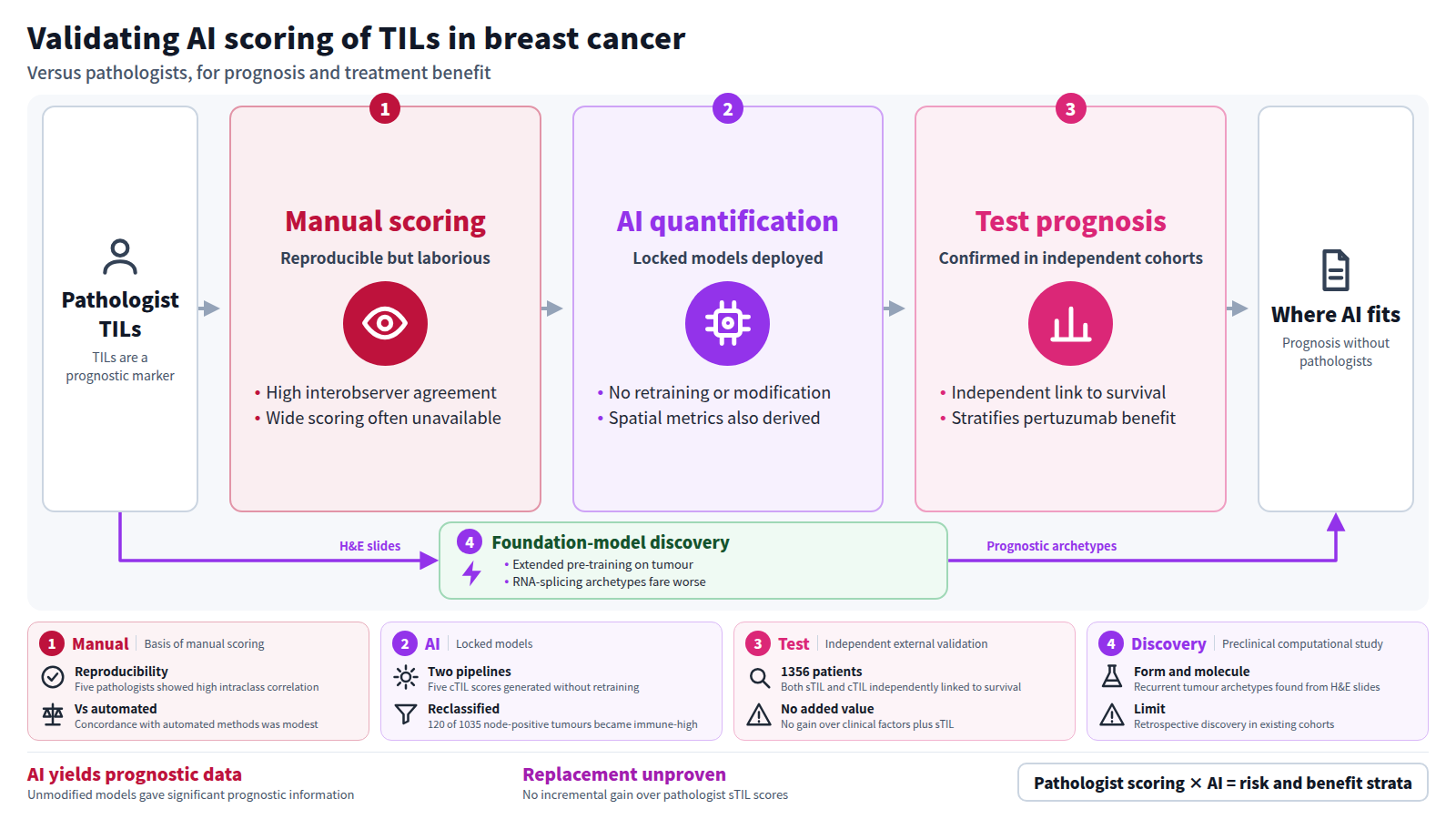
Background: Tumour-infiltrating lymphocytes (TILs) are a robust prognostic marker in patients with triple-negative breast cancer. Artificial intelligence (AI)-derived computational tools assessing TILs could improve efficiency, but require independent validation against clinical outcomes. We aimed to compare the prognostic performance of AI-derived TIL scores with pathologist-scored TILs in a large, prospectively collected dataset pooled from randomised controlled trials.
Methods: CATALINA was an independent, external validation study using prospectively collected long-term clinical outcome data pooled from seven randomised clinical trials conducted at multiple sites. We independently evaluated two previously validated AI pipelines that generate five computationally assessed tumour-infiltrating lymphocyte (cTIL) scores by masked, independent deployment of locked models. cTIL scores were correlated with the mean of the pathologist-scored stromal TILs (sTILs) in 220 digitised haematoxylin and eosin whole slide images in a cohort of patients with early-stage triple-negative or HER-2 positive breast cancer, previously scored by trained pathologists in a TIL-reproducibility study. Prognostic performance was assessed in a separate cohort of patients with early triple-negative breast cancer pooled from seven prospective, randomised adjuvant trials. Multivariable Cox regression models adjusted for clinicopathological factors and study heterogeneity assessed associations of cTIL score and sTIL score with invasive disease-free survival, distant disease-free survival, and overall survival. 5-year discrimination was estimated using time-dependent area under the receiver operating characteristic curve (AUC).
Findings: Individual data were collated from 1759 patients, of whom 1356 had complete clinicopathological data, pathologist sTIL scores, and cTIL scores available. Modest correlation (r 0·375-0·473) was observed between cTIL scores and the mean pathologist sTIL score. Both sTIL and cTIL were independently associated with 5-year invasive disease-free survival, distant disease-free survival, and overall survival after adjustment for clinicopathological factors (hazard ratio for invasive disease-free survival was 0·73 [95% CI 0·66-0·82]; q<0·0001, distant disease-free survival was 0·70 [0·61-0·79]; q<0·0001, and overall survival was 0·72 [0·63-0·82]; q<0·0001 for sTIL scores and 0·80 [0·73-0·89]; q<0·0001, 0·77 [0·69-0·86]; q<0·0001, and 0·79 [0·70-0·88]; q=0·0002, respectively, for percentage_lymphocyte scores). In models adjusted for clinicopathological variables and sTIL score, cTIL score did not maintain a statistically significant prognostic association. Both sTIL and cTIL scores improved the 5-year AUC over clinicopathological variables alone, while cTIL score did not significantly further improve AUC when combined with clinicopathological variables and sTIL score.
Interpretation: Two cTIL models deployed entirely without retraining or modification provided statistically significant prognostic information and improved risk discrimination compared with clinicopathological variables alone in this large, platform-based, independent validation study. Although cTIL score did not incrementally improve prognostication compared with models combining clinicopathological variables with sTIL score, these findings support the application of cTILs as a reproducible prognostic biomarker, particularly in settings where routine or widespread pathologist assessment is unavailable.
Funding: Breast Cancer Research Foundation (USA).
Reference: Dixon-Douglas JR, Drubay D, Salgado R, Acs B, van der Laak J, Yuan Y, et al. Artificial intelligence-based tumour infiltrating lymphocyte quantification in patients with triple-negative breast cancer: an independent validation study. Lancet Oncol. 2026 Sep;27(9):1181-92. doi:10.1016/s1470-2045(26)00339-6. PMID: 42636839.Checked: Abstract only - Abstract
Background: Stromal tumour-infiltrating lymphocytes (sTILs) are prognostic in early-stage HER2-positive breast cancer, but their role in the context of dual HER2 blockade remains undefined. We evaluated manual, digital, and artificial intelligence (AI)-based sTIL quantification, together with AI-derived spatial metrics, for prognostic and treatment-benefit stratification using tumour samples from the phase 3 APHINITY trial.
Methods: In the APHINITY trial, 4805 patients were randomly assigned to receive chemotherapy plus trastuzumab with pertuzumab or chemotherapy plus trastuzumab with placebo. Median follow-up was 74·1 months (IQR 68·3-75·4). We analysed 4262 haematoxylin and eosin-stained images using manual assessment, an automated digital approach, AI-based lymphocyte quantification (AI percentage lymphocytes), and two AI-derived spatial features (AI-TIL and immune hotspot). Interobserver reproducibility was assessed in 262 randomly chosen tumour samples scored independently by five pathologists. Multivariable Cox models were used to assess associations between TIL levels and invasive disease-free survival (primary outcome in APHINITY), distant recurrence-free interval, and overall survival. The heterogeneity of pertuzumab benefit was evaluated using subgroup analyses, subpopulation treatment effect pattern plot analyses, and nested Cox models with treatment-by-biomarker interaction terms.
Findings: Manual scoring showed high interobserver reproducibility (intraclass correlation coefficient 0·84 [95% CI 0·79-0·88]). Concordance between manual and automated methods was modest. AI-based scoring (AI percentage lymphocytes) reclassified 120 (11·6%) of 1035 node-positive tumours from immune-low (by manual scoring) to immune-high; this subgroup of patients showed greater separation of 5-year invasive disease-free survival curves between pertuzumab and placebo groups compared with patients whose tumours were concordantly classified as immune-low by both manual and AI-based approaches. Higher levels of TILs were associated with improved invasive disease-free survival for all sTIL measurement approaches and spatial measurements (hazard ratios [HRs] 0·41-0·93). Pertuzumab was associated with improved invasive disease-free survival at higher sTIL levels across all measurement approaches (HRs 0·36-0·48), but was not associated with higher values of spatial measures. The largest 6-year absolute improvements with pertuzumab were observed in patients with node-positive disease whose tumours scored in the highest level of immune infiltration of manual sTIL scoring (≥70·0%; mean absolute improvement 12·1 percentage points [SD 2·8]). In nested prognostic and predictive models, AI-based immune hotspot scores provided the most consistent additional information when combined with any sTIL measurement (all p<0·010).
Interpretation: Standardised manual sTIL scoring was reproducible, and digital and AI-based methods showed consistent prognostic stratification and potential for treatment-benefit stratification despite only modest correlation between platforms. AI spatial metrics provided complementary information beyond sTIL density and could support more scalable immune assessment. Future studies are needed to validate these approaches in independent cohorts and to clarify their clinical utility for stratifying contemporary HER2-directed therapies.
Funding: None.
Reference: Lara González LE, Giudici F, Salgado R, Yan H, Rojo F, Comerma L, et al. Manual, digital, and AI tumour-infiltrating lymphocyte scoring: a secondary analysis of the APHINITY randomised trial. Lancet Oncol. 2026 Sep;27(9):1168-80. doi:10.1016/s1470-2045(26)00247-0. PMID: 42636838.Checked: Abstract only - Abstract
Recently, histopathology foundation models (hFM) have rapidly advanced in size and complexity, achieving excellent performance in cancer diagnosis and biomarker discovery. Here, we specialise pre-trained hFMs to invasive tumour tissue and present three key contributions. First, we systematically evaluate the biological concepts encoded in hFM representations across multiple biological scales. Second, we demonstrate that informed extended pre-training transforms generalist models into tumour-specialised ones encoding richer semantic information, enabling discovery of recurrent tumour archetypes with consistent morphological and molecular identities across patients. Third, we identify dominant tumour archetypes with aberrant gene-expression programs coexisting within tumours and recurring across heterogeneous epithelial cancers, including HER2-positive and triple-negative breast cancer. Crucially, these archetypes exhibit prognostic value, with RNA splicing-associated archetypes consistently predicting poorer outcomes. Our work shows that tumour-specialised hFMs unlock rich molecular and morphological information from routine H&E slides, providing computationally efficient and biologically informed solutions for biological discovery and patient stratification.
Reference: Fournier L, Haefliger G, Vernhes A, Jung V, Loye L, Du Bois V, et al. Prognostic RNA-splicing archetypes in breast cancer identified by extended pre-training of histopathology foundation models. Nat Commun. 2026 Jul 7;17(1):8470. doi:10.1038/s41467-026-75217-z. PMID: 42414307; PMCID: PMC13478289.Checked: Full text checked