AI and Cancer Research ── Prostate ── 2026-09-30

Prostate cancer: treatment, trials and AI
- Abstract
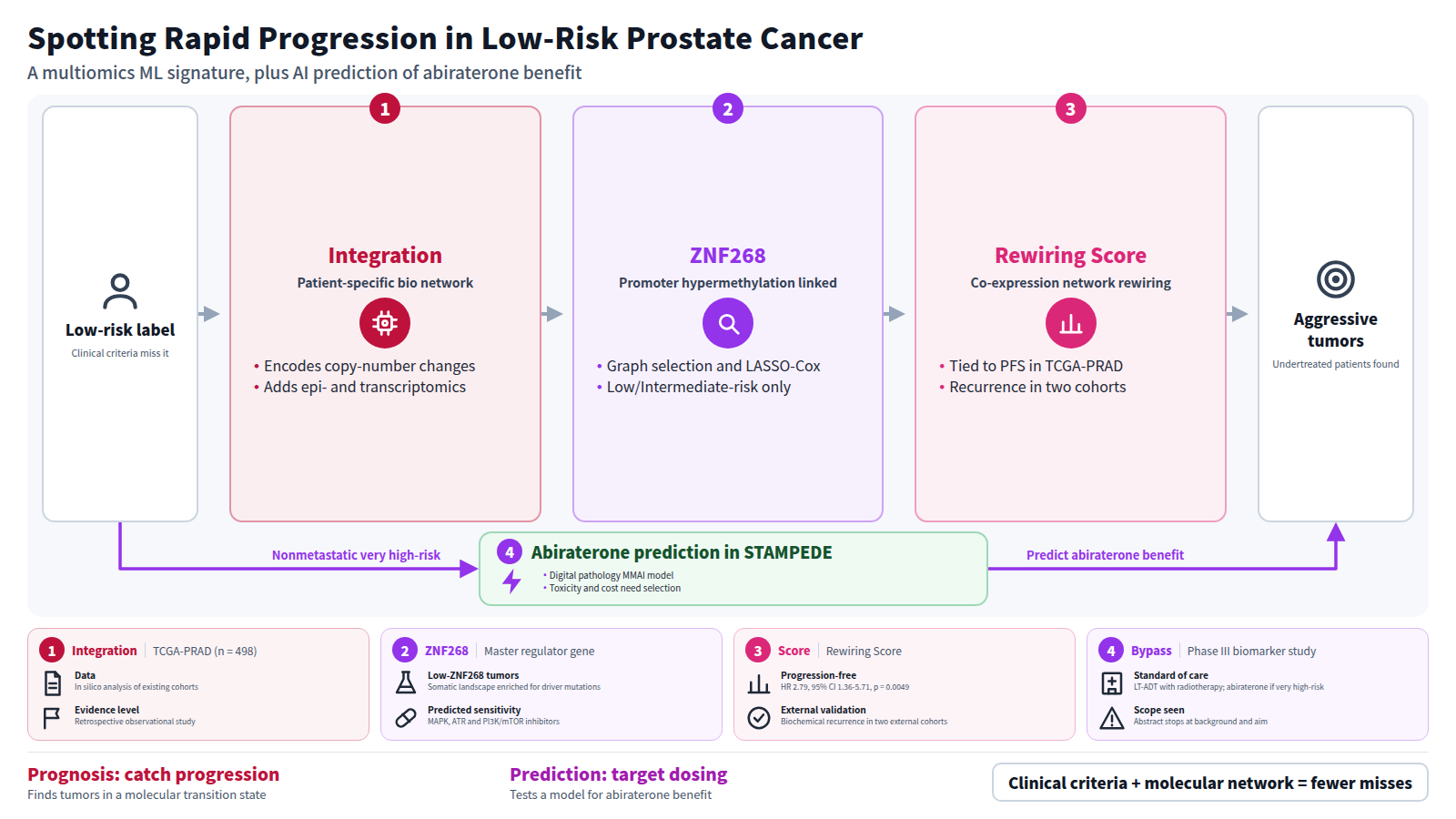
Risk stratification in primary prostate cancer remains heavily reliant on clinicopathological criteria that frequently miss the heterogeneity underlying early aggressive disease. We present a novel machine learning non-linear prognostic framework encoding somatic copy-number alterations and biological information associated with gene products, along with an integrative multi-omics approach including epigenomics and transcriptomics into a patient-specific biological network. Applied to the TCGA-PRAD (n = 498), our weighted graph-based feature selection and LASSO-Cox model identified ZNF268 as a master regulator gene, in which the hypermethylation of its promoter region is linked to a distinct oncogenic transition exclusive to Low/Intermediate-risk disease. Post-hoc analysis of Low-ZNF268 tumors showed a distinct somatic landscape enriched for driver mutations and predicted sensitivity to MAPK, ATR, and PI3K/mTOR inhibitors, providing potential therapeutic vulnerabilities alongside the prognostic signal. Topological network analysis further revealed that ZNF268 loss impacts a co-expression rewiring gene network, quantified as a Rewiring Score: associated with Progression-Free Survival in the TCGA-PRAD (HR: 2.79, 95% CI: 1.36-5.71, p = 0.0049) and Biochemical Recurrence in two external cohorts. By capturing tumors at an active molecular transition state preceding systemic progression, this framework offers a prognostic tool to identify biologically aggressive prostate cancer disease within patients currently undertreated by standard risk criteria.
Reference: Rafeletou A, Fathi F, Kiseļova T, Taheri G, Lundberg A. A novel multiomics machine learning signature identifies rapid progression in clinically low risk prostate cancer. NPJ Digit Med. 2026 Sep 14;9(1):702. doi:10.1038/s41746-026-03254-5. PMID: 42736338; PMCID: PMC13575102.Checked: Full text checked - Abstract
Background: Long-term androgen deprivation therapy (LT-ADT) with radiotherapy is standard-of-care for high-risk localized prostate cancer, with abiraterone added for clinically very high-risk disease. Given the potential toxicity and cost of abiraterone, a predictive biomarker to refine patient selection is needed. We evaluated a digital pathology multimodal artificial intelligence (MMAI) model, previously validated as a prognostic biomarker, for prediction of abiraterone benefit among nonmetastatic clinically very high-risk prostate cancer. Patients and methods MMAI scores were generated for patients enrolled in two sequential abiraterone trials (no shared controls) in the STAMPEDE (Systemic Therapy in Advancing or Metastatic Prostate Cancer: Evaluation of Drug Efficacy) platform protocol (NCT00268476) using digital pathology images, prostate-specific antigen, tumor stage, and age. We applied the previously established 75th percentile threshold to classify patients as MMAI very high-risk or standard high-risk. The primary endpoint was metastasis-free survival (MFS). Treatment effects and risk estimates were obtained using Cox regression and Kaplan-Meier method, respectively. Prediction was assessed using a treatment-by-biomarker interaction Cox model.
Results: In total, 1137 patients randomly assigned to LT-ADT (N = 583) or LT-ADT with abiraterone (N = 554) were included. The MMAI very high-risk group (N = 268) demonstrated significant MFS improvement from adding abiraterone [hazard ratio (HR) 0.47, 95% confidence interval (CI) 0.31-0.70], with 5-year MFS increasing from 62% (95% CI 54% to 70%) in LT-ADT to 81% (95% CI 74% to 88%) in LT-ADT with abiraterone. Limited abiraterone benefit was observed in the MMAI standard high-risk group (N = 869; HR 0.83, 95% CI 0.63-1.09), with a 5-year MFS of 82% (95% CI 78% to 85%) versus 84% (95% CI 80% to 87%, interaction P-value = 0.02). This differential effect was consistent in local node-negative and node-positive subgroups.
Conclusion: In this post hoc study of randomized clinical trial data, a locked digital pathology MMAI test displayed a strong prognostic association and predicted abiraterone efficacy in very high-risk, nonmetastatic prostate cancer. This biomarker could be implemented clinically to maximize benefit from treatment intensification while avoiding unnecessary toxicity.
Reference: Parker CTA, Huang HC, Grist E, Mendes L, Yamashita R, Croucher D, et al. Multimodal artificial intelligence prediction of abiraterone efficacy in two STAMPEDE phase III trials of nonmetastatic very high-risk prostate cancer. Ann Oncol. 2026 Oct;37(10):1334-44. doi:10.1016/j.annonc.2026.05.708. PMID: 42250604.Checked: Abstract only