AI in Medicine — Cancer & Rare Disease — 2026-10-01 (Thu) Evening News
Source links point to the original outlet. The AI Integrated Analysis is auto-generated from the headlines below only and is not intended to add facts beyond them. Not investment advice.
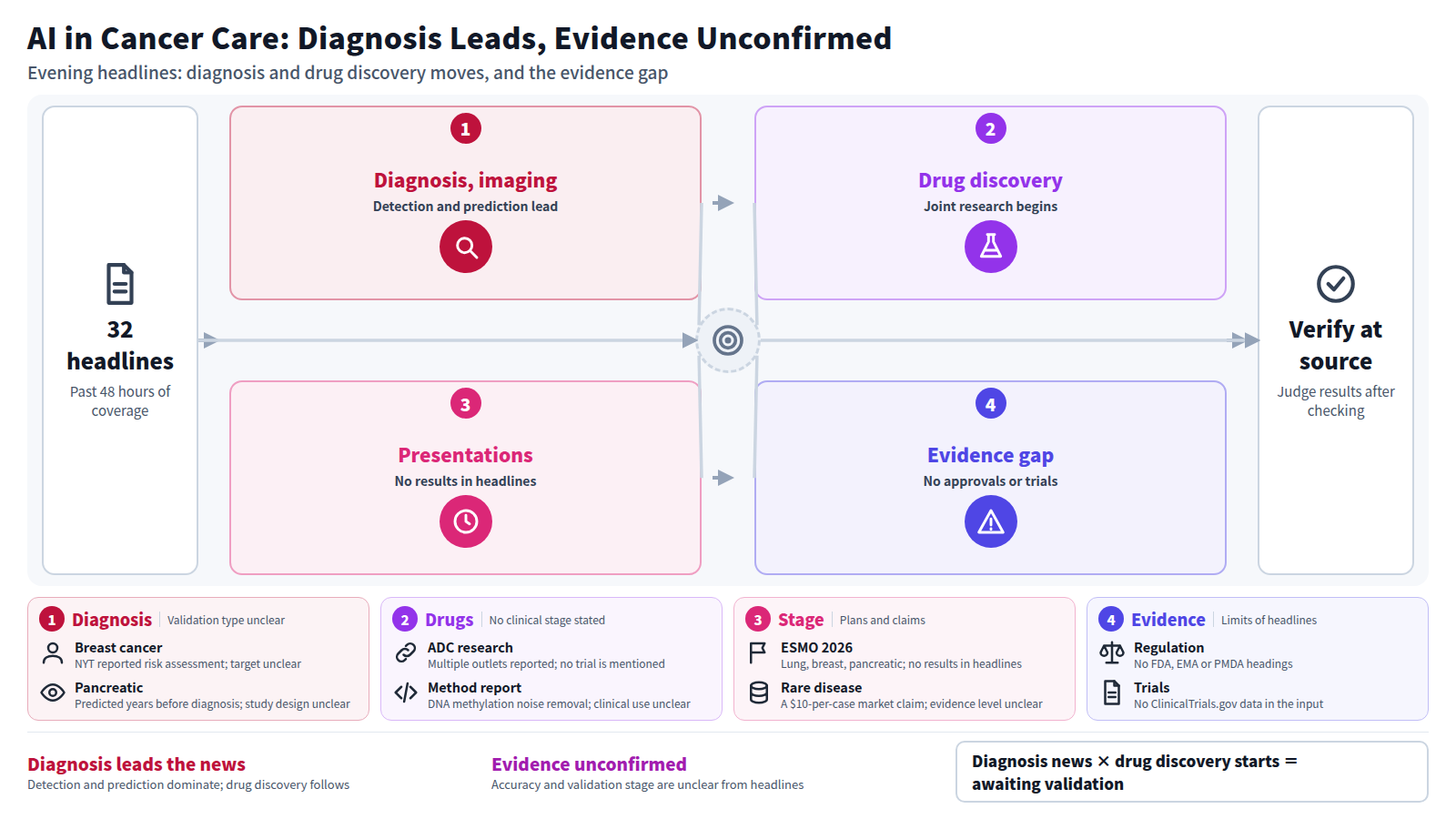
Latest news on AI and cancer treatment
Overview
- The areas where there was notable movement were the areas of diagnosis, imaging, and pathology, with reports including detection of pancreatic and gastric cancer, biomarker prediction from pathology slides, and breast cancer risk assessment. - In drug discovery, multiple media reported that Dong-A ST and Galux have begun joint research on AI-designed ADCs. - No regulatory/approval headings and no clinical trial data provided.
Breast cancer
- NYT reported that women can now use AI to assess their breast cancer risk. The target, accuracy, and verification stage are unclear from the headline. - WCYB reported that Simbiosys demonstrated advances in AI in breast cancer care. The specific details are unknown. - diagnosticimaging.com has published a podcast (Part 1) covering the current status, challenges, and possibilities of AI in breast imaging diagnosis. - Lunit plans to present five AI biomarker studies across lung, breast, and pancreatic cancers at ESMO 2026 (Korea Biomedical Review). The content of breast cancer is unknown.
lung cancer
- Lunit's AI biomarker presentations for ESMO 2026 (a total of 5 topics across lung, breast, and pancreatic cancers) were reported in Korea Biomedical Review and Businesskorea. At the time of publication, the results are not in the headlines. - No other headings specific to lung cancer.
Malignant brain tumor
- Bioengineer.org reported that AI has mapped mechanisms of treatment resistance in pediatric brain tumors. The target is pediatric brain cancer, and it is unclear from the headline whether it is a glioblastoma, the research stage, and the results.
Leukemia/lymphoma
No applicable information
Colon cancer/digestive organ
- Earth.com reported that AI predicts pancreatic cancer years before diagnosis. Accuracy, target population, and type of validation (retrospective or prospective) are unclear from the headline. - Bioengineer.org reported that an AI model detected stomach cancer in patients with psychological symptoms. Similarly, the numbers and verification stage are unknown. - There is no heading regarding endoscopic detection of the colon.
Rare cancer
No relevant information (no heading specific to adenoid cystic carcinoma/sarcoma). As a reference, there is an article (finance.biggo.com) by Daniel McKinnon, who deals with diagnosis of rare diseases, but it is unclear whether the content is limited to cancer.
Diagnosis/Pathology/Image
- Bioengineer.org reported that AI predicted cancer biomarkers in 12 tumor types from routine pathology slides. The accuracy and verification stage are unclear from the headline. - The same media also reported on AI that calculates senescence scores from blood proteins and predicts death and disease. It is unclear whether the content is limited to cancer. - Radiology Business reported that the introduction of AI in private practice has brought efficiency gains. It says "measurable" improvement, but there are no numbers in the headline. - XAID selects top 7 AI radiology platforms for remote reading providers (marketscreener.com). This is a vendor rating, and the basis for clinical performance is unknown. - AuntMinnie (AI in clinical practice), Cardiovascular Business (Mass General's cardiovascular imaging workflow), and ET HealthWorld (AI native hospital) are not cancer-specific.
Treatment selection/drug discovery
- Dong-A ST and Galux have started joint research on ADC using AI antibody design (Seoul Economic Daily, Asian Economy, Chosunbiz). There is no mention in the heading that this is the beginning stage of joint research and that it is in the clinical trial stage. - Bioengineer.org reported an AI framework that removes batch noise from DNA methylation data and refines cancer subtype classification. This is a method report, and its clinical usefulness is unclear from the headline. - EurekAlert! reported on AI-driven analysis and data mining strategies in drug discovery (which appears to be a general overview). - Collaborations Pharmaceuticals published case studies of AI applications from the past 10 years (EIN News). - Microsoft announces Quine, an AI for scientific discovery (HPCwire). It is unclear from the headline whether it is cancer-specific.
Regulations/Approval
No relevant information (no headings regarding FDA/EMA/PMDA approval/designation/guidelines).
Clinical trial implementation status
No applicable information. ClinicalTrials.gov data is not included in the input and trial name, phase, and registration status are not inferred.
Japanese movements
- The Nihon Keizai Shimbun published an interview with Yusuke Nakamura titled "Genomic medicine 'Avoiding side effects and diagnostic errors through integration with AI'". The purpose of the headline is to avoid side effects and diagnostic errors through the fusion of genomic medicine and AI, but the underlying data is unclear from the headline. - Global Startup EXPO 2026 will be held in Osaka, with 15 deep tech companies in the fields of AI, advanced robots, and bio/healthcare taking the stage. The content is not specific to cancer medical care. - East Asia ST and Galux's ADC joint research (with article in Japanese) and KT's medical AI standard model (Mainichi Keizai) are moves by Korean companies and are not examples in Japan.
Remarks from VIPs
- The list of VIPs being tracked is empty and not applicable. - For reference, list the people whose statements are included in the headline. In both cases, the titles are not listed in the headings, and the text is unconfirmed. - Yusuke Nakamura: Avoiding side effects and diagnostic errors through the fusion of genomic medicine and AI (Nihon Keizai Shimbun). - Daniel McKinnon: Diagnosis of rare diseases is AI's first "superhuman" area and a $10-per-diagnosis market (finance.biggo.com).
Note: Headlines related to market prices and market conditions (such as Asian shares) were excluded as they were out of scope.
Latest news on AI and rare and intractable diseases
Overview
Movements can be seen mainly in the rare disease diagnosis field (remarks discussing the commercialization of AI-based diagnosis). Genetic analysis and therapeutic drug development are one or two headlines each, and the content remains at a summary level. There are no headings related to systems/patient support and trends in Japan.
Diagnosis of rare diseases
- Daniel McKinnon is quoted as saying, ``Rare disease diagnosis is AI's first 'superhuman' market'' and ``$10 per case'' are the headlines distributed in the English and Japanese versions (BigGo Finance). - A conversation between him and Joel Borgen titled "AI Utopia and Rare Disease Diagnosis" (The Cognitive Revolution) is also in the headlines. - From the headline, it is not possible to confirm how much the time to diagnosis has been reduced, what percentage the diagnosis rate is, the target disease, or the verification method (prospective/retrospective, number of cases). "Superhuman" and "$10" are headline claims, and the level of proof is unclear.
Gene analysis/genome
- Earth.com: "Millions of years of evolution have fostered an AI model that identifies dangerous DNA." The content is that an AI model that has learned evolutionary information can identify dangerous DNA. What was determined (pathological significance of the mutation, sensitivity/specificity), target disease, and validation data cannot be confirmed from the headline, and the level of evidence is also unclear. - Tempus AI (TEM): This is an article for the stock market asking, ``What is the background behind the latest topics?'' The results of diagnosis and analysis cannot be gleaned from the headline.
Development of therapeutic drugs
- LMU Munich (University of Munich) visited CUHK Medicine (Chinese University of Hong Kong). The headlines list CRISPRa gene therapy and healthcare AI, but they appear to be reports of visits and interactions, and do not indicate the results of therapeutic drugs. Target disease and development stage are unknown. - Collaborations Pharmaceuticals shares safe AI practices from the past decade. It cannot be confirmed from the headline whether the drug falls under the category of orphan drug or drug repurposing, and the development stage is also unknown.
Nerve/muscular diseases
No applicable information
Immunology/Collagen disease
No applicable information
Rare metabolic/endocrine diseases
No applicable information
System/Patient Support
No applicable information. The two articles classified as ``systems and support for designated intractable diseases'' are both headings of rare disease diagnosis related to Mr. McKinnon, and the content regarding medical expense subsidies, the Intractable Disease Act, research groups, and patient associations cannot be confirmed.
Japanese movements
No applicable information. Japanese headlines are only available in Japanese for overseas articles provided by BigGo Finance.
Remarks from VIPs
- Daniel McKinnon (title not visible in headline): argues that rare disease diagnosis is the first "superhuman" market for AI, at $10 per case. The basis for the numbers and verification data are unclear from the headline. - Joel Borgen (title not visible in the headline): With McKinnon, he speaks on The Cognitive Revolution on the topic of AI and rare disease diagnosis. The main point of the statement is not clear from the headline.
Please note that the headline for this period does not include the specific name of the disease, so it is not possible to confirm whether it is a designated intractable disease or not. The number of cases and number of facilities are not listed in the heading, so all information needs to be confirmed with primary information.
- Women Can Now Assess Their Breast Cancer Risk With the Help of A.I. — The New York Times10/01 09:03 UTC
- Simbiosys shows how AI has advanced breast cancer care — WCYB09/30 23:55 UTC
- The Reading Room Podcast: Current Perspectives, Challenges and Possibilities with AI in Breast Imaging, Part 1 — diagnosticimaging.com09/30 21:55 UTC
- Asian shares mostly rise amid market optimism about AI, despite Iran worries — KTBS 310/01 07:46 UTC
- Lunit to present 5 AI biomarker studies across lung, breast, pancreatic cancers at ESMO 2026 — Korea Biomedical Review10/01 00:33 UTC
- Widespread AI adoption in private practice produces measurable efficiency gains — Radiology Business10/01 06:48 UTC
- Making AI matter at the point of care — AuntMinnie10/01 01:07 UTC
- Lunit Plans Five AI Biomarker Abstracts for ESMO — Businesskorea10/01 01:00 UTC
- AI Maps How Deadly Childhood Brain Tumors Outsmart Treatment — Bioengineer.org09/30 23:04 UTC
- AI predicts pancreatic cancer years before diagnosis — Earth.com09/30 17:11 UTC
- Microsoft Pushes AI Deeper Into Scientific Discovery With Quine — HPCwire09/30 19:38 UTC
- AI Model Flags Gastric Cancer in Patients With Psychological Symptoms — Bioengineer.org09/30 18:34 UTC
- XAID Ranks Top 7 AI Radiology Platforms for Teleradiology Groups — marketscreener.com10/01 08:05 UTC
- How Mass General is using AI to improve its cardiovascular imaging workflows — Cardiovascular Business09/30 21:03 UTC
- AI Reads Routine Pathology Slides to Predict Cancer Biomarkers Across 12 Tumor Types — Bioengineer.org10/01 08:51 UTC
- AI Turns Blood Proteins Into a Senescence Score That Predicts Death and Disease — Bioengineer.org10/01 03:55 UTC
- From AI experiments to AI-native hospitals — ET HealthWorld10/01 02:16 UTC
- AI Framework Cleans Batch Noise From DNA Methylation Data to Sharpen Cancer Subtyping — Bioengineer.org10/01 08:51 UTC
- AI-driven analytics and data-mining strategies for drug discovery — EurekAlert! Science News Releases09/30 11:45 UTC
- Dong-A ST Partners With Galux on AI-Designed ADC Cancer Drugs — Seoul Economic Daily09/30 23:57 UTC
- Donga ST and Galaxy Launch Joint Research on ADC Drug Discovery Based on AI Antibody Design — 아시아경제09/30 23:38 UTC
- Genomic medicine "Avoiding side effects and diagnostic errors through integration with AI" Interview with Yusuke Nakamura — 日本経済新聞09/30 20:00 UTC
- Global Startup EXPO 2026, 15 deep tech companies gather in Osaka, AI/advanced robots, bio/healthcare take the stage — 日本ネット経済新聞10/01 06:00 UTC
- KT has released a standard model for medical AI transformation (AX) that utilizes artificial intelligence (AI) for everything from patient reservations to medical staff creation of medical records and hospital management. We select and implement the AI services needed for each hospital, and together we provide data and communication infrastructure. — 매일경제10/01 06:36 UTC
- Toa ST and Galux jointly develop new ADC with AI design - CHOSUNBIZ — Chosunbiz10/01 06:42 UTC
- Daniel McKinnon: Rare-Disease Diagnosis Is AI's First Superhuman, $10-per-Case Market — finance.biggo.com09/30 21:08 UTC
- Tempus AI (TEM), What Is Behind The Latest Buzz? — Yahoo Finance09/19 07:00 UTC
- Millions of years of evolution taught an AI model to flag dangerous DNA — Earth.com09/20 07:00 UTC
- From CRISPRa Gene Therapy to AI in Healthcare: LMU Munich’s Visit to CUHK Medicine — Oncodaily09/30 19:06 UTC
- Collaborations Pharmaceuticals, Inc. case studies describe the safe real-world applications of AI over the past decade — EIN News09/30 18:55 UTC
- Daniel McKinnon: Rare disease diagnosis is AI's first 'superhuman' market - $10 per case — BigGo ファイナンス09/30 21:08 UTC
- AI Utopia and Rare Disease Diagnosis | Joel Borgen & Daniel McKinnon | The Cognitive Revolution — BigGo ファイナンス09/30 21:49 UTC