1. Competent where it was trained, unreliable elsewhere
LLMs are now used as agents that operate screens, browse the web and make a chain of decisions to complete a task. The problem the authors address is that such agents transfer poorly to environments they have not seen.[1]
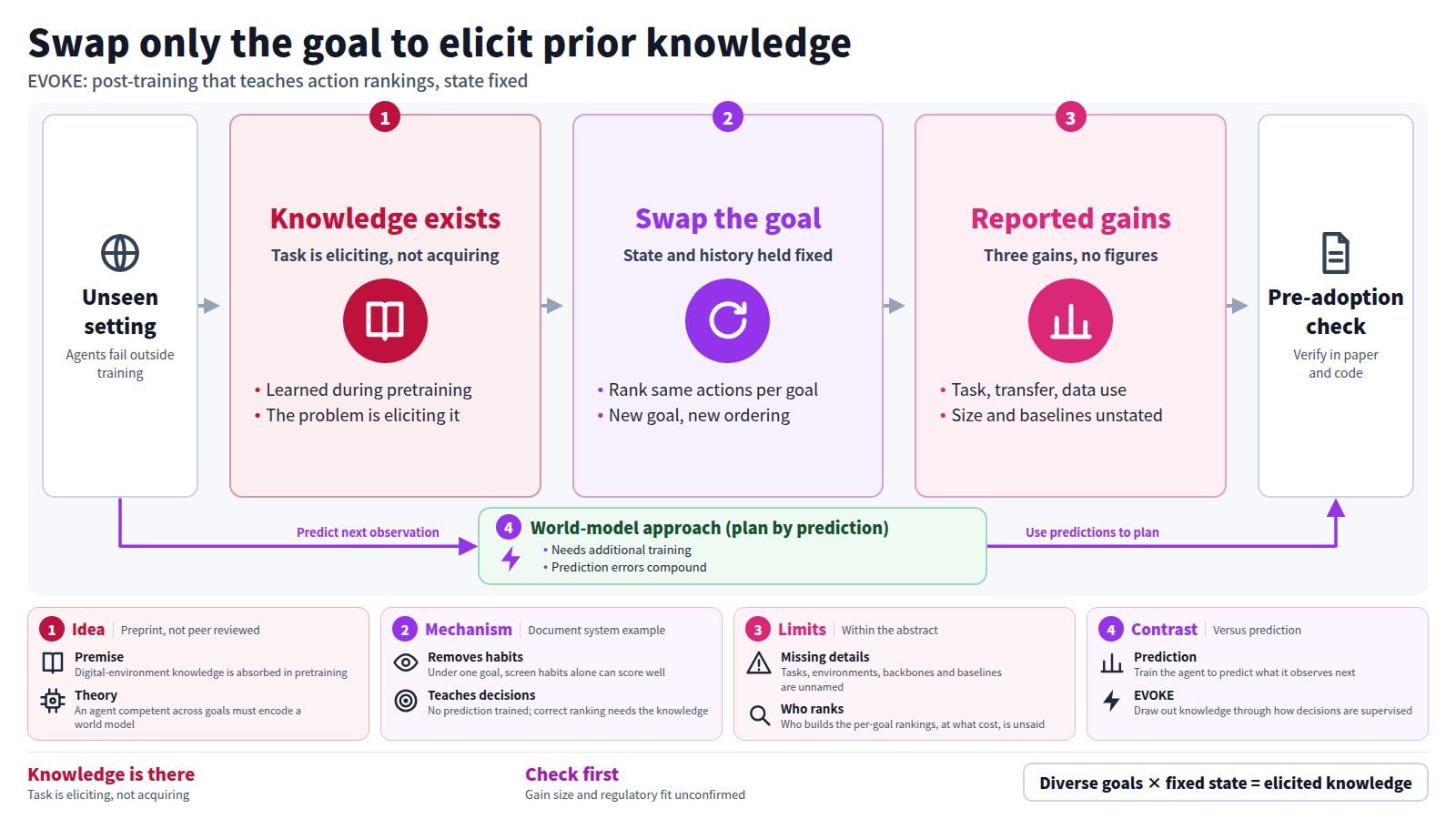
One established answer is the world-model approach: train the agent to predict what it will observe after an action, and use those predictions for planning. That requires additional training, and prediction errors compound when the predictions are chained into a plan.
The authors turn the question around. For LLM agents in digital environments, much of this world knowledge was already absorbed during pretraining. If so, the task is not acquiring the knowledge but eliciting it. The primary source is a preprint posted on arXiv and has not yet been through peer review.
2. The core idea: fix the state, change only the goal
In the authors' view, typical post-training puts little pressure on the model to draw on that knowledge. At each visited state it is supervised under a single goal, so a policy can score well by relying on superficial contextual habits, picking whatever action usually appears in that kind of context.
The core of EVOKE fits in one sentence: hold the environment state and interaction history fixed, swap in alternative goals, and have the agent rank the same candidate actions under each goal. When the goal changes, the right ordering of actions changes too. A policy that relies on contextual habits or on correlations with a single goal cannot order them correctly.
The design is motivated by theory: an agent that is competent across diverse goals must encode a world model that can be recovered from its action preferences. Rather than training the agent to predict the world, EVOKE supervises decisions directly, which implicitly pushes the policy to use the world knowledge it acquired in pretraining when it decides.
3. What the abstract reports
EVOKE was evaluated across diverse tasks with three backbones. The authors report gains in three respects: task performance, generalization to unseen environments, and data efficiency.
They also say they ran controlled analyses to understand what drives these gains.
The abstract, however, gives no figure for the size of any improvement. It does not say which tasks, which models, or which baselines were used. Within the abstract, therefore, all that can be said is that the authors report improvement on three fronts; how large that improvement is cannot be checked.
4. A worked example: the same screen in an internal system, different goals
Consider a document management system with the detail screen of one document open. Four options are visible: open the version history, request approval, duplicate the document under a new name, or return to search.
Trained under a single goal
In the training data, almost every visit to this screen had requesting approval as the correct action. The agent learns the pairing of this screen with approval requests as a habit. When the goal becomes finding out what changed since the previous version, it still reaches first for the approval request on this screen.
Trained in the EVOKE manner
With the same screen and the same history, the goal is swapped between requesting approval, checking differences from the previous version, and finding another document, and the agent has to re-rank the four options for each. Because the screen alone does not reveal the right order, the agent is pushed to use what it knows about how the system works, such as what the version history will show.
The point of the comparison is that the training on the right never asks the agent to predict how the system behaves. It teaches only the ranking of decisions; knowledge of the system gets used because ranking correctly requires it.
5. What is not new, and what the abstract does not settle
The idea that an agent able to handle many goals must carry a world model is not original to this paper. Earlier work argued that agents capable of goal-directed tasks must have learned a predictive model of their environment that can be extracted from their policy.[4] The EVOKE abstract does not name the theory it relies on, but its contribution can be read as turning this line of argument into a training procedure. Reusing the same experience under different goals to enrich training data has also long been used in reinforcement learning.
The limitations are significant. First, as noted, the abstract contains no figure for the size of the gains. Second, it does not name the tasks, environments, the three backbones, or the baselines. Third, swapping goals at a fixed state requires correct rankings under each goal, and the abstract does not say who produces those rankings, how, or at what cost. Fourth, the premise that the knowledge is already there is stated for digital environments; whether it also holds for specialized systems that pretraining rarely covers is not shown within the abstract.
The implementation is public as a repository.[2] On the paper-sharing page it has 69 upvotes and 3 comments, and the repository has 6 GitHub stars.[3] These are indicators of attention, not of correctness. No independent reproduction has been found.
6. Why this is getting attention, as a paper without a cluster
In this collection run, the paper's cluster size was 1, and only one signal family, reader votes, was raised. This is not a case of several independent papers taking up the same question at once; it is a single paper that attracted votes, and it should be read as a pick made under that condition.
Its keywords are agents, decision-making, eliciting, transferable, world and knowledge. Recent work on giving agents world models has mostly gone in the direction of predicting future observations. This paper stands out for offering an answer from the opposite side: not teaching prediction, but drawing out existing knowledge through the way decisions are supervised.
The other two papers selected on the same day deal with inference-time context management and with per-action verification. All three ask what an agent relies on when deciding during long tasks or in unfamiliar situations, but they do not form a cluster that cites one another.
7. Where this connects to pharmaceutical and regulatory work
The first connection is behavior outside the training environment. Systems used in pharmaceutical work are often in-house or specialized, and their screens change when versions are upgraded. The main concern when introducing an agent is how it behaves when the evaluated environment and the production environment diverge. EVOKE addresses exactly this, but the abstract does not state the size of the improvement. Before using it as grounds for adoption, the conditions need to be checked against the full paper and the code.
The second is how to build evaluations. Checking whether an agent's chosen action changes correctly when only the goal changes on the same screen is useful not just as a training method but as an evaluation method. An agent that keeps choosing the same action whatever the goal is likely acting on habits tied to the screen.
The third is how to treat the premise that the knowledge already exists. It may hold for general web pages and apps, but regulatory procedures and internal company rules are likely to be barely covered in pretraining. Given also that this is a preprint, the premise cannot simply be carried over into a business environment.