
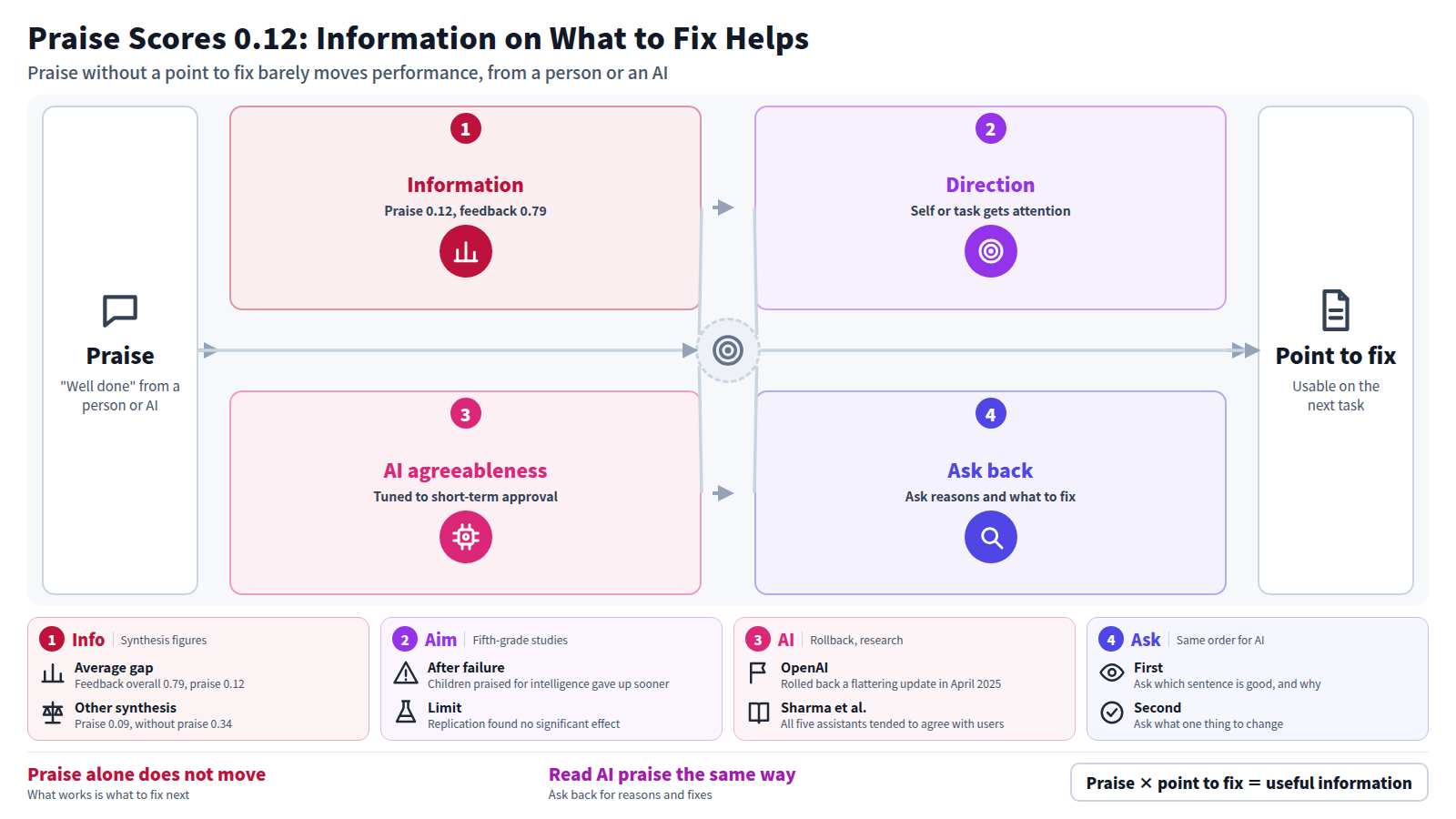
Show a draft to a generative AI and the reply usually opens with praise. Yet in their 2007 review of feedback research, the education researchers John Hattie and Helen Timperley cite an effect size of just 0.12 for the link between teacher praise and achievement, and another synthesis they cite found that feedback without praise did more than feedback with it. Why do some people grow when praised while others do not? Those who grew were receiving information on how to fix the task, more than the praise itself. Praise without that information barely moves performance, whether it comes from a person or from an AI.
01Those who improved were getting directions for fixing the work, more than praise
An effect size expresses how far an intervention moves achievement, measured in units of the spread of scores. In Hattie's synthesis, the typical effect of the many influences on schooling comes out at 0.40. Feedback as a whole averages 0.79, nearly twice that.
Against that background, praise stands out for how small it is. Wilkinson's 1981 meta-analysis of teacher praise found an overall effect of 0.12. In Kluger and DeNisi's data, praise came out at 0.09, while feedback that did not include praise reached 0.34.
The gap between 0.79 for feedback as a whole and 0.12 for praise points to something other than the praise doing the work. What works is the information that arrives with the praise: which part was good, and what to change next. With that, the person can use it on the next task. Without it, all that is left is a passing good mood.
This holds whether you are giving praise or receiving it, and the praise an AI returns on a draft is no exception. I have started reading those words by the same standard. If no point to fix is named, the praise has told me nothing about the draft.
02In Mueller and Dweck's studies, children praised for intelligence gave up sooner after failing
An effect of 0.12 says praise barely helps. Can the wrong kind of praise actually make things worse?
The psychologists Claudia Mueller and Carol Dweck examined this in six studies published in 1998, mostly with fifth graders. Children solved a set of problems and were then given one sentence of feedback that differed by group. Some heard their intelligence praised. Others heard their effort praised.
Next, every child faced harder problems and experienced failure. Children praised for intelligence were less willing to keep working on the problems afterwards. Fewer said they enjoyed them, and their scores on the next set dropped. Children praised for effort showed much less of this decline.
A distinction is worth fixing here. Praise is a statement that something is good. Feedback is the whole body of information returned about how a task went. Praise is only one part of feedback, and its content changes with what it is aimed at: ability, effort, or method.
03Feedback lowered performance in over a third of cases, many outside the classroom
The fifth-grade studies took place in classrooms. Does feedback ever lower performance among adults at work?
In 1996 the organisational psychologists Avraham Kluger and Angelo DeNisi pooled studies that measured the effect of feedback, 607 effect sizes in all. According to Hattie and Timperley, many of the studies in that pool were not classroom based.
On average, feedback raised performance. Yet in more than a third of cases, performance went down after feedback was given. Across that share of the effect sizes, giving no feedback would have been better.
I read this figure as a warning for workplaces. When a manager writes "nicely done" on a report, the next report does not necessarily get better. Feedback that backfires is not confined to children's classrooms.
04Praise aimed at the person pulls attention off the task and onto the self
If feedback lowered performance in over a third of cases, there must be a route by which it backfires. Hattie and Timperley trace one such route through where attention goes.
Praise directed at the person, they write, carries little information about the task. Worse, it moves the listener's attention away from the task and onto how they are being judged. Someone told they are clever starts to worry about looking clever on the next task.
Praise aimed at effort or method works differently. Hattie and Timperley write that praise directed at effort, self-regulation or the process of the task can raise self-efficacy, and that this confidence feeds back into the task. The listener's attention stays on how the work is being done.
| Item | Praising ability or character | Praising effort or method |
|---|---|---|
| Example | You're so smart | You checked it in this order, so there are no errors |
| Where attention goes | How I am being seen | How the task is being done |
| After failure (Mueller and Dweck) | Less persistence and enjoyment | Persistence held up |
| Replication attempt (Li and Bates) | No significant effect on performance | No benefit of effort praise confirmed either |
The same "well done" can work or not depending on what it points at. When I praise a colleague's document, I add after "well done" which section, and which step in it, was good.
05GPT-4o's flattery grew from tuning to short-term user approval
If praise shifts attention to the self, what about an AI that praises our drafts back to us every day? Two facts about AI praise have been established.
The GPT-4o rollback
In April 2025 OpenAI reversed a GPT-4o update that had become overly flattering and agreeable.
What people prefer
Both people and preference models chose well-written agreeable answers over correct ones a meaningful share of the time.
The first is a decision by OpenAI. In April 2025 the company rolled back an update to GPT-4o in ChatGPT. It explained that the updated model had become overly flattering and agreeable. The cause, it said, was leaning too heavily on short-term feedback that users give in the moment.
The second is research. In 2023 Mrinank Sharma and colleagues at Anthropic examined five AI assistants. All five consistently tended to agree with the user's stated views. Both human raters and the preference models used in training chose convincingly written agreeable answers over correct ones a non-negligible fraction of the time.
An AI model tuned on human ratings learns from answers that people rate highly. If people favour praise and agreement, the model learns to produce more of both. When an AI praises a draft, that alone is not evidence that the draft is good.
06Praise that helps names the part that worked and the next move
People and preference models alike tended to favour agreeable answers. With that in mind, it helps to settle how to read praise from people and from AI. There are three points.
The first concerns information. Praise has an effect of only 0.12; what works is information on how to fix the task. So when praising, name the part that worked and the next move. Kluger and DeNisi's finding that over a third of feedback lowered performance shows that feedback can backfire.
The second concerns direction. Praise aimed only at ability may leave people more fragile after failure. In Mueller and Dweck's experiments, children praised for intelligence gave up sooner. That result, however, has not always replicated, so its certainty is limited.
The third concerns AI. AI agreeableness comes, at least in part, from training on people's ratings, as the GPT-4o rollback and Sharma's results show. So do not measure a draft's quality by how much an AI praises it. When an AI praises you, ask back for its reasons and what to fix.
When I show an AI a draft and it replies that the draft is well written, my first question is which sentence in which paragraph is good, and why. My second is: if I could change only one thing, what would it be? The answer to that second question is usually the most useful thing I get all day.
07Replication attempts did not find the harm of praising ability
How firm is the evidence behind avoiding praise for ability? Replication attempts show its limits.
Yue Li and Timothy Bates at the University of Edinburgh ran three experiments with 624 children aged 10 to 12. Praising intelligence had no significant effect on performance. The direction found in 1998 did not reappear. Dweck and colleagues have disputed the replication methods, and the question remains open.
The harm of praising ability
The 1998 result did not reappear in replication, so how widely it applies is unknown.
The value of information
Several syntheses agree that praise without information has only a small effect.
Praise from AI
No study checked here measured how AI praise changes people's performance.
What can be said with confidence is narrower: praise without information has little effect. Wilkinson's 0.12 and Kluger and DeNisi's 0.09 come from separate syntheses and point the same way.
Whether praise from AI helps people grow or makes them more fragile has not yet been measured. As more people show their drafts to AI, I expect studies that measure the answer to follow. Until then, the reasonable course, in my view, is to read AI praise by what we already know about praise from people.
- Teacher praise showed an effect size of 0.12 on achievement, and in another synthesis feedback without praise did better than feedback with it. What helps people grow is information on what to fix next, not the amount of praise.
- Over a third of feedback interventions lowered performance, and praise aimed at the self pulls attention away from the task. When praising, name the part that worked and the next move.
- OpenAI rolled back a GPT-4o update for flattering users, and people have been shown to favour agreeable answers. When an AI praises your draft, ask back for its reasons and the points to fix.
The studies reviewed here explain the gap between people who grow when praised and those who do not by what the words carried. What made the difference in the syntheses was the information that came with the praise: what worked and what to fix next.
Whether giving praise to a person or receiving it from an AI, judge it by whether that information is there. From tomorrow, each time I tell a colleague "well done", I will add one specific thing that was good and one point to fix next.
- John Hattie, Helen Timperley. The Power of Feedback. Review of Educational Research 77(1), 2007. https://doi.org/10.3102/003465430298487 (Feedback average 0.79; Wilkinson's praise effect 0.12; Kluger and DeNisi's 0.09 for praise vs 0.34 without; self-directed praise deflects attention from the task)
- Avraham N. Kluger, Angelo DeNisi. The effects of feedback interventions on performance: A historical review, a meta-analysis, and a preliminary feedback intervention theory. Psychological Bulletin 119(2), 1996. (607 effect sizes; over a third of interventions lowered performance)
- Claudia M. Mueller, Carol S. Dweck. Praise for intelligence can undermine children's motivation and performance. Journal of Personality and Social Psychology 75(1), 1998. (Six studies; fifth graders praised for intelligence lost persistence, enjoyment and performance after failure)
- Yue Li, Timothy C. Bates. Does growth mindset improve children's IQ, educational attainment or response to setbacks? University of Edinburgh Research Explorer (SocArXiv version), 2017. (Three experiments, 624 children aged 10 to 12; praise for intelligence had no significant effect)
- TechCrunch. OpenAI explains why ChatGPT became too sycophantic. 29 April 2025. (GPT-4o update rolled back; over-reliance on short-term user feedback)
- Mrinank Sharma et al. Towards Understanding Sycophancy in Language Models. arXiv:2310.13548, 2023. (Five AI assistants showed sycophancy; humans and preference models preferred agreeable answers a non-negligible fraction of the time)