
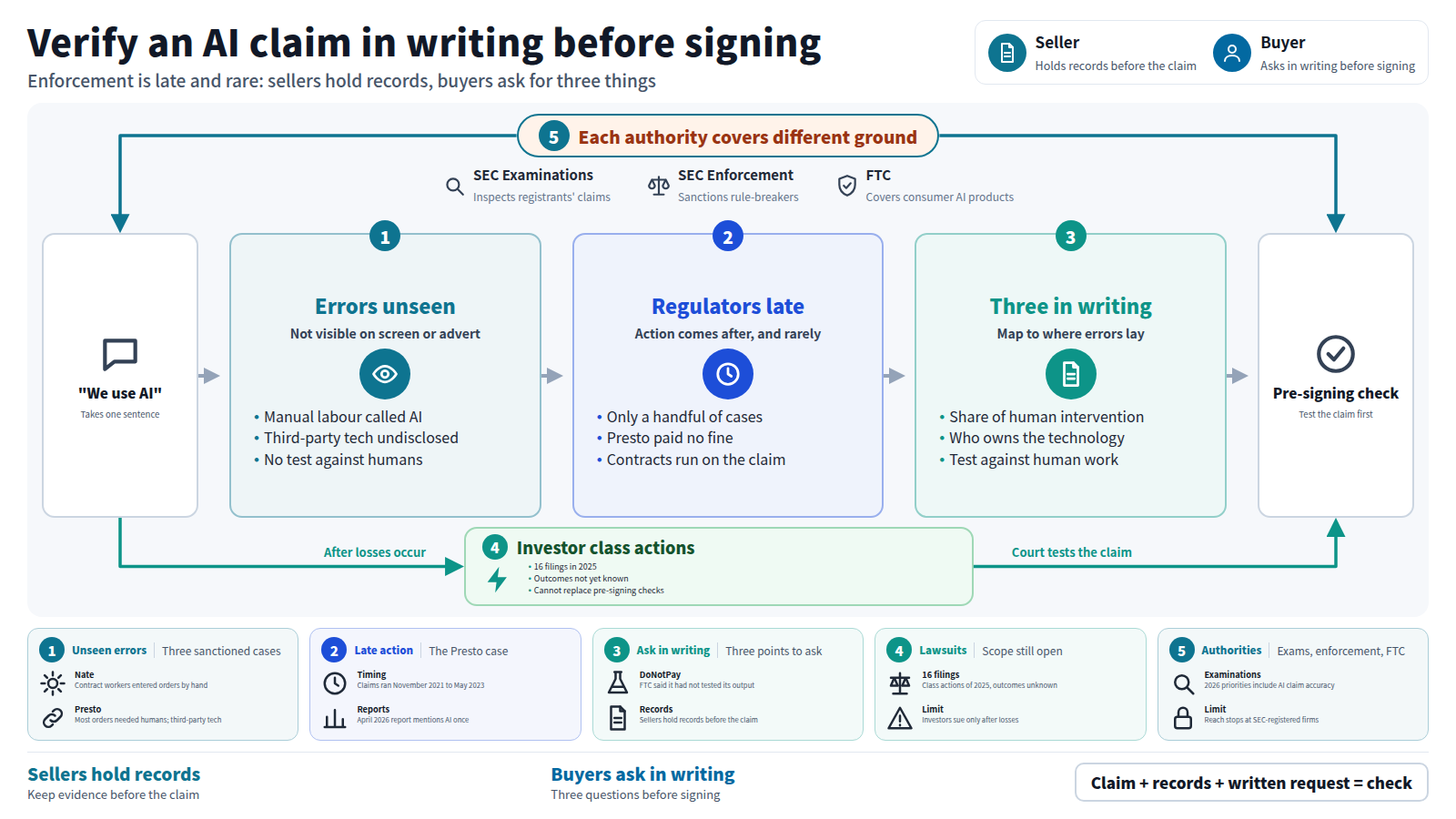
On 10 October 2026, Quartz reported that the US Securities and Exchange Commission (SEC) keeps warning companies about exaggerated AI claims yet rarely punishes them, and that the one listed company it could point to, Presto Automation, paid no fine. When a company says it uses AI, who checks whether that claim is true, and when? Regulators check only after the claim is out, and only occasionally. So the evidence has to be held on record by the seller before the claim goes out, and requested in writing by the buyer before anything is signed.
01The SEC warned about AI washing but has brought only a handful of cases
Exaggerated AI claims go by the name AI washing: marketing a product as AI-driven when it uses no AI, or far less capable AI than advertised. The SEC has been warning companies about it since 2024.
The enforcement record Quartz describes is thin. Two investment advisers in 2024. Presto in 2025. The founder of Nate, a shopping app, in the same year. Presto was a publicly listed company, and it paid no penalty.
Trace the sequence from claim to sanction and the regulator arrives last. By the time anyone looks inside the system, the people who believed the claim have already signed contracts or invested.
I draw one conclusion from this. A company buying an AI product should not wait for enforcement. Before signing, it should ask three things in writing. What share of the orders or tasks does a human touch? Who owns the technology? Was the output ever tested against the human work it claims to replace?
02The three firms sanctioned misstated whether they used AI or overstated its abilities
Cases are few, but the ones that exist show what kind of statement the SEC treated as false. Set side by side, they look like this.
| Item | Delphia (2024) | Presto (2025) | Nate (2025) |
|---|---|---|---|
| Claim | AI that predicts which companies will grow | Voice ordering that removes the need for staff to take orders | AI completes purchases with no human involvement |
| Reality | Did not have that capability | Most orders needed human intervention; the technology was for a time owned by a third party | Contract workers entered orders by hand |
| Outcome | $400,000 across two advisers | No civil penalty | SEC complaint and parallel criminal charges |
Delphia, an investment adviser, said it used client data and AI to predict which companies and trends were about to take off. The SEC found it did not have that capability. Together with Global Predictions, charged the same day, the two advisers paid $400,000.
Presto sold a system that took drive-thru orders by voice. According to the SEC, Presto said its AI could eliminate the need for staff to take those orders. In fact, for one version of the system, the vast majority of orders required human intervention. For a period, the speech recognition itself was owned and operated by a third party.
Nate's founder told investors the app completed online purchases without people in the loop and raised more than $42 million. The SEC alleges that contract workers entered many of those orders by hand.
Each case was one of two things: claiming AI that was not there, or claiming more of it than there was. In each, the one-line claim and what happened inside the system did not match.
03SEC examiners list the accuracy of AI claims among their 2026 priorities
All three firms came from the investment world. Which other authorities look at AI claims? In the United States at least three bodies cover different ground.
SEC Division of Examinations
Inspects brokers and advisers on a routine cycle. Its 2026 priorities include checking whether statements about AI capabilities are accurate.
SEC Division of Enforcement
Brings cases against firms that break the rules. It handled Presto and Nate.
FTC
The Federal Trade Commission covers consumer AI products. In September 2024 it announced five actions at once.
The examinations document says staff will review registrants' representations about their AI capabilities for accuracy. That is a way of looking at the gap between claim and substance before it becomes an enforcement matter. Its reach, however, stops at firms registered with the SEC.
Among the FTC's five actions was DoNotPay, which marketed itself as the world's first robot lawyer. The FTC said the company had not tested whether its output matched the work of a human lawyer. DoNotPay agreed to pay $193,000.
04A claim takes one sentence; the error shows only once someone opens the system
The examiners look at accuracy because errors in AI claims cannot be seen from outside. None of the three cases could be detected from a screen or an advert.
A Nate user saw a screen saying the order was done. Nothing on that screen said whether software or a person in another country had placed it.
At a Presto drive-thru, a voice system really did take the order. How often a person stepped in behind it, and who owned the speech technology, were invisible to the customer and to the investor alike.
A DoNotPay customer received a document written by the AI. Whether it reached the standard of a lawyer's work could not be known by anyone, because no one had run the comparison.
A claim takes one sentence. Writing "our AI handles this automatically" costs nothing. Checking whether that sentence is true requires processing logs or test results, and a regulator sees those only after opening an investigation.
05Under Chairman Atkins, the SEC says it has ended regulation by enforcement
If errors surface only when someone looks inside, then the question becomes how much looking the regulator does. Quartz describes a change in posture since 2024.
| Item | 2024 | 2026 |
|---|---|---|
| Statements | Enforcement Director Grewal told listed companies to watch their AI claims too | Chairman Atkins said the agency had stopped regulating by enforcement |
| Cases | Two advisers, $400,000 in total | April enforcement report mentions AI once, in the Nate case |
| Staffing | ─ | New unit of about 30 staff from February 2025; "AI washing" not among its listed priorities |
Regulation by enforcement means defining what counts as a violation through individual cases rather than through new written rules. According to Quartz, Chairman Paul Atkins has said the Commission put a stop to it.
In February 2025 the SEC created a Cyber and Emerging Technologies Unit with about 30 fraud specialists and attorneys. Its listed priorities include fraud committed using AI. The announcement does not use the phrase AI washing.
In the enforcement report the SEC released in April 2026, AI appears in a single place: the case against Nate's founder. On those numbers alone, the work of checking AI claims is moving out of the regulator's hands.
06Evidence comes down to the seller's records and three questions the buyer asks before signing
If AI appears only once in the SEC's April 2026 report, the checking has to happen outside the agency. I break that work into three points.
The first is timing. Enforcement comes after the fact and rarely. Presto's misleading statements ran from November 2021 to May 2023, and the order came in January 2025. While a buyer waits for enforcement, contracts keep running on the false claim.
The second is substance. The errors in the sanctioned cases sat in three places: human intervention, ownership of the technology, and testing. Nate called manual labour AI. Presto did not disclose a third party's technology. DoNotPay had not run the tests. Those three are where the questions belong.
The third is paper. Buyers should ask for answers to all three in writing before signing. Sellers should hold the records before making the claim. What the FTC held against DoNotPay was exactly the absence of test records.
With written answers in hand, a buyer can show exactly what differed if the product turns out not to match the claim. Presto's investors had no means of learning the rate of human intervention.
07Sixteen class actions were filed in 2025; whether they fill the regulatory gap is open
Asking three questions is the buyer's tool. Outside the regulator there is one more place where claims can be tested: lawsuits brought by investors.
Cornerstone Research counted 16 AI-related securities class action filings in 2025. A class action lets a few investors sue on behalf of many who suffered the same loss. Even without an SEC case, investors can challenge a false claim in court.
Lawsuit outcomes
How the 16 class actions filed in 2025 will end is not yet known.
Number of cases
The cases Quartz lists come from reporting; the SEC has not published a full count.
The Nate case
Both the SEC complaint and the criminal charges are allegations not yet tested at trial.
Whether litigation can stand in for the regulator has not been shown. Lawsuits come after losses. The job of checking a claim before a contract is signed still falls to the seller and the buyer.
I read the figure of 16 as a sign that false AI claims are starting to surface as investor losses. Whether that number rises or falls can only be seen in the yearly counts still to come.
- The SEC has sanctioned only a handful of AI-washing cases, and Presto, a listed company, paid no fine. Waiting for regulators means contracts run on a false claim in the meantime.
- The errors in sanctioned claims lay in the substance: human labour, a third party's technology, or no testing at all. None of these is visible from an advert or a screen.
- Buyers should ask in writing, before signing, for the human-intervention rate, who owns the technology and the test records; sellers should hold those records before making the claim. These two steps alone move the check from after the fact to before it.
Regulators check a "we use AI" claim only after it is made, and rarely. Before a contract is signed, the only parties who can confirm it are the seller who holds the records and the buyer who asks for them in writing.
If someone pitches me an AI product, my first question is what share of orders a human touches. If the answer does not come back on paper, I treat the claim as unverified.
- Quartz (via Yahoo Finance). The SEC warns companies about 'AI washing' but rarely punishes them. 10 October 2026. https://qz.com/sec-ai-washing-enforcement-small-companies-investors-100826 (Few cases; Presto as the listed-company example; Chairman Atkins's remark; the April 2026 enforcement report)
- U.S. Securities and Exchange Commission. SEC Charges Two Investment Advisers with Making False and Misleading Statements About Their Use of Artificial Intelligence. Press Release 2024-36, 18 March 2024. (Delphia and Global Predictions; $400,000 in total; Enforcement Director Grewal's remarks)
- U.S. Securities and Exchange Commission. Presto Automation Inc. Administrative Proceeding File No. 3-22413, 14 January 2025. (Most orders required human intervention; third-party technology; statements from November 2021 to May 2023; no civil penalty)
- U.S. Securities and Exchange Commission. Alberto Saniger Mantinan, a/k/a Albert Saniger. Litigation Release No. 26282, 11 April 2025. (Nate's claims and manual order entry by contract workers; more than $42 million raised)
- U.S. Securities and Exchange Commission, Division of Examinations. Fiscal Year 2026 Examination Priorities. 17 November 2025. (Review of registrants' AI representations for accuracy)
- Federal Trade Commission. FTC Announces Crackdown on Deceptive AI Claims and Schemes. 25 September 2024. (Five actions; DoNotPay's "world's first robot lawyer" claim and lack of testing; $193,000)
- U.S. Securities and Exchange Commission. SEC Announces Cyber and Emerging Technologies Unit to Protect Retail Investors. Press Release 2025-42, 20 February 2025. (A unit of about 30 staff and its listed priorities)
- Cornerstone Research. Securities Class Action Filings—2025 Year in Review. 2026. (16 AI-related filings in 2025)