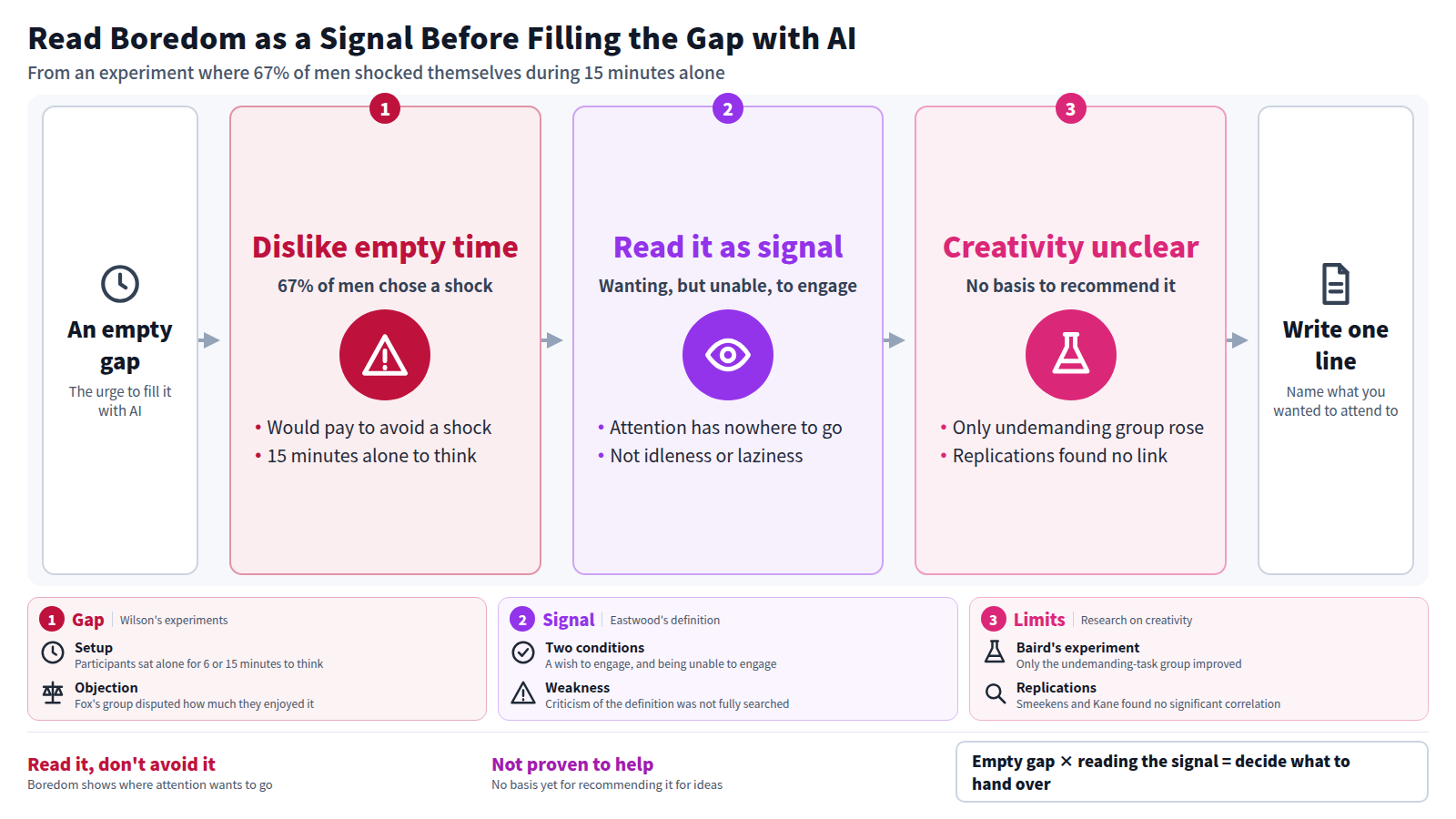
Generative AI can fill a blank page or an idle minute almost instantly. In an experiment Timothy Wilson and colleagues reported in Science in 2014, 67% of the men left alone to think for 15 minutes gave themselves an electric shock. Among the women, 25% did. Is boredom something we should avoid? My answer is no. Boredom is a signal that attention cannot settle on a satisfying activity, and before filling the gap with AI or a screen, it is worth reading that signal for what it says you want to attend to.
01Boredom is a signal from attention, worth reading before AI fills the gap
Whether boredom should be avoided can be answered with three pieces of evidence: a definition, an experiment, and a set of failed replications.
Start with the definition. In 2012 the psychologist John Eastwood and his colleagues described boredom as "an aversive state of wanting, but being unable, to engage in satisfying activity." They located its cause in the workings of attention rather than in the amount of free time someone has.
The experiment is Wilson's. Every participant had said beforehand that they would pay money not to receive a shock of that strength. Left alone with nothing but their thoughts, many of them shocked themselves anyway. The pull to fill empty time is that strong.
The replications concern whether time close to boredom, spent on an undemanding task, helps creative thinking. A 2012 study found that people who did an undemanding task between two attempts at a creativity test scored higher the second time. Later work, however, failed to find the link between mind wandering and those scores. For now there is no basis for telling anyone that boredom will make them more creative.
Put the three together and, in my judgement, boredom is neither something to stamp out quickly nor something to seek. Wilson's result shows how strongly people dislike empty time; it does not show that boredom does harm. It is information about where attention wants to go.
Generative AI now fills the small gaps in a working day almost instantly: the blank page before a draft, the pause before a search. I think that reading the signal once, before the gap is filled, makes it easier to separate the work I want to own from the work I am content to hand over.
02Boredom means wanting, but failing, to engage with something
Calling boredom a signal from attention is a reading I draw from Eastwood's definition. If the definition holds, feeling bored indicates that there is something you want to engage with and that attention is not reaching it. The Association for Psychological Science publicized the paper in September 2012; it appeared in Perspectives on Psychological Science.
The definition has two parts. One is a desire to be absorbed in something. The other is the fact that, at this moment, you cannot be. Boredom is what it feels like when both are present at once.
Eastwood's group placed the failure on the side of attention. Either attention will not stay on the activity in front of you, or there is nowhere you would rather point it. Boredom grows out of that state.
On this account, boredom and idleness come apart. A long wait in an airport lounge is not boring if you are lost in a book you wanted to read. A meeting can be boring even though every minute of it is scheduled, if your attention will not engage with what is being said.
Boredom is also different from laziness. A lazy person could engage and chooses not to. A bored person wants to engage and cannot. That difference is what makes the moment of boredom useful: it invites the question of what, exactly, you were hoping to engage with.
03Work with generative AI has moved toward checking
If boredom depends on where attention can go, it is worth asking where attention is being sent at work today. A useful clue comes from a 2025 survey by Hao-Ping Lee and colleagues at Microsoft Research.
Lee's team asked 319 knowledge workers to describe occasions when they had used generative AI on the job. The results were presented at CHI 2025, the main international conference on human-computer interaction. The thinking these people did had shifted toward three kinds of work.
Verifying information
More of the work became checking whether what the AI produced was correct.
Integrating answers
More of the work became fitting the AI's answer into the context of one's own task.
Stewarding the task
More of the work became deciding what to ask the AI to do and seeing the result through.
Reviewing promotional materials has always been work built around checking. In Lee's survey, respondents in other jobs reported their thinking shifting in the same direction.
Two limits matter here. The survey collected self-reports. And it contains no data showing that using generative AI makes people more or less bored. What it supports is narrower: by their own account, where these respondents put their thinking during work is changing.
04Given 15 minutes alone to think, 67% of men chose a shock
If, by Lee's respondents' own account, thinking at work is shifting toward checking, what happens in the gaps when that work stops? Wilson's experiments looked at exactly those empty minutes.
Across six initial studies, Wilson's team asked hundreds of participants, mostly undergraduates, to sit alone for 6 or 15 minutes and simply think. They later tested the core finding with a community sample of adults whose average age was 48.
In the version with electric shocks, the thinking period lasted 15 minutes, and participants could shock themselves if they wished. Three facts from that study belong side by side.
What they said beforehand
Every participant had said they would pay money not to receive a shock of that intensity.
What they did
During the time alone with their thoughts, 67% of the men and 25% of the women shocked themselves at least once.
The challenge
Fox and colleagues argued that participants enjoyed just thinking more than the authors claimed.
The objection came in the same year. I have not been able to read Fox's critique itself; I know its content from the reply Wilson's team published in Frontiers in Psychology.
As far as that reply shows, the dispute is about interpretation, namely how much participants enjoyed the thinking period. The share of people who chose the shock is not what the two sides were arguing over.
People can dislike empty time enough to choose pain over it. Reasoning from that, it would not be surprising if many people reach for a phone or open a chat window with an AI the moment a gap appears. The experiment, though, tested whether people chose a shock, not whether they reached for a phone or an AI.
05Only the group given an undemanding task improved on the second try
People dislike empty time intensely. So what happens to thinking when something close to empty time is deliberately inserted? A 2012 experiment by Benjamin Baird and colleagues in Psychological Science answers that with counts.
The task was the Unusual Uses Task: list as many unusual uses as you can for a common object. Participants did it twice. Between the two attempts they were split into four groups according to how they spent the interval.
One group did a demanding task and another did an undemanding one. The third group rested for 12 minutes, and the fourth had no break at all.
Only the group that did the undemanding task improved its score on the second attempt. People in that group also reported more mind wandering during the task. Baird's team concluded that simple tasks that let the mind wander may help creative problem solving.
The group that rested for 12 minutes did not improve. The study does not say that any idle time will do.
06Boredom is disliked and informative, but its creative benefit is unproven
Only the undemanding-task group improved. How far can that result be trusted? Taking that question into account, what can be said about boredom falls into three claims.
First, people dislike boredom strongly. That changes how we should judge the urge to fill every gap with AI or a screen: it would not be surprising if many people feel it, and it need not be read as a personal weakness. The ground for saying so is Wilson's result, in which 67% of men and 25% of women chose a shock they had said they would pay to avoid.
Second, boredom can be read as a signal. If you read it, you gain a moment to ask what you wanted to engage with before you fill the gap. The ground for this is Eastwood's definition, which describes boredom as wanting, but being unable, to engage.
Third, it cannot yet be said that boredom aids creativity. Nobody should be told to "get bored and the ideas will come." Here I am treating mind wandering during an undemanding task as a state close to boredom. In 2016, Smeekens and Kane ran three experiments on mind wandering and Unusual Uses scores and found no significant correlation in any of them.
Steindorf and colleagues looked again in 2020. They found no group difference in the incubation effect, and no correlation between the tendency to mind-wander and performance on the second attempt. The three claims line up as follows.
| Aspect | Boredom is disliked | Boredom signals attention | Boredom aids creativity |
|---|---|---|---|
| Basis | Wilson et al. 2014 (Science) | Eastwood et al. 2012 (a proposed definition) | Baird et al. 2012 (Psychological Science) |
| Later debate | Fox et al. dispute the interpretation | I have not checked for objections | No correlation in Smeekens & Kane or Steindorf et al. |
| What this essay can claim | The pull to fill empty time is strong | It can be read as a signal | No basis for recommending it |
The middle column has its own weakness. I have not searched thoroughly for criticism of Eastwood's definition, so reading boredom as a signal is a reading that depends on accepting that definition.
07The effect on attention of filling every gap with AI is, as far as I can find, unmeasured
If boredom's creative benefit is unproven, what can be said about the habit of filling every gap with AI? Lee's survey has one relevant finding.
Workers who placed more confidence in generative AI reported less critical thinking. This is a correlation between self-reports. It does not show that trusting AI caused anyone to think less.
Does filling empty time with AI, day after day, change how boredom feels? Does it move where attention goes? Within the sources I checked for this essay, no study has measured either. I will not pretend to an answer.
Where measurement is missing, research cannot settle whether the habit is good or bad, so until it can, I rely on a personal routine. When boredom arrives, I first write one line saying what I wanted to be absorbed in. Then I decide which part of that the AI can take. The part I keep, I think through myself, even if only for a few minutes.
In materials review, that division is easy to picture. Searching for the literature behind a claim is something I am happy to let an AI help with. How a physician will read a particular phrase is something I want to think through with my own head.
The few minutes of boredom can tell me what I want to take responsibility for. Handing the rest to an AI can wait until after that.
- In Wilson's study, 67% of men and 25% of women chose an electric shock over just thinking. The pull to fill empty time is strong, so it would not be surprising if people fill it with AI or a screen.
- Eastwood and colleagues define boredom as wanting, but being unable, to engage in satisfying activity. It reads as a signal about where attention wants to go, not about idle time.
- Baird's finding that an undemanding task improved creative scores has not held up in follow-ups on mind wandering. It is no basis for recommending boredom as a creativity aid.
Boredom is not something to avoid. It signals that attention cannot settle on a satisfying activity. It has not been shown to aid creativity, but it can help you check what you want to engage with.
Read that signal once before letting generative AI fill the gap. The next time I feel bored, before I open an AI window, I will write down the name of the work I wanted to be absorbed in.
- Association for Psychological Science. "I'm Bored!" – Research on Attention Sheds Light on the Unengaged Mind. 26 September 2012. https://psychologicalscience.org/?p=77138 (Eastwood et al.'s definition of boredom and its grounding in attention; paper in Perspectives on Psychological Science)
- Timothy D. Wilson et al. Just Think: The Challenges of the Disengaged Mind. Science, 2014. (Time alone with one's thoughts and self-administered shocks)
- BPS Research Digest. It's the darkness within – some people would rather shock themselves with electricity than spend time alone with their thoughts. 3 July 2014. https://bps.org.uk/research-digest/it-darkness-within-some-people-would-rather-shock-themselves-electricity-spend-time (6 or 15 minutes of thinking; 67% of men and 25% of women; prior statements that they would pay to avoid the shock)
- Timothy D. Wilson et al. Reply to Fox et al., "Is thinking really aversive?". Frontiers in Psychology, 2014. https://www.frontiersin.org/journals/psychology/articles/10.3389/fpsyg.2014.01428/full (Fox et al.'s objection and the reply)
- Association for Psychological Science. More than Just 'Zoning Out' – Psychological Science Examines the Cognitive Processes Underlying Mind Wandering. 11 October 2012. https://www.psychologicalscience.org/news/releases/more-than-just-zoning-out-psychological-science-examines-the-cognitive-processes-underlying-mind-wandering.html (Baird et al.'s four groups and results)
- PLOS ONE. Propensity or diversity? Investigating how mind wandering influences the incubation effect of creativity. 2022. https://pmc.ncbi.nlm.nih.gov/articles/PMC9053813/ (Smeekens & Kane 2016 and Steindorf et al. 2020 found no correlation between mind wandering and task scores)
- Hao-Ping (Hank) Lee et al. The Impact of Generative AI on Critical Thinking: Self-Reported Reductions in Cognitive Effort and Confidence Effects From a Survey of Knowledge Workers. CHI 2025. https://www.microsoft.com/en-us/research/publication/the-impact-of-generative-ai-on-critical-thinking-self-reported-reductions-in-cognitive-effort-and-confidence-effects-from-a-survey-of-knowledge-workers/ (319 knowledge workers' self-reports; shift toward verification, integration and stewardship)