
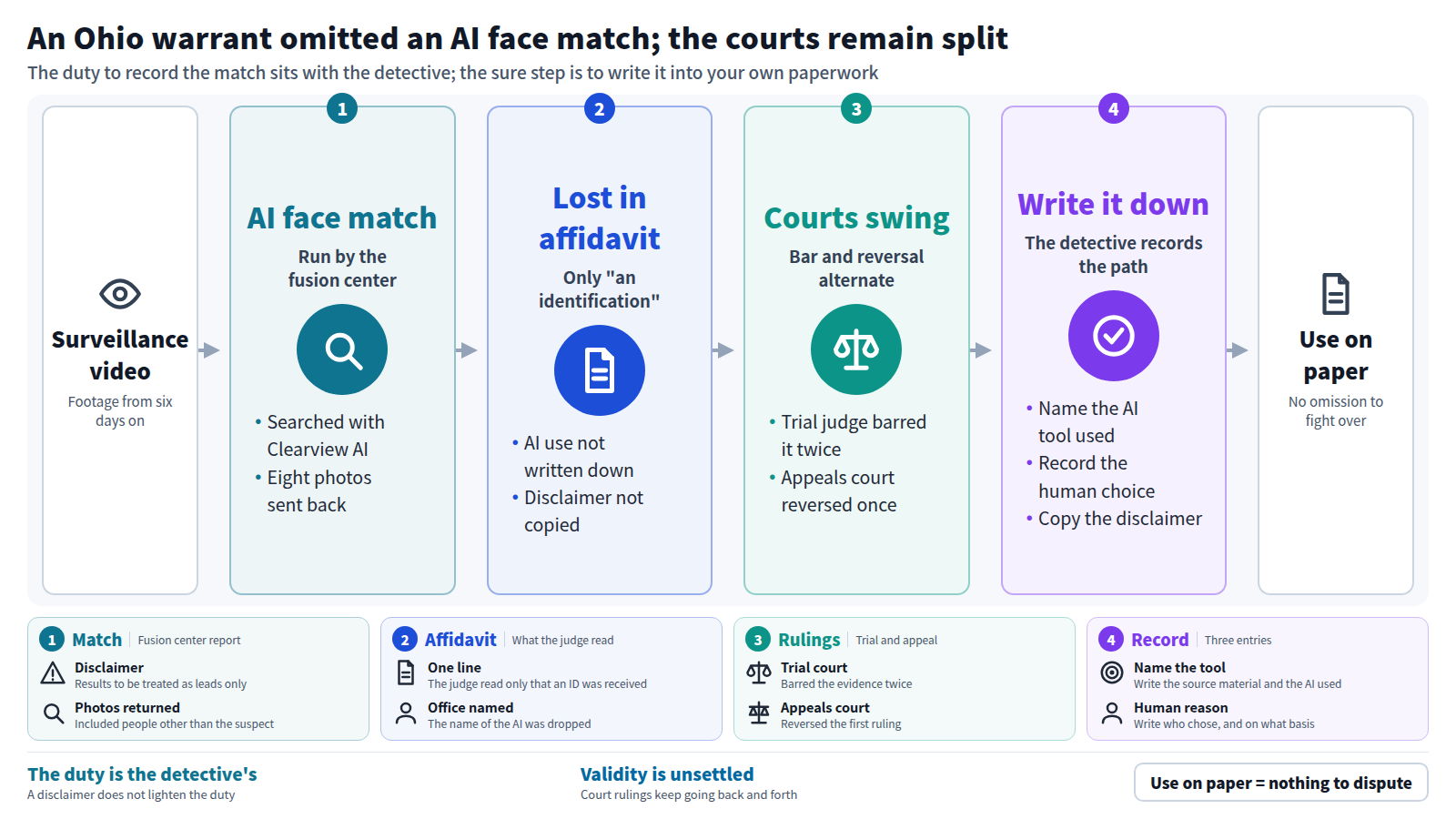
On 6 January 2026, a court in Ohio faulted a detective who had left the use of an AI face match out of a warrant affidavit, and ruled that the evidence seized under that warrant could not be used at trial. When an AI match is used as a lead, who carries the duty to put that use in writing? The duty sits with the detective who used the AI to seek the warrant; whether a warrant that left it out still stands keeps swinging from one court to the next, so the only sure step is to write the use into your own paperwork.
01The Ohio warrant that left out an AI face match keeps moving between courts
Who has to record the use of an AI match is a question one murder case in Cleveland, Ohio, helps to answer. The killing took place in February 2024. Police sent surveillance video, recorded six days after the killing, to the state fusion center. The fusion center ran the footage through a face-matching tool called Clearview AI and sent eight photos back to the police.
The detective then asked a judge for a warrant to search the suspect's home. The affidavit said the police had "received an identification" through the fusion center. The detective did not write that an AI face match had been used. The affidavit also said nothing about the AI having returned photos of people other than the suspect.
The search turned up a handgun, and the man was charged with murder. The case, State v. Tolbert, has not been settled by a single ruling.
- January 2025: the trial judge ruled that the evidence obtained under the warrant could not be used at trial.
- 25 September 2025: an Ohio appeals court reversed that ruling and sent the matter back to the trial court for a fresh look.
- 6 January 2026: the trial judge found that the detective had deliberately written statements contrary to the facts, and again barred the evidence.
- 9 January 2026: the state appealed once more.
On 1 October 2026, the legal news service Bloomberg Law ran a story under a headline saying that Ohio prosecutors had won an appellate ruling allowing the use of AI as a basis for a search. I could read only the headline. I have not been able to confirm whether that ruling concerns the Cleveland case.
The duty to put the AI face match in writing sits with the detective who used it to seek the warrant, and the courts have split on whether a warrant that left it out is valid. However the courts rule, a use that was written down cannot be attacked as an omission. Anyone who uses an AI answer as a lead in their own work should therefore write that use into their own documents.
02The fusion center's own report limited the AI result to a lead
The Cleveland detective wrote only that an identification had been received. The fusion center that ran the face match had, for its part, written down limits on how the AI result could be used.
According to the legal commentary site Objectively Reasonable, the fusion center's report carried a disclaimer. The disclaimer said that face-match results were to be treated as investigative leads, and that an arrest must not rest on the AI result alone. The report also did not allow the AI result to be used as evidence at trial or in papers filed with a court.
Neither the AI face match nor the fusion center's disclaimer appeared in the detective's affidavit. The judge who issued the warrant had only one line to read: that an identification had been received.
The limits the fusion center set stayed inside its report and never reached the judge who signed the warrant.
03Recording the materials used is already standard practice for drug companies in Japan
The fusion center's disclaimer was never copied into the detective's affidavit. A procedure for keeping the source of what one uses on paper already exists in another industry.
In 2018, Japan's Ministry of Health, Labour and Welfare issued guidelines on how companies provide sales information about prescription drugs. Under them, a drug company first sends any material its staff will use to explain a drug to doctors through review by a department that is independent of sales. What a sales representative told a doctor, spoken explanations included, goes into a business record that the company keeps.
| Point of comparison | Warrant affidavit | Prescription drug materials |
|---|---|---|
| Who checks before use | The detective seeking the warrant and the judge who issues it | A review department independent of sales |
| Is the source written down | In this case, the AI face match was not written down | The materials used go into the business record |
| Spoken exchanges | Nothing survives outside the affidavit | Spoken explanations are recorded too |
| When something is left out | Rulings barring the evidence and a reversal have gone back and forth | Material that fails review cannot be used |
At a drug company, the basis on which a sales representative spoke to a doctor stays in the company's records. For warrant affidavits, I could find no rule, as of this case, requiring a detective to set out, step by step, how the investigation arrived at the suspect.
04The detective wrote that the answer came from a state office, not from an AI
Drug companies keep records of the materials they use, yet the Cleveland detective left the AI face match out of the affidavit. The wording of that affidavit shows how the detective presented the answer.
In the affidavit, the suspect's name is presented as having arrived from a government office, the state fusion center. The affidavit kept the office's name and dropped the name of the AI that produced the answer. The sources do not say why the detective wrote it this way; the trial judge found the wording deliberately contrary to the facts.
On appeal, prosecutors argued that other investigative work backed up the identification. They pointed out that the surveillance video showed the man's movements, and that the location was his address while on parole. In the prosecution's view, the AI face match was only one part of the investigation, and the warrant had enough grounds without it.
If an AI answer is treated, as the prosecution treated it, as one part of a larger investigation, it follows that leaving the AI out of the paperwork leaves the warrant's grounds intact. AI research has also measured the way a factor that moved an answer disappears from the explanation given afterwards. In 2023, Turpin and colleagues ran experiments in which they added cues to a language model's input that pushed its answer in one direction. The model changed its answers, but its explanations did not mention the cue. Accuracy fell by as much as 36%.
Turpin and colleagues measured language-model explanations, not detectives' paperwork. I do not claim that the detective's omission and the model's omission have the same cause. A factor that moved an answer can drop out of the later account, in a person's written statement and in an AI's explanation alike. That is as far as I can go.
05A detective can put the path to the suspect on paper
The name of the AI had dropped out of the Cleveland detective's affidavit. Keeping it on paper takes three steps.
First, the detective writes down which material the suspect's name came from. In the Cleveland case, that means the fact that the surveillance footage was searched with Clearview AI and that eight photos came back.
Second, the detective writes down how the candidates were narrowed: who looked at what, and how one person was picked out of the eight photos.
Third, the detective checks that both the AI result and the detective's own way of choosing appear in the affidavit. The affidavit filed with the court is the only document a judge or a defence lawyer can read.
Name the tool you used
Write down which material the candidate came from, together with the name of the AI that was used.
Record the human choice separately
Write down who narrowed the candidates and on what basis, apart from the AI result.
Copy the disclaimer across
Put the disclaimer that the party returning the AI result attached into the same document as the AI result.
The hardest part to write is the human reason. Why the detective picked that one person exists only in the detective's head, and if it is not written down, nobody can check it later.
06The duty stays with the user of the AI, and the warrant's fate is still open
The Cleveland detective could have written the path to the suspect into the affidavit. People who use AI answers in their work can take three lessons from the case.
A disclaimer does not shift the duty
Even when the party that returned the AI result attaches a disclaimer, the person who uses the result still has to write it down.
The warrant's validity is unsettled
On a warrant that left out the use of AI, the courts' rulings have gone back and forth.
EU rules require per-use records
EU rules already contain a provision requiring each use of AI to be written into a record.
First, in this case a disclaimer did not lighten the duty of the person who used the result. The fusion center's report said the AI result was to be used only as an investigative lead. But the judge who issued the warrant read only the detective's affidavit. In January 2026, the trial judge faulted that affidavit. The detective had written neither that AI was used nor what the disclaimer said, and the judge found that the detective had deliberately written statements contrary to the facts. In court, the party held responsible was the detective who filed the affidavit, not the fusion center that wrote the disclaimer.
Second, whether a warrant that left out the use of AI is valid has not been decided. The trial judge twice barred the evidence, in January 2025 and in January 2026. The appeals court reversed the first of those rulings in September 2025. After the January 2025 ruling, prosecutors said they had lost the prospect of winning a murder conviction. That trial ruling changed the course of the case. Whether the warrant finally stands is something the courts have yet to decide.
Third, EU rules require every use of AI to be written down. Article 26 of the EU AI Act requires the police, each time they identify a person from recorded footage after the fact, to note that use in the police file. EU rules do not apply to the Ohio case. Even so, a duty to record each use of AI already exists in EU law.
07The reach of the duty to record AI use may be the next point of dispute
The treatment of a warrant that left out the AI face match is still swinging in the Ohio courts. The open matter is how far the duty to record the use of AI will extend, and two documents give some indication.
Article 26 of the EU AI Act requires the police, when they identify a person from recorded footage after the fact, to request authorization. They must ask a court or a similar authority within 48 hours at the latest. The police are also required to note each use in the police file.
In the United States, the attorneys general of 26 states sent a letter to the leadership of Congress on 23 September 2026. They asked for an arrangement under which, when an AI incident occurs, investigators can look directly at a company's books and records and publish their findings.
Neither document applies to the Ohio case; the EU AI Act is European law and is not used in American cases. Whether the letter will ever become law is something I have not been able to confirm.
The Cleveland case is not over either, and I could not confirm whether the Bloomberg Law headline of 1 October refers to it. The appeals court may yet allow the evidence. Even then, the trial judge's two rulings faulting the affidavit remain in the court record. Had the detective written that AI was used, the courts would have had no omission to fight over.
- The fusion center's report limited the AI face-match result to an investigative lead. A disclaimer reaches the judge only if the detective copies it into the affidavit.
- The trial judge barred the evidence in January 2025 and again in January 2026, and the appeals court reversed the first ruling in September 2025. Whether a warrant that left out the use of AI is valid has not been decided.
- The EU AI Act requires the police to note in the police file each time they identify a person from recorded footage after the fact. A procedure for recording each use of AI already exists in EU law.
The duty to put an AI face match in writing sits with the detective who used the AI to seek the warrant. The fusion center's disclaimer did not lighten that duty.
The Ohio courts have moved back and forth between barring the evidence and reversing that bar, on a warrant that left out the use of AI. Whatever the appeals court decides, anyone who uses AI answers at work has the same task: write down, in your own documents, the AI you used and what you looked at when you chose. If the use of AI is on paper, nobody can later fight in court over its omission.
- ACLU of Ohio. State v. Tolbert (amicus). 2026.(The appeals court's reversal and remand of 25 September 2025; the trial court's finding on 6 January 2026 that the affidavit contained deliberately false statements, and its voiding of the warrant; the state's appeal of 9 January 2026)
- Objectively Reasonable. Can law enforcement use artificial intelligence facial recognition to identify a suspect without notifying the court of the AI disclaimer? 2025-12-15.(The wording of the disclaimer in the fusion center's report; the affidavit's statement that an identification was received through the fusion center; the other corroboration cited by prosecutors)
- Ideastream Public Media. Attorneys: Cleveland police use facial recognition without training or transparency on its use. 2026-02-11.(The content of the 6 January 2026 ruling; the affidavit's silence on the AI face match and on the other candidates; the prosecution's appeal)
- The Record. Prosecutors say they can't obtain murder conviction after judge throws out evidence from facial recognition match. 2025-01-28.(Prosecutors' statement, after the January 2025 trial ruling, that they had lost the prospect of a murder conviction)
- Bloomberg Law. Article reporting that Ohio prosecutors won an appellate ruling allowing AI use as a basis for a search (headline only). 2026-10-01.(Headline only; article not read; case not confirmed)
- Ministry of Health, Labour and Welfare (Japan). Guidelines on Sales Information Provision Activities for Prescription Drugs. 2018-09-25.(Consulted via the explanatory page of the Japan Generic Medicines Association; prior review of materials by an independent supervisory department; creation and retention of business records, including spoken explanations)
- Turpin, M., Michael, J., Perez, E., Bowman, S. R. Language Models Don't Always Say What They Think: Unfaithful Explanations in Chain-of-Thought Prompting. NeurIPS 2023 / arXiv:2305.04388.(When biasing cues are added, models change their answers without mentioning the cues in their explanations; accuracy fell by up to 36%)
- European Union. Regulation (EU) 2024/1689 (Artificial Intelligence Act), Article 26. 2024-06-13.(For post-remote biometric identification, a request for authorization within 48 hours and a note of each use in the police file)
- Attorneys general of 26 states (published by the California Attorney General's Office). Letter to congressional leadership on federal regulation of frontier artificial intelligence. 2026-09-23.(A call for government-led incident investigation with direct access to books and records and public findings)