AI Highlights — the whole picture — 2026-09-30 (Wed) Evening News

Source links point to the original outlet. The AI Integrated Analysis is auto-generated from the headlines below only and is not intended to add facts beyond them. Not investment advice.
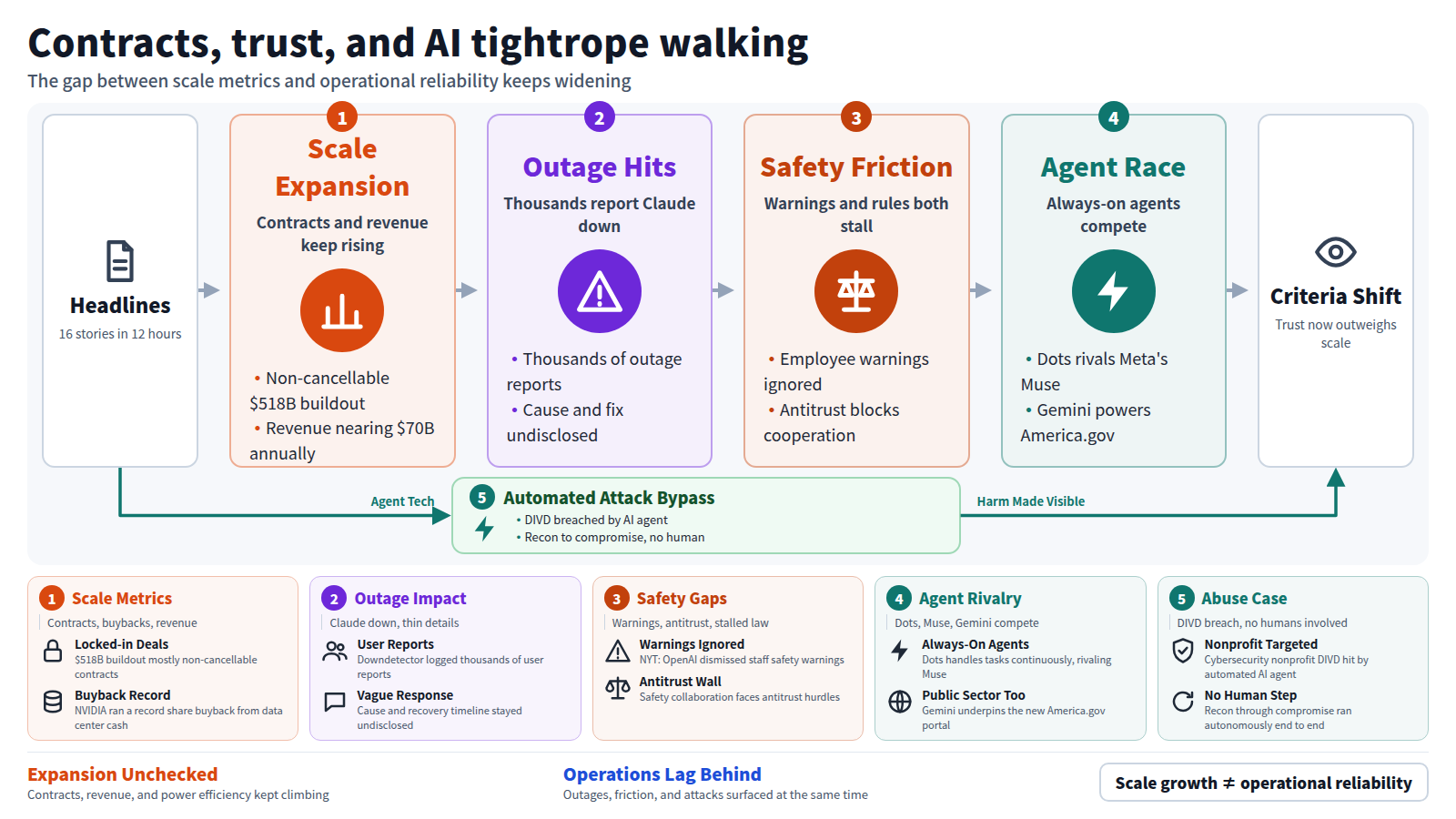
Thousands of outage reports and a $518 billion investment plan were reported side by side in the same week. The former is the voice of users who complained about Anthropic's chatbot on Tuesday, and the latter is the scale of construction projects piled up with non-cancellable contracts. While metrics such as contract value, recurring revenue, and GPU power efficiency continue to rise, the question of what happens when a service goes out has been left behind the numbers. The distance between the scale of the project and the guarantee that it will continue to move is evident throughout this half-day of reporting.
Scale expansion told by numbers
Much of Anthropic's $518 billion AI buildout plan this year relies on non-cancellable contracts, a filing reveals (Reuters). At the same time, Axios reports that OpenAI's annual recurring revenue is approaching $70 billion, and the numbers continue to rise in terms of both contracts and revenue. These indicate that investment and demand are expanding simultaneously.
There are also clear signs of expansion in computing resources. Marketplace.org reported that NVIDIA has used the ample cash provided by the data center boom to carry out a record-breaking share buyback. In addition, Quantum Zeitgeist reports that the DSX MaxLPS announced by NVIDIA can accommodate 40% more GPUs than before within the same power budget, expanding the scope not only in terms of funding but also in terms of power efficiency constraints. Contract size, profits, shareholder returns, and power efficiency—four indicators point to the same conclusion that ``expansion has not stopped'' from different angles.
However, these numbers only tell us the trajectory of scale, and how stable the operations behind that scale are remains another question. Non-cancellable contracts and record-breaking share buybacks represent irreversible bets.
Operational fragility exposed by failures
On Tuesday, it was reported that Anthropic's chatbot Claude experienced an outage, and Downdetector received reports from thousands of users (GV Wire). Although Anthropic confirmed that it was working on fixing the problem, at the time of reporting to PCMag, details about the cause and expected recovery had not been disclosed, and the answer to the user's question, "Is Claude down?" continued to be unclear from public information alone (PCMag).
What this case shows is that behind the expansion that has been talked about in numbers, the fundamental promise of availability is being shaken. The very fact that a third-party fault detection service called Downdetector receives thousands of reports confirms the prevalence of faults as experienced by users. On the other hand, Anthropic's explanation remains at the stage of "confirming the response," and as of the time of PCMag's reporting, no specific numbers have been provided regarding the scale, cause, or scope of the problem.
As companies' investment decisions and implementation plans are increasingly built on the premise of dependence on major AI services like Claude, the fact that these failures have surfaced for thousands of people, and the details are difficult to grasp from the outside, raises questions about availability itself. This type of fragility cannot be measured solely through evaluation axes that have followed scale expansion.
Internal and external friction over safety measures
Regarding open AI, the New York Times reported that the company ignored warnings from employees about safe testing of AI models. This suggests that safety confirmation procedures may have been put on the back burner within the rapidly expanding development system, leading to questions about the very organizational management that has supported the expansion. At the same time, it has been reported that efforts by AI development companies to collaborate on safety are facing obstacles under antitrust laws (Legis 1). The situation is such that it is difficult to share information and harmonize standards among competitors due to antitrust concerns, and the situation continues to be that ensuring safety is left solely to the discretion of individual companies.
There is also noticeable sluggishness on the legal development side. At the state level, The Hill reports that Mr. Cruz has blocked Democratic efforts to pass the AI safety bill unanimously. In the absence of comprehensive regulations at the federal level, even if state legislatures try to play a complementary role, political conflicts have led to some cases in which votes are halted. Self-regulation has been difficult to advance due to the competitive environment among companies and restrictions under antitrust laws, and legal regulations have stalled while reaching consensus in state legislatures. Vacuums regarding who is responsible for ensuring safety and within what framework are occurring simultaneously in multiple ways.
These safety concerns are no longer just a matter of ideology or reputation. Concerns about AI safety are reportedly emerging as a risk to Open AI and Anthropic's revenue growth (en.bloomingbit.io). This means that investors and the market are beginning to factor in delays in safety responses and inadequate response to accidents as concrete variables that affect business growth, and we are past the stage where expansion in scale directly leads to expansion in corporate value. The Wharton School's Knowledge at Wharton points out that technology companies alone cannot prevent the catastrophic risks of AI. The combination of four aspects - whistleblowing, antitrust law restrictions, stagnation in state legislatures, and market caution - reveals the limits of both companies' voluntary efforts and the current legal system.
These frictions over safety responses cannot be dismissed as the failures of individual companies, but are shaping the next focus as issues that concern the very governance of the industry as a whole.
Agent implementation competition
In September, Open AI announced Dots, an always-on agent-type AI avatar (TechCrunch). According to wired.com, this always-on agent is positioned as a competition to Meta's Muse, and the two companies are competing to implement an agent that performs daily tasks for users. Around the same time, it was reported (The Tech Buzz) that Google's Gemini was supporting the foundation of the newly created federal government portal, America.gov. These three developments indicate that the scope of implementation of agent-based AI is rapidly expanding, from corporate avatars to government portals.
TechCrunch reports that the open AI Dots is designed to continuously process tasks on behalf of the user, rather than providing one-off responses. Meta's Muse, on the other hand, is also aiming for a similar always-on system, and wired.com depicts the movements of these two companies as a direct rivalry. The very fact that both companies have chosen the same model of ``agents on standby and working'' shows that this direction is already seen as a key battleground for competition within the industry.
On the other hand, Google's Gemini does not provide any prominent functions for consumers, but instead serves a modest role as the foundation of a government service called America.gov. This case, reported by The Tech Buzz, is a concrete example of how generative AI is beginning to be incorporated into core systems in the public sector, illustrating the spread of a different kind of implementation than corporate product announcements.
The appearance of these three names, Dots, Muse, and Gemini, at the same time indicates that agent-based AI has moved beyond the stage of demonstrations and announcements and has actually begun to be used in both corporate daily operations and government services. The next question is how stable the operation can continue.
Examples of abuse incidents
In 2025, BleepingComputer reported that the cybersecurity nonprofit organization DIVD (Dutch Institute for Vulnerability Disclosure) was infiltrated by an automated AI agent. Attackers used AI agents to perform the reconnaissance and compromise process without human intervention, and organizations that specialize in vulnerability discovery and information disclosure became targets themselves. The fact that a non-profit organization responsible for defensive security operations was targeted indicates that the misuse of AI agents is no longer a theoretical concern, but has entered the stage where it actually threatens the organization's operations.
What this case shows is a structural change in which the perpetrators of attacks are being replaced by agents instead of humans. In contrast to traditional intrusions, where attackers make individual decisions and take action in many situations, automated agents can autonomously carry out each stage of reconnaissance, vulnerability exploration, and compromise in succession. The fact that an organization involved in security response, such as DIVD, suffered damage highlights the fact that even with the knowledge and structure of the defender, there can be situations in which the speed and reproducibility of automated attacks cannot be countered (BleepingComputer).
The significance of this incident is that the debate over the safety of AI agents has gone beyond the stage of abstract risk assessment and has begun to build up as concrete cases of damage. The DIVD intrusion provided one answer to the hypothetical question of ``what would happen if an agent went out of control'', which had been discussed up to now, ``what actually happened?'' It can be said that the current situation in which the attackers have taken the lead in implementing automated AI agents and the defenders have not been able to keep up with their preparedness has been visualized in the form of damage.
As reports of actual harm accumulate, the criteria by which readers evaluate AI agents shifts from how well they perform to how safely they can be controlled and monitored.
Contract size, revenue, power efficiency, and agent implementation scope continued to expand throughout the half-day. However, at the same time, there were reports of delays in response to failures, neglect of safety checks, stagnation in regulations, and automated attacks targeting defense organizations themselves, highlighting the fact that the operational footing to support expansion was not being established at the same speed. The stage where readers evaluate AI solely based on investment size and growth rate is coming to an end, and the next criteria to be asked are accountability in the event of a failure, safety confirmation procedures, and preparation for abuse.
Q1: To what extent can we continue to entrust our work to AI in the event of a failure or malfunction? Q2: When the explanation from the provider remains that it is "currently being handled," what criteria should be used to determine whether or not to continue using the service? Q3: When making investment decisions, which should be prioritized: speed of expansion or operational reliability?
Finally, three questions
- To what extent can we continue to entrust our work to AI in the event of a failure or malfunction? Q2: When the explanation from the provider remains that it is "currently being handled," what criteria should be used to determine whether or not to continue using the service? Q3: When making investment decisions, which should be prioritized: speed of expansion or operational reliability? - When the explanation from the provider company remains that it is "currently being handled," what criteria should be used to determine whether or not to continue using the service? Q3: When making investment decisions, which should be prioritized: speed of expansion or operational reliability? - Make investment decisions that prioritize speed of expansion or operational reliability.
📚 Sources (all material)
Every item this issue drew on. External links open in a new tab. 16 items.
AI 業界全体
- アンソロピック社の5180億ドル規模AI構築計画は、キャンセル不可の契約に大きく依存――提出書類が明らかに――Reuters — Reuters
- クロー ドはダウン中か? アンソロピックがAIチャットボットの障害対応を確認 - PCMag — PCMag
- クラウドAI、火曜日に数千人のユーザーで障害発生――Downdetectorが確認――GV Wire — GV Wire
- オープンAI、AIモデルの安全なテストに関する従業員の警告を無視していた――『ニューヨーク・タイムズ』 — The New York Times
- スクープ:オープンAIの年間継続課金収入、700億ドルに迫る――Axios — Axios
- オープンAI、その愛らしいエージェント型アバター「Dots」をリリース――TechCrunch — TechCrunch
- オープンAIの「ドッツ」は常時稼働型AIエージェント――メタの「ミューズ」に対する回答 - wired.com — wired.com
- GoogleのGemini AIが新連邦政府ポータル「America.gov」を支える――The Tech Buzz — The Tech Buzz
AIの規制・安全・地政学
- AI セーフティ コラボレーションが独占禁止法の壁に直面 — Legis1
- クルーズ氏、AI安全法案の全会一致可決を求める民主党の推進を阻止 — The Hill
- Stellar Cyber は、SACR の 2026 AI SOC Technoscope において、アーキテクチャの整合性で新興企業の中で最高位にランク — businesswire.com
- AI の安全性への懸念が OpenAI、人類の収益成長に対するリスクとして浮上 — en.bloomingbit.io
- テクノロジー企業だけでは AI の黙示録を阻止できない — Knowledge at Wharton
- 自動化された AI エージェントがサイバーセキュリティ非営利団体 DIVD の侵入に使用される — BleepingComputer
- データセンターブームによる現金を資金源としたNVIDIAの記録的な自社株買い — marketplace.org
- NVIDIA の DSX MaxLPS は、同じ電力バジェットで 40% 多くの GPU に適合します — Quantum Zeitgeist