AI, Economy & Finance News — 2026-09-30 (Wed) Morning News
Source links point to the original outlet. The AI Integrated Analysis is auto-generated from the headlines below only and is not intended to add facts beyond them. Not investment advice.
AI and Economy Latest News
Overview
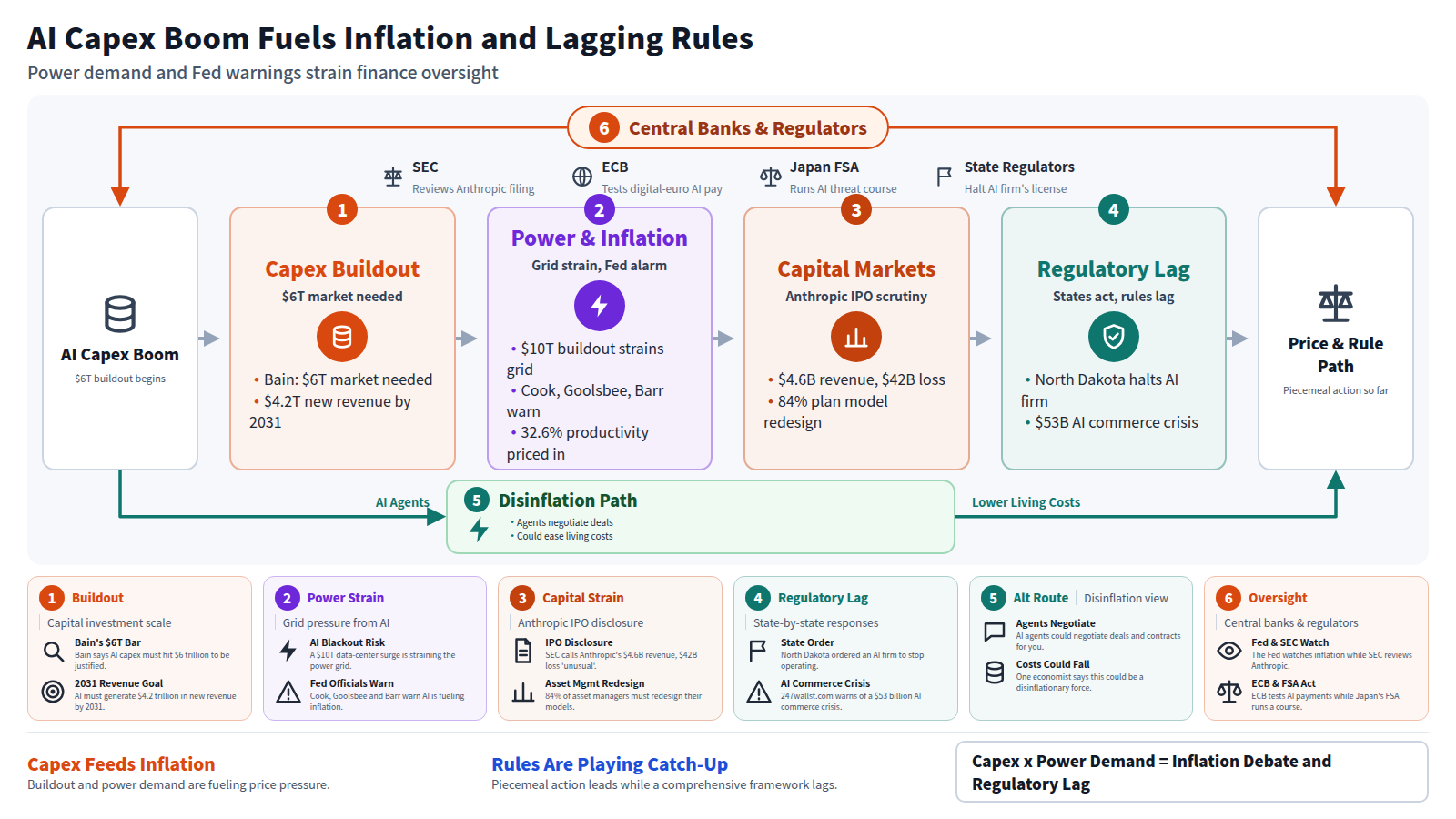
Fed officials (Cook, Goolsbee, Barr) have successively warned of inflationary pressures due to the AI capital investment boom, sparking a monetary policy debate (Axios, Seeking Alpha, WSJ). At the same time, the ECB announced that it will start a proof of concept for AI agent payments in the digital euro next year (Bloomingbit). Concerns about data center power demand and changes in the employment structure are also occurring at the same time.
Macroeconomic/growth trends
Federal Reserve Board Director Lisa Cook has warned that the AI boom will sustain inflationary pressures for some time (Axios, TheGrio), and Chicago Fed President Goolsbee has also pointed out the risk that excessive expectations for AI will fuel inflation (Seeking Alpha). On the other hand, this view has been strongly opposed by Mike Lee, calling it "ridiculous" (Fox Business), and the conflict of opinion has surfaced over the inflationary effects of AI. In Japan, production was said to be "picking up" in the monthly economic report for September, and it was analyzed that AI-related demand was a tailwind (Nikkan Kogyo Shimbun).
Productivity trends
Investors are said to have factored into stock prices the assumption that software engineers' productivity will increase by 32.6% (The Register). Bain analyzed that the market size would need to be commensurate with the $6 trillion capital investment in AI (Business Standard), and also estimated that AI would need to generate $4.2 trillion in new revenue by 2031 (BeInCrypto). The Economist argued that the AI boom could worsen fiscal stress in developed countries.
Trends in employment and labor market
Concerns about job losses due to AI are growing in the financial industry (CFO Dive), and job openings for creative positions are said to have plummeted amid the AI boom (Gizmodo). Gina Raimondo, former US Secretary of Commerce, said that while AI will eventually create jobs, she is concerned about the initial wave of layoffs (cnbc.com). In New York State, Governor Hochul announced the commission's next efforts to address the impact of AI on the labor market (Governor Kathy Hochul official).
Trends in energy/power demand
It has been pointed out that the $10 trillion expansion of data centers poses a risk of an "AI blackout" that would put pressure on the power grid (247wallst.com). The NYT reported that the Trump administration's plan to expand AI data centers has left some Republican lawmakers in a dilemma. New Jersey has released a report supporting the expansion of managed AI data centers (ROI-NJ). SpaceX is reportedly planning to launch a prototype space laser grid for AI data centers (HotHardware). In Japan, the issue of how to deal with the rapid increase in power consumption due to the expansion of AI usage has become an issue (ASCII.jp).
Remarks by central banks, international organizations, and VIPs
- Lisa Cook (Fed Board member): Warns that inflationary pressures from the AI boom will continue for some time (Axios, TheGrio) - Austan Goolsbee (Chicago Fed President): Points out the risk that excessive expectations for AI will fuel inflation (Seeking Alpha) - Michael Barr (Fed): Said that the surge in AI-related investment and related demand is having a measurable impact on prices (WSJ) - ECB: Announced that it will consider the use of AI agent payments and machine-to-machine payments in the digital euro and will start proof of concept in January next year (Cryptonews.net, Bloomingbit, Biggo)
Individual statements from the tracked dignitaries Lagarde, Ueda, Bailey, Georgieva, Cormann, Banga, Acemoglu, and Brynjolfsson are not included in the headline.
Trends in corporate capital investment
A detailed analysis article on Nvidia's capital investment trends has been published (Seeking Alpha). Bain estimates that the AI market needs to reach a scale of $6 trillion (Business Standard) and analyzes that new revenue generation of $4.2 trillion will be needed by 2031 (BeInCrypto). AI infrastructure investment in the Middle East region reportedly reached $8.4 billion (Arabian Business). One economist said that AI agents could lower the cost of living by negotiating contracts and deals, which could be a disinflationary factor (Fortune).
Trade and industrial policy
An AI summit was held at the White House with tech company CEOs and President Trump (The Tech Buzz). It was reported that the US and China agreed to extend the trade truce with a focus on AI at the Trump-Xi meeting in Washington (globalpost.com). A Canadian entrepreneur reportedly canceled his participation in an AI conference in San Francisco due to backlash against Trump (SF Standard). MKS Instruments' stock price rises due to rising demand for AI-use semiconductors (Yahoo Finance). As steel factories suspend operations due to tariffs, there have been reports that warnings about AI safety are increasing (Stockhouse).
Integrated analysis: What is happening now
The fact that several senior Federal Reserve officials (Cook, Goolsbee, Barr) alluded to inflationary pressures stemming from AI capital investment at almost the same time indicates that the AI boom has been elevated to a major issue in macroeconomic and monetary policy discussions. Behind this upward pressure on prices is the demand for capital investment estimated at $6 trillion by Bain, and the rapid increase in electricity demand for data centers to support it (concerns about an "AI blackout"). The structural path through which capital investment affects prices through the tightening of electricity infrastructure can be seen from several headlines. On the policy front, AI became the focus of trade talks at the U.S.-China summit, and the Trump administration's push to expand data centers is causing friction with some members of Congress, so it appears that industrial and trade policies regarding AI are rapidly becoming integrated.
Future points of interest
- How will the conflict between Fed officials' views on AI inflation (Cook, Goolsbee, and Barr vs. critics) be reflected in future monetary policy decisions? - To what extent will the rapid increase in power demand for data centers affect the real economy through strained power grids and electricity prices? - How will the extension of the US-China trade truce be reflected in concrete measures related to AI (semiconductors and export regulations)?
AI and finance latest news
Overview
SEC Paul Atkins called Anthropic's IPO disclosure ($4.6B in revenue, $42B in loss) "unprecedented," bringing regulatory and capital market tensions into focus (Yahoo Finance). In banking and insurance, regulators are simultaneously addressing the cyber risks of AI and issuing cease-and-desist orders (Bloomberg, knoxradio.com). In asset management, investment money continues to flow, with BlackRock presenting an electricity demand of 148GW for AI infrastructure (tokenpost.com).
Bank trends
Fed Director Michelle Bowman said AI could be used for both banks' cybersecurity defenses and cyberattacks (Bloomberg, tokenpost.com). Forbes reported an article warning of "AI 'Bank Run'" (Forbes). Finastra deploys AI to solve bank payment processing problems (PYMNTS.com) Citi Investor Services revamps AI-powered market guidance platform (businesswire.com). In Japan, North Pacific Bank uses AI to predict crowding at each branch and optimize staff allocation (Nihon Keizai Shimbun).
Insurance trends
North Dakota health officials have ordered an AI company to cease operating in the state (knoxradio.com). Business Insider reports (businessinsurance.com) that ``AI facilitates cyberattacks while evolving defenses.'' KPMG publishes a paper on AI value creation in the insurance industry (kpmg.com). Piko Labs AI announces reinsurance brokerage service for captives (Captive International). In South Korea, Samsung Life Insurance was reported to be using AI and digital technology to reduce the complexity of insurance (매일경제).
Trends in asset management and market transactions
BlackRock presented 148GW of power demand associated with building AI infrastructure (tokenpost.com). A survey by HCLTech reported that 84% of asset management companies recognize the need to redesign their business models to support AI (Devdiscourse, Adgully.com). North American family offices are reportedly optimistic about AI and private equity (Wealth Solutions Report). On the market side, MarketWatch analyzes the signals the bond market sends to the AI boom and the stock market (MarketWatch). In Japan, Asemane One has partnered with asset management AI company BFAI (nna.jp).
Fintech/payment trends
Visa was reported to be increasing its vigilance against the "increasing risks posed by AI" (Reuters). Visa is said to be focusing on stablecoins and AI payments as it prepares to announce its financial results on October 27th (tikr.com). Meta expands its Muse AI agent to small and medium-sized businesses by linking it with Shopify, Stripe, Slack, etc. (Stocktwits). 247wallst.com warns that AI commerce is unprepared for a ``$53 billion crisis'' (247wallst.com). It was reported that the ECB is considering starting a demonstration experiment of AI agent payments using the digital euro in January next year (BigGo Finance).
Remarks from key figures and authorities in the financial world
- SEC Chairman Paul Atkins: SEC staff says Anthropic's "unusual" AI risk disclosure is under review (Yahoo Finance). - Fed Director Michelle Bowman (not tracked, but related remarks): Points out that AI can be both a defense and a threat to bank cybersecurity (Bloomberg, tokenpost.com). *There are no notable changes in the headline regarding direct statements or actions regarding the VIPs being tracked (Jamie Dimon, Larry Fink, Jane Fraser, David Solomon, Brian Moynihan, Ted Pick, Ken Griffin).
Trends in AI-related stocks and funding
AI startup EliseAI reaches a valuation of $4 billion in its latest funding round (Reuters). Dorm Room Fund, which invests in student-led AI startups, raises $50M (Dealroom.co). AI startup Instinct has raised $1 billion, giving it a valuation of $10 billion (Inshorts). Anthropic is said to be aiming for an IPO with a valuation of $2 trillion, but one industry source said it "will not be a market catalyst" (TradingView). Anthropic IPO prospectus leaked, with disclosures about AI risks reportedly shared early with Wall Street (Gizmodo).
Trends in financial regulation and supervision
SEC Chairman Paul Atkins says SEC staff is reviewing Anthropic's "unusual" AI risk disclosure (Yahoo Finance). Regarding the FCA, it was reported that AI is passing the examination (defense) of crypto asset applicants (law360.com). Napier AI warns that opaque AI could lead to companies losing licenses (FinTech Global). National Mortgage Professional study identifies AI oversight gaps among small mortgage lenders (National Mortgage Professional). In Japan, the Financial Services Agency held a practical implementation course on nine items for responding to AI threats (Business + IT).
Integrated analysis: What is happening now
Anthropic's huge IPO preparations (reported valuation of $2 trillion, disclosure of $4.6 billion in profits and $42 billion in losses) have become the focus of attention as the interface between capital markets and the AI industry, and the disclosure content, which SEC's Paul Atkins described as "unusual", could serve as a test of future regulatory compliance. In the banking and insurance sector, the dual nature of AI being both a defensive tool and a means of attack is a common theme in both the Fed (Bowman) and Business Insider articles, and cyber risk management has emerged as a cross-industry challenge. On the asset management side, as shown by BlackRock's infrastructure investment (power demand 148GW) and HCLTech's survey (84% recognized the need to redesign business models), AI implementation has already moved beyond the "consideration stage" and into the "implementation redesign" stage. In the payment field, Visa's caution and Meta's expansion of AI agent commerce are proceeding in parallel, and the ``$53 billion AI commerce crisis'' pointed out by 247wallst.com symbolizes the risk that AI agents are becoming the main entity for payment execution without proper regulation. North Dakota's health authorities' orders to halt operations for AI companies and the warning that Napier AI will lose its license demonstrate a structure in which regulatory responses at the state and industry level take precedence on an individual case basis, and a comprehensive framework has not caught up.
Future points of interest
- Consequences of SEC Paul Atkins' Anthropic disclosure review and its impact on IPO disclosure standards for AI companies. - Materialization of AI payment/stablecoin strategy at Visa financial results announcement (October 27th). - To what extent will financial regulations (FCA, Financial Services Agency, etc.) develop an implementation-level supervisory system in response to the expansion of payments and commercial transactions using AI agents?
- Too much AI hype risks fueling inflation, Chicago Fed's Goolsbee says (TLT:NASDAQ) — Seeking Alpha09/29 18:00 UTC
- Investors are pricing in a 32.6% AI productivity boost for software engineers — The Register09/29 12:30 UTC
- AI spurs rising job loss fears in finance — CFO Dive09/29 15:22 UTC
- How the AI boom could worsen the rich world’s fiscal crunch — The Economist09/29 15:55 UTC
- New Innovation Is Required to Fund AI’s $6 Trillion Buildout — Bain09/29 17:48 UTC
- A Collection of HBR’s Most Insightful Research on AI at Work — Harvard Business Review09/29 13:09 UTC
- Governor Hochul Highlights Next Steps in Nation-Leading Commission to Address Impacts of AI on New York’s Workforce — Governor Kathy Hochul (.gov)09/29 16:39 UTC
- Gina Raimondo thinks AI ultimately will create jobs. It's the initial mass layoffs wave that worries her — cnbc.com09/29 15:12 UTC
- LinkedIn’s CEO on How AI is Reshaping Hiring | The Morning Download for Sept. 29 — wsj.com09/29 12:34 UTC
- Creative Jobs Have Plummeted Amid the AI Boom — Gizmodo09/29 15:45 UTC
- The Coming AI Blackout: $10 Trillion Data Center Surge Threatens to Break the Grid — 247wallst.com09/29 15:19 UTC
- Trump’s Push for AI Data Center Expansion Puts Some Republican Lawmakers in a Bind — The New York Times09/29 14:54 UTC
- Focus NJ report backs managed AI data center expansion in New Jersey — ROI-NJ09/29 14:26 UTC
- SpaceX To Launch Prototype Laser Grid For AI Data Centers In Space — HotHardware09/29 15:44 UTC
- AI Data Centers Make Power, Cooling Critical to Scaling — EE Times09/29 14:44 UTC
- Tech CEOs Meet Trump at White House for Critical AI Summit — The Tech Buzz09/29 17:42 UTC
- ‘I don’t find this is ethical’: Canadian founder ditches SF AI conference because of Trump — The San Francisco Standard09/29 13:00 UTC
- MKS (MKSI) Gains on Rising AI Semiconductor Demand — Yahoo Finance09/29 16:08 UTC
- Market Open: AI Safety Warnings Mount as Steel Plant Idles on Tariffs | Sep 29th | 2026-09-29 | Investing News — Stockhouse09/29 14:15 UTC
- Fed’s Barr: Surge of Investment and Related Demand from AI Buildout is Having Measurable Effect on Prices — wsj.com09/29 17:11 UTC
- ECB wants to test AI-powered digital euro payments — Crypto News09/29 12:27 UTC
- Nvidia: A Deep Analysis About The AI CapEx (NASDAQ:NVDA) — Seeking Alpha09/29 16:23 UTC
- AI may prove disinflationary because agents can negotiate contracts and deals to make your life cheaper, says top economist — Fortune09/29 10:15 UTC
- Bain: Artificial Intelligence market has to reach $6 trn to justify capex — Business Standard09/29 17:17 UTC
- AI infrastructure spending across the Middle East hits $8.4 billion — Arabian Business09/29 11:48 UTC
- AI Must Create $4.2 Trillion in New Revenue by 2031, Bain Says — BeInCrypto09/29 09:19 UTC
- [Ryutsu Keizai University] 2027 Entrance Exam - Newly established "Generative AI Utilization Type" that utilizes Generative AI in comprehensive selection — Digital PR Platform09/29 11:24 UTC
- Japan-Uzbekistan joint economic meeting held in Tashkent, outlook report on AI, digital fields, etc. (Japan, Uzbekistan) | Business briefings — jetro.go.jp09/29 06:16 UTC
- If everyone uses AI casually, power consumption will increase tremendously. So what should I do? — ASCII.jp09/29 09:00 UTC
- The forefront of employment for people with disabilities in the AI era - Two practical examples presented at the "Vocational Rehabilitation Research and Practice Presentation" organized by the Ministry of Health, Labor and Welfare and sponsored by JEED — シブヤ経済新聞09/29 10:18 UTC
- Production “picks up” September monthly economic report AI-related demand tailwind — 日刊工業新聞09/29 08:00 UTC

- Fed’s Bowman Touts AI Benefits, Risks for Bank Cybersecurity — Bloomberg09/29 15:00 UTC
- Finastra Deploys AI to Help Banks Tackle Payment Processing Issues — PYMNTS.com09/29 16:04 UTC
- After banking a +547% gain: A new list of AI picks for October is coming SOON — Investing.com09/29 17:15 UTC
- Citi Investor Services Reimagines Market Guide Platform, Harnessing AI to Deliver Timely Intelligence for Decision Makers — businesswire.com09/29 13:00 UTC
- Insurance customer retention in the AI age — SAS: Data and AI Solutions09/29 14:58 UTC
- AI fuels cyberattacks as defenses evolve — businessinsurance.com09/29 17:02 UTC
- Unlocking AI value in insurance — kpmg.com09/29 13:57 UTC
- North Dakota Insurance Commissioner orders AI company to stop doing business in the state — knoxradio.com09/29 15:00 UTC
- Piko Labs AI unveils reinsurance intermediary for captives — Captive International09/29 15:42 UTC
- Report: North American Family Offices Optimistic About AI, Private Equity — Wealth Solutions Report09/29 13:43 UTC
- BlackRock Highlights 148 GW Power Need in AI Infrastructure Buildout — tokenpost.com09/29 09:46 UTC
- The hidden messages the bond market is sending about the AI boom and the stock market — MarketWatch09/29 16:44 UTC
- Webull Expands Cloud MCP to Enable AI-Powered Trading Without Coding or Installation — PR Newswire09/29 13:00 UTC
- AI Lab Race: Manifold Traders Give One Lab 31% Odds of Pulling Ahead Before 2028 — tech-insider.org09/29 16:09 UTC
- Wall Street Says the Muse AI Catalyst for Twilio Stock Is More Hype Than Substance — Barchart.com09/29 15:00 UTC
- Visa joins growing alarm over AI-powered risks — Reuters09/29 16:10 UTC
- Visa Stock Heads Into October 27 Earnings With Stablecoins and AI Payments in Focus — tikr.com09/29 17:02 UTC
- Meta Expands Muse AI Agent To Small Businesses With Shopify, Stripe, Slack And More — Stocktwits09/29 17:07 UTC
- Sibos 2026: Under the hood - where AI will really transform financial services — FinTech Futures09/29 11:35 UTC
- Going Rogue and Getting a Wallet: The $53 Billion AI Commerce Crisis No One Is Ready For — 247wallst.com09/29 16:13 UTC
- 3 AI Stocks That Could Surprise Investors by 2029 — Yahoo Finance09/29 11:30 UTC
- Dorm Room Fund raises $50M for student-led AI startup bets — Dealroom.co09/29 09:47 UTC
- Anthropic Eyes Monster $2 Trillion IPO, Yet Deal Veteran Says It Won’t Be a Market Catalyst — TradingView09/29 11:18 UTC
- AI startup Instinct raises $1 billion, valued at $10 billion | Tap to know more | Inshorts — Inshorts09/29 16:39 UTC
- AI Smashes Defenses Of Crypto Applicants For FCA Regime — law360.com09/29 17:01 UTC
- Mortgage AI Survey Finds Monitoring Gap At Smaller Lenders — National Mortgage Professional09/29 16:58 UTC
- SEC Chair Paul Atkins Says SEC Staff Is Reviewing Anthropic’s ‘Unusual’ AI Risk Disclosures — Yahoo Finance09/29 15:25 UTC
- Napier AI warns opaque AI could cost firms their licence — FinTech Global09/29 17:04 UTC
- Financial Services Agency AI Threat Response 9 Items Practical Implementation Course — ビジネス+IT09/29 09:35 UTC
- North Pacific Bank uses AI to predict crowding at each branch and appropriate staff allocation — 日本経済新聞09/29 09:41 UTC
- ECB considers demonstration of AI agent payments for digital euro...starting in January next year — BigGo ファイナンス09/29 13:05 UTC
- Asemane One partners with asset management AI company BFAI — nna.jp09/29 15:00 UTC
- Samsung Life is actively using artificial intelligence (AI) and digital technology to reduce the ``complexity'' of insurance. From changing the information text into words that consumers can easily understand to reducing unnecessary touches during the mobile billing stage, we... — 매일경제09/29 15:00 UTC