AI, Economy & Finance News — 2026-10-02 (Fri) Morning News
Source links point to the original outlet. The AI Integrated Analysis is auto-generated from the headlines below only and is not intended to add facts beyond them. Not investment advice.
AI and Economy Latest News
Overview
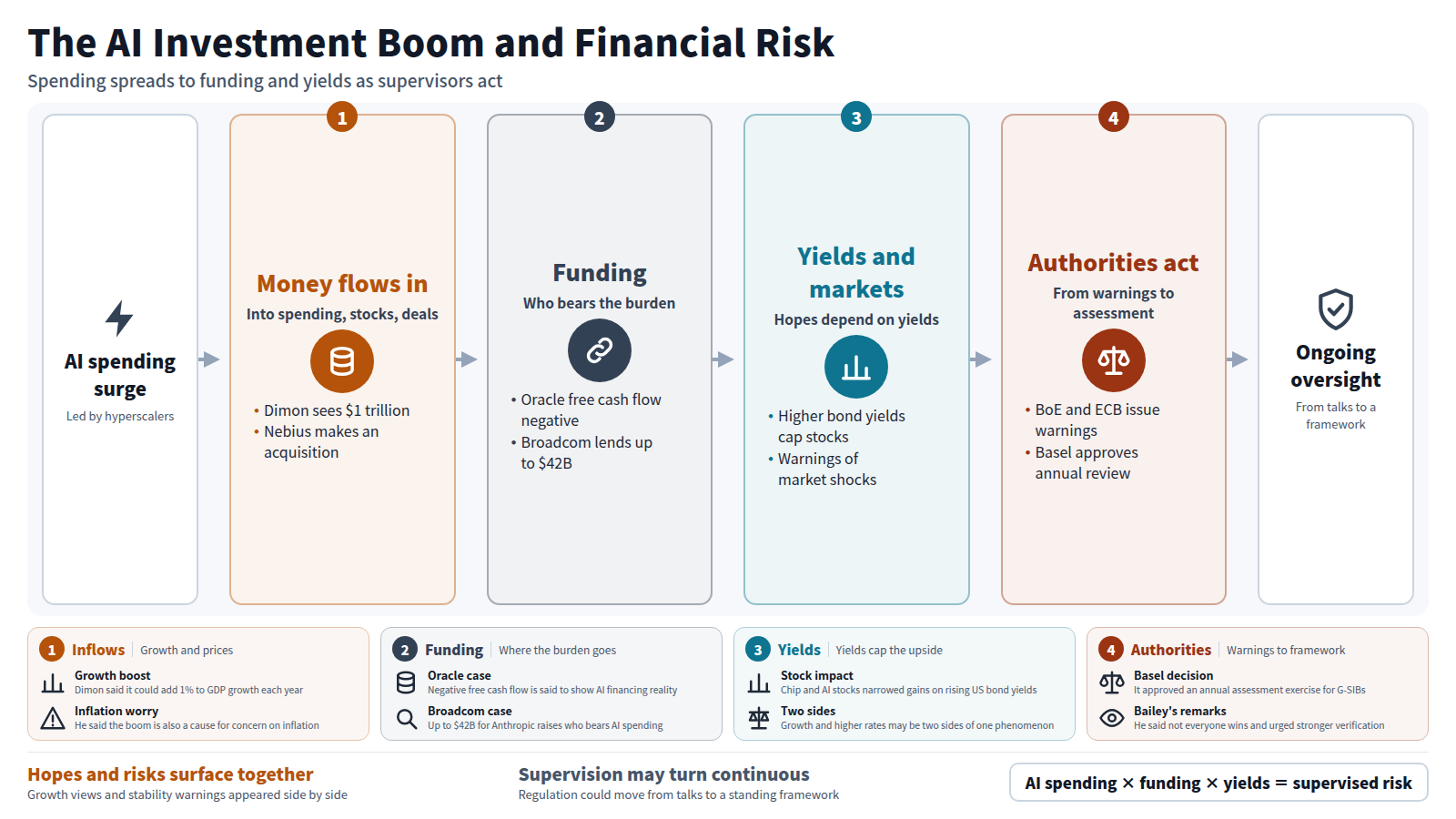
Andrew Bailey (Governor of the Bank of England) and Christine Lagarde (President of the ECB) have successively warned of the risks to the financial system posed by the AI boom. Meanwhile, Jamie Dimon said that hyperscaler AI-related spending could reach $1 trillion, pointing to both growth contributions and inflation concerns. Oracle's free cash flow is reported to be negative, and Broadcom's loan of up to $42 billion to Anthropic has become a hot topic, drawing attention to the funding structure for AI investments.
Macroeconomic/growth trends
Jamie Dimon says hyperscaler AI spending could reach $1 trillion next year, boosting GDP growth by 1% annually, but also worries about inflation (fool.com). Analysis suggests that AI is not pushing up prices, but rather pushing up US interest rates (Morningstar). Jefferies executives are weighing the rewards of AI against the risks of recession (Bloomberg.com). The “wealth effect of AI” has been brought up as an issue (Axios). In Japan, it was reported that the company plans to formulate an AI action plan for growth by the end of the year (Nation Thailand).
Productivity trends
The Fed's Kashkari said the U.S. economy is "strong" beyond AI, and cited the potential for capital to shift from homes to data centers (TradingView). Andrew Yang compared AI to Walmart's hollowing out of local communities (Benzinga). There is an argument that excessive reliance on AI may lead to a decline in independence (Fair Observer). Capacity building for the AI economy is a challenge in Africa (United Nations Development Programme). There are no headings that indicate productivity figures themselves.
Trends in employment and labor market
In California, it was reported that there is a ``No Robo Bosses Act'' that prohibits the firing of employees based solely on AI (qz.com). Employers in the state will be required to disclose mass layoffs caused by AI (Fisher Phillips LLP). A new lawsuit has been filed questioning the involvement of AI in firing and rehiring (Staffing Industry Analysts). NAHB says the risk of AI is low for most occupations in the construction industry (HousingWire). Greenville Technical College responds to demand for AI and cybersecurity talent (prnewswire.com).
Trends in energy/power demand
The number of AI data centers is rapidly increasing in the United States, and there is a debate over the burden of fees (WBMA). NPR covered how much of the burden is on ratepayer (NPR). Big IT companies are considering data centers in orbit as demand for electricity increases (aa.com.tr). Google is testing Project Suncatcher, an AI data center concept in space (Scientific American). Food & Water Watch has released a document that examines myths about data centers (Food & Water Watch).
Remarks by central banks, international organizations, and VIPs
Andrew Bailey, Governor of the Bank of England, has warned that the AI boom could cause market shocks (BBC). He cited both the risks and benefits of AI (detroitnews.com) and said, "Not everyone wins all the time" (The Next Web). He also stated that society should retain the right to intervene in AI (Resultsense) and called for stronger verification of AI (Magzter). Christine Lagarde, ECB President, said Europe must develop its own AI capabilities (Bloomberg.com). ECB leaders have warned that the rapid adoption of AI poses systemic risks to the financial sector (aa.com.tr). The ECB also published a document titled ``Where AI risks meet'' (European Central Bank). The Fed's Kashkari rated the US economy as "solid" (TradingView). Director Waller said that half of the access to FRED is through AI (Bloomberg.com). Statements about Kazuo Ueda, Kristalina Georgieva, Mathias Cormann, Ajay Banga, Daron Acemoglu and Erik Brynjolfsson are not found in the headlines.
Trends in corporate capital investment
Dell has participated in a $15 billion AI data center project in Japan (Benzinga). Equinix joins the AI capital investment race (Seeking Alpha). It has been pointed out that Oracle's free cash flow is negative, which shows the reality of AI financing (24/7 Wall St.). Temasek expressed confidence in current AI investments despite high levels of capital expenditure (Global Banking & Finance Review). Broadcom is reported to be lending up to $42B to Anthropic, raising the issue of where the burden of AI spending will go (Yahoo Finance).
Trade and industrial policy
A group believed to be connected to China conducted a phishing attack targeting experts on AI policy in the United States. It was reported that the attacker impersonated Anthropic executives and former White House officials (CyberScoop, The Register, CyberSecurityNews). Proofpoint attributed the attack to a pro-China group (findarticles.com). Kevin Mudd discussed the real risks of the US-China AI race (The Economist). There are no headings regarding tariffs, export controls, or subsidies. The policy for formulating Japan's AI action plan is as above (Nation Thailand).
Integrated analysis: What is happening now
It appears that AI has begun to be treated not only as a factor pushing up growth, but also as a pressure on interest rates, prices, and financial stability. Dimon's view that it will "boost GDP growth by 1% every year" (fool.com) and the analysis that AI is pushing up interest rates (Morningstar) may be two sides of the same phenomenon. Expanding investment involves financing issues. Oracle's negative free cash flow (24/7 Wall St.) and Broadcom's up to $42B loan (Yahoo Finance) appear to be issues tied to Bailey and the ECB's warnings about the financial system (BBC, aa.com.tr). In the electric power sector, there is a discussion on rate burden (NPR) and space data center concept (Scientific American), and it is possible that responding to increased demand is facing constraints on the ground. In employment, regulations and lawsuits (qz.com, Staffing Industry Analysts) are taking the lead, and the trend for greater transparency in dismissal through AI is expected to grow. On the policy front, Europe's homegrown AI capabilities (Bloomberg.com), Japan's AI Action Plan (Nation Thailand), and Chinese-backed phishing (CyberScoop) are putting AI on the security and industrial policy agenda.
Future points of interest
- How will the financing structure of AI-related investments (examples of Oracle and Broadcom) be incorporated into central bank discussions as a risk to the financial system? - Will the debate over how to allocate the burden of electricity costs for data centers develop into changes in rates and regulations? - The year-end formulation of Japan's AI action plan and the sustainability of demand for AI and semiconductors as reflected in the Bank of Japan's Tankan.
AI and finance latest news
Overview
The Bank of England's governor has warned that an AI investment boom could cause a market shock, and the Basel Committee and the European Central Bank (ECB) have also raised the risk of AI. Meanwhile, Jamie Dimon said hyperscaler AI spending could reach $1 trillion, pointing to both growth contributions and inflation concerns. It was a 12-hour period in which expectations and risks came to the fore at the same time, with rising government bond yields offsetting expectations for AI-related stocks. (BBC, fool.com, Global Regulation Tomorrow, Yahoo! Finance Canada)
Bank trends
JPMorganChase's head of technology in Seattle says AI is changing the qualities banks look for in engineers (GeekWire). Regarding Bank of America, there is an article examining whether an AI agent can break the bank's $2 trillion deposit advantage (Yahoo Finance). American Bankers Association CEO talks about using AI to fight bank fraud (CNBC). Deutsche Bank named nine stocks, including Meta and ServiceNow, as leading the next phase of AI-related trading (qz.com). Barclays expands use of Anthropic's AI despite warnings of cyber risks (thebanker.com).
Insurance trends
Health insurance companies are looking to AI to figure out why nearly $1 billion in suspicious hospital claims appeared (CNBC). State Farm's documents reveal the company's intention to use AI to automate insurance claims processing ("touchless claims") (NonDoc Media). Finys has rebuilt its core system to utilize AI for a property and casualty insurance (P&C) company (FinTech Global). Qumis brings insurance insights to AI assistants with MCP connector (Business Wire). CIAB has added an AI platform, etc. (Insurance Business).
Trends in asset management and market transactions
BlackRock (Bond Buyer) said municipal bonds (muni) will not play a large role in building AI infrastructure. BlackRock's Mansson said AI was a recurring topic at New York Climate Week (AMWatch). AI hedge fund Situational Awareness has reportedly sold its shares due to pressure from lenders (WinBuzzer). W1M Wealth Management appoints Wenyu Bai as head of AI (privatebankerinternational.com). Nasdaq Calypso announced agent-based AI for the transaction lifecycle (FinTech Global). Professional Wealth Management discusses the value of human advice in the age of AI.
Fintech/payment trends
Agent payments were a central topic on the third day of Sibos 2026 (FinTech Futures). Swap Commerce acquires Vizby, expanding agent-based commerce platform into AI discovery space (Business Wire) Google is reportedly testing paying publishers for their contributions to AI search (Editor and Publisher). Fortune argued that AI is consuming human knowledge and should learn how to pay for it. Former spies and fintech unicorn executives have announced an open source platform to take on big AI labs (prnewswire.com).
Remarks from key figures and authorities in the financial world
- Jamie Dimon, CEO of JPMorgan Chase, said hyperscaler AI spending could reach $1 trillion next year and could boost GDP growth by 1% each year. At the same time, he said, the boom is also a cause for concern on the inflation front (fool.com). - Andrew Bailey (Governor of Bank of England): Regarding the AI boom, he said, "Not everybody always wins." There are also reports warning that it could cause a market shock (The Next Web, BBC). - Larry Fink, Jane Fraser, David Solomon, Brian Moynihan, Ted Pick, Ken Griffin, Paul Atkins: No notable moves.
Trends in AI-related stocks and funding
Rising government bond yields rocked global markets, offsetting expectations for AI stocks (Yahoo! Finance Canada). Semiconductor and AI stocks also narrowed their gains, weighed down by rising U.S. bond yields (Seeking Alpha). Accenture stock rose as demand for AI boosted earnings (WSJ). Wall Street is reacting to Gemini 4, and the focus is on whether Google will bounce back (Investor's Business Daily). Wall Street sees 40% upside in Microsoft as AI monetization pays off (24/7 Wall St.) Nebius acquires 10-month-old stealth-stage AI startup Inferize for $100-150 million (calcalistech.com). Asian stocks generally rose on optimism about AI, but concerns about Iran remained (ABC News). An explanatory video regarding Anthropic's initial public offering (IPO) has also been released (Yahoo Finance).
Trends in financial regulation and supervision
The Basel Committee discussed AI at its meeting and approved an annual assessment exercise for globally systemically important banks (G-SIBs) (Global Regulation Tomorrow). The European Central Bank (ECB) addressed the risks of AI under the title ``Where AI risks meet'' (European Central Bank). Bank of England has warned that the AI boom could lead to market shocks (BBC). The actions of the SEC, FCA, FSB, and Financial Services Agency cannot be confirmed from the headlines.
Integrated analysis: What is happening now
Money is going toward hyperscaler AI spending (Dimon sees $1 trillion), AI stocks, and acquisitions like Nebius. On the other hand, rising government bond yields are suppressing the upward trend in stock prices, suggesting that expectations for AI are influenced by the interest rate environment. Risks can be categorized into three types. The first is sudden market fluctuations, and the Bank of England and the Basel Committee's discussions seem to overlap with this point. Second, with regard to cyber fraud risk, the Barclays case and the American Bankers Association's statements have something in common with the Nihon Keizai Shimbun's coverage of bank cyber defense. Third, in insurance claims processing, there have been reports of automation using AI and an increase in suspicious claims. On the business side, AI is being incorporated into operations in banking, insurance, and trading, and in payments, the focus is shifting to agent-based commerce. Regulation could move from individual discussions to a continuous supervisory framework, as seen in the approval of annual assessments for G-SIBs.
Future points of interest
- How will capital inflows into AI-related stocks change if government bond yields continue to rise? - Contents of the annual AI assessment conducted by the Basel Committee on G-SIBs and the responses of national authorities. - Will agent-based payment and AI search content compensation mechanisms become widespread as actual commercial services?
- The AI wealth effect — Axios10/01 11:39 UTC
- Actually, AI Is Boosting US Interest Rates, Not Inflation — Morningstar10/01 09:13 UTC
- Top Jefferies Banker Weighs AI Rewards Against Recession Risk — Bloomberg.com10/01 15:17 UTC
- Jamie Dimon Says Hyperscaler AI Spending Could Hit $1 Trillion Next Year, Adding 1% to GDP Growth Each Year. Here's Why That Boom Also Worries Him on Inflation. — fool.com10/01 13:00 UTC
- Japan to prepare AI action plan by year-end for economic growth — Nation Thailand10/01 15:21 UTC
- Fed’s Kashkari Says US Economy Is ‘Robust’ Beyond AI — Sees Capital Shifting From Housing To Data Centers — TradingView10/01 16:22 UTC
- Andrew Yang Compares AI To Walmart Hollowing Out Local Communities. 'The Market Will Optimize For Product — Benzinga10/01 16:47 UTC
- Is Overreliance on AI Causing Agency Decay? — Fair Observer10/01 10:13 UTC
- Africa's AI Crossroads: Building the Capabilities for an AI Economy — United Nations Development Programme10/01 13:31 UTC
- California Employers Will Soon Need to Say When AI Causes a Mass Layoff: 5 Steps to Prepare — Fisher Phillips LLP10/01 16:23 UTC
- Greenville Technical College Meets Workforce Needs in AI and Cybersecurity — prnewswire.com10/01 15:42 UTC
- New lawsuits test AI’s role in layoffs and rehiring — Staffing Industry Analysts10/01 15:17 UTC
- Artificial Intelligence-Based Adaptive Simulation Integrated With a Workforce Decision-Support System to Improve Simulated Nursing Leadership Performance: A Randomized Controlled Study — Cureus10/01 16:45 UTC
- AI risk remains low for most construction jobs, NAHB finds — HousingWire10/01 14:46 UTC
- Take The Power Back | Explosion of AI Data Centers Across the US — WBMA10/01 17:04 UTC
- Tech giants eye orbit for AI data centers as energy demand soars — aa.com.tr10/01 16:36 UTC
- Mythbusting: AI Data Center Edition — Food & Water Watch10/01 16:04 UTC
- AI policy circles targeted in China-linked phishing operation — CyberScoop10/01 14:07 UTC
- Top Big Data Stocks to Tap the Growing AI Analytics Opportunity — Yahoo Finance Australia10/01 12:25 UTC
- ECB’s Lagarde Says Europe Must Develop Its Own AI Capabilities — Bloomberg.com10/01 13:47 UTC
- Rapid AI adoption poses systemic risks to financial sector, ECB chief warns — aa.com.tr10/01 15:03 UTC
- Equinix Joins AI Capex Race, Consolidation Triggers Upgraded Buy Rating (NASDAQ:EQIX) — Seeking Alpha10/01 13:15 UTC
- Dell Joins $15 Billion Japan AI Data Center Project as AI Infrastructure Spending Keeps Surging — Benzinga10/01 14:19 UTC
- Oracle's Negative Free Cash Flow Exposes the Uncomfortable Truth About AI's Financing Game — 24/7 Wall St.10/01 13:05 UTC
- Temasek Confident in Current AI Investment Despite High Capex — Global Banking & Finance Review10/01 16:18 UTC
- Now synonymous with cassette tape... ``AI trend'' is the key to Bank of Japan Tankan — 朝日新聞10/01 09:52 UTC
- Utilization of Fed economic data “FRED” soars, half of access is made up of AI – Director Waller — Bloomberg.com10/01 16:29 UTC
- South Korea: AI/semiconductor demand provides economic tailwind, but political headwinds persist — 第一ライフ資産運用経済研究所10/01 09:14 UTC
- Bank of Japan Kitakyushu Branch improves for the first time in two quarters in the Tankan, demand for AI and semiconductors is strong — NHKニュース10/01 10:27 UTC
- ‘Not everybody always wins’: Bank of England’s Bailey on the AI boom — The Next Web10/01 13:00 UTCAndrew Bailey / Bank of England Governor


- New JPMorganChase Seattle tech leader: How AI is changing what the bank looks for in engineers — GeekWire10/01 15:20 UTC
- Can AI Agents Crack Bank of America’s $2 Trillion Deposit Moat? Here’s the Evidence So Far — Yahoo Finance10/01 11:05 UTC
- Deutsche Bank names Meta, ServiceNow, and 7 other tech stocks to lead next AI trade leg — qz.com10/01 13:01 UTC
- American Bankers Association CEO on combating AI-powered bank scams — CNBC10/01 11:59 UTC
- Qumis Brings Insurance Intelligence Directly Into AI Assistants With New MCP Connector — Business Wire10/01 18:00 UTC
- CIAB adds AI platform, Lloyd's broker, and environmental MGA in Q3 — Insurance Business10/01 13:31 UTC
- Finys rebuilds insurance core to unlock AI for P&C carriers — FinTech Global10/01 10:36 UTC
- ‘Touchless claims’: State Farm documents reveal intent to automate claims process with AI — NonDoc Media10/01 12:20 UTC
- Munis won't play big role in AI buildout, says BlackRock — Bond Buyer10/01 18:01 UTC
- BlackRock's Mansson on New York Climate Week: "AI was a recurring theme" — AMWatch10/01 13:11 UTC
- W1M Wealth Management appoints Wenyu Bai as AI head — privatebankerinternational.com10/01 11:48 UTC
- How AI Hedge Fund Situational Awareness Sold Stocks Under Lender Pressure — WinBuzzer10/01 09:10 UTC
- Calculating the true value of human advice in the AI age — Professional Wealth Management10/01 09:31 UTC
- Accenture Stock Climbs as AI Demand Boosts Results — WSJ10/01 14:59 UTC
- Will Google Turn The Tables In AI Race? Wall Street Reacts To Gemini 4. — Investor's Business Daily10/01 14:33 UTC
- Wall Street Sees 40% Upside For Microsoft as AI Monetization Finally Pays Off — 24/7 Wall St.10/01 15:15 UTC
- Asian shares mostly rise amid market optimism about AI, despite Iran worries — ABC News - Breaking News, Latest News and Videos10/01 08:37 UTC
- AI is consuming human knowledge. It should learn how to pay for it — Fortune10/01 12:00 UTC
- Swap Commerce Acquires Vizby to Expand Its Agentic Commerce Platform Into AI Discovery — Business Wire10/01 13:00 UTC
- Google reportedly tests payments to publishers for AI search contributions — Editor and Publisher10/01 11:40 UTC
- Sibos 2026: Agentic payments take centre stage on day three — FinTech Futures10/01 12:01 UTC
- Ex-Spies and Fintech Unicorn Leaders Bet Against Big AI Labs with New Open Source Platform — prnewswire.com10/01 12:49 UTC
- Rising bond yields rattle markets worldwide and offset hopes for AI stocks — Yahoo! Finance Canada10/01 15:01 UTC
- Dan Ives Names 3 Under the Radar AI Stocks: ‘Starting to Get a Renaissance of Growth’ — Benzinga10/01 14:54 UTC
- 3 Top AI Stocks for October — theglobeandmail.com10/01 15:02 UTC
- Nebius acquires 10-month-old stealth AI startup Inferize in $100-150 million deal — calcalistech.com10/01 11:22 UTC
- Basel Committee meeting discusses AI and approves annual assessment exercise for G-SIBs — Global Regulation Tomorrow10/01 15:53 UTC
- Where AI risks meet — European Central Bank10/01 13:32 UTC
- Longevity, AI Concerns Take Toll on Retirement Readiness, per TIAA — planadviser10/01 15:25 UTC
- Barclays expands Anthropic AI use despite cyber risk warnings — thebanker.com10/01 09:37 UTC
- Lebanese banks aim to rebuild economy by betting on large-scale AI training — アラブニュース10/01 17:22 UTC
- Bank cyber defense doubles detection of ``weaknesses'' with cutting-edge AI; system shutdown is also an option — 日本経済新聞10/01 17:00 UTC
- Career diagnosis after joining the company using AI - Major company holds informal offer ceremony — 時事ドットコム10/01 10:11 UTC
- Promoting support for introducing generative AI and AI agents to client companies in collaboration with Kumamoto Bank — PR TIMES10/01 06:30 UTC
- [Era of agentic commerce] SP.LINKS becomes a hub that “connects” AI and EC member stores — 日本ネット経済新聞10/01 07:41 UTC