AI in Medicine — Cancer & Rare Disease — 2026-09-30 (Wed) Evening News
Source links point to the original outlet. The AI Integrated Analysis is auto-generated from the headlines below only and is not intended to add facts beyond them. Not investment advice.
Latest news on AI and cancer treatment
Overview
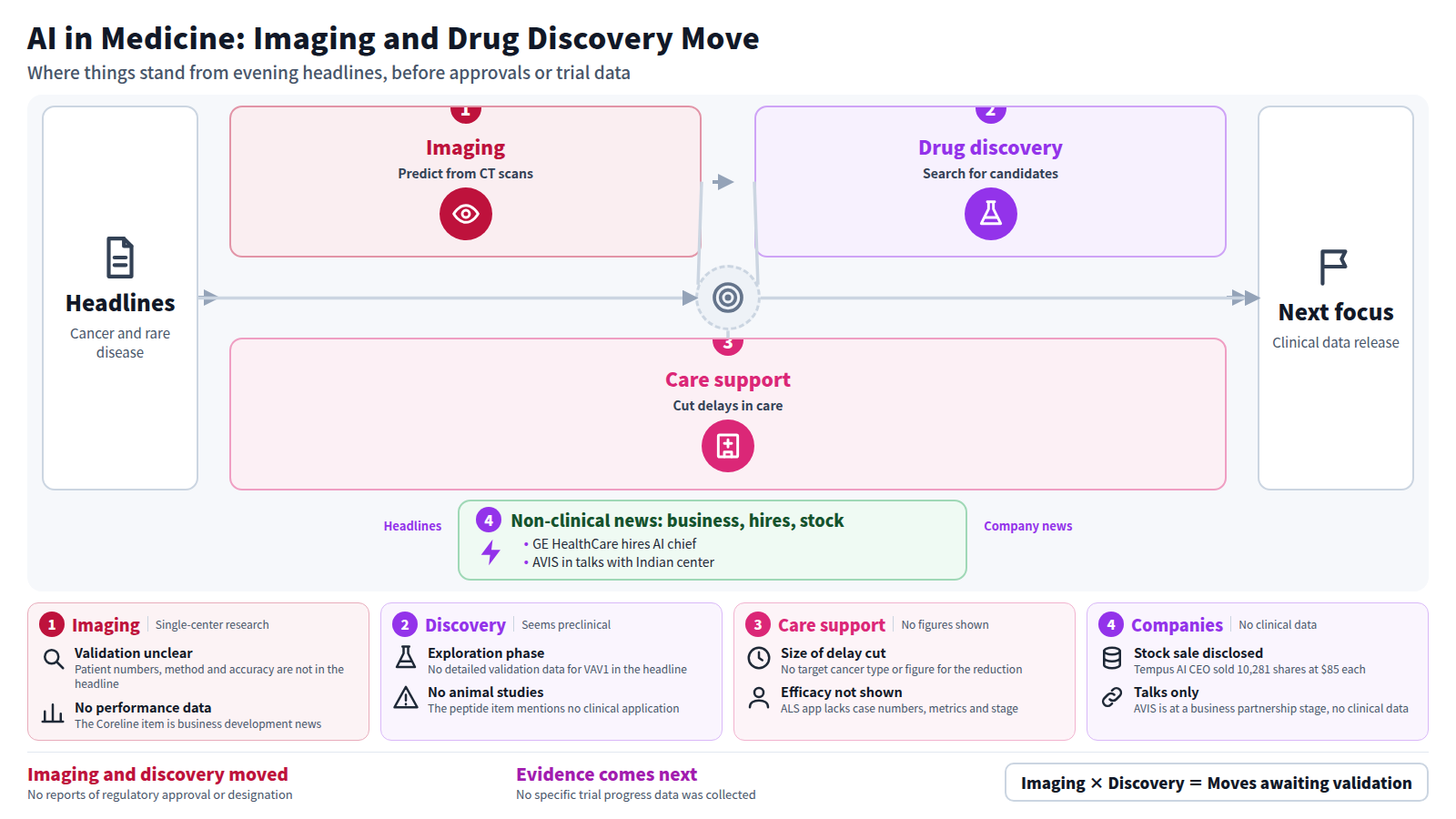
There was movement in the areas of image diagnosis (lung CT, tumor markers) and drug discovery (molecular adhesive search, peptide search). There have been no reports regarding approval or designation by regulatory authorities, and specific data on clinical trial progress is not included in this collection.
Breast cancer
- OzarksFirst.com (US local news) reported that ``A new AI tool is supporting breast cancer treatment,'' but the headline alone did not specify the number of patients targeted, the method used, or the metrics presented. - An article on oncodaily.com (author: Matthew Kurian) raises the issue of "Who benefits from extended AI treatment?", but the link to breast cancer and specific clinical data cannot be determined from the headline. (All information is headline information only, and figures such as accuracy and detection rate are not shown.)
lung cancer
- MD Anderson (USA) releases an AI model that predicts immunotherapy-related lung inflammation from regular CT images. The report was based on a single facility, and the number of patients, verification method, and accuracy index are unclear from the headline. The evidence stage is presumed to be "single-center research stage," but no details are provided. - Coreline Soft (Korea) expands its Japanese business from "pulmonary nodule AI" to "coronary artery calcification analysis." This is business development news and does not include data on clinical performance.
Malignant brain tumor
No relevant information (The article about the introduction of AI curriculum in the Nye County School District is news in the education field and is judged to be unrelated to brain tumor treatment)
Leukemia/lymphoma
No applicable information
Colon cancer/digestive organ
- A research team at the University of Macau (UM) reports that they have used AI to identify a promising anti-cancer peptide against pancreatic cancer. Although it appears to be at the preclinical (in silico/laboratory level) stage, there is no mention of animal experiments or clinical application stages in the headline. - The Mainichi Shimbun article (an essay on the crossroads of AI) deals with the ethics and social impact of AI in general, and clinical information specific to gastrointestinal cancer cannot be confirmed from the headline.
Rare cancer
- Health Tech World (UK) reports that ``AI tools aim to reduce delays in starting radiation treatments.'' Although the application is expected to be applied to rare cancers such as adenoid cystic carcinoma, the headline does not mention the target cancer types, specific figures for delay reduction, or the stage of evidence.
Diagnosis/Pathology/Image
- GE HealthCare hires a new Chief AI Officer (no personnel news or technical details). - It is reported that AVIS is in talks with a major cancer center in India regarding the introduction of AI (at the stage of business partnership, no clinical data). - Medical Buyer magazine published an article explaining "biomarkers identified by AI." The target cancer type, biomarker type, and verification stage are unclear from the headline.
Treatment selection/drug discovery
- It is reported that the search for molecular glue candidates targeting VAV1 has been accelerated by combining AI and proteomics (Genetic Engineering and Biotechnology News). The stage appears to be preclinical (exploration/identification phase), but detailed verification data are not listed in the headline. - UTHSC (University of Tennessee Health Science Center) published an article on the intersection of academic medicine and AI. There are no specific research results or drug names listed.
Regulations/Approval
No applicable information
Clinical trial implementation status
No relevant information (Information on the individual trial name, target cancer type, phase, and registration status derived from ClinicalTrials.gov is not included in the main text of the news provided this time)
Japanese movements
- eurekalert.org introduces AI research that integrates "disease prediction x classification x treatment" by a joint research team in Japan. Details of the target disease, cancer type, and research stage (preclinical/clinical) are unclear from the headline. - The Japanese edition of Newsweek introduces a statement about the use of AI in medical settings that says it has "saved more than 1,000 lives." The basis for calculating this number, the target disease, and the verification method cannot be confirmed from the article headline alone, and should not be treated as a definitive statement of causality (it is only introduced as a claim in the source article).
Remarks from VIPs
No relevant information (The name of the author of the oncodaily.com article, Matthew Kurian, can be confirmed, but the title and direct quote are not included in the headline. The list of important people being tracked is also blank, so there is no corresponding statement)
Latest news on AI and rare and intractable diseases
Overview
Only two headlines were provided, and there is little information on concrete progress in diagnostic technology, therapeutic drugs, or systems. We can only confirm stock transactions by executives in genome-related companies and reports on a voice AI app for ALS patients.
Diagnosis of rare diseases
No applicable information
Gene analysis/genome
It was reported that the CEO of Tempus AI (TEM, a diagnostic and genome analysis company) sold 10,281 shares of the company's stock at $85 per share based on a pre-determined trading plan. This is a disclosure regarding stock transactions by executives, and the headline does not provide specific details regarding the performance of the company's diagnostic/genome analysis technology or its application to rare disease diagnosis.
Development of therapeutic drugs
No applicable information
Nerve/muscular diseases
A new AI app was introduced that aims to preserve the voice of patients with amyotrophic lateral sclerosis (ALS, which is listed on the list of designated incurable diseases. The notification number cannot be confirmed from the list in this report) (ALS News Today). The headline only indicates the provision of tools related to speech synthesis and storage, but there is no information about the number of cases, evaluation indicators, or development stages (preclinical/clinical trials, etc.) that indicate effectiveness.
Immunology/Collagen disease
No applicable information
Rare metabolic/endocrine diseases
No applicable information
System/Patient Support
No applicable information
Japanese movements
No applicable information
Remarks from VIPs
No relevant information (only disclosure of stock sale by Tempus AI CEO, no report on what was said)
- How New AI Tools Are Helping Treat Breast Cancer — OzarksFirst.com09/29 15:31 UTC
- Matthew Kurian: Who Benefits From Extended AI Therapy? — oncodaily.com09/29 18:27 UTC
- MD Anderson AI Model Predicts Immunotherapy-Related Lung Inflammation From Routine CT Scans — Pulse 2.009/30 00:07 UTC
- Coreline Soft Expands Japan Business from Lung Nodule AI to Coronary Calcium Analysis — Korea IT Times09/30 01:47 UTC
- Nye County school district introducing AI curriculum — WDBJ709/30 05:29 UTC
- UM research team uses AI to identify promising anti-pancreatic cancer peptide — University of Macau09/30 04:21 UTC
- Humanity at an AI crossroads: Will we choose the happy ending? — 毎日新聞09/29 22:02 UTC
- AI tool aims to cut radiotherapy treatment delays — Health Tech World09/29 09:05 UTC
- GE HealthCare hires chief artificial intelligence officer — Radiology Business09/30 07:09 UTC
- AVIS in AI Talks With Major Indian Cancer Center — 동아비즈니스리뷰09/29 04:57 UTC
- Decoding AI-identified biomarker — Medical Buyer09/28 12:59 UTC
- AI and Proteomics Accelerate VAV1 Molecular Glue Discovery — Genetic Engineering and Biotechnology News09/30 02:13 UTC
- Where Academic Healthcare Meets AI — UTHSC News09/29 18:32 UTC
- Disease prediction x classification x treatment evolving with AI - the future of therapeutics opened up through collaborative research — eurekalert.org09/30 01:49 UTC
- Utilizing AI in the medical field that has “saved more than 1,000 lives” | Newsweek Japan Official Site — newsweekjapan.jp09/29 23:00 UTC
- A trading plan governed the sale of 10,281 Tempus AI (TEM) shares by its diagnostics CEO at $85 each. — Stock Titan09/29 20:15 UTC
- New AI app helps people with ALS keep their own voices — ALS News Today09/29 14:34 UTC