AI in Medicine — Cancer & Rare Disease — 2026-09-30 (Wed) Morning News
Source links point to the original outlet. The AI Integrated Analysis is auto-generated from the headlines below only and is not intended to add facts beyond them. Not investment advice.
Latest news on AI and cancer treatment
Overview
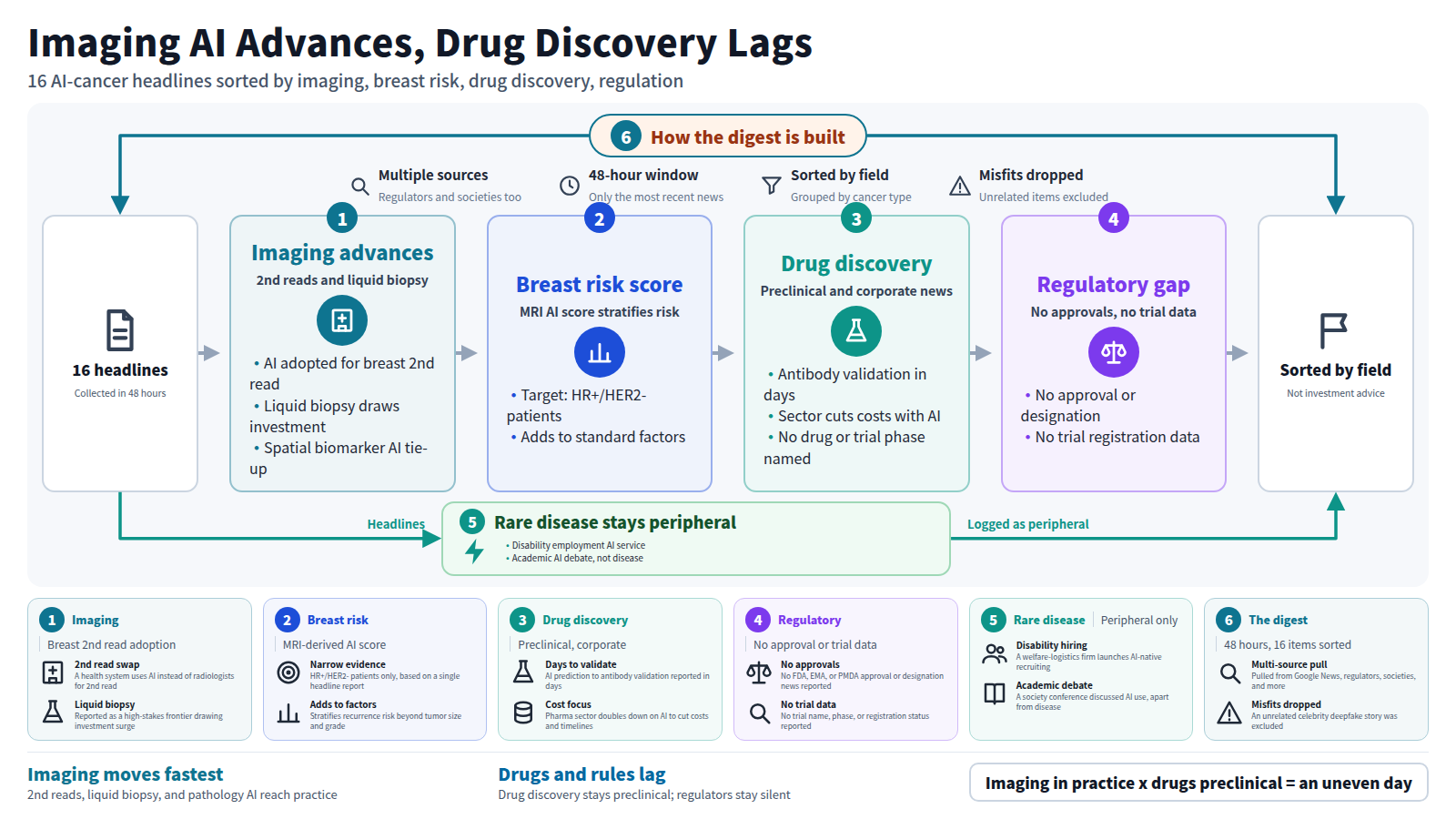
There is a noticeable movement toward the use of AI in the field of diagnostic imaging (second lead breast imaging, liquid biopsy as a substitute for liver biopsy, and spatial biomarker analysis for pathology). In breast cancer, there were reports on stratification of recurrence risk, while in the drug discovery field, the focus was on preclinical and corporate trends such as antibody exploration and partnerships. Specific information regarding announcements of approval/designation by regulatory authorities (FDA/EMA/PMDA) and clinical trial registration is not within the scope of this collection.
Breast cancer
- Target: HR+/HER2- breast cancer patients. It was reported that the AI score extracted from MRI can stratify recurrence risk in addition to existing standard prognostic factors (tumor size, grade, etc.) [Vera Health]. There is only a single headline information, and the target size and verification method (retrospective/prospective, single center/multicenter) are unclear. - It was reported that some medical institutions are using AI to replace radiologists for the 2nd read of breast images [Radiology Business]. Efficacy indicators (sensitivity, specificity, etc.) are not listed in the heading. - Flatiron Health expands AI-powered real-world dataset targeting breast cancer and NSCLC to UK, Germany, and Japan [BioSpace] Expanding the data base rather than making clinical validity claims.
lung cancer
We only confirmed that NSCLC (non-small cell lung cancer) is included in the Flatiron Health real-world data expansion mentioned above. There are no headlines regarding new findings regarding specific diagnostic accuracy or treatment selection.
Malignant brain tumor
- Article reporting that optical (photonic) biosensors incorporating AI may be useful in detecting glioblastoma tissue [azosensors.com]. The clinical application stage is unclear from the headline (it is assumed to be at the technology development/basic research stage, but it is not stated). - "Sheinelle Jones Horrified by Convincing AI Fake Featuring Her Children" [Reality Tea] is entertainment news about AI-generated deep fakes and has nothing to do with cancer treatment or medical AI. It was determined that the data was collected in error and was excluded from the analysis.
Leukemia/lymphoma
No applicable information
Colon cancer/digestive organ
"Latest hospital AI deployments in Singapore and more briefs" [Healthcare IT News] is an overview article about the introduction of AI in hospitals in Singapore, but the headline does not contain any specific content specific to the detection of colorectal cancer or gastrointestinal cancer.
Rare cancer
No applicable information
Diagnosis/Pathology/Image
- The use of AI in liquid biopsies was reported as a "hot field" [GlobeNewswire, citybiz (BCC Research)]. This is a report on market and investment trends, and clinical data such as detection sensitivity are not listed in the headline. - Haga Bioscience and Imagenomix enter into partnership to utilize AI in spatial biomarker analysis in cancer pathology [Genome Web]. This is a technical partnership announcement, and there are no figures regarding clinical performance. - Diagnostic imaging AI company reports 15% headcount reduction and annual revenue growth to $28 million [Radiology Business]. This is management and business trends, not information on clinical effectiveness. - The adoption of AI for the second lead in breast imaging (same case as 2. above) was also featured in an industry summary article [Radiology Business]. In the same article, ``KOA (knee arthropathy) treatment using low-dose radiation therapy'' is not covered because it is unrelated to cancer.
Treatment selection/drug discovery
- It was reported that the pharmaceutical industry as a whole is moving to strengthen the use of AI to reduce costs and development times [Reuters]. This is an article about industry trends, with no description of individual drugs or stages. - Announcement that Massive Bio has been recognized by TIME magazine in the Health Tech AI and Data Analytics category [businesswire.com]. This is a corporate award and does not indicate the clinical stage of a specific drug. - A method to verify antibodies within a few days from predictions made by AI was reported [News-Medical]. This is a technical report at the preclinical (antibody discovery/verification) stage, not information at the clinical trial stage.
Regulations/Approval
No applicable information
Clinical trial implementation status
No relevant information (Specific data regarding trial name, target cancer type, phase, and registration status from ClinicalTrials.gov is not provided at this time)
Japanese movements
Flatiron Health expands the provision of AI-based real-world datasets for breast cancer and NSCLC to Japan [BioSpace]. The headline does not mention any unique developments regarding medical treatment, approval, or clinical trials in Japan.
Remarks from VIPs
The list of important people to be tracked is empty, and there are no quotations with titles in the headlines, so there is no relevant information.
Latest news on AI and rare and incurable diseases
Overview
Only two headlines were provided, and both of them were peripheral articles related to systems and employment, rather than direct information on diagnostics and therapeutic drugs. There are no headlines indicating specific progress regarding diagnostic and therapeutic drugs for designated intractable diseases.
Diagnosis of rare diseases
No applicable information
Gene analysis/genome
No applicable information
Development of therapeutic drugs
No applicable information
Nerve/muscular diseases
No applicable information
Immunology/Collagen disease
No applicable information
Rare metabolic/endocrine diseases
No applicable information
System/Patient Support
- Asura Co., Ltd., which supports the social participation of people with disabilities through "welfare x logistics," realizes AI native recruitment with "MyTalent" (Nico Nico News): This article appears to be an introduction to AI-based services related to employment of people with disabilities, but it is not possible to confirm whether the article is a target disease or a designated intractable disease just by looking at the headline.
Japanese movements
- Report that there was a discussion on the actual state of AI utilization at the Japanese Society of Religious Studies academic conference (Chugai Nippo). The headline does not suggest a direct connection to rare or intractable diseases, but rather appears to be in the context of AI ethics and social debate.
Remarks from VIPs
No applicable information
- Flatiron Health Expands Global Panoramic Datasets With AI-Powered Breast Cancer and NSCLC Real-World Data for the UK, Germany, and Japan — BioSpace09/29 13:46 UTC
- Health system will use AI instead of radiologists for breast imaging 2nd reads — Radiology Business09/29 07:37 UTC
- HR+/HER2- breast cancer: MRI-derived AI score stratifies recurrence risk beyond standard factors — Vera Health09/29 03:18 UTC
- AI-Enhanced Photonic Biosensor Could Help Detect Glioblastoma Tissue — azosensors.com09/29 13:21 UTC
- Sheinelle Jones Horrified by Convincing AI Fake Featuring Her Children — Reality Tea09/29 13:32 UTC
- Latest hospital AI deployments in Singapore and more briefs — Healthcare IT News09/29 11:52 UTC
- Radiology AI firm trims 15% of staff, sees annual revenue surge to $28M — Radiology Business09/29 07:48 UTC
- AI-Powered Liquid Biopsy Emerges as a High-Stakes Frontier — GlobeNewswire09/29 12:23 UTC
- Haga Bioscience, Imagenomix Partner for AI Spatial Biomarker Analysis in Cancer Pathology — Genome Web09/29 13:35 UTC
- BCC Research Highlights Investment Surge in AI-Powered Liquid Biopsy — citybiz09/29 16:25 UTC
- Hospitals replace radiologists with AI for 2nd reads | Imaging AI firm notches $28M in revenue | Low-dose RT for treating KOA — Radiology Business09/29 13:16 UTC
- Pharma sector doubles down on AI to slash costs, timelines — Reuters09/29 00:51 UTC
- TIME Recognizes Massive Bio Among the Top HealthTech Companies in AI and Data Analytics — businesswire.com09/29 14:00 UTC
- From AI prediction to antibody validation in days — News-Medical09/29 10:13 UTC
- [News] Discussion on the current state of AI utilization, sharing specific examples, Japanese Society of Religious Studies Academic Conference — 中外日報社09/25 02:41 UTC
- Asura Co., Ltd., which supports the social participation of people with disabilities through "welfare x logistics," has launched "MyTalent," which realizes AI native recruitment. — ニコニコニュース09/29 15:00 UTC