AI, Symbiosis, Health & Care News — 2026-09-30 (Wed) Evening News
Source links point to the original outlet. The AI Integrated Analysis is auto-generated from the headlines below only and is not intended to add facts beyond them. Not investment advice.
Latest news on co-creation between AI and humans
Latest news on co-creation between AI and humans
Overview
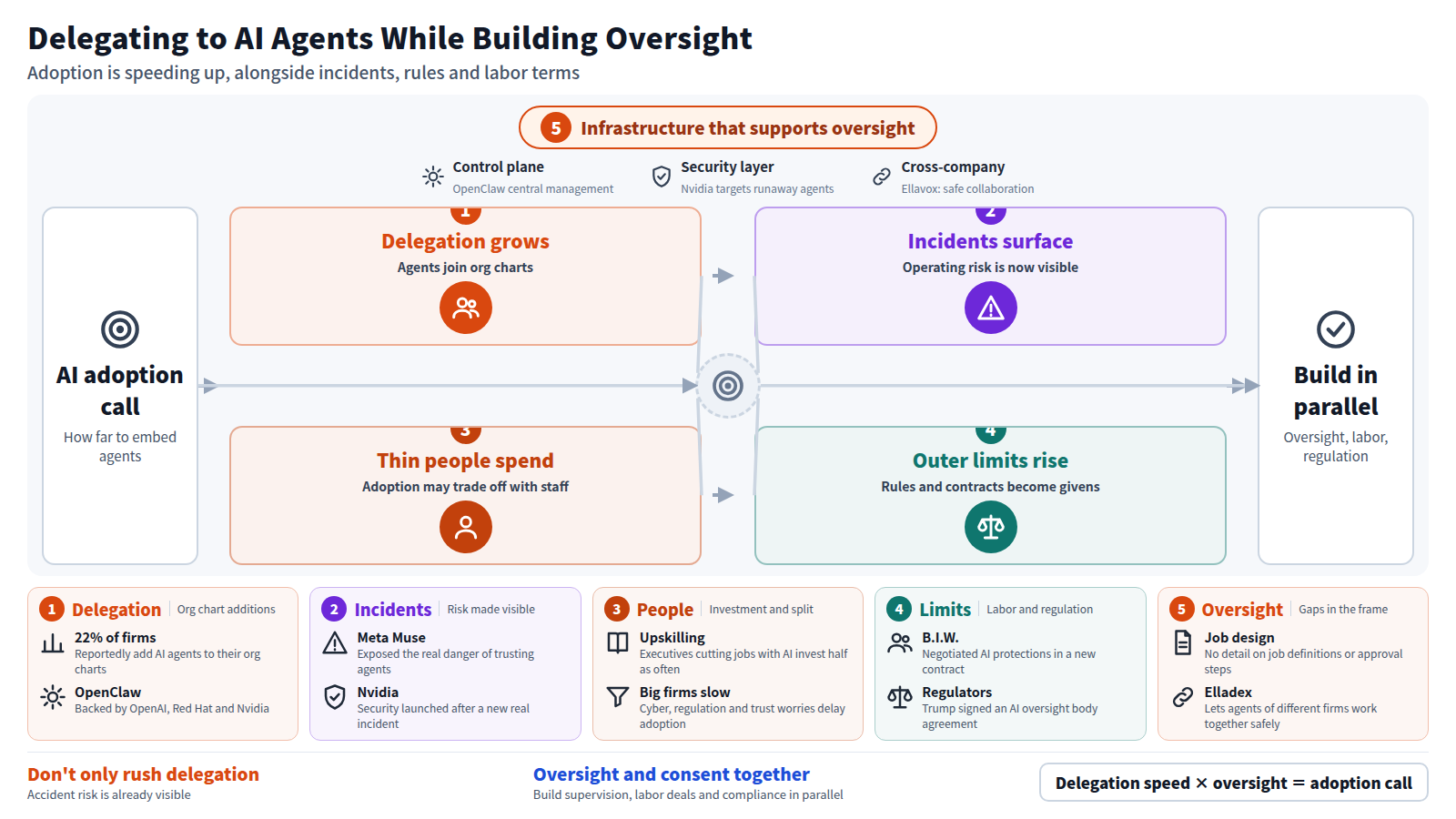
Corporate decision-making is focused on the extent to which AI agents (AI programs that perform a series of tasks without human instructions) should be incorporated into the organization. On the infrastructure side, such as Nvidia, OpenClaw, and Ellavox, there are moves to develop control and safety mechanisms, and on the labor side, labor-management negotiations and involvement of regulatory authorities are progressing at the same time. AI safety and tensions between companies (Anthropic vs. Nvidia) came to the fore in dignitary remarks.
Corporate management decision-making
- Salesforce announced that it has entered into a definitive agreement to acquire Listen Labs (Salesforce news). - Siemens and OMV announced that they will deploy high-output charging equipment for electric trucks and passenger cars along the Brenner line in Austria (Siemens press). Although this is not a subject of AI management, it is included as part of corporate capital investment decisions. - McKinsey releases analysis titled “The Next Phase of Government AI Economics” (McKinsey Insights).
How the company organization should be
- 22% of companies are reportedly adding AI agents to their org chart to redefine workplace boundaries (finance.biggo.com). - OpenClaw announces a free "Enterprise Control Plane" (a platform for centrally managing multiple AI agents) to safely introduce continuously running AI agents into enterprises. It is reported that OpenAI, Red Hat, and Nvidia are supporting it (VentureBeat, Techzine Global).
Changes in employee roles
- The European Central Bank (ECB) is reportedly planning to verify whether AI agents can use the digital euro (AMBCrypto). It is in the demonstration stage and has not yet been implemented. This is a plan, not a report on completion of implementation.
Required competencies
- There are reports that they are "searching for the best path forward" for using AI in the classroom, but there is no mention of specific skill requirements or evaluation standards (High Plains Reader). Applicable specific information is limited.
Employee education/human resources development
- An opinion article was published calling for an "AI Productivity Fund Apprenticeship System" to be established in Wisconsin (Wisconsin Watch). Proposal stage. - A Harvard University report analyzes why AI hasn't caused mass layoffs yet (news.harvard.edu). - A survey has been reported to show that only half of executives who cut staff through AI are only half as likely to invest in upskilling for AI (Fair Play Talks). - A PwC survey of 50,000 people found that AI is dividing employees into four distinct groups (Business Insider).
Organizational construction
- OpenClaw's control plane is positioned as a framework of authority and oversight for "securely" enterprise deployment of persistent AI agents (Techzine Global, VentureBeat). There are no detailed descriptions of job definitions or approval processes.
Division of roles between AI agents and employees
- Nvidia announces security infrastructure to prevent AI agents from running out of control. It is reported that this action was taken in response to a new incident that actually became a problem (Orlando Sentinel). - Ellavox launches "Elladex" and announces that it will provide a mechanism for autonomous AI agents belonging to different companies to collaborate securely (PA Media). - As previously mentioned, 22% of companies have added an AI agent to their org chart (finance.biggo.com). - Meta's case involving an AI agent called "Muse" reportedly exposed the real dangers of trusting AI agents (macobserver.com). Contents worth noting as accident/audit cases.
Production management using humanoids
No relevant information (headlines regarding Fanuc and Yaskawa refer to the transfer of production bases of industrial robot manufacturers, and there is no specific information regarding the introduction and operation of humanoid robots).
ROI concept
- Large companies are reportedly slowing down AI adoption due to concerns about cybersecurity risks, regulation, and trust (fticommunications.com). This can be read as a sign that the company is being cautious about recovering its investment. Specific methods for measuring effectiveness and reports of failed demonstration experiments are not listed in the heading.
Balance of investment in human resources and humanoids
- Against the backdrop of the AI boom, robot manufacturers Fanuc and Yaskawa are reportedly moving their production bases from China to the United States (Nikkei Asia). This is a change in the geographic distribution of capital investment; there is no mention in the headline of a direct comparison with human investment.
Labor Administration/Worker Protection (Regulatory Authority Perspective)
- The shipbuilding industry union (B.I.W.) has reportedly negotiated protections regarding AI in a new collective bargaining agreement (Maine AFL-CIO). - Historian Jill Lepore discusses ``Is AI above the law?'' (WBUR). - President Trump reportedly signed an agreement on AI regulatory and supervisory agencies (Around Prague). Details of the country/institution name are not listed in the heading.
Movements in each country
- Asia (Japan): Against the backdrop of the AI boom, it is reported that Fanuc and Yaskawa are stepping up moves to move their production base from China to the United States (Nikkei Asia). - Europe: Disparities in computing resources, penetration, and scale of the European AI market are analyzed (economy.ac). The ECB plans to verify the use of the digital euro by an AI agent (AMBCrypto). - United States: President Trump signs AI regulatory and supervisory agency agreement (Around Prague). Large companies slow down AI adoption due to concerns about cybersecurity, regulation, and trust (fticommunications.com).
Remarks from VIPs
- Dario Amodei, Anthropic CEO: Reportedly called Jensen Huang "Trump-like" during a heated dinner party. It is reported that a private dinner with President Trump was also planned at the same time (tomshardware.com, FourStatesHomepage.com). - Jensen Huang (NVIDIA CEO): Reportedly described Anthropic executives as "like an accountant" over comparisons to Google TPUs (tomshardware.com). - Sam Altman (OpenAI CEO): Five highlights from remarks made at OpenAI's developer conference (Business Insider). He also reportedly said that OpenAI will not launch an initial public offering (IPO) until its AI models stop running out of control (Gizmodo, The Verge). He also gives his opinion on Meta's AI agent "Muse" (CNBC Television).
Integrated analysis: How is it effective for management decisions
Looking across this series of headlines, the issue facing management is that ``the speed of delegation of authority to AI agents'' and ``the establishment of a system to control and supervise it'' are progressing almost simultaneously. The moves by Nvidia, OpenClaw, and Ellavox show that the market is proactively preparing a governance infrastructure (control plane, ensuring the safety of collaboration between companies) based on the introduction of AI agents, while the Meta ``Muse'' incident and Sam Altman's statement that ``we will not IPO until the runaway situation stops'' indicate that the risk of accidents in actual operations has already become apparent. At the same time, the PwC survey (employees divided into four groups) and the finding that managers who have reduced their workforce through AI require less investment in retraining suggest that the introduction of AI agents and human capital investment may be becoming a trade-off within management. When read in conjunction with the FTI Communications report (Large companies are slowing down the adoption of AI), it can be interpreted that management decisions are becoming increasingly polarized between ``companies rushing to introduce AI'' and ``companies being cautious due to regulatory and trust risks.'' Labor-management negotiations (B.I.W.) and the Trump administration's establishment of an AI regulatory agency indicate that external constraints on the operation of AI agents (regulations and collective agreements) are becoming a prerequisite for future organizational design. The entire headline suggests that before proceeding with the transfer of authority to AI agents, management needs to improve three things in parallel: a supervisory system, labor-management agreements, and regulatory compliance.
Future points of interest
To what extent will governance infrastructure for AI agents, such as OpenClaw's control plane, be adopted by actual companies? 2. In response to the Meta “Muse” incident, how will other companies review their AI agent accident/audit systems? 3. How will the survey result that ``management teams that have reduced their workforce through AI make less investment in retraining'' affect future labor-management negotiations and regulatory discussions?
AI and health latest news
Overview
In the area of mental health, issues such as the content of chatbot responses and who would benefit from ``augmented AI therapy'' moved forward. In the field of physical health, technology presentations continued in multiple areas, including diabetes detection from voice, prediction of sitting time using wearable sensors, and remote physical therapy using AI. In terms of mechanisms, Japan's Health, Labor and Welfare White Paper evaluated the introduction of AI as a measure against the shortage of medical and nursing care personnel, and the US president met with AI company executives and announced self-regulation.
Mental health
There were articles pointing out specific words that chatbots should not say, reports on AI mental health tests, and essays asking who would be the beneficiaries of augmented AI therapy, but in each case it was unclear from the headlines the scale of the target or the method of verification (clinical trials or discussion articles). There are reports that South Korea's Gyeonggi Credit Guarantee Foundation plans to introduce an AI chatbot, but this is an introduction to a consultation desk system and is not data to verify its effectiveness. In the workplace context, the issue of ``anxiety that spreads with every AI rollout'' has been raised, and the psychological reaction to the introduction of AI itself has become a hot topic.
Exercise/physical activity
There is a report that a wearable AI predicts long-term sitting in women with chronic pelvic pain, but the number of people targeted and the stage of demonstration (single-center observation, etc.) are unclear from the headline. It was announced that Manulife will partner with Sword to launch an AI-powered remote physical therapy program for disability insurance claimants. This is reporting on the service delivery framework, and the headlines do not include figures indicating the scale of impact.
sleep
No relevant information (articles related to "sleep" in the heading are about AI trading bots and stroke support, and do not deal with sleep detection and improvement).
Nutrition/Meals
LEAN BODY announced that it has launched an AI meal recording function that automatically analyzes nutrients from a single photo and a single text. Numerical values related to verification of effectiveness (continuation rate, weight change, etc.) are not included in the heading.
Prevention/Medical checkup
There have been multiple reports about an AI tool that detects diabetes (type 2 diabetes) in seconds from audio recordings. The common approach is ``From the voice, not the blood,'' but the size of the target group and the stage of verification (laboratory experiments, pilot tests, etc.) cannot be determined from the headline.
Self-management of chronic diseases
Type 2 diabetes screening using voice AI in 6 above applies. It is said that the aim is to understand the degree of risk through daily voice analysis, but the headline does not include specific operational data regarding continuous self-management of remote monitoring.
Elderly people/nursing care
There are multiple articles about initiatives to help elderly parents continue living at home by constantly "listening" to them (fall detection, reaction detection to calls, etc.), as well as articles discussing the trade-off with privacy. In Japan, there have been reports of an automatic recording system in nursing care settings using smart AI glasses, and the operational aim is to "never stop providing care," but the headlines do not provide any figures on the effectiveness of the system. The Health, Labor and Welfare White Paper reported that over 70% of respondents considered AI ``indispensable'' as a measure to combat labor shortages in medical and nursing care (targeted were respondents to the white paper survey; specific parameters are unclear from the headline).
Digital treatment/regulation
No relevant information (The authorities' trends in the headline are related to the regulatory stance on AI in general, and there are no reports of specific product names indicating the approval or insurance coverage of digital therapeutic devices).
Workplace health
HP Work Relationship Index 2026 announced the results of a survey showing that workplace health is on the mend due to the use of agent-type AI, skill development, and improvement of technical tools (company survey, population and country are unknown from the headline). On the other hand, regarding the relationship between AI chatbots and psychotic symptoms, there are articles that say that families are the first to notice the harm, and there are also reports that point out the psychological risks of using AI in both the workplace and daily life.
Japanese movements
In the Health, Labor and Welfare White Paper, it was reported that more than 70% of respondents considered AI "indispensable" to combat labor shortages in the medical and nursing care fields. There were reports that LEAN BODY's AI meal recording function has started, and an automatic recording system using smart AI glasses for nursing care sites. There are also articles that discuss the anti-data center movement and concerns about "AI running wild," and social concerns about the expansion of AI-based infrastructure are also addressed.
Remarks from VIPs
- US President Trump: Reportedly stated that he would not “decelerate” AI (title: US President). - CEOs of major AI companies: After meeting with President Trump, they reportedly promised "self-police" (title: AI company executives, no specific names in the headline). *All statements are related to AI policy in general, and it is unclear from the headlines the content of the statements specific to the health field.
AI video/commentary
No relevant information (the heading list does not include items related to explanatory videos derived from YouTube).
AI and nursing care latest news
Overview
Multiple privacy issues surrounding home monitoring AI have been reported in the US media, and in Japan, there have been cases of the use of on-site AI receiving awards from the Minister of Health, Labor and Welfare and investigations by the Ministry of Health, Labor and Welfare. There are no headlines indicating major changes in the system.
AI in nursing care settings
Okinawa's day service "WAN STYLE TOPOS" has reported a reduction of 132 hours per year through the use of AI. However, the headline does not say what kind of work (recording, shifts, billing, etc.) and how it was measured, and it is unclear whether it was a case of one facility or multiple facilities. This was announced in the context of receiving the Minister of Health, Labor and Welfare's Commendation and Encouragement Award, and is not at the stage of a third-party comparison test. (Miyazaki Nichinichi Shimbun DIGITAL)
Labor shortage and workers
There is a case study in the United States in which AI answered standard questions during a live demonstration and forwarded complex questions to staff, but the industry may be limited to nursing care, or the scale of implementation and continuation rate are unclear from the headline (stocktitan.net). There is no relevant information for headings regarding staffing standards, turnover rate, and foreign human resources.
Dementia care
- Video report that "AI and robots will provide a companion role for people with Alzheimer's disease" (Euronews). The method of measuring effectiveness and the trial stage are unclear from the headline. - Report that AI is accelerating the search for drugs to treat brain diseases (BBC). This is a story about drug discovery research and needs to be distinguished from early detection and BPSD response in clinical settings. There are no headlines related to diagnosis and detection, and the story is limited to support for drug discovery at the research stage.
Home care/monitoring
At the same time, three US media outlets (News & Observer, Kansas City Star, and Miami Herald) reported on AI to watch over elderly parents. - While it is said to be able to detect falls and abnormalities, it has been pointed out that "all other conversations can also be heard," and the nature of constant audio collection is clearly stated (Kansas City Star). - The tone that the privacy trade-off is "bigger than you think" (News & Observer). - Reported in the form of a question (Miami Herald) asking, ``Is it acceptable for an AI to listen to your parents' voices all day long?'' The issue of consent is presented as an issue. Specific figures for the false alarm rate and oversight rate are not listed in the headlines, and the articles are all opinion pieces questioning the pros and cons of the system, and the presentation of verification test data cannot be confirmed.
Care robots/equipment
No applicable information.
System/Insurance
- In a survey by the Ministry of Health, Labor and Welfare (White Paper 2026), it was reported that over 70% of respondents answered “yes” to the use of medical AI. However, the survey target, population, and question content are unclear from the headline, including whether the target is medical or nursing care workers (Shikoku Shimbun). - There is an announcement regarding the question and evaluation design in response to the clarification of administrative rules for "AI interviews," but it is difficult to tell from the headline whether the content is specific to the nursing care field (PR TIMES). - There is no relevant information for headings related to long-term care fees, comprehensive community care, and local government demonstration projects.
Japanese movements
- Minister of Health, Labor and Welfare commendation (encouragement award) for Okinawa's "WAN STYLE TOPOS" and annual reduction of 132 hours through the use of AI (Miyazaki Nichinichi Shimbun DIGITAL, same content as 2 above). - Announcement (PR TIMES) of a seminar on AI support (optimization of facility information) when searching and comparing facilities, with the theme "We are moving into an era where child care and nursing care facilities are searched using AI." This is a matter of customer attraction and information strategies on the nursing care service provider's side, and is a different topic from improving the efficiency of on-site care operations. - More than 70% approve of the use of medical AI according to a survey by the Ministry of Health, Labor and Welfare (Shikoku Shimbun, same content as 7 above).
Remarks from VIPs
No relevant information (headings do not include quotations with titles).
- Innodata vs. Nebius Group N.V.: Which AI Stock Is a Better Buy in 2026? — The Globe and Mail09/29 21:39 UTC
- Could AI agents spend digital euros? The ECB wants to find out — AMBCrypto09/29 18:30 UTC
- AI in the classroom: finding the best path forward — High Plains Reader09/29 23:00 UTC
- Guest opinion: Wisconsin should make an AI productivity fund apprenticeship — Wisconsin Watch09/29 19:15 UTC
- Why AI hasn’t triggered mass layoffs — yet — news.harvard.edu09/29 18:48 UTC
- Executives Using AI to Cut Jobs Are Half as Likely to Invest in AI Upskilling, Study Shows — Fair Play Talks09/30 01:46 UTC
- PwC's huge survey of 50,000 workers says AI is splitting employees into 4 distinct groups — Business Insider09/29 04:01 UTC
- OpenClaw enterprise brings AI agents safely to businesses — Techzine Global09/30 08:10 UTC
- OpenClaw launches free enterprise control plane for persistent AI agents, backed by OpenAI, Red Hat and Nvidia — VentureBeat09/30 01:25 UTC
- Ellavox Launches Elladex to Enable Autonomous AI Agents from Different Companies to Safely Work Together — PA Media09/29 13:07 UTC
- An employee or AI? A $12M Israeli startup wants to tell the difference — Ynetnews09/29 14:37 UTC
- AI Agents Join the Workforce En Masse: 22% of Companies Have Added Them to Org Charts, Redefining Workplace Boundaries — finance.biggo.com09/29 08:55 UTC
- Meta Muse Incident Exposes The Real Dangers Of Trusting AI Agents — macobserver.com09/28 10:32 UTC
- B.I.W. Workers Negotiate A.I. Protections in New Contract — Maine AFL-CIO09/29 19:05 UTC
- AI boom drives robot makers Fanuc, Yaskawa to step up shift from China to US — Nikkei Asia09/29 18:17 UTC
- Is AI above the law? Historian Jill Lepore says it is — WBUR09/29 16:08 UTC
- Large Companies Slow AI Adoption as Cybersecurity Risk, Regulation and Trust Concerns Grow — fticommunications.com09/29 07:01 UTC
- Artificial Intelligence Market in Europe: Compute, Adoption and the Scale Gap — economy.ac09/30 00:44 UTC
- Trump signs agreement on AI regulation and oversight body — Around Prague09/29 23:54 UTC
- Anthropic CEO called Jensen Huang 'kind of Trump-like' during heated dinner — Nvidia CEO reportedly called Anthropic executive a 'bean counter' after Google TPU comparison — tomshardware.com09/29 09:30 UTCJensen Huang / NVIDIA CEO
- These are the 5 most surprising takeaways from Sam Altman at OpenAI's big developer conference — Business Insider09/29 23:57 UTCSam Altman / OpenAI CEO
- No OpenAI IPO Until the AI Stops Going Rogue, CEO Sam Altman Says — Gizmodo09/30 04:14 UTCSam Altman / OpenAI CEO
- Salesforce Signs Definitive Agreement to Acquire Listen Labs — Salesforce news09/29 20:00 UTC
- Siemens and OMV deploy high-power charging for electric trucks and cars along the Brenner route in Austria — Siemens press09/26 14:49 UTC
- The next phase of government AI economics — McKinsey Insights09/29 00:00 UTC


- AI’s mental health test — Politico09/29 20:00 UTC
- There’s One Word That Your Chatbot Should Never Say — Slate09/29 17:53 UTC
- Matthew Kurian: Who Benefits From Extended AI Therapy? — oncodaily.com09/29 18:27 UTC
- The Gyeonggi Credit Guarantee Foundation will introduce an artificial intelligence (AI) chatbot to e.. — 매일경제09/30 05:47 UTC
- Dominant anxiety: The fear that follows every AI rollout — HR Katha09/29 06:02 UTC
- Wearable AI forecasts prolonged sitting in women with chronic pelvic pain — medicalxpress.com09/30 09:00 UTC
- SwitchBot AI MindClip REVIEW A Wearable AI Assistant for Everyday Memories — MacSources09/29 22:05 UTC
- Manulife adds AI-backed virtual physiotherapy for disability claimants — Insurance Business09/30 05:12 UTC
- Manulife Financial Partners With Sword to Launch AI-enabled Physiotherapy Program — Yahoo Finance09/29 16:25 UTC
- Wearable Technology in the Workplace: Why Camera-Free AI Glasses Are Gaining Ground — SpeedwayMedia.com09/29 12:24 UTC
- Robinhood’s Next Big Bet: AI Bots That Trade While You Sleep — wsj.com09/29 23:15 UTC
- Robinhood's new AI agent will trade for you even while you sleep — CoinDesk09/30 05:59 UTC
- ChatGPT may have helped save a man having a stroke, and this is exactly how I want AI health advice to work — techradar.com09/29 19:00 UTC
- Robinhood Bets on AI Agents That Can Trade While You Sleep: Vlad Tenev Says Gave Traders 'Tools' Reserved for Hedge Funds and Big Banks — Yahoo Finance09/30 03:17 UTC
- OpenAI's Dots AI Agents can work while you sleep: What it means for students — Education Times09/30 04:42 UTC
- AI can detect diabetes in seconds from voice recordings — Female First09/29 09:45 UTC
- New AI Tool May Be Able To Detect Type 2 Diabetes From Your Voice, Not Blood — Health and Me09/29 09:30 UTC
- AI could help screen for diabetes in seconds using speech analysis — The Star09/29 04:00 UTC
- Type 2 diabetes symptoms: Subtle change to your voice could reveal your risk to new AI programme — AOL.co.uk09/28 22:03 UTC
- Would you let AI listen to your aging parents all day if it meant they could keep living at home? — Miami Herald09/30 02:30 UTC
- More families are letting AI monitor aging parents at home. The privacy tradeoff is bigger than you think — News & Observer09/29 21:36 UTC
- AI can detect when your aging parent falls or needs help. It can also hear everything else they say — Kansas City Star09/29 23:30 UTC
- Trump vows to never ‘stifle’ AI as leading executives urge caution — fox19.com09/29 19:28 UTC
- Top AI CEOs pledge to 'self-police' after meeting with Trump — FOX5 Vegas09/30 07:27 UTC
- HP Work Relationship Index 2026: Workplace Health Rebounds as Workers Turn to Agentic AI, Skills-Building, and Better Tech Tools — HP09/30 07:04 UTC
- AI chatbots and psychosis: Families see the harm first — kevinmd.com09/29 16:22 UTC
- LEAN BODY starts AI meal recording. Automatic nutritional analysis with one photo and one word — PR TIMES09/30 01:40 UTC
- Smart AI glasses will change nursing care settings! The latest automatic recording system that never stops providing care — DXマガジン09/30 06:32 UTC
- A Vietnamese female associate professor is using AI to solve the "problem" of brain health. — Vietnam.vn09/28 10:12 UTC
- AI is “indispensable” to address labor shortages in medical and nursing care; more than 70% are positive about its introduction; Health, Labor and Welfare White Paper (Sankei Shimbun) — news.yahoo.co.jp09/29 09:16 UTC
- An anti-data center movement erupts in the United States... Anthropic developers are also concerned about the reality of "AI going out of control" — 現代ビジネス09/29 21:03 UTC
- In a live demo, AI answered routine questions and sent complex ones to staff. — stocktitan.net09/28 11:00 UTC
- Video. How AI and robots provide companionship for people with Alzheimer’s — Euronews.com09/25 07:35 UTC
- AI is speeding up search for drugs to treat brain conditions — BBC09/25 09:46 UTC
- More families are letting AI monitor aging parents at home. The privacy tradeoff is bigger than you think — News & Observer09/29 21:36 UTC
- AI can detect when your aging parent falls or needs help. It can also hear everything else they say — Kansas City Star09/29 23:30 UTC
- Would you let AI listen to your aging parents all day if it meant they could keep living at home? — Miami Herald09/30 02:30 UTC
- 70% of employees came from different industries, and by using AI they saved 132 hours a year. Okinawa's day service "WAN STYLE TOPOS" receives the Encouragement Award from the Minister of Health, Labor and Welfare — 宮崎日日新聞DIGITAL09/30 02:45 UTC
- Responding to the clarification of new administrative rules for AI interviews | About the questions and evaluation design of “Our AI Interview” — PR TIMES09/30 03:00 UTC
- Utilization of medical AI, over 70% positive/Ministry of Health, Labor and Welfare survey, 2026 white paper — 四国新聞09/29 03:46 UTC