
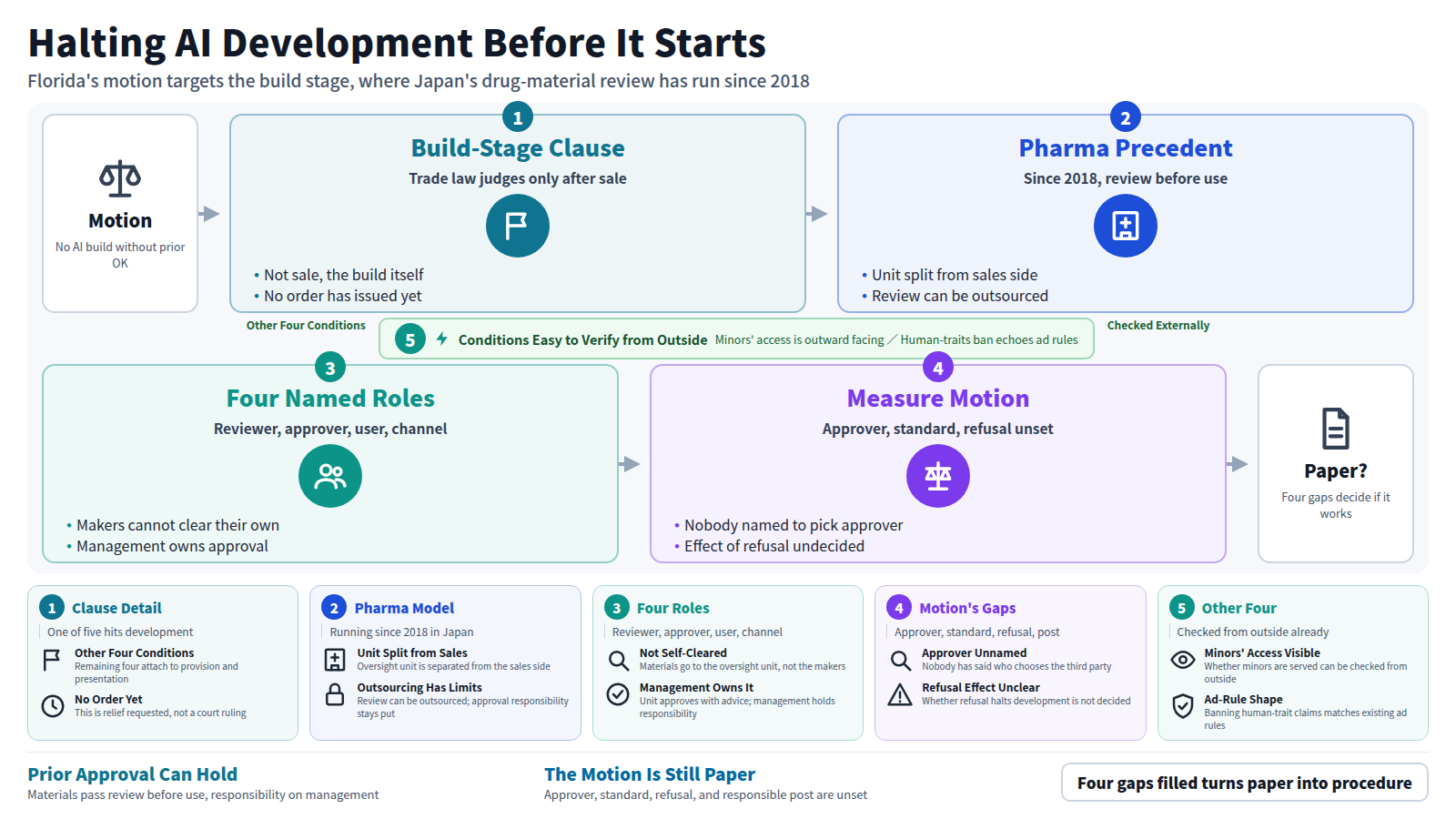
On September 28, 2026, Florida Attorney General James Uthmeier asked a state circuit court to bar OpenAI from developing new AI models without safety approval from an independent third party. Can a rule hold that nothing may be built until an outside body has approved it? It can. Since 2018, promotional materials for prescription drugs in Japan have passed a pre-use review and approval by an oversight unit separate from the sales side.
01The State Reached the Development Stage and Asked for Prior Approval of AI
The motion does not confine itself to labeling or to an age line. Florida asked for a condition that no new model be developed without safety approval from an independent third party. The condition attaches not to how a product is sold but to the stage at which it is made.
Selling and building are reached at different moments. Trade practice law ordinarily judges conduct after a product reaches the market. Attaching a condition to development moves responsibility from damages paid afterward to approval granted beforehand.
No order has issued. This is relief that has been requested, not a ruling. Even so, the shape of the request sets out one design: clear the work with an outside body before building it. In Japanese pharmaceutical practice, that design has been running since 2018.
02The Motion Asks for Third-Party Safety Approval and an End to Minors' Access
Since the state asked for a condition at the development stage, the conditions it listed are worth counting. Reporting describes five. No development without safety approval from an independent third party. No provision of ChatGPT to minors in Florida. Limits on collecting personal data from children under 13. A ban on presenting the product as possessing human characteristics, emotions, consciousness, or independent thought. And limits on features that keep users engaged.
The filing went to the Tenth Circuit in Highlands County as part of a suit brought on June 1. That first complaint turned on harm to children and on deceptive trade practices.
OpenAI has said ChatGPT is a general-purpose tool used by hundreds of millions of people every day for legitimate purposes, and that the company works continuously to strengthen its safeguards against harmful intent. The company has also said it paused training of its most capable models. Resumption, it said, waits until the company is confident. The place where that judgment sits has not moved outside.
03Drug Promotion Materials Pass an Independent Oversight Review Before Use
Of the five conditions, only this one touches the development stage; the other four attach to provision and to presentation. That is why the heaviest is the one placing approval before development. A procedure of that shape is already running somewhere. Japan's guideline on promotional information activity for prescription drugs requires that materials be submitted in advance to the promotional information oversight unit for review before use. Approval follows, informed by advice from a review and oversight committee.
The oversight unit is separated from the sales side that makes and uses the materials. The review work itself may be outsourced. The responsibility for approval does not travel with it. The guideline places that responsibility on the oversight unit and, through it, on management.
| Point of comparison | The arrangement Florida requested | The arrangement running for materials |
|---|---|---|
| Timing of the decision | Before a model is developed | Before materials are used |
| Who reviews | An independent third party (unspecified) | The promotional information oversight unit |
| Outsourcing | A third party is assumed | Review work yes, approval no |
| Who is responsible for approval | Not specified | The oversight unit and management |
The two regimes differ in purpose and in audience. Florida went to court to protect consumers; the guideline was issued by a ministry to keep information given to health professionals sound. They overlap on two points only: the moment the decision falls, and the place responsibility is fixed.
04Damages Awarded Afterward Cannot Change a Decision Made Before Building
For materials, approval comes before use. For AI models, responsibility arrives after provision. The state's request is aimed at the limits of that second arrangement.
Florida's trade practice statute declares unlawful the unfair methods of competition, unconscionable acts, and unfair or deceptive practices in any trade or commerce. It is a strong provision, and its judgment falls after the conduct. Damages ordered once a child has been harmed do not return anything to that child.
So the state asked for a condition at the development stage rather than for money. The same reasoning was settled as procedure in pharmaceutical practice in 2018. Recalling a faulty piece of promotional material after it reached a physician does not reach the patient whose prescription was already decided from it. Placing the review before use is what that limit calls for.
05The Guideline Puts Approval on Management and Limits Outsourcing to the Review Itself
If responsibility after the fact cannot reach a decision made beforehand, what does prior approval actually settle? The guideline writes out four roles.
Review
Materials go to the oversight unit for review in advance of use. The people who made them cannot clear them.
Approval
The oversight unit approves, informed by advice from the review and oversight committee. Responsibility rests with that unit and with management.
Limits on use
Staff may use only materials found appropriate in review. Nothing on hand may be circulated at will.
Complaint channel
An externally visible channel receives complaints; facts are investigated promptly and measures taken.
All four share one feature: they state by role who carries what. Reviewer, approver, user, and complaint handler are distinct. Because they are distinct, anyone can determine afterward whom to ask.
The state's motion has none of this division yet. It contains the phrase independent third party and does not say who selects that party.
06Halting Development, Drawing an Age Line, and Banning Anthropomorphism Carry Different Weights
In the review of materials, prior approval operates because reviewer, approver, and user are written out separately. Measured by whether the same division can be required of them, the conditions bundled into one motion come apart.
The condition on development weighs most. Without a settled approver, an order cannot be carried out. Who chooses the third party, how its independence is verified, whether a refusal stops the work — leave those three open and the condition stays on paper.
The age line runs the other way. Whether minors in Florida are being served can be checked from outside without difficulty. What the check reaches is only provision, never conduct. Children move away from the danger while the danger stays where it was.
The ban on anthropomorphic presentation sits close to existing advertising rules. Forbidding a product to be presented as having human characteristics, emotions, or consciousness takes the same stance as rules against claims that give a false impression of what a product is. Drug advertising draws the line at the approved efficacy, which may not be exceeded even by implication. Drawing lines around presentation is a long-established regulatory method.
07If the Order Issues, the Choice of the Approving Third Party Still Remains
Suppose the heaviest of the five conditions becomes an order. Three items would still be undecided, and beyond them nobody has said who sets the standard the review would apply.
Selecting the approver
Nobody has said who chooses the third party or how its independence is verified.
Effect of refusal
Nobody has said whether development stops on refusal or proceeds under conditions.
Where responsibility lands
No post has been named as carrying responsibility for approval.
The review of promotional materials answers all three. The marketing authorization holder establishes the oversight unit, and separation from the sales division is how its independence is verified. Staff may not use materials the review has not found appropriate. Responsibility rests with the unit and with management.
Whether an order will issue, I do not know. Neither the hearing date nor the defendant's response was verifiable when I wrote this. Two things can be written: what the requested conditions contain, and what remains unsettled before those conditions could operate.
- On September 28, 2026, Florida asked that development be barred without independent third-party safety approval. The target of the request moved from how the product is sold to the stage before it is built.
- Materials for prescription drugs pass a pre-use review and approval by an oversight unit; the review work may be outsourced while the approval responsibility stays with management. For promotional materials, prior approval has already been worked out as a design problem.
- The motion does not say who selects the approver. Unless the approver, the standard, the effect of refusal, and the responsible officer are all fixed, a prior-approval condition will not operate even as an order.
Nothing may be built until an outside body approves it. The rule can hold. At a Japanese pharmaceutical company, before a single page reaches a physician, a unit other than the one that wrote it reads the page, approves it on committee advice, and management carries the responsibility. Eight years of operation stand behind that.
Carrying the same shape into AI development will not be easy. Materials can be counted one page at a time; training runs resist counting. Still, difficulty and impossibility are separate findings.
What the Florida motion lacks is not the idea. Who selects the approver, what standard applies, what a refusal does, which post carries the responsibility. Whether those four can be written in decides whether prior approval stays on paper or becomes a procedure.
- Engadget. Florida AG requests emergency order to stop OpenAI model development. 2026-09-28. (Date and structure of the motion; OpenAI's statement)
- News4JAX (WJXT). Uthmeier asks court to temporarily block OpenAI from offering ChatGPT to minors. 2026-09-28. (Tenth Circuit, Highlands County; the five requested conditions; the June 1 complaint)
- PYMNTS. Florida Asks Judge to Stop OpenAI Model Development Over Safety Risks. 2026-09-28. (Wording of the independent safety condition; the paused training and internal resumption decision)
- Reuters. Florida asks court to bar OpenAI from new model development as part of suit over harm to children. 2026-09-28. (Standing of the suit and the target of the request)
- Florida Statutes. Fla. Stat. § 501.204 — Unlawful acts and practices. (Unfair or deceptive acts declared unlawful; judgment falling after the conduct)
- Ministry of Health, Labour and Welfare, Japan. Guideline on Promotional Information Activities for Prescription Drugs. 2018-09-25. (Pre-use review and approval; outsourcing limits; where approval responsibility is fixed; complaint channel and limits on use)
- OpenAI. Statement on paused training and the decision to resume. 2026-09. (Training of the most capable models paused; resumption when the company is confident)