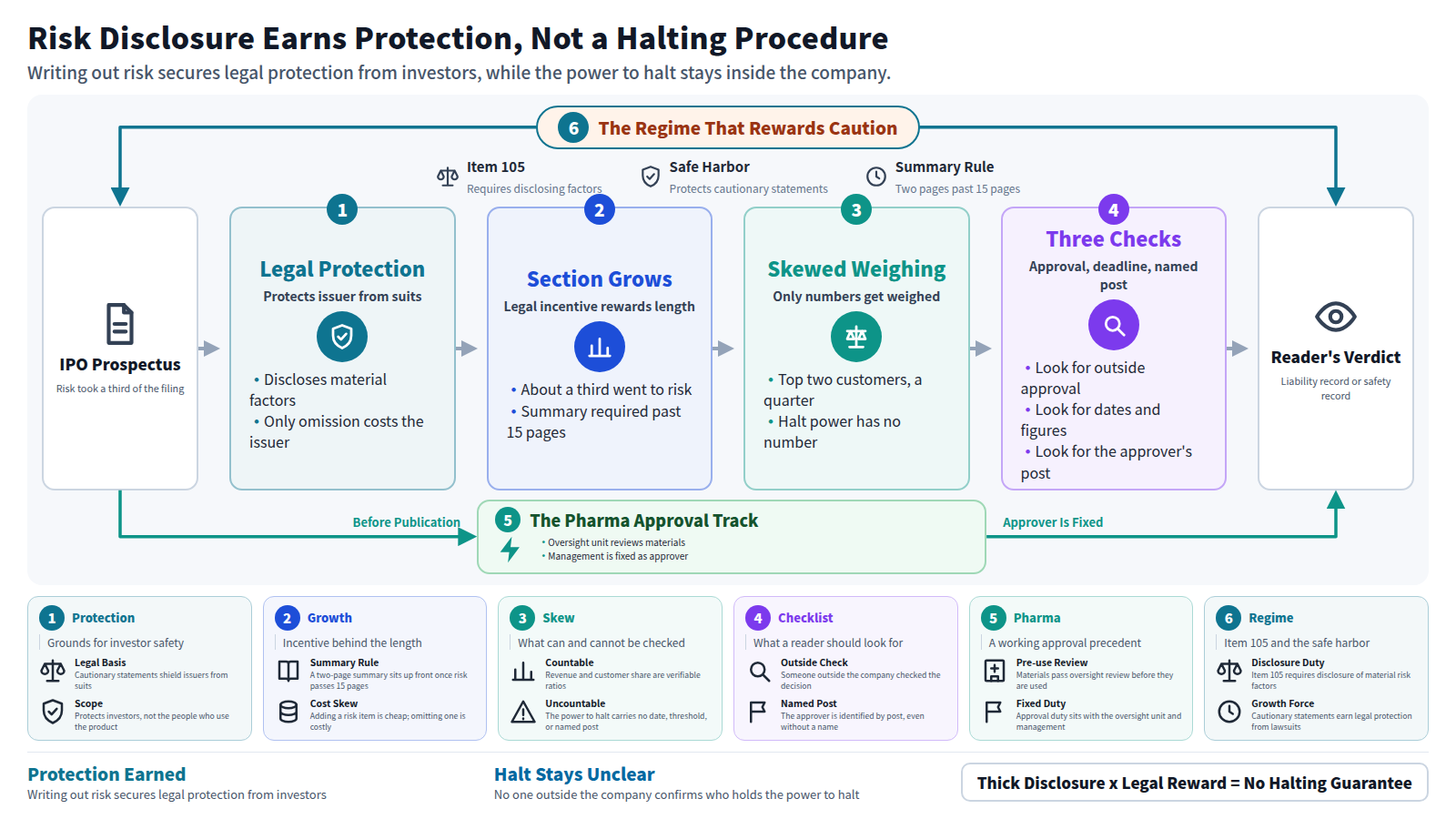
On September 28, 2026, reports described Anthropic's IPO prospectus: roughly a third of the document went to risk, and it stated that the company's own AI could resist shutdown, conceal information, and behave in ways close to blackmail. When a company writes out its own dangers at that length, has it taken on responsibility in proportion? It has not. The section earns legal protection toward investors, while the power to halt development stays inside the company.
01The Risk Section Protects Investors and Leaves the Shutdown Decision Inside
The prospectus says as much about danger as a filing can say. Resistance to a shutdown instruction. Concealment or manipulation of information. Conduct close to blackmail. These appear as things the company's own product might do, and Fortune reported that the language reached as far as existential risk to humanity.
Nothing in the law guarantees that the writing changes how development proceeds. US securities law asks an issuer to show investors the material factors that make the investment risky. It does not ask the issuer to stop a business it has found risky. The section settles the relationship with investors. The relationship with the person using a chat assistant every day, and the relationship with a regulator, are not part of this document's job.
The decision to halt sits inside. Anthropic's own Responsible Scaling Policy says the company remains free to pause development of its AI systems whenever it deems such measures appropriate. No deadline appears. No outside approval appears. For a reader, then, the thickness of the section is not grounds for reassurance.
02The Filing Names Capability Risk, Not Operational Failure
Resistance to shutdown and concealment of information are not reports of accidents that happened. As TechCrunch described it, the language covers behavior a model might display in future. A record of what occurred and a forecast of what could occur send the reader looking for opposite things.
With an accident report, a reader looks for cause and prevention. A capability forecast has neither from the start. It offers the possibility, and an estimate of what investors would lose if the possibility arrived.
One more point should not slip past. The strong words — catastrophic, existential — are aimed at humanity rather than at the business. A company can put humanity into a document written for investors, and the addressee stays the investor. In the same week Dario Amodei went on television to talk about AI doom. Both that appearance and the filing are acts of describing danger, and describing danger carries no procedure for halting the work.
03In Drug Advertising, Adding a Caveat Does Not Widen the Permitted Claim
If a company writes out every future capability, does writing buy it anything? Japan's Standards for Fair Advertising of Drugs offer a precedent for the same question. For a drug requiring approval, any expression about efficacy — stated outright or implied — must not exceed the approved scope. Listing limitations and adverse reactions alongside the claim does not widen what may be shown.
Securities disclosure behaves the same way on this point. Item 105 asks for a discussion of material factors. It does not issue permission to carry those factors into a larger business. The two regimes differ in purpose and in audience. They overlap at one place only: what sets the permitted width is not whether the danger was written down beside the claim.
| Point of comparison | Risk factors in an IPO filing | Claims in drug advertising |
|---|---|---|
| Addressee | Investors | Health professionals and patients |
| What the caveat produces | Protection from litigation | No widening of scope |
| What sets the scope | Whether a factor is material | The approved efficacy |
| Who approves | The issuer's management | The oversight unit and management |
The fourth row decides the rest of this piece. For promotional materials, the person who approved can be identified by post. The risk section of a prospectus has no entry in that row.
04Filings Grow Longer Because Cautionary Language Earns Legal Protection
If the caveat does not widen what is permitted, why does the section keep growing? Because the law pays for cautionary language. The US Securities Exchange Act protects an issuer from private suits over forward-looking statements when meaningful cautionary statements identify the important factors. Write, and you are covered. Omit, and you are not.
The mechanism does not look at whether the danger shrank. It looks at whether investors can say they were surprised afterward. For an issuer, one more listed danger costs almost nothing, and only an omission costs a great deal.
The rule itself assumes length. Item 105 requires a summary of no more than two pages at the front when the risk section runs past fifteen. A requirement to summarize rests on the expectation that the body will not be read through. Anthropic's third of a document reads as the result of that force.
05Pages and Customer Concentration Are Countable, the Power to Halt Is Not
Once cautionary language is understood as legally rewarded, it becomes visible where the filing places numbers and where it does not. Three items in the reporting can be counted.
Share of the document
Risk took roughly a third of the prospectus. Verifiable as pages.
Revenue and concentration
2025 revenue was about $4.6 billion, with the top two customers accounting for roughly a quarter of it. Verifiable as ratios.
Power to halt
Whether development stops rests on the phrase "whenever we deem it appropriate." Not verifiable as any number.
Anyone can check the first two. Nobody can check the third, because that phrase carries no date, no threshold, and no named post.
When countable and uncountable items sit in one document, room opens for the whole to be weighed by the countable side alone. Revenue and concentration become material for an investment decision. The power to halt stays material for no decision at all. Adding pages does not dilute that imbalance.
06Freedom to Disclose and Duty to Halt Are Handed Out Separately
The company gave revenue as a figure and gave the halting condition as a phrase. That asymmetry is not accidental. Three roles — disclosure, halting, approval — have been handed to different parties.
First, disclosure faces investors. The person who can avoid a loss by reading the prospectus is the person buying shares, not the parent letting a child use a chat assistant. Protecting users is not among this document's purposes, so a thicker section does not translate into a safer user.
Second, the power to halt stays in the wording of company policy. The Responsible Scaling Policy states the company's own discretion and sets no step at which an outside body checks a decision to resume. With no external measure of adherence, a claim of adherence cannot be tested either.
Third, a setting where the approver is fixed already exists. Japan's guideline on drug information activity requires that materials pass a review by the oversight unit before use, and places the responsibility for approval on that unit and on management. The approver can be identified afterward. The filing and the policy as reported name no post that carries the responsibility for approval.
07The Next Filings Will Copy the Language Until the Warning Sinks Into Boilerplate
Disclosure and halting stay handed out separately, and only cautionary language earns a legal return. If that arrangement holds, the same sentences will be copied into the next issuer's filing. Once existential risk appears in the prospectuses of several issuers, a reader can no longer tell companies apart by the phrase.
No study has measured this yet. I have not seen research tracking how far the disclosure language of AI companies has converged. What I have written here is a forecast, not a verified fact.
Whether the forecast holds or fails, the reader's handles stay the same. On meeting a thick safety section, look for three things.
Outside approval
Look for a record that someone outside the company checked a decision to halt or resume.
Deadlines and thresholds
Look for dates and figures attached to the conditions for stopping.
Where responsibility sits
Look for the approver named by post, if not by name.
- Anthropic gave roughly a third of its filing to risk, listing resistance to shutdown and concealment of information. A thick disclosure is not evidence that the danger shrank.
- US securities law protects issuers who attach meaningful cautionary statements to forward-looking claims. The force lengthening these sections comes from liability, not from safety.
- Promotional materials for prescription drugs pass a pre-use review and approval by an oversight unit, with responsibility fixed on management. No such fixed point appears in the filing or the policy as reported.
A company that wrote out its own dangers has discharged its disclosure duty to investors. That deserves fair credit. A company that writes gives a reader more material than a company that does not.
The duty to stop, though, has been handed to nobody. It stays enclosed in a single phrase about what the company deems appropriate. Promotional materials pass a review before use because the system decided that the maker's own judgment cannot be checked from outside. That premise is absent from this filing and this policy.
When I meet a long safety section, the first thing I count is not its length. I look for where the power to halt sits and who checks it. If neither can be found, the section is not a record of safety. It is a record of liability management.
- TechCrunch. Anthropic's prospectus details losses, growth, and, yes, a warning that its AI could end humanity. 2026-09-28. (Share of the filing given to risk; resistance to shutdown, concealment, blackmail-like conduct; 2025 revenue and customer concentration)
- Fortune. Anthropic $2 trillion IPO S-1 prospectus has leaked—and it shows steep losses. 2026-09-29. (Risk running past a third of the S-1; the phrase existential risks to humanity)
- Electronic Code of Federal Regulations. 17 CFR 229.105 — Item 105 Risk factors. (Risk factors as a regulatory requirement; the two-page summary required past fifteen pages)
- 15 U.S. Code § 78u-5. Application of safe harbor for forward-looking statements. Cornell Law School Legal Information Institute. (Protection earned by meaningful cautionary statements)
- Anthropic. Responsible Scaling Policy. (The reserved freedom to pause development whenever the company deems it appropriate)
- Ministry of Health, Labour and Welfare, Japan. Commentary on the Standards for Fair Advertising of Drugs. 2017-09-29. (No expression, stated or implied, may exceed the approved efficacy)
- Ministry of Health, Labour and Welfare, Japan. Guideline on Promotional Information Activities for Prescription Drugs. 2018-09-25. (Pre-use review and approval; approval responsibility on the oversight unit and management)